To write a patient narrative, settle the template first, build the participant's profile from the study data, write the course in study days with their calendar dates, and write the causality sentence last — attributing each opinion to whoever actually recorded it. That order is the whole method. It is hard because the facts are scattered across a dozen listings that each change on their own schedule, and because the narrative has to hold still long enough for a physician to check it while the data underneath are still moving. Botminds' CSR Patient Narratives does the mechanical part of that work: it assembles each participant's timeline from the study data, drafts the narrative in the sponsor's template with every sentence tied to the records it came from, and leaves the reading, the medicine and the signature to people.
Everything that goes wrong in review goes wrong because one of those four steps was skipped. A narrative written straight from the adverse-event listing reads fluently and omits the dose that was held. A narrative written before the template was agreed comes back for reformatting. A narrative whose causality sentence says "the event was probably drug-related" without saying who thought so has invented an opinion, and no amount of editing can repair that: the opinion has to be found in a record or left out.
The participant, the study and the people in the examples below are invented sample data from the solution, not a customer's study: participant 301-1043-0217 of study CRV-301, a 64-year-old woman at site 1043 with Grade 3 interstitial lung disease. The regulatory and research figures are from the guidelines and journals linked where they appear.
How do you write a patient narrative?
In four steps, in this order. Settle the template. The section structure, the house style and the writing rules are decided once for the study and then not reopened; the medical-writing literature is blunt about why. "The process begins with template finalization which is a crucial step in the NWP as it avoids subjectivity," write Ledade and colleagues in Perspectives in Clinical Research (Narrative writing: Effective ways and best practices). Subjectivity is the cost: two writers given prose guidance produce two different narratives from identical data, and a reviewer cannot tell which is wrong.
Build the profile. One participant, one timeline, assembled from every domain that can say something about them — demographics, exposure, adverse events, concomitant medicines, medical history, laboratory results, vital signs and disposition. The same paper states the rule that makes a narrative checkable: "Every data point in the template should be mapped against the patient profile." A field with no source in the profile is a field a writer will guess at.
Write the course. Past tense, chronological, study day with the calendar date at first mention in each paragraph, and no sentence that the profile cannot support. Then write causality, last, as reported speech: the investigator thought this, the sponsor thought that, the committee concluded the other.
The seven steps in CSR Patient Narratives, and the two only a person may take
A person decides
Lead medical writerSettles the template, the house style and the trigger rules for the study, once.
Never: Not reopened mid-batch: a template change re-sets every narrative already written to it.
Agent
Profile buildAssembles one timeline per participant from DM, EX, AE, CM, MH, LB, VS and DS, and computes study days from the first dose.
Never: Values are copied, never inferred; a missing value is marked missing.
Agent
DraftingWrites the course in the template’s sections, in past tense, each sentence tied to the records behind it.
Never: No sentence without a source record.
Agent
Fact checkCompares every date, study day, dose, grade, value, outcome and causality in the draft with the record it cites.
Never: A difference is never corrected silently; it reaches a person.
Agent
House styleMakes the drug names, units, phrasing and coded terms the same in every narrative of the study.
Never: Facts are locked; only wording may change.
A person decides
Study physicianReads the narrative against the participant’s timeline, resolves the writer’s comments, accepts or rejects each tracked change.
Never: The medicine is the physician’s: no agent forms a clinical opinion.
A person decides
SignatureSigns the narrative for section 14.3.3, with the meaning of the signature stated; a death narrative takes a second signature from the medical lead.
Never: Signing waits until every open data difference is settled.
What ICH E3 asks a narrative to contain
ICH E3 is short on this subject and specific. Section 12.3.2 asks for a brief narrative for each death, each other serious adverse event and the significant events of special clinical interest — the triggers are taken apart in the guide to which events need one — and then lists what each should describe (ICH E3, adopted 30 November 1995). That list is the contract. Read it as fourteen elements — the eight in the "in general" sentence and the seven items of the "in addition" list, with the patient's general clinical condition taken together with age and sex — and the drafting problem becomes a mapping problem: every element must be carried by a sentence, and every sentence must be carried by a record.
"In general, the narrative should describe the following: the nature and intensity of event, the clinical course leading up to event, with an indication of timing relevant to test drug/investigational product administration; relevant laboratory measurements, whether the drug was stopped, and when; countermeasures; post mortem findings; investigator's opinion on causality, and sponsor's opinion on causality, if appropriate."
ICH E3, Structure and Content of Clinical Study Reports, §12.3.2
Note what the guideline does not say. It sets no word count, no section headings and no sentence order; the word it uses is "brief". Sponsors invent the eight-or-so sections you see in a narrative template, and they are free to; what they are not free to do is drop an element. A template that collapses the investigator's and the sponsor's opinions into one line has lost an element ICH E3 names separately, and a reviewer who knows the list will find it.
The fourteen elements of ICH E3 12.3.2, the sentence that carries each, and where its value comes from
| ICH E3 12.3.2 asks for | The sentence that carries it | Where the value comes from |
|---|---|---|
| Patient identifier | "Participant 301-1043-0217, a 64-year-old woman at site 1043…" | DM — the demographics record |
| Age and sex; general clinical condition | "…a 64-year-old White woman with stage IV non-squamous non-small cell lung cancer." | DM, and the baseline assessment |
| Disease treated, with duration of the current episode | "…adenocarcinoma, diagnosed March 2025", a year before the first dose. | MH — medical history |
| Relevant concomitant and previous illnesses, with occurrence and duration | "Relevant medical history included chronic obstructive pulmonary disease since 2019, hypothyroidism since 2016 and former smoking (35 pack-years)." | MH |
| Relevant concomitant and previous medication, with dosage | "Concomitant medications at the time of the event were tiotropium 18 µg inhaled once daily and levothyroxine 75 µg once daily." | CM — concomitant medicines |
| Study drug administered, dose and length of time | "…the study drug at 5.4 mg/kg intravenously every 3 weeks", first dose on Day 1 (12 March 2026), four doses given. | EX — exposure |
| The nature and intensity of the event | "Grade 3 interstitial lung disease (reported term: drug-induced pneumonitis), assessed as serious and as an adverse event of special interest." | AE — the adverse-event record |
| The clinical course, timed against dosing | "Onset on Day 80 (30 May 2026), 16 days after the fourth dose." | AE and EX together |
| Relevant laboratory measurements | "…oxygen saturation was 89% on room air." Infection was excluded by blood cultures, a respiratory viral panel and a Pneumocystis PCR. | LB, VS and MB |
| Whether the drug was stopped, and when | "The Day 84 dose was held and treatment was permanently stopped on Day 99." | EX and DS — disposition |
| Countermeasures | "She was treated with methylprednisolone 1 mg/kg/day intravenously from Day 84 to Day 90, followed by an oral prednisolone taper until Day 126, and supplemental oxygen." | CM, PR |
| Post mortem findings | "Not applicable; the participant was alive at the data cut-off." | DS; the death record where there is one |
| The investigator’s opinion on causality | "The investigator assessed the event as related to the study drug." | AE — the investigator assessment |
| The sponsor’s opinion on causality, where appropriate | "The sponsor assessed the event as related; the lung adjudication committee agreed." | The sponsor medical review; committee minutes |
Start with the participant's profile, not the paragraph
The instinct of a trained writer is to start writing. On narratives that instinct is expensive, because the sentences a writer produces first are the ones the data can support least. Build the profile first and the narrative becomes a reading of it.
A profile is every dated fact about one person on one axis: each dose with its amount and date, each adverse event with its onset, grade, outcome and the investigator's assessment, each concomitant medicine with its dose and dates, each laboratory and vital-sign value with its normal range, the medical history, the hospital stay, and the disposition record that says when and why treatment stopped. On the sample study, the profile builder assembles that from eleven domains and computes every study day from the date of the first dose, so the writer never does the arithmetic twice and never does it differently in two paragraphs.
One participant's whole course on one axis, the narrative written beside it
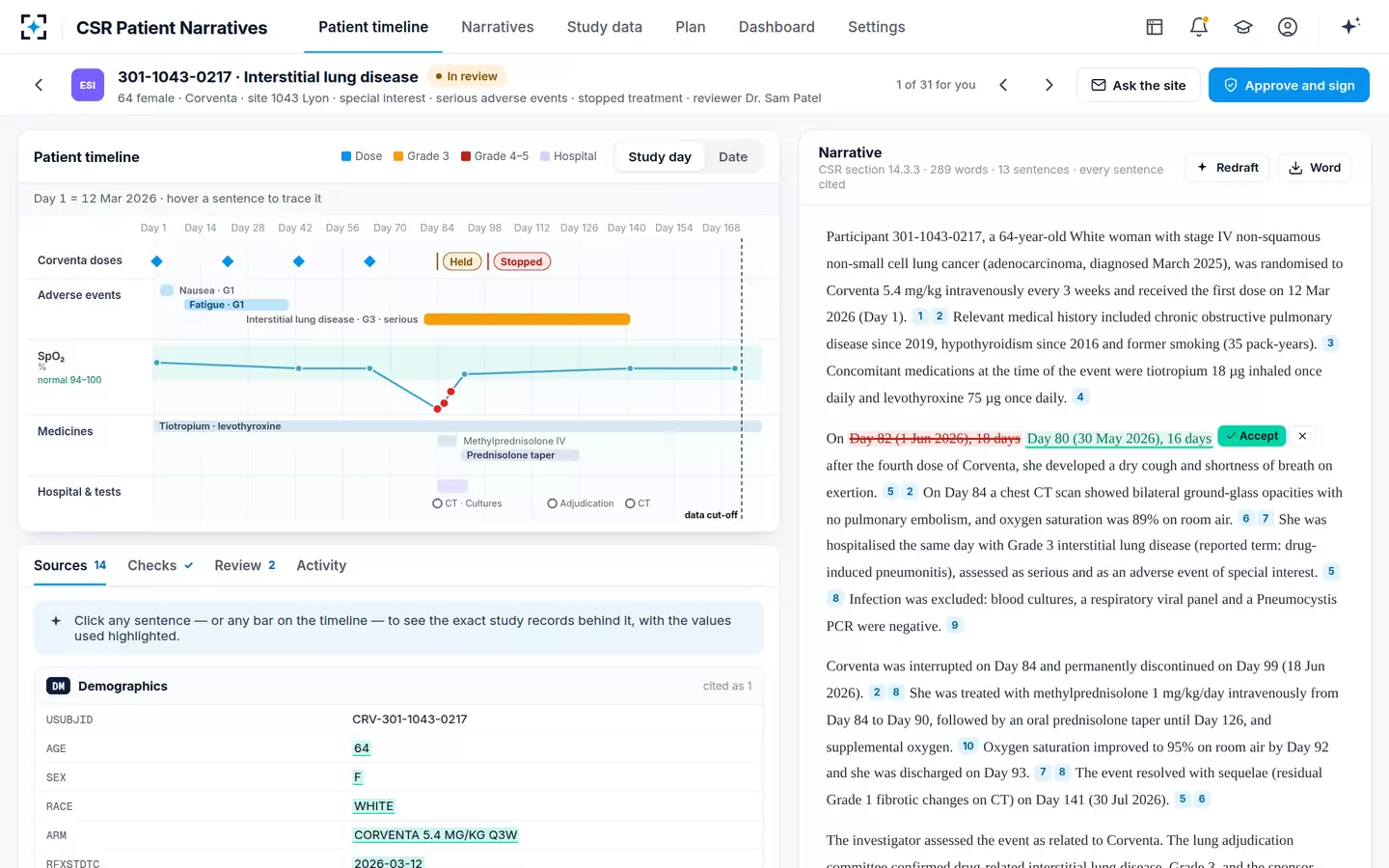
The profile is also where the first honest disagreement appears. Where a concomitant-medicine record carries no dose and no frequency, the profile shows an empty field rather than a plausible dose, and the narrative says "dose not recorded". That is the correct output. A narrative that reads well because someone filled a gap is worse than one that reads awkwardly and is true, and the gap is a question for the site, not for the writer.
The chronology: study days, calendar dates and the dose that was held
Write the course as a chronology, not as a diagnosis working backwards. Give the study day and the calendar date together at first mention in each paragraph — "Day 80 (30 May 2026)" — so a reviewer flipping between the narrative and a listing keyed on either one never has to convert. Give the interval that matters: not "shortly after dosing" but "16 days after the fourth dose".
The event that most often goes missing from a chronology is a non-event: a dose that was not given. On the sample participant the Day 84 dose was held, fifteen days before treatment was permanently stopped on Day 99. A narrative that lists four doses and a stop date is arithmetically complete and clinically misleading, because the held dose is the first action the investigator took in response to the event. It belongs in the sentence about action taken with the study drug, and ICH E3 asks for exactly that: "whether the drug was stopped, and when".
Ninety-nine days of one participant, drawn to scale, and the sentences each span produced
- Doses 1–3, on Days 1, 22 and 4342 days
- To the fourth dose on Day 6421 days
- Dose 4 to onset on Day 8016 days
- Onset, CT and SpO₂ 89%, dose held Day 84, stopped Day 9919 days
- Exposure, in one sentence1
- The fourth dose1
- Onset, grade, reported term3
- Investigations, action taken, countermeasures, outcome, causality8
The shape of that second lane is typical and worth knowing before you draft. Sixty-three days of uneventful dosing earn two sentences between them. The nineteen days from onset earn eight, because that is where the investigations, the held dose, the steroids and the outcome all land. A writer who gives each week equal attention produces a narrative that is long in the wrong places, and a reviewer with fifty of them to read will notice.
Laboratory values, vital signs and the sentence that needs a normal range
A laboratory value without its reference range is a number a reviewer cannot use. "Oxygen saturation was 89%" means something to a pulmonologist and nothing to a reader checking a narrative against a listing; "oxygen saturation was 89% on room air (normal range 95–100%)" can be checked and can be read. The same goes for units, which must be the units the listing uses, and for the measurement's date, which must be a study day.
Include the values the event turns on and leave out the rest. ICH E3 asks for "relevant laboratory measurements", and relevance here is narrow: the values that supported the diagnosis, the values that defined the grade, the values that show the course, and the values the countermeasures changed. A narrative that recites a full chemistry panel on each of nine visits is not thorough; it is unreadable, and the values already exist as listings — the abnormal ones in section 14.3.4, and every measurement by patient in section 16.2.8 where a regulator asks for it.
The same sentence, written from the adverse-event listing alone and from the whole profile
From the adverse-event listing: "On Day 80 the participant developed Grade 3 pneumonitis, which was assessed as related to the study drug."
From the whole profile: "On Day 80 (30 May 2026), 16 days after the fourth dose of the study drug, she developed a dry cough and shortness of breath on exertion. On Day 84 a chest CT scan showed bilateral ground-glass opacities with no pulmonary embolism, and oxygen saturation was 89% on room air. She was hospitalised the same day with Grade 3 interstitial lung disease (reported term: drug-induced pneumonitis), assessed as serious and as an adverse event of special interest."
From the adverse-event listing: The calendar date, the interval from dosing, the presenting symptoms, the investigations, the reported term, the admission and the measured value.
From the whole profile: Nothing the element list asks for, in this part of the course.
From the adverse-event listing: Three: nature and intensity, timing (vaguely), investigator causality.
From the whole profile: The nature and intensity, the clinical course timed against dosing, the investigations and the vital-sign value — four elements in three sentences, with causality still to come.
From the adverse-event listing: Opens the exposure and vital-sign listings to work out what the writer could not see.
From the whole profile: Checks each value against the record the sentence cites, and moves on.
Who may have an opinion on causality, and who may not
Causality is the sentence writers get wrong most often, and the error is almost always the same: an opinion with no owner. A narrative may report the investigator's assessment, the sponsor's assessment and an adjudication committee's conclusion. It may not contain an assessment of its own, and neither may the person or the tool drafting it.
There is also no settled vocabulary to borrow. ICH E2A notes that "many terms and scales are in use to describe the degree of causality (attributability) between a medicinal product and an event, such as certainly, definitely, probably, possibly or likely related or not related", and adds plainly: "However, there is currently no standard international nomenclature. The expression 'reasonable causal relationship' is meant to convey in general that there are facts (evidence) or arguments to suggest a causal relationship" (ICH E2A). So write the word the assessor recorded, in quotation marks if the scale is unusual, and name the assessor. Do not translate "possibly related" into "probably related" because the clinical picture seems strong to you.
The regulatory threshold is a separate matter from the narrative's wording, and worth keeping straight. For US expedited reporting, 21 CFR 312.32 defines a suspected adverse reaction as "any adverse event for which there is a reasonable possibility that the drug caused the adverse event", and specifies that "'reasonable possibility' means there is evidence to suggest a causal relationship between the drug and the adverse event" (21 CFR 312.32). That test decides what the sponsor reports to the agency during the trial. It does not decide what word goes in the narrative; the assessor's own record does.
How long should a CSR patient narrative be?
As long as the elements need and no longer. ICH E3 sets no word count — its only instructions on length are the word "brief" and the allowance that events clearly unrelated to the study drug may be left out or described very briefly. No published norm sets a range either, so the test is whether every element is carried once: the sample participant's narrative, for a serious event with investigations and countermeasures, does it in 289 words and 13 sentences. A narrative several times that length is usually carrying a clinical discussion that belongs in section 12.3.3, or a listing that belongs in section 14.3 or 16.2.
Length is also a house-style decision rather than a writer-by-writer one, which is the point of agreeing it in the narrative plan. Two writers on the same study producing 280-word and 700-word narratives from the same kind of event have given the reviewer two documents to learn instead of one. If you want a number to hold yourself to, set it in the plan as a range and treat an outlier as a question, not a failure.
The reported term, the coded term, and which one belongs in the sentence
Both, in a fixed order: the coded preferred term as the subject of the sentence, the investigator's reported term in brackets after it. The coded term is what the summary tables count, so the narrative must agree with them. The reported term is what the investigator actually wrote, and it is often the more informative of the two.
How much hangs on the exact words is easy to underestimate. The ICH-endorsed MedDRA term selection guide asks that the "MedDRA Lowest Level Term(s) (LLT) that most accurately reflects the reported verbatim information should be selected" (MedDRA Term Selection: Points to Consider) — the code follows what the investigator wrote, down to its qualifiers. A narrative that paraphrases the reported term has quietly changed the evidence behind the code, which is why the reported term is reproduced verbatim or not at all. The narrative template that names a data source for every field puts both terms in the same sentence by construction.
The brief narrative for a death clearly unrelated to the study drug
ICH E3 allows events clearly unrelated to the study drug to be left out or described in a line or two. On an oncology study with disease progression deaths that allowance is the difference between a manageable batch and an unmanageable one, and it is the sponsor's judgement to exercise — written down in the narrative plan, applied by rule, and visible as a rule when an inspector asks why one death got 60 words and another got 400.
A brief narrative still carries the identifier, the age and sex, the disease, the exposure, the event with its date and the cause of death, and the causality assessment that made it brief. What it drops is the investigation-by-investigation course. On the sample study, 29 of the 247 narratives use the brief format; which events qualify, and who decides, is the subject of which events need an SAE narrative at all.
What a reviewer sends back, and how to pre-empt it
Reviewers send narratives back for a small, repeatable set of reasons, and almost all of them are visible before the narrative leaves the writer. A date that does not match the listing. A study day computed from the wrong anchor. A dose that is the protocol dose rather than the dose actually given. An outcome recorded as "recovering" in the narrative and "recovered with sequelae" in the record. A causality opinion with no owner. A value with no range.
Nine checks before a narrative leaves the writer
- Study day with its calendar date at first mention in each paragraph
So a reviewer keyed on either one never converts, and two paragraphs never disagree.
- The dose actually given at the time of the event, not the protocol dose
Read from the exposure record, including any reduction or hold before onset.
- Action taken with the study drug, including a dose held
ICH E3 asks whether the drug was stopped and when; a held dose is part of that answer.
- Outcome in the words of the record
Recovered, recovering, recovered with sequelae, not recovered, fatal, unknown — the record’s term, not a synonym.
- Both causality opinions, each attributed
The investigator’s and the sponsor’s, plus an adjudication committee where one applies.
- The coded preferred term, with the reported term in brackets
Reproduced verbatim: a paraphrase changes the evidence behind the code.
- Every laboratory and vital-sign value with its unit and normal range
A value a reviewer cannot place is a value they have to look up.
- Missing values marked missing
"Dose not recorded" is a finding and a query to the site; a plausible dose is neither.
- No inference, and every sentence traceable to a record
If you cannot name the record behind a clause, delete the clause or raise the question.
Running those nine checks by hand on a batch of narratives is slow and error-prone in the specific way repetitive comparison always is: attention falls off, and it falls off on the dullest fields, which are the ones listings disagree about. On the sample study the fact-checking step compares every date, study day, dose, grade, value, outcome and causality statement in a draft with the record the sentence cites, and flags what does not match before a reviewer opens it. It never edits study data and never settles a difference itself.
A reviewer asking CSR Patient Narratives where one sentence came from
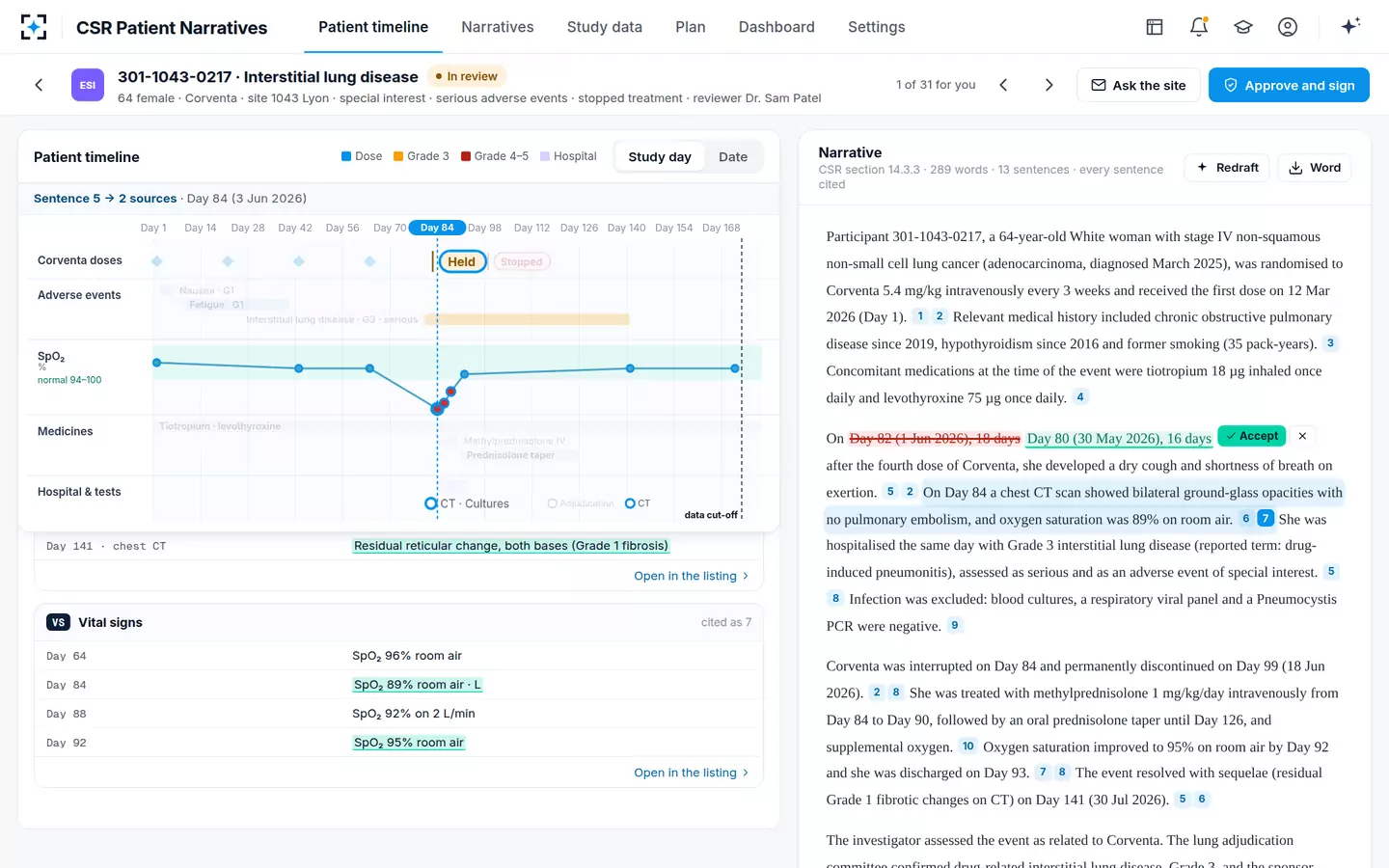
That is also the fastest way to pre-empt a review comment: read your own narrative the way the physician will, one sentence at a time, asking which record each clause rests on. Where you cannot answer, you have found the comment before the reviewer did. The discipline behind it — what ensures data traceability in a clinical trial — is also what an inspector asks about, and it applies to a sentence in a report exactly as it applies to a value in a dataset.
Who reviews a narrative before it goes into the CSR
Three readers, in order, and they are looking for different things. The writer checks the facts against the data. The lead medical writer checks that the narrative reads like the other 246 and that the template's sections are all answered. The study physician checks the medicine: whether the chronology supports the grade, whether the countermeasures are described as they happened, and whether the causality sentence fairly reports what was assessed. A death narrative then takes a second signature from the medical lead.
The order matters because each reader is expensive in a different way. Sending a physician a narrative with an unchecked date spends the scarcest reviewer on the cheapest error. On the sample study the writer's check and the house-style pass both run before anything reaches a reviewer, and a narrative with an unsettled data difference cannot be signed at all. What arrives in the physician's queue is a narrative whose facts have already been compared with the records, so the review time — the design target is about twelve minutes — is spent on the medicine.
Tracked changes and a comment, before a signature
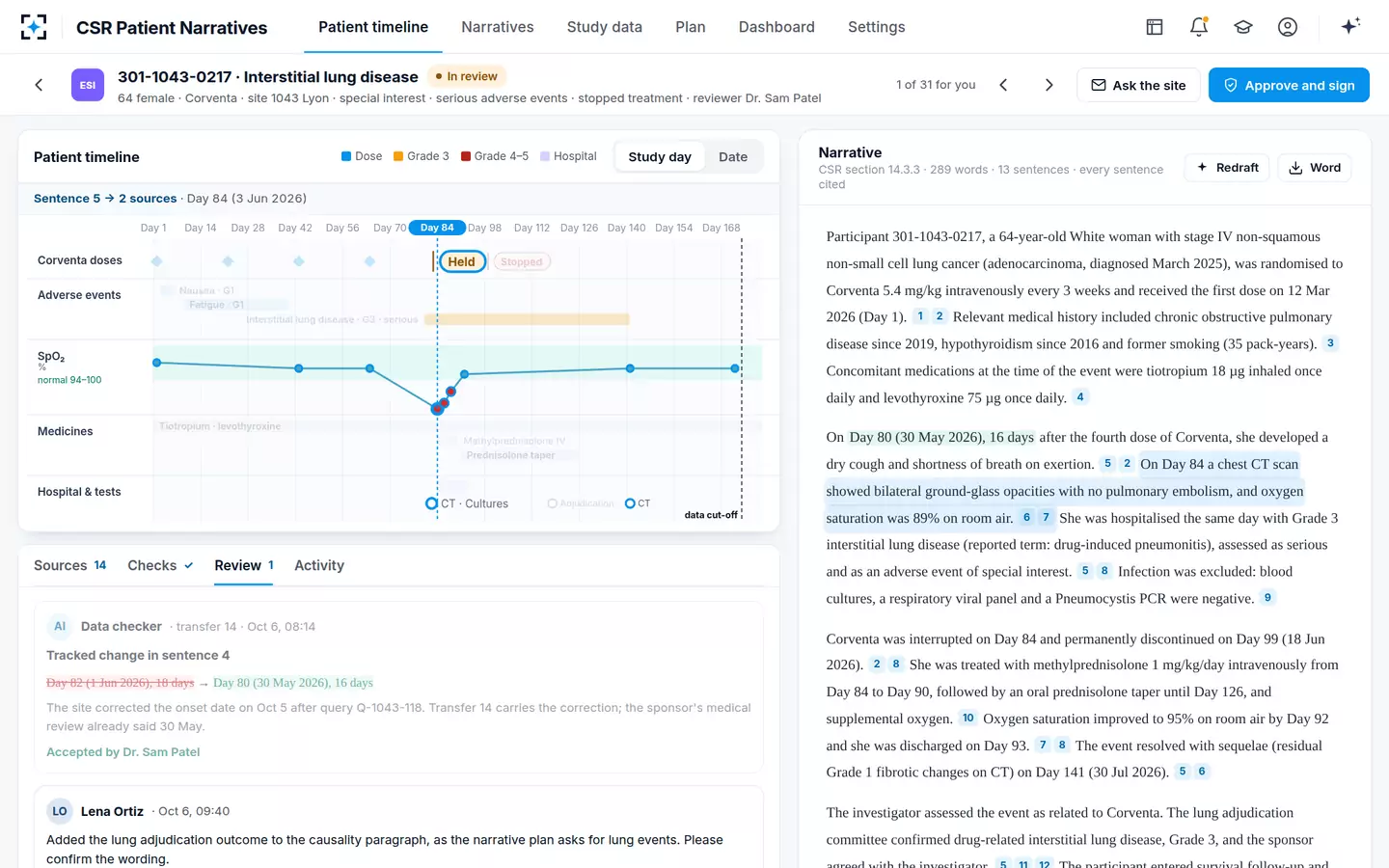
To see the profile, the traced sentences and the signature together on a study of your own, start from CSR Patient Narratives.
Questions people ask
Do you write a patient narrative in the past tense?
Yes. A narrative describes events that have happened, so the course, the investigations, the countermeasures and the outcome are all past tense. The exception is an outcome still open at the data cut-off, which is reported in the record's own words — "recovering", or "not recovered" — rather than rewritten as a prediction. Tense is a house-style decision that belongs in the narrative plan, so that 247 narratives do not arrive in two tenses.
What data sources are used to write a patient narrative?
The study data, domain by domain: demographics for the identifier, age and sex; medical history for the disease and concomitant illnesses; exposure for the doses actually given; the adverse-event record for the onset, grade, outcome and investigator causality; concomitant medicines for countermeasures; laboratory and vital-sign results for the measured values; and disposition for when and why treatment stopped. The sponsor's medical review form and any adjudication committee minutes supply the sponsor's and the committee's causality.
What do you do when a value is missing from the data?
Mark it missing in the text and raise a query. "The dose and frequency were not recorded" is accurate, is a finding, and gives the data manager something to chase; a plausible dose is none of those things. The gap belongs to the site, not to the writer, and a narrative that hides it will be checked against a record that does not contain what the sentence says.
Should a narrative use the reported term or the coded term?
Both: the coded preferred term in the sentence, the investigator's reported term verbatim in brackets. The coded term keeps the narrative consistent with the summary tables that count events; the reported term preserves what the investigator actually observed. The MedDRA term selection guide asks for the lowest-level term that most accurately reflects the verbatim report, so a qualifier the investigator wrote — a body site, an organism — can decide the code, which is why the reported term is quoted rather than paraphrased.
How do you write the causality sentence in a narrative?
As reported speech, with every opinion attributed and in the assessor's own scale word. "The investigator assessed the event as related to the study drug; the sponsor agreed" is a narrative sentence. "The event was probably drug-related" is an opinion with no owner, and ICH E2A points out there is no standard international nomenclature to fall back on, so the assessor's recorded word is the only safe one to use.
Can a tool draft a patient narrative?
It can draft the chronology, which is mechanical: assembling the profile, computing study days, writing the course in the template's sections and checking each fact against its record. It cannot supply the clinical judgement, and it must not supply a causality opinion — the three that exist belong to the investigator, the sponsor and any adjudication committee. The solution's design targets are a first draft in under a minute and about twelve minutes of physician review — targets, not measurements — which is the ratio the method is meant to produce.