Electronic signatures in clinical trials are not a picture of a name; they are four facts recorded together. Under 21 CFR part 11 a signed electronic record has to carry the printed name of the signer, the date and time the signature was executed and the meaning of the signature, and the signature has to be linked to the record so it cannot be lifted off and put somewhere else. European inspectors add a fourth expectation that matters most to anyone signing prose: the link must be unbreakable, so that a signed version whose text later changes shows its signature as invalid. That is hard for study data and harder for a patient narrative, which is a paragraph assembled from dozens of data points that keep moving until database lock. Botminds' CSR Patient Narratives drafts those narratives from the study data, checks every fact in them against the records they came from, and puts the signature on the text with the meaning written out — then reopens it as a tracked change when a transfer moves one of the facts underneath.
What a signature must show is settled law and published guidance, quoted and linked below. The study, the drug and the people in the product examples are invented sample data: study CRV-301, a trial of Corventa against docetaxel with 612 participants and 247 narratives, reviewed by Dr. Sam Patel and signed second on deaths by Dr. Maya Chen. No figure here is a customer's measured result.
What does an electronic signature in a clinical trial have to show?
It has to show three things on the face of the record and prove a fourth about the record itself. The three are set out in 21 CFR 11.50: the printed name of the signer, the date and time when the signature was executed, and the meaning associated with the signature. The fourth is the link — 21 CFR 11.70 requires that signatures be bound to their records so that nobody can cut, copy or move them onto another record by ordinary means (21 CFR 11.70).
Part 11 specifies that signed electronic records must contain the printed name of the signer, the date and time when the signature was executed, and the meaning associated with the signature.
FDA, Electronic Systems, Electronic Records, and Electronic Signatures in Clinical Investigations: Q&A, October 2024
Note what the rule does not ask for. It does not ask for an image, a scanned initial or a certificate. It asks for the name spelled out, the moment recorded, and a word that says what the signer was doing — reviewing, approving, taking responsibility, or claiming authorship. The regulation itself lists the meanings it has in mind — review, approval, responsibility or authorship — and the FDA's October 2024 questions-and-answers guidance for clinical investigations restates the three items in a single sentence, quoted above (21 CFR 11.50(a)).
European expectations are written as functions the system must have rather than fields the record must carry. The EMA's guideline on computerised systems says that where ICH E6 requires a document to be signed and an electronic signature is used, the functionality should authenticate the signatory, ensure non-repudiation, ensure an unbreakable link between the record and its signature, and provide a timestamp recording "the date, time, and time zone when the signature was applied" (EMA/INS/GCP/112288/2023). Satisfy both lists and the signature survives an inspection in either region.
The six-part test a narrative signature has to pass
- The printed name of the signer
Spelled out on the record, not an image or a pair of initials. 21 CFR 11.50(a)(1).
- The date and time the signature was executed
Recorded by the system, not typed by the signer. EMA asks for the time zone as well, which matters when a reviewer in Lyon signs text a monitor in Boston will read.
- The meaning, in words
Review, approval, responsibility or authorship — and better still, the sentence the signer would actually say. 21 CFR 11.50(a)(3).
- An unbreakable link to the exact text signed
If a word of the signed version changes afterwards, the signature must show as invalid. EMA calls this out explicitly; Part 11 forbids the signature being excised, copied or transferred.
- An audit trail of what changed, and who changed it
A signature is evidence about one moment. The audit trail is what lets a reader see every moment before and after it.
- A rule for re-signing when a fact moves
Written down before the study, not invented in the week before lock. Which triggers reopen a signed narrative, who re-signs it, and whether the first signature is void or superseded.
The three things Part 11 makes a signature carry
Of the three, the meaning is the one most often left blank, and it is the only one a person has to decide. A date and a name are facts the system knows. The meaning is a claim about what was done, and on a patient narrative there are at least four candidate claims: that the text reads well, that the facts match the data, that the medical judgement in it is sound, or that the document is approved for a named section of the clinical study report. Those are different claims, held by different people, and a signature that says none of them tells an inspector nothing.
Part 11 also sets the mechanics of signing. An electronic signature not based on biometrics needs at least two distinct identification components, an identification code and a password being the usual pair (21 CFR 11.200). Inside a single continuous period of controlled system access the first signing uses all components and later ones may use at least one that only the individual can execute; a signing outside that period uses all of them again. The FDA's 2024 guidance repeats the rule in the same terms, so a reviewer signing thirty narratives in one sitting is not asked for a password thirty times — but a reviewer who comes back after lunch is.
That concession is about keystrokes, not about judgement. It assumes the signer has read each record. It is not permission to apply one signature to a stack, which is a different act and a different risk, and the subject of the next section but one.
The unbreakable link between the text and the signature
A narrative is prose built on data. The sentence "On Day 84 a chest CT scan showed bilateral ground-glass opacities with no pulmonary embolism, and oxygen saturation was 89% on room air" rests on two records in two domains, and either can change in the next transfer. If the signature is attached to a document and the document is then regenerated from new data, the signature is attached to text nobody signed.
The EMA guideline states the requirement as a property of the system: the functionality must "ensure an unbreakable link between the electronic record and its signature, i.e. that the contents of a signed (approved) version of a record cannot later be changed by anyone without the signature being rendered visibly invalid". It then closes the obvious loophole: where a signature sits on a separate page or on part of a document, "there should still be an unbreakable link between the electronic document to be signed and the document containing the signature". A signature page in a shared folder, next to a Word file that was re-exported on Tuesday, does not meet that.
There are two honest ways to build the link. Bind the signature to the content, so that any change to the content invalidates it. Or lock the content on signature, so that a change is not an edit but a new proposal a person must accept. The second is what the solution does: signing locks the narrative, and a later data change reopens it only as a tracked change for the reviewer to accept or reject. The practical difference is who finds out. Content binding tells you afterwards that something broke; locking tells the reviewer, by name, that a fact behind a sentence they signed has moved. How those changes arrive is the subject of what a transfer reopens around database lock.
Signing a narrative when its facts settle, and re-signing when they move
Agent
Facts checked against the dataEvery date, study day, dose, grade, value, outcome and causality in the draft is compared with the record it was taken from, and serious events are cross-checked with the sponsor’s medical review.
Never: Never edits study data, and never settles a difference on its own
A person decides
Differences settledThe reviewer sends the drafted query to the site or settles it with a reason. Nothing is signed while a difference is open.
A person decides
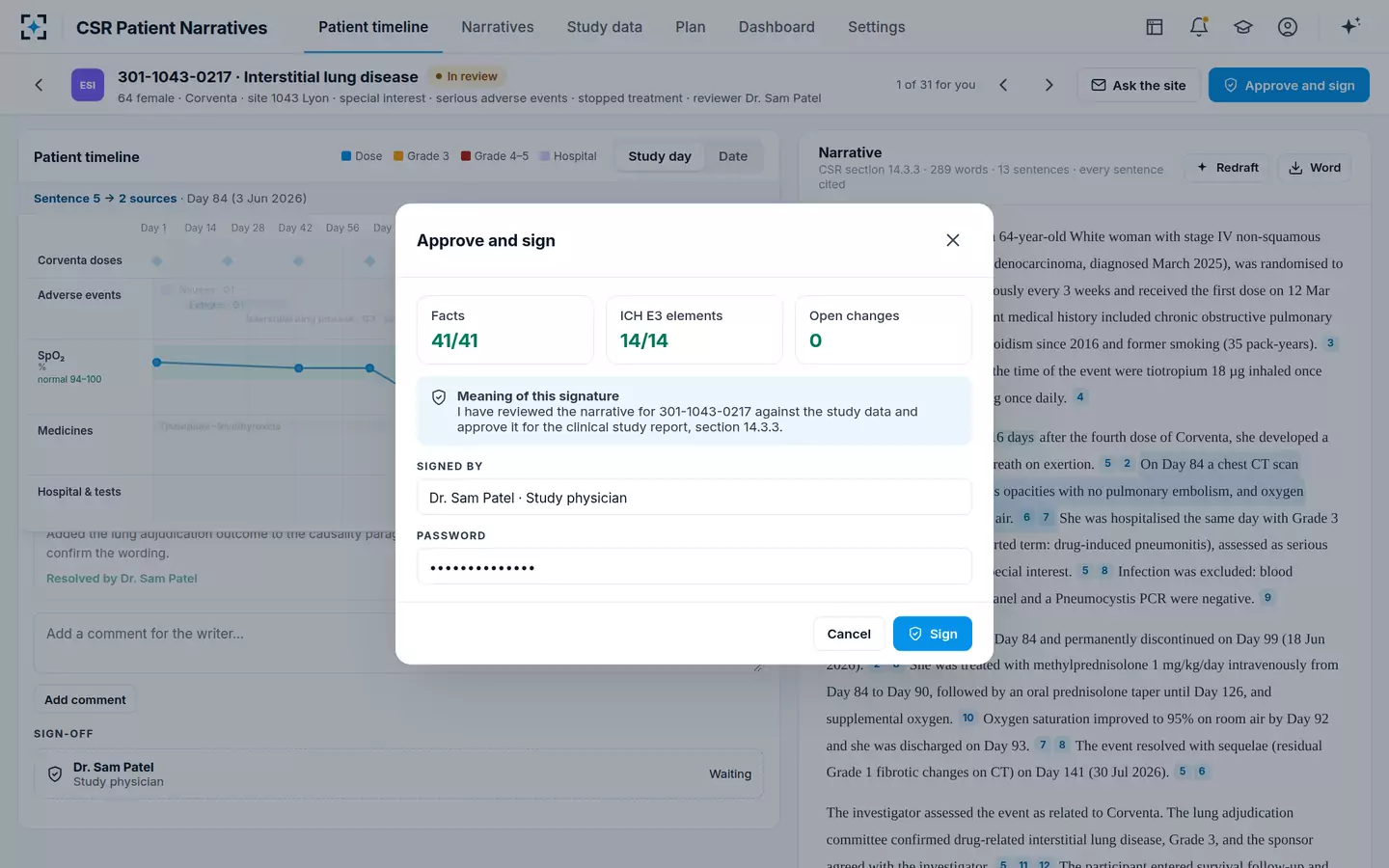
Signature applied, with its meaning statedThe study physician signs with a password; the printed name, the time and the sentence that states what the signature means are recorded together.
Agent
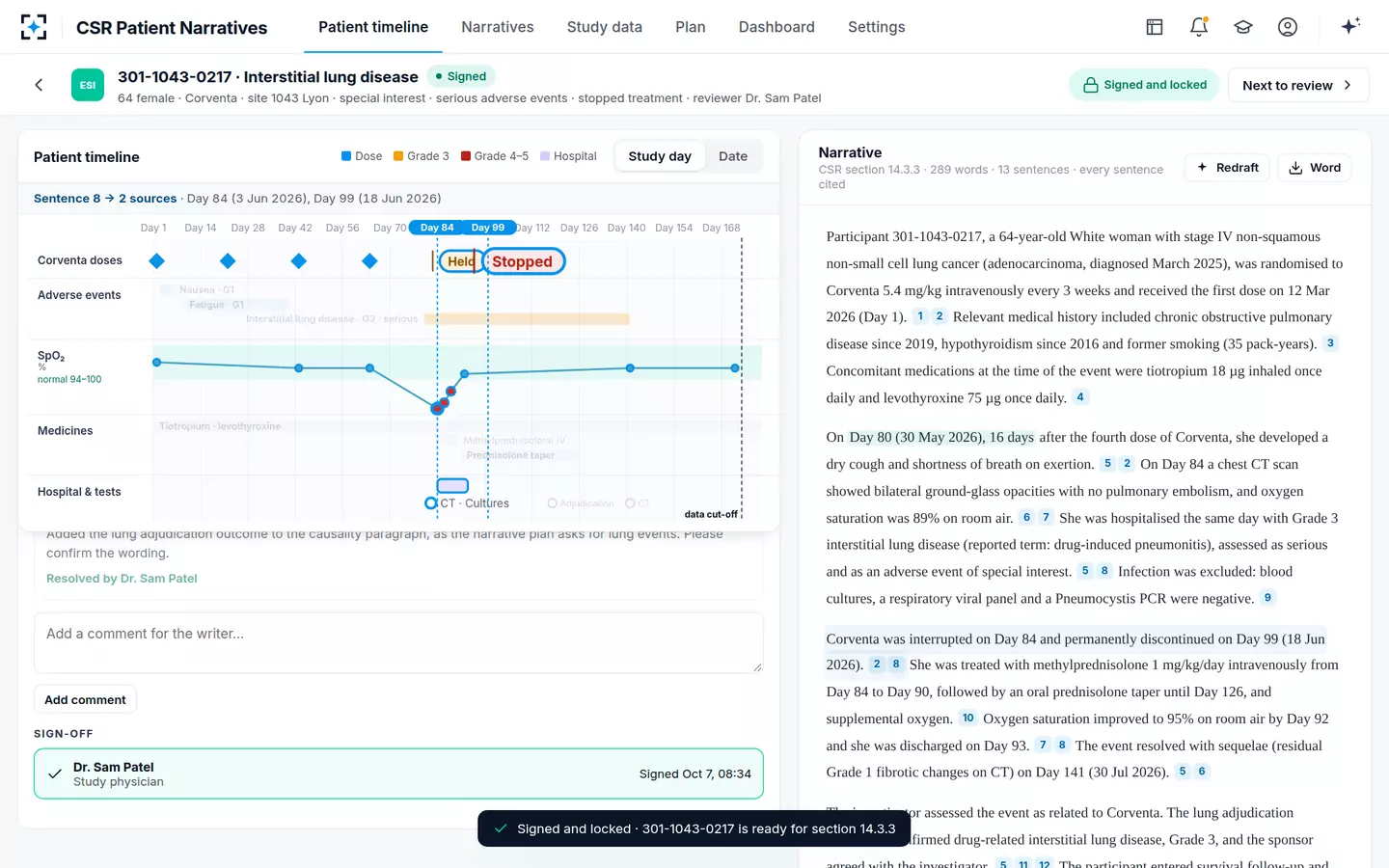
Narrative lockedThe signed text is held as signed. A later edit is not possible as an edit.
Agent
A later transfer moves a factOnly the sentences that use the changed record are re-drafted, and the narrative reopens as a tracked change addressed to the person who signed it.
Never: Never silently replaces signed text
A person decides
Accepted or rejected, then re-signedThe reviewer accepts or rejects each change and signs again. Both signatures and the change between them stay on the audit trail.
Why one signature just before database lock is rarely enough
European inspectors have already settled the rhythm question for study data, and the reasoning carries to anything built on that data. Discussing the investigator's sign-off of entered data, the EMA guideline says it is essential that data are confirmed before interim and final analysis, and that important data — it names serious adverse event reporting, adjudication of important events, endpoint data and safety monitoring board review — "are signed off in a timely manner". It then draws the conclusion in one line.
Therefore, it will rarely be sufficient to just provide one signature immediately prior to database lock.
EMA GCP Inspectors Working Group, on the timing of data sign-off
The same paragraph rules out the shortcut that makes batch signing attractive: "Signing of batches of workbooks is also not suited to ensure high data quality and undermines the purpose of timely and thorough data review." Read that against a study with a few hundred narratives and the problem is obvious. If every narrative waits for the last transfer, the whole medical review of the safety section of the clinical study report happens in the fortnight when the writers, the statisticians and the reviewers are all busiest, and a reviewer facing thirty documents in two days reads differently from one facing three in a morning.
Signing early has a cost too, which is why the rhythm needs a rule rather than a preference. A narrative signed in September on a participant whose culture result arrives in October has to be reopened. The question is not whether to pay that cost but how to make it small: reopen the sentences that changed rather than the document, and tell the signer exactly which fact moved.
One signature on a batch at lock, against a signature when each narrative’s facts settle
Batch-signed in the week before lock: Thirty documents in two days, read in the order they were generated.
Signed as each narrative settles: Three or four a morning, in trigger order, each one with its checks already shown.
Batch-signed in the week before lock: A version produced from the final extract, often minutes old.
Signed as each narrative settles: The text as it stood when its facts were settled, with later movement tracked against it.
Batch-signed in the week before lock: Nothing, because nothing was signed yet — the cost was paid in review time instead.
Signed as each narrative settles: A reopened narrative and a second signature, on the sentences that changed.
Batch-signed in the week before lock: That everything was approved at the end. Little about when each fact was accepted.
Signed as each narrative settles: When each narrative was accepted, what moved afterwards, and who agreed to the move.
Batch-signed in the week before lock: One signature immediately prior to database lock "will rarely be sufficient"; batch signing "undermines the purpose of timely and thorough data review".
Signed as each narrative settles: Important safety data should be "signed off in a timely manner".
Who signs a narrative, and who signs it second
There is no regulation that names the signer of a patient narrative. ICH E3 says what a narrative must contain and where it goes in the report; who approves it is the sponsor's decision, written into the narrative plan. In practice the signature that matters is medical, because the content is a clinical account with a causality statement in it, and the person who signs is the one who would answer a regulator's question about it.
A death narrative is usually treated differently, and for a reason that is about review rather than ceremony: a death is the event most likely to be read closely in a submission, and the hardest to reconstruct after the fact. Two signatures mean two people have read the chronology against the data. In the sample study the study physician signs first and the medical lead second, and the first signature is shown as "Sign (1 of 2)" so that nobody mistakes it for the end of the process.
Who signs what, on a study with 247 narratives
| The signature | Who applies it | What it means | When |
|---|---|---|---|
| Investigator sign-off of trial data | The investigator or a qualified, documented delegate at the site | That the data entered and submitted are attributable, legible, original, accurate, complete and contemporaneous | Through the trial, and before each analysis — not once at lock |
| Sponsor medical review of a serious event | The sponsor’s medical reviewer | That the event’s onset, outcome and causality have been assessed by the sponsor | As each serious event is reported |
| The narrative, first signature | The study physician named for that trigger | Reviewed against the study data and approved for the clinical study report section it belongs to | When the narrative’s facts are settled and no difference is open |
| The narrative, second signature on a death | The medical lead | Read again, independently, against the data | After the first signature, before the narrative is final |
| The clinical study report itself | The sponsor’s signatories named in the report | Approval of the report as a whole | After the narratives are final |
Stating the meaning in the signer’s own words
The rule offers four example meanings and does not limit a sponsor to them. Review, approval, responsibility and authorship are categories; the useful meaning is a sentence. Compare two: Approved, and I have reviewed the narrative for 301-1043-0217 against the study data and approve it for the clinical study report, section 14.3.3. The second names the participant, the comparison the signer made and the destination of the document. A year later, in an inspection, it is the difference between a record that answers a question and one that invites it.
Three rules make a good meaning statement. Say what was compared, not just that something was approved. Name the document's destination, because a narrative approved for a safety section is not the same claim as text approved for a summary. And keep one meaning per signature: a signature that claims the facts match, the writing is in house style and the medical judgement is sound is three claims sharing one password, and if one of them turns out to be wrong there is no way to tell which.
What CSR Patient Narratives shows a signer before the signature
Open and closed systems, and why it matters at a site
Part 11 defines the two by who controls access. A closed system is "an environment in which system access is controlled by persons who are responsible for the content of electronic records that are on the system"; an open system is one where it is not (21 CFR 11.3). The distinction decides what the signature has to prove about identity.
The EMA guideline draws the same line and says which case is which in practice. Closed systems "constitute the majority of systems used in clinical trials", are typically provided by the responsible party or its service provider, and have a system owner who "knows the identity of all users and signatories and grants and controls their access rights". For those, the EU's eIDAS regulation on electronic identification does not apply, and the guideline's expectation is instead that "the electronic signature functionality in these systems should be proven during system validation to meet the expectations mentioned above". For open systems, where the signatories are not known in advance, EU sites are expected to meet eIDAS requirements, and sites in other countries to use solutions compliant with local law and proven against the same four expectations.
For a narrative this is usually straightforward: the people who sign are a handful of named sponsor staff in a system the sponsor controls, which is the closed case. It stops being straightforward when a signature is collected outside that system — a scanned page from an investigator, an e-signature service used for one site, a document mailed for approval. Each of those is a different identity problem and, under the unbreakable-link rule, a separate question about what the signature is attached to.
Can a signed narrative be changed?
Not as an edit. A signed narrative can be superseded, and that is the only honest route. Part 11's audit-trail requirement is explicit that a change to a record must never hide what was recorded before (21 CFR 11.10), so the signed version and the change to it both have to remain legible, with the person and the time on each. ICH E6(R3) adds the standard for corrections generally: each one is attributed to the person or system that made it, justified, supported by source records from around the time of the original entry, and made promptly.
Three things therefore have to be true of any system where a signed narrative can move. The signature must stop being valid for text that is no longer the signed text. The change must arrive as something a named person accepts or rejects, not as a silent regeneration. And both versions, plus the reason, must stay readable afterwards. In the sample study, 301-2604-0231 is the case to look at: the narrative was signed, a dose date moved by a day in the next transfer, and the narrative reopened as a tracked change on the sentences that used that date rather than as a new document.
A narrative held as signed, and what happens next
What an inspector asks to see
An inspector does not ask whether the signature is compliant. They ask to be shown one, and then follow it. The questions run in a predictable order, and a study can rehearse them on a single narrative in twenty minutes.
Show me a signed narrative, and show me the printed name, the time and the meaning on the same record. Show me the text that was signed, and show me what the system does if a word of it changes. Show me the audit trail from the first draft to the signature, with each change attributed. Show me the rule that says who signs this trigger, and the approval of that rule. Show me a narrative where a fact moved after signature, and show me who agreed to the move. Show me how the signer's identity is controlled, and where the two identification components are held. The EMA guideline's own answer to the second question is that the signature functionality "should be proven during system validation" — which is the sponsor's activity, not the supplier's claim, and the subject of what validation a tool that drafts regulated text needs.
Writing the sign-off rules for a study
Sign-off rules belong in the narrative plan, with the triggers and the template, and they are short. Five decisions cover almost every study: who signs each trigger, whether any trigger needs two signatures, what the meaning statement says, whether signing locks the text, and what reopens a signed narrative. Write them once and every narrative in the study inherits them; leave them to practice and each reviewer invents their own.
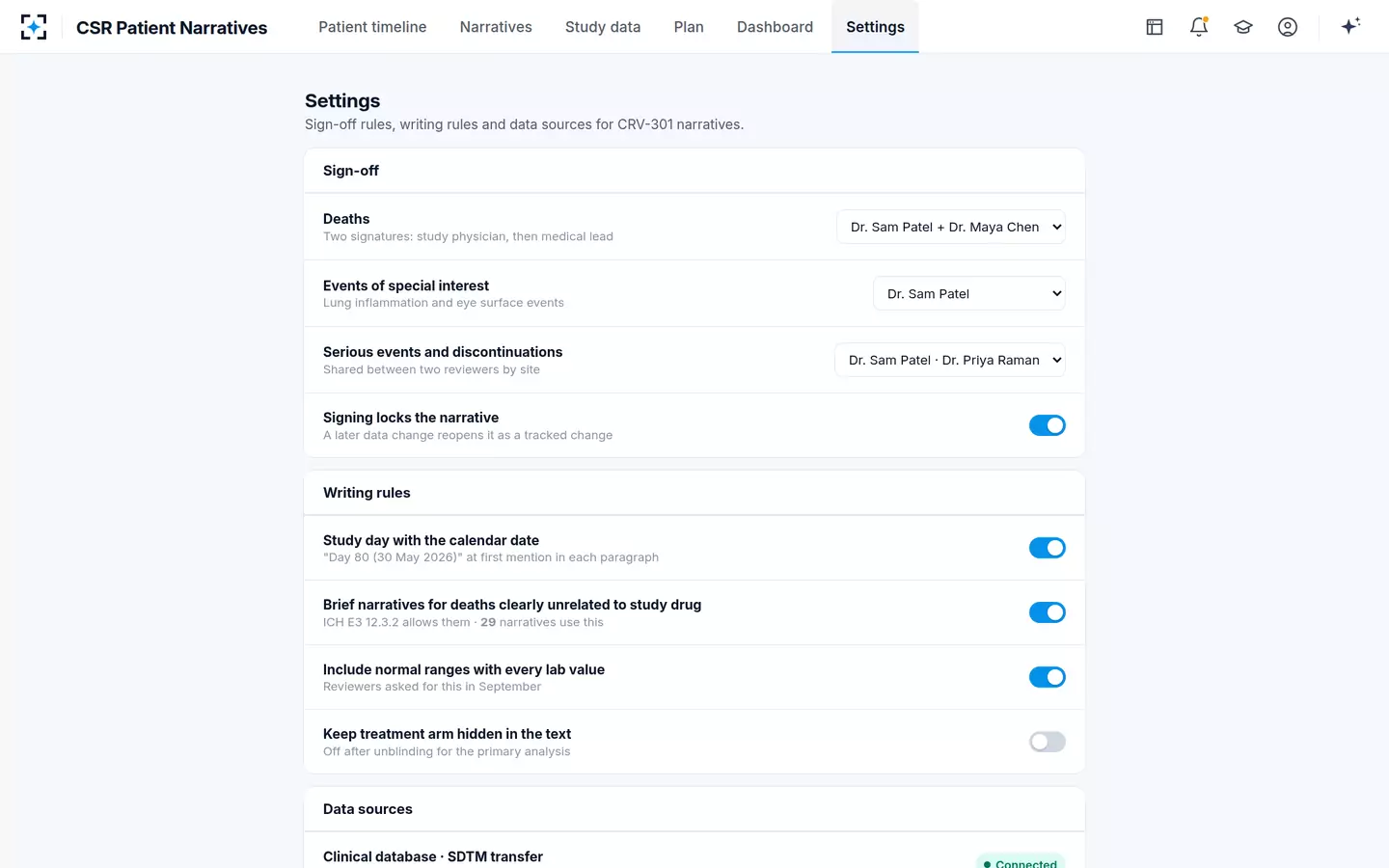
The decisions are worth taking deliberately because they are where the rhythm is set. A sponsor that routes deaths to two named signers and events of special interest to one reviewer has also decided that deaths will take longer, which decides when they must start. A sponsor that locks on signature has decided to pay for re-signature in exchange for knowing what every signature covered. In the sample study those choices are settings rather than code — deaths to the study physician then the medical lead, events of special interest to one named reviewer, serious events and discontinuations shared by site — and a change to the narrative plan needs the plan owner's approval, which is itself on the audit trail.
Sign-off by trigger, held as a study setting
One last rule is worth writing down because it is the one that gets broken under deadline pressure: nothing is signed while a difference is open. A narrative with a fact that does not match its record is not a document awaiting approval; it is a question awaiting an answer. How those questions are found before review, rather than after it, is the subject of tracing every sentence back to its records. To see the signature, the lock and the reopened narrative on one participant, start from CSR Patient Narratives.
Questions people ask
Is an electronic signature the same as a handwritten signature?
For regulatory purposes it can be. ICH E6(R3) defines a signature as "a unique mark, symbol or entry executed, adopted or authorised by an individual … to show expression of will and allow authentication of the signatory", and adds that "a signature may be physical or electronic". What makes the electronic one equivalent is the controls around it: two identification components, the three recorded items in 21 CFR 11.50, and the link to the record in 21 CFR 11.70.
What does a signed record in a clinical trial have to show?
Three things, on the record itself: the printed name of the signer, the date and time the signature was executed, and the meaning associated with the signature. The rule gives review, approval, responsibility and authorship as examples of meaning. European expectations add the time zone of the timestamp and a signature that is rendered visibly invalid if the signed content changes.
When should a study physician sign the study data?
As the data become reliable, not at the end. The EMA's guideline says important data such as serious adverse event reporting, adjudication of important events and endpoint data should be "signed off in a timely manner", and that one signature immediately before database lock "will rarely be sufficient". For narratives the equivalent rule is to sign when a narrative's facts are settled and reopen it if they move.
Do death narratives need two signatures?
No regulation requires it. It is a sponsor choice, and a common one, because a death is the event read most closely in a submission and the hardest to reconstruct later. In the fictional sample study the study physician signs first and the medical lead second, and the first signature is labelled as one of two so that it is not mistaken for approval of the final document.
Does a password count as an electronic signature on its own?
Not on its own. 21 CFR 11.200 requires at least two distinct identification components, such as an identification code and a password, for a signature not based on biometrics. Within one continuous period of controlled system access the first signing uses all components and later signings may use at least one component that only that individual can execute, so a reviewer signing several narratives in a sitting is not challenged for every one.
What is the difference between an electronic signature and a digital signature?
A digital signature is one kind of electronic signature. Part 11 defines it as "an electronic signature based upon cryptographic methods of originator authentication, computed by using a set of rules and a set of parameters such that the identity of the signer and the integrity of the data can be verified". Cryptography is one way to achieve the unbreakable link; a closed system whose access and content controls are validated is another, and is what most clinical trial systems use.