What ensures data traceability in clinical trials is an unbroken chain of four links — the source record, the validated transfer, the derivation rule and the sentence that states the value — each of which can be shown to a reviewer on demand. The work is hard because the links are owned by different people and the chain is only ever tested at the far end: a reviewer picks one number in a document and asks where it came from, and the answer has to arrive in minutes, sometimes years after anyone involved has moved on. Botminds' CSR Patient Narratives carries the chain the last and most neglected step, into prose: every sentence of every narrative it drafts is tied to the records behind it, so selecting a sentence lights the data points it rests on, and selecting a data point lights every sentence that uses it.
The distinction worth holding onto is between being right and being verifiable. A sentence can be perfectly accurate and still fail an inspection, because nobody can show how it was arrived at. Traceability is the evidence that the sentence was arrived at from the data, and it has to be built in while the work happens — it cannot be reconstructed afterwards.
The examples below are invented sample data from the solution: study CRV-301, participant 301-1043-0217, with fictional people and sites. The rules quoted are from ICH, the FDA and the EMA, linked where they appear.
The four links in the chain
Every number in a clinical study report has the same lineage, whether it ends up in a table or in a paragraph. Someone observed it and wrote it down. A transfer carried it out of the system it was written in. Something may have been computed from it. And a sentence stated it to a regulator. Break any one of those links and the number is no longer verifiable, however carefully the other three were kept.
The four links, what each rulebook asks of them, and what to keep as evidence
1
The source record
The first place the observation was written down: the site’s record of the chest CT finding, the oxygen-saturation reading, the dose given.
What the rulebook asksICH E6(R3) asks that a source record can be traced to whoever made it, read, made at the time, kept as the original, accurate and complete — and that any change to it is traceable, leaves the original entry visible and is explained where needed, through an audit trail.
Evidence to keepThe record itself, its audit trail, and the study’s own definition of what counts as a source record — which E6(R3) asks the investigator to set before the trial starts.
2
The transfer
The validated extract that carries the record from the clinical database to whoever uses it, week after week until lock.
What the rulebook asksICH E6(R3) asks for validated processes, or other suitable ones such as reconciliation, so that transferred data keep their integrity. The EMA expects the transfer, its origin, destination, timing and the actions applied to it to be described in advance.
Evidence to keepThe transfer description, the validation evidence, and a record of which transfer each value came from.
3
The derivation
Any value computed rather than observed: the study day, the interval from the most recent dose, the duration of the event, a change from baseline.
What the rulebook asksICH E6(R3): "The sponsor should ensure the traceability of data transformations and derivations during data processing and analysis."
Evidence to keepThe rule in writing, the anchor it uses, and the inputs for the specific value — so a reviewer can recompute it.
4
The sentence
The clause in the clinical study report that states the value to a regulator — in a narrative, a listing or a table.
What the rulebook asksThe FDA asks that a reviewer be able to trace the relationships between "the analysis results (tables, listings and figures in the study report), analysis datasets, tabulation datasets, and source data".
Evidence to keepThe link from the clause to the records it rests on, and the signature that says a person read it against them.
Source records, and what ALCOA asks of them
The first link is the one most people mean when they say traceability, and ICH E6(R3) states it in two sentences that carry the whole ALCOA idea without using the acronym: a source record has to be attributable, legible, contemporaneous, original, accurate and complete, and a change to it has to be traceable, leave the original entry readable, and be explained where needed through an audit trail (ICH E6(R3)).
Two things in that rule are easy to skip past. Original rules out a transcription standing in for the thing itself, which is why E6(R3) goes on to ask sites to avoid copying a value by hand from the source record into the data collection tool when the copy is not needed — every transcription is a link that can break. And leaving the original entry readable is the rule that makes a correction safe: a changed value with its previous value still visible is evidence; a changed value that overwrote its predecessor is a gap, no matter how good the reason was.
E6(R3) also asks the investigator to define, before the trial starts, what counts as a source record and where it lives. That sounds procedural and is in fact the thing that makes the rest possible: a chain cannot start at a link nobody has identified.
Derived values: study day, duration, change from baseline
The link most often missing is the third. Observed values get kept carefully; computed ones get kept as results, with the arithmetic in someone's head or in a program nobody archived. ICH E6(R3) is explicit that this is not enough: "The sponsor should ensure the traceability of data transformations and derivations during data processing and analysis."
A study day is the smallest possible example and a good test of whether a study takes the rule seriously. "Day 80" is not an observation; it is the difference between a date and an anchor, and the anchor is a choice. Computed from the first dose, an onset falls on Day 80. Computed from randomisation, it might fall on Day 83. Both are defensible; only one can be in the narrative, and a reader needs to know which without asking. The same applies to the interval from the most recent dose, to the duration of an event that is still ongoing at cut-off, and to every change from baseline in the report.
What a reviewer actually wants from a derived value is the ability to recompute it: the rule, the anchor and the two inputs. On the sample study, study days are computed from the date of the first dose and the record behind every value is kept with it, so a derived number in a sentence can be taken apart into the dates it came from. That is also what makes the template's derivation rules worth writing down field by field: an unwritten rule is a derivation nobody can retrace.
One value's life, from the ward to a signed sentence
- Recorded at the site on Day 84 (3 June 2026)source record
- Carried in the weekly validated transfertransfer
- Study day derived from the first dosederivation
- Stated in sentence 5 of the narrative, with its sourcessentence
- Read against the records and signed for section 14.3.3signature
- The record and its audit trailthe record
- Which transfer carried it, and the transfer descriptiontransfer 14
- The anchor and the two dates behind the study daythe rule
- The link from the clause to the records it rests ontwo sources
- Who signed, when, and what the signature meantwho and when
What the audit trail has to be able to say
An audit trail is the evidence that the first three links held. ICH E6(R3) defines the obligation compactly: "The audit trail should show activities, initial entry and changes to data fields or records, by whom, when and, where applicable, why. In computerised systems, the audit trail should be secure, computer-generated and time stamped."
The EMA's inspectors are more demanding about how that evidence has to be available, which is the part sponsors underestimate. Their guideline on computerised systems asks that "audit trails should be visible at data-point level in the live system, and it should be possible to export the entire audit trail as a dynamic data file to allow for the identification of systematic patterns or concerns in data across trial participants, sites, etc." (EMA/INS/GCP/112288/2023).
Two requirements hide in that sentence. Visible at data-point level in the live system: a monitor looking at one value must be able to see its history there and then, not request an extract. And exportable as a dynamic data file: the whole trail must be analysable, because an inspector is looking for patterns across participants and sites, not for one entry. The same guideline sets out the fields: the trail "should show the initial entry and the changes (value – previous and current) specifying what was changed (field, data identifiers) by whom (username, role, organisation), when (date/timestamp) and, where applicable, why (reason for change)."
The FDA frames the same artefact by what it is for: "Audit trails provide a means to verify the quality, authenticity, and integrity of data, allowing reconstruction of significant details about clinical investigation conduct and source data collection" (FDA, Electronic Systems, Electronic Records, and Electronic Signatures in Clinical Investigations, October 2024). Reconstruction is the test. If the trail cannot be used to rebuild what happened, it is a log, not an audit trail.
Why a reviewer asks where a sentence came from
Because the alternative is to take the document's word for it, and the whole apparatus exists so that nobody has to. The FDA's conformance guide says what happens when the chain fails, in the plainest terms any of these documents manage.
"If the reviewer is unable to trace study data from the data collection of subjects participating in a study to the analysis of the overall study data, then the regulatory review of a submission may be compromised."
FDA, Study Data Technical Conformance Guide, October 2026
Note what it does not say. It does not say the data are wrong, or that the submission is rejected. It says the review may be compromised — the reviewer cannot do their job, and the sponsor carries the consequence of that. The guide's positive statement of the same idea names all four stops on the route: "Traceability permits an understanding of the relationships between the analysis results (tables, listings and figures in the study report), analysis datasets, tabulation datasets, and source data."
Traceability inside a document, not just inside a dataset
Almost all of the effort a study spends on traceability stops at the dataset boundary. Define files, reviewer's guides, derivation specifications and conformance checks all describe how data got from collection to analysis. Then the study report quotes those numbers in prose, and the chain goes quiet.
That gap is widest exactly where regulators read most closely. A narrative is thirteen sentences of assertion about one participant, and a reviewer reading it has no way to check any of them except by opening the listings and doing the comparison themselves. Nothing in the document says which listing, which row or which transfer. The reviewer's only lever is to ask.
The same sentence, with and without its records, from a reviewer's seat
A sentence with no chain: "On Day 84 a chest CT scan showed bilateral ground-glass opacities with no pulmonary embolism, and oxygen saturation was 89% on room air."
A sentence that carries its records: The same sentence, with each fact linked to the record it came from and the transfer that carried it.
A sentence with no chain: Open the vital-sign listing, find the participant, find the visit, match the date, read the value.
A sentence that carries its records: Select the sentence: the data points light up on the participant’s timeline and the records open with the values used highlighted.
A sentence with no chain: Find the first dose date in the exposure listing and subtract.
A sentence that carries its records: The derivation shows its anchor and the two dates behind it.
A sentence with no chain: Re-read every narrative that might use the value, because nothing says which do.
A sentence that carries its records: The changed record names the sentences that use it; only those are re-checked and re-drafted.
A sentence with no chain: Raises a question, waits, and reads the answer against their own notes.
A sentence that carries its records: Sees the difference flagged before they open the draft, with the query already written.
A sentence with no chain: "I read this document."
A sentence that carries its records: "I read this document against the records these sentences cite, on this date."
Selecting a sentence in CSR Patient Narratives to see the data points behind it
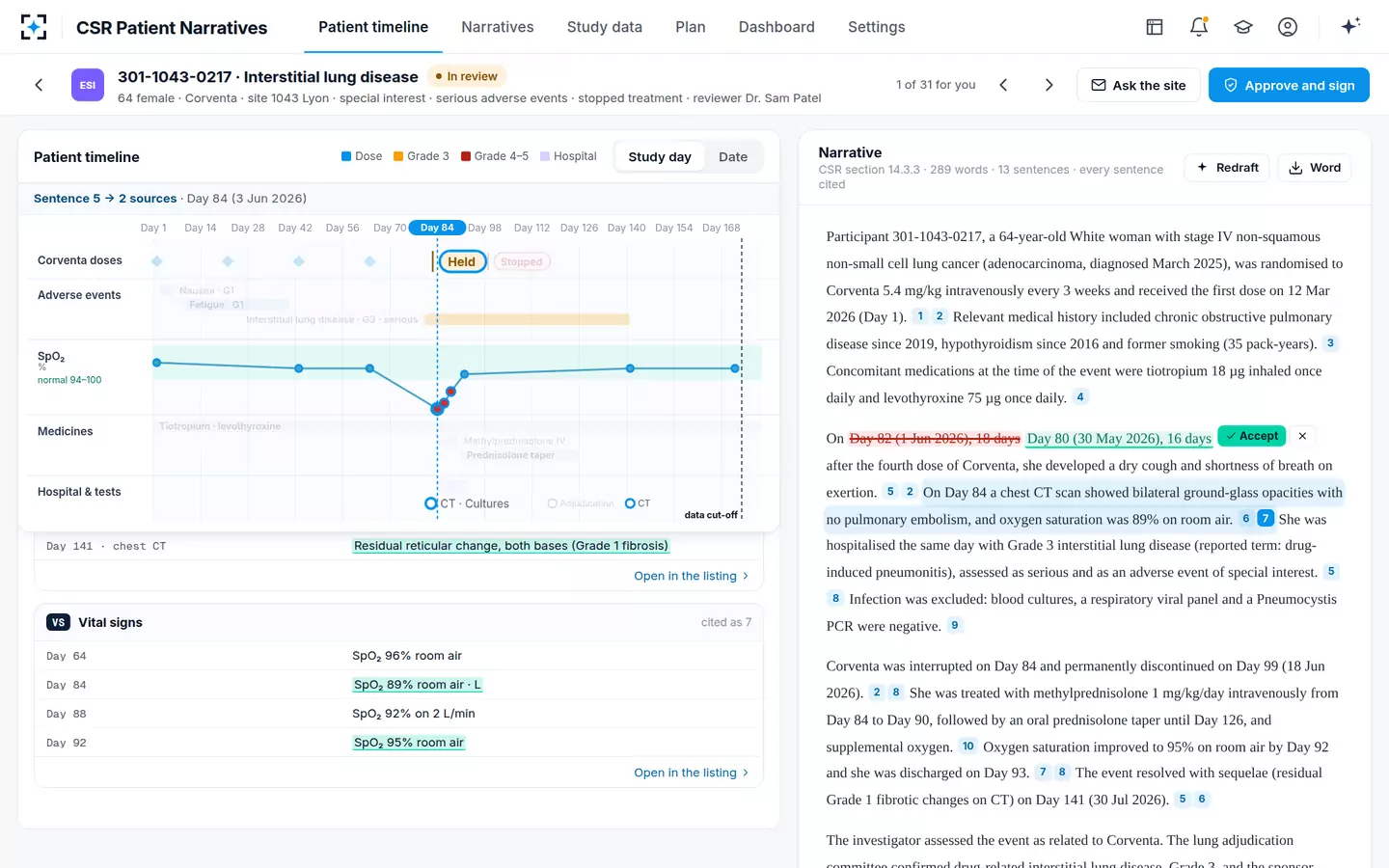
The reverse direction is the one that turns traceability from an audit answer into daily work. A corrected onset date is not interesting in itself; what matters is which sentences in which narratives now say something the data no longer support. A chain that runs from the data point to the prose answers that in a click, and a study that has it stops re-reading documents to find out what changed.
What breaks the chain: transcription, re-mapping and copy-and-paste
Three failures account for most broken chains, and all three are ordinary work done without a link.
Transcription. A value typed from one system into another, with nothing recording that the two are the same value. E6(R3) asks for unnecessary transcription steps to be avoided for exactly this reason; each one is a place where the copy can drift from the original and nothing will notice.
Re-mapping. Converting data from a non-standard format into a standard one, where a collected element cannot be represented and quietly disappears. The FDA's conformance guide treats this as a known hazard of legacy conversion and asks sponsors to explain in the reviewer's guide why any element could not be fully standardised — an explanation, not a silence.
Copy-and-paste. The commonest of the three and the least discussed, because it happens in documents rather than in systems. A sentence copied from one narrative into another, from a previous study's report, or from an email, arrives carrying no link to anything. It may be entirely accurate. Nobody can tell.
How do you prove traceability to an inspector?
By doing the retrace in front of them, on a value they pick. That is the only proof that counts, and it is worth rehearsing, because every part of it is fast if the chain is intact and slow if it is not.
What the rehearsal tends to expose is not missing data but missing joins. The record exists; the transfer exists; the derivation rule exists in a specification; the sentence exists. What is missing is anything saying that this sentence used that value from that transfer. On the sample study every draft, tracked change, comment, query and signature is recorded with the person and the time, and a narrative cannot be signed while a data difference is open — so the join is made at the moment the work happens rather than reconstructed later.
The chain in CSR Patient Narratives, and the two places a person signs it
A person decides
Site records the observationWrites the value where it is first captured, attributable and contemporaneous, with changes visible rather than overwritten.
Never: An original entry is never obscured by a correction.
Agent
Validated transferCarries the record out of the clinical database on a stated cadence, with the transfer it came from kept against each value.
Never: No value enters a narrative without a transfer behind it.
Agent
DerivationComputes study days and intervals from the first dose, keeping the rule, the anchor and the inputs with the result.
Never: A derived value is never stated without the inputs that produced it.
Agent
SentenceStates the value in the narrative, linked to the records it rests on, so selecting one lights the other.
Never: No sentence is written without a source record.
Agent
Re-checkWhen a transfer changes a record, finds every sentence that used it and re-drafts only those, as tracked changes.
Never: A signed narrative never changes silently.
A person decides
Reviewer signsReads the narrative against the records its sentences cite and signs, with the meaning of the signature stated; a death narrative takes a second signature.
Never: Signing waits until every open difference is settled.
The ten-minute test: pick a sentence, pick a number, retrace it
You can run this on any study, today, without changing anything. Take a document going to a regulator, choose a sentence that states a number, and time how long it takes to produce the five things below. If it takes an afternoon, the chain has a gap — and the gap is almost always at the same link twice in a row.
A ten-minute retrace on any document
- Name the records the sentence rests on
Not the dataset — the specific rows, for this participant, at this visit.
- Show the source record behind each value, and its audit trail
Including any correction, with the previous value still visible and a reason recorded.
- Name the transfer that carried each value
And show the description of that transfer: origin, destination, timing and the actions applied to it.
- Show the derivation rule for any computed value
The anchor, the inputs and the arithmetic, so the reviewer can recompute the number themselves.
- Show who signed the document, when, and what the signature meant
A statement of meaning, not just a name and a date.
- Then reverse it: name every other sentence that uses the same data point
This is the question nobody can answer by hand, and the one a corrected value makes urgent.
What one transfer changed, and which sentences it reaches
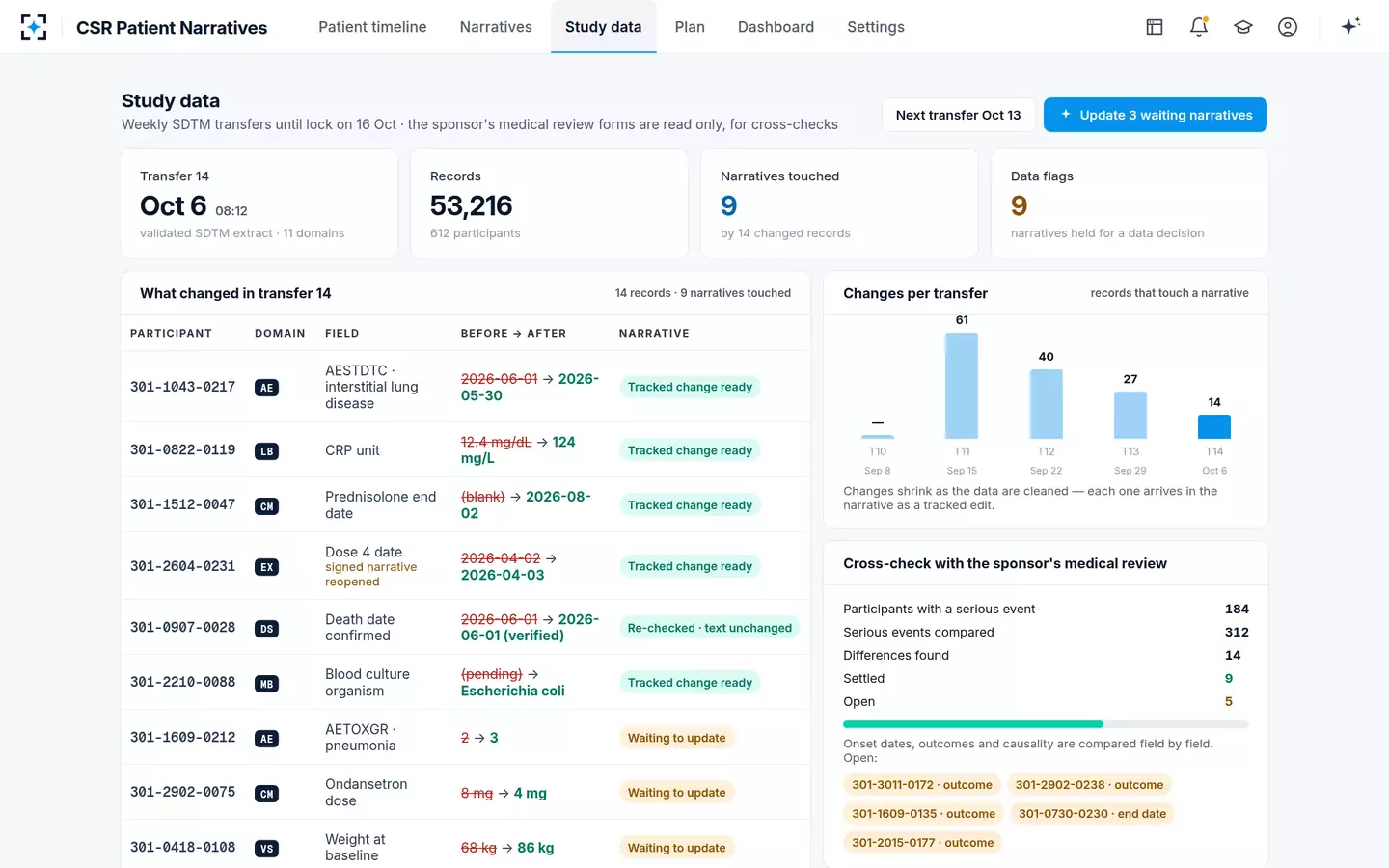
One caution worth stating plainly: carrying a citation is not the same as satisfying a rule. ICH E6(R3), the EMA guideline and the FDA conformance guide all place their obligations on the sponsor, and they are met by the sponsor's own processes, systems and people. What a document can do is make the chain visible at the link where it is usually invisible — the sentence. To see that on a study of your own, start from CSR Patient Narratives, or read what happens when the two records of one event disagree.
Questions people ask
What is traceability in clinical data management?
The ability to follow any value from the result that states it back to the observation it came from, through every transfer and derivation on the way. The FDA describes it as understanding the relationships between the analysis results in the study report, the analysis datasets, the tabulation datasets and the source data. It is a property of the joins between those things, not of any one of them.
What is the difference between source data verification and traceability?
Source data verification is an activity: someone compares what the database holds with the site's own record, usually on a sample. Traceability is a property the data and documents have, or do not, independent of whether anyone has checked them lately. A study can verify a sample of its data thoroughly and still be unable to show where a particular sentence in its report came from.
What has to be in an audit trail?
The initial entry and every change, with the previous and current value, what was changed, by whom with their role and organisation, when, and where applicable why. ICH E6(R3) adds that in computerised systems it must be secure, computer-generated and time-stamped, and the EMA expects it to be visible at data-point level in the live system and exportable as a dynamic data file so that patterns across participants and sites can be analysed.
How do you show traceability of a derived value like study day?
By keeping the rule, the anchor and the inputs with the result. "Day 80" is the difference between an event date and a reference date, and which reference date was used is a choice — the first dose and randomisation can be days apart. Write the anchor down in the plan, apply it to every derived value in the document, and keep the two dates with the result so a reviewer can recompute it.
What breaks traceability in a clinical trial?
Transcription between systems with nothing recording that the two values are the same one; re-mapping during a conversion where a collected element cannot be represented and disappears without explanation; and copy-and-paste in documents, which produces sentences carrying no link to anything. The first two are known hazards with known remedies. The third mostly goes unexamined because it happens in prose rather than in a system.
What will an inspector ask to see about traceability?
Usually one value, picked by them, retraced in front of them: the records behind it, their audit trail, the transfer that carried them, the derivation rule for anything computed, and who signed the document that states it. The harder follow-up is the reverse direction — every other place in the submission that uses the same data point — which is the question a study cannot answer by reading its own documents.