A clinical study report narrative template is a list of sections and the fields each one must carry, and the useful version of it names the study-data source behind every field. That is the difference between a template a person interprets and a template a machine can fill: the second kind can be checked field by field against the data transfer, and the first kind cannot. Writing it is harder than it looks, because ICH E3 gives an element list rather than a section structure, and because four of the fields a narrative needs cannot be read from any dataset at all. Botminds' CSR Patient Narratives holds the template and the house style as the study's narrative plan, assembles each participant's profile from the domains the template names, drafts every narrative into those sections, and flags any field whose data do not support it before a reviewer opens the draft.
A template written as prose guidance produces hundreds of narratives in a dozen voices and gives a reviewer nothing to check against. A template written as fields with sources produces narratives that differ only where the participants differ.
The template and figures below use the sample study in the solution — CRV-301, with invented participants, people and sites. The guidance quoted is from ICH, FDA and the medical-writing literature, linked where it appears.
What goes in a clinical study report narrative template?
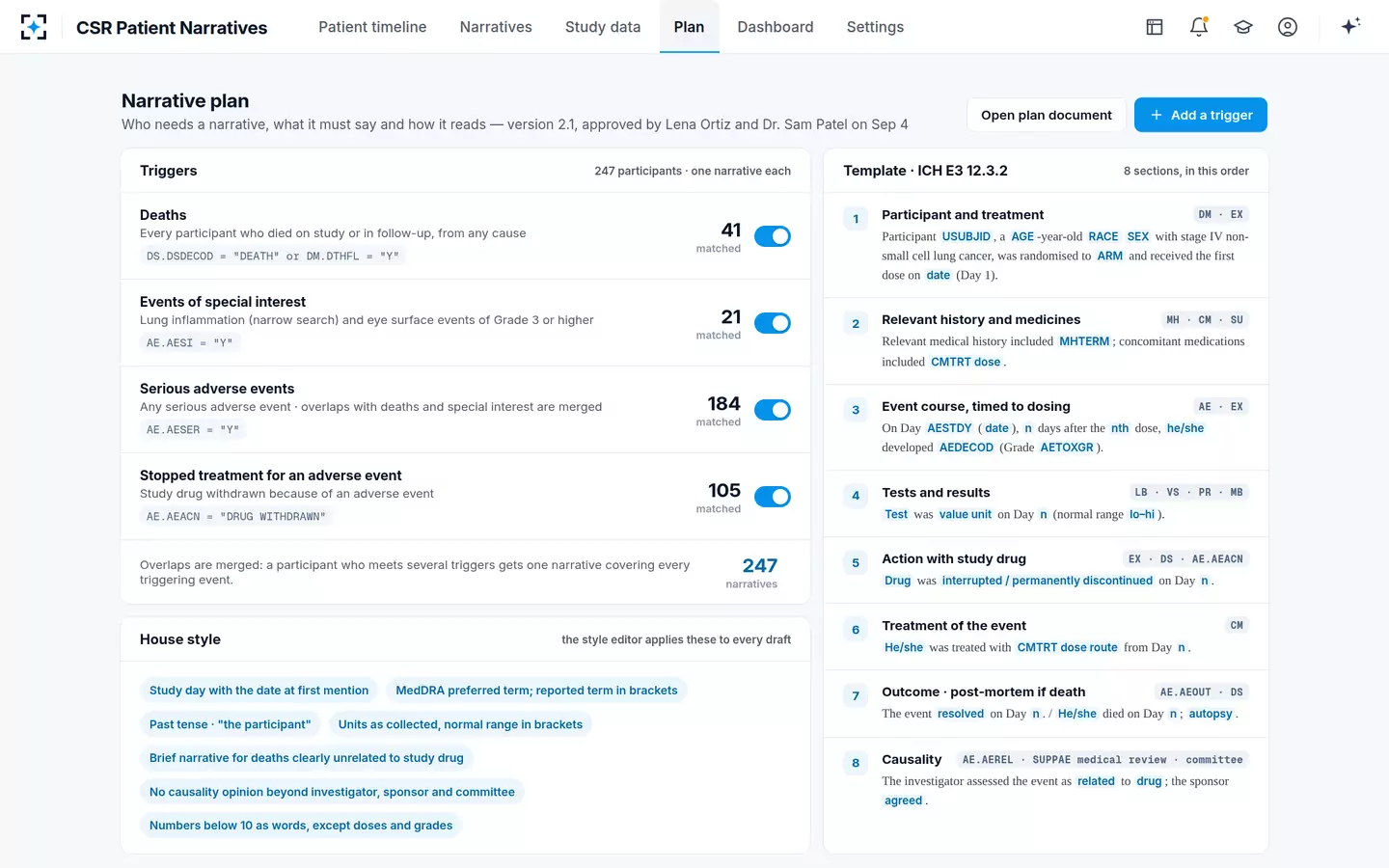
Eight sections is the common shape, and the sample study uses it: participant and disease; exposure; the event and its course; investigations; action taken; concomitant treatment; outcome; causality. Be clear about where that structure comes from, though, because it is often misdescribed. ICH E3 §12.3.2 gives an element list — what the narrative should describe, plus a list of information to include — and it names no sections, no order and no headings. The eight sections are the sponsor's own; what the sponsor may not do is lose an element in the arrangement.
So the first job in template design is a mapping exercise, not a layout exercise: every element of §12.3.2 must land in exactly one section, and every section must own at least one. ICH E3's own words for the second half of that list are worth having in front of you while you do it: "In addition, the following information should be included: − Patient identifier − Age and sex of patient; general clinical condition of patient, if appropriate − Disease being treated (if the same for all patients this is not required) with duration (of current episode) of illness − Relevant concomitant/previous illnesses with details of occurrence/duration − Relevant concomitant/previous medication with details of dosage − Test drug/investigational product administered, drug dose, if this varied among patients, and length of time administered" (ICH E3 §12.3.2).
Eight sections, and what each one owes
Each section owes something specific, and the obligation is easier to hold writers to than a style instruction. "Describe the course clearly" is advice. "This section must state the onset as a study day and a calendar date, the interval from the most recent dose, the coded term and the reported term" is a specification.
Eight template sections, what each one owes, and where its values come from
| Section | What it owes | Study-data domains behind it |
|---|---|---|
| 1. Participant and disease | Identifier, age, sex, baseline condition, the disease treated and how long the current episode had lasted, and the relevant concomitant or previous illnesses. | DM, MH |
| 2. Exposure | The study drug, the dose given, each dose with its study day and date, and any hold, reduction or interruption before the event. | EX, DS |
| 3. The event and its course | Coded preferred term and the reported term verbatim, grade, which seriousness criterion was met, onset as study day and date, and the interval from the most recent dose. | AE, with EX for the interval |
| 4. Investigations | The laboratory, vital-sign and imaging results the event turned on, each with its unit, its normal range and its date. | LB, VS, PR, MB |
| 5. Action taken | What was done with the study drug — held, reduced, withdrawn — and when. | AE action taken, EX, DS |
| 6. Concomitant treatment | The countermeasures given, with dose, route and dates, and any hospital stay. | CM, and the healthcare-encounter record |
| 7. Outcome | The outcome in the record’s own term, the end date or a statement that the event was ongoing at cut-off, and whether treatment was discontinued. | AE, DS |
| 8. Causality | The investigator’s assessment, the sponsor’s assessment, and an adjudication committee’s conclusion where one applies — each attributed. | AE, the sponsor medical review form, committee minutes |
Every field names its source: the domain map
The eight sections become a working template when each field under them carries the domain and variable it is read from. Twenty-five fields cover a full narrative on the sample study. Four more are needed that no domain can supply, and those four are the interesting ones, because they are where a template silently asks a writer to make a judgement it never admitted to asking for.
Twenty-five fields with a source, and four without one
Participant and disease
Participant identifier
DM.USUBJID
Age at first dose, sex
DM.AGE, DM.SEX
General clinical condition at baseline
The baseline assessment record
Disease treated, and how long the current episode had lasted
MH — medical history
Relevant concomitant and previous illnesses, with dates
MH (see the four fields below)
Exposure
Study drug, dose and unit
EX.EXTRT, EX.EXDOSE, EX.EXDOSU
Each dose with its study day and date
EX.EXSTDTC, against the first dose
Dose held, reduced or interrupted, with the date
EX, and the disposition record
Relevant concomitant and previous medication, with dosage
CM (see the four fields below)
The event and its course
Coded preferred term
AE.AEDECOD
Reported term, verbatim
AE.AETERM
Severity or grade
AE.AESEV or AE.AETOXGR
Seriousness, and which criterion was met
AE.AESER and its criterion flags
Onset, as study day and calendar date
AE.AESTDTC
Interval from the most recent dose
Computed from AE.AESTDTC and EX
Investigations
Laboratory value, unit and normal range
LB.LBORRES, LBORRESU, LBORNRLO/HI
Vital sign value, unit and normal range
VS.VSORRES, VSORRESU
Imaging or other procedure, with its finding
PR, and the microbiology record where there is one
Action taken and treatment
Action taken with the study drug
AE.AEACN
Countermeasures given, with dose and dates
CM
Hospital admission and discharge
The healthcare-encounter record
Outcome and causality
Outcome, in the record’s own term
AE.AEOUT
End date, or that the event was ongoing at cut-off
AE.AEENDTC
Treatment discontinued, and the reason
DS — disposition
Investigator’s causality assessment
AE.AEREL
No domain can supply these
Which concomitant illnesses and medicines are "relevant"
ICH E3 asks for the relevant ones. No study-data domain carries a relevance flag, so the plan sets a rule — for example, every medicine active in a window around onset — and a reviewer may still add or remove one.
The sponsor’s causality opinion
Recorded on the sponsor’s medical review form for serious events, not in the study data. The template must name that form as the source, and the form is read, never written to.
An adjudication committee’s conclusion
In the committee’s minutes. Where a committee adjudicated the event, its conclusion belongs in the causality section and nowhere else.
Whether the brief format applies
A recorded judgement that the event was clearly unrelated to the study drug, applied by the plan’s rule, not derived from any field.
Those last four are worth arguing about at template-approval time rather than at narrative 180. "Relevant" is the word ICH E3 itself uses twice, and relevance is a clinical judgement; a template that asks for relevant concomitant medicines without saying how relevance is decided has handed every writer a different question. The sample study's plan answers it with a rule — medicines active in a window around onset, plus anything the reviewer adds — which is defensible precisely because it is written down and can be overridden on the record.
Study day with the calendar date: one rule that removes a hundred questions
Give both, study day first, at first mention in each paragraph: "Day 80 (30 May 2026)". The rule looks trivial and removes an entire class of review comment, because the listings a reviewer checks against are keyed on one or the other and nobody remembers which. It also forces the template to name the anchor — study days computed from the date of the first dose, not from randomisation or screening — so two paragraphs of the same narrative cannot disagree by a day.
The reason to settle it in the template rather than in a style note is that it propagates. Every interval in the narrative is derived from the same anchor: the time from the most recent dose to onset, the duration of the event, the gap between the hold and the permanent discontinuation. Change the anchor and all of them move. Fix it once and the derivation becomes checkable: a reviewer can recompute any study day in the narrative from two dates in the data.
The reported term and the coded term, side by side
The template should ask for both in one sentence, in a fixed order: the coded preferred term as the subject, the investigator's reported term in brackets. Asking for only the coded term loses what the investigator actually observed; asking for only the reported term puts the narrative out of step with every summary table in the report, which counts coded terms.
"A single letter difference in a reported verbatim text can impact the meaning of the word and consequently the term selection"
MedDRA Term Selection: Points to Consider, ICH-Endorsed Guide for MedDRA Users
The guide's own example is sobering for anyone tempted to tidy a reported term in passing: a reported "lip sore" selects a term under lip pain, while "lip sores" selects one under cheilitis. The same document gives the rule that makes a template field rather than a style preference out of it: "When selecting terms, no reported information should be excluded from the term selection process; similarly, do not add information by selecting a term for a diagnosis if only signs or symptoms are reported." A template field that says "reported term, verbatim" and a house style that forbids editing it are what keep the narrative and the coding consistent.
ICH's own E3 questions and answers make the same point about the listings the narrative sits beside: "Listings should also display investigator's verbatim terms for each event and could be used to show demographic or disease-specific information, dosage, duration of treatment, or treatment cycle (for cancer chemotherapy)" (ICH E3 Q&As (R1)). If the verbatim term is in the listing and in the narrative, the two can be compared; if the narrative paraphrased it, they cannot.
Missing values: marked, not smoothed
Every field in the template needs a defined behaviour when the data do not have it, and the only safe behaviour is to say so. "Dose not recorded" in a narrative is accurate, is visible to a reviewer, and gives the data manager something to chase. A plausible dose is none of those things, and it will be checked against a record that does not contain it.
On the sample study that rule produces a specific, useful outcome. A participant's narrative came through the fact check with 26 of 27 facts matching, because the record for her lubricating eye drops carried no dose and no frequency. That one difference is what the reviewer saw first — either a query to the site, or a reason recorded on the audit trail for leaving it as it is. A template that let the gap be filled would have produced a narrative with 27 matching facts and one invented one.
The template in CSR Patient Narratives, with the domains behind each section
How do you keep hundreds of narratives in one voice?
By deciding the voice once, before the batch, and then applying it mechanically. The medical-writing literature is direct about the first half — Ledade and colleagues put template finalisation first in the narrative writing process, as the step that takes subjectivity out of it — and on the second half it names the practice — "Quality calibration is a paramount step to ensure consistency within the narratives in a batch and among the team members so as to meet reviewer(s) expectations" (Ledade et al., Perspectives in Clinical Research).
Calibration by hand means a lead writer reading a sample from every writer and circulating corrections, which works and does not scale past a few writers. The mechanical half of it is narrower than most teams assume: the same drug names, the same units, the same phrasing for recurring constructions, the same coded terms from the same dictionary version. On the sample study the house-style step applies those across all 247 narratives, with the facts locked so that only wording can change — which is the important constraint, because a style pass that can alter a number is a second drafting step wearing a disguise.
A prose guidance template and a field-level template, on the same section
Prose guidance: "Describe the event, its severity and its clinical course, including relevant timing in relation to study drug administration."
Fields with sources: Six named fields: coded term (AE.AEDECOD); reported term verbatim (AE.AETERM); grade (AE.AETOXGR); seriousness criterion (AE.AESER); onset as study day and date (AE.AESTDTC); interval from the most recent dose (computed from AE and EX).
Prose guidance: Two different sentences, both defensible, with different facts in them.
Fields with sources: The same sentence with different values, because the fields are the same.
Prose guidance: Whether it reads well, and whether anything obvious is missing.
Fields with sources: Each field against the record behind it, and the list of fields against the ICH E3 element list.
Prose guidance: Someone re-reads every narrative to find the ones affected.
Fields with sources: The changed record maps to the fields that use it, and only those sentences are re-drafted.
Prose guidance: Produce fluent text that may not be supported.
Fields with sources: Fill it, cite each field, and refuse any field whose record is missing.
Units, ranges and the numbers reviewers argue about
Fix the units in the template and read them from the data, rather than converting. The listing a reviewer checks against carries the result in its original unit; a narrative that converted it to a house unit has created a number that appears nowhere else in the report, and the reviewer has to redo the conversion to agree with you.
Include the normal range with every laboratory and vital-sign value, as a template field rather than as a writer's option. Ranges vary by laboratory and sometimes by visit, so the range belongs to the measurement, not to the test; a template that asks for "the value and its range" and reads both from the same record cannot mismatch them. The same discipline applies to grades: state the scale as well as the number, because Grade 3 under one criteria set is not Grade 3 under another.
Standardised study data make all of this considerably easier, and the FDA says as much about timing: "It is recommended that sponsors implement the SDTM standard for representation of clinical trial tabulation data prior to the conduct of the study" (FDA, Study Data Technical Conformance Guide). A template designed against the standard domains before the study starts asks for fields the transfer will actually contain. A template designed against a legacy extract asks for fields someone will have to derive, and derivations are where traceability goes — the chain a reviewer retraces from one sentence is only as good as the rules behind its derived values.
Testing the template on five narratives before the batch
Write five before you write two hundred, and choose them to break the template rather than to flatter it: a straightforward serious event, a death, an event of special interest with an adjudication, a participant with a missing value, and the most complicated course in the study. Then read the five against the element list and against each other.
Ten acceptance tests for a narrative template
- Every ICH E3 §12.3.2 element lands in exactly one section
Including the sponsor’s causality opinion, which is easy to lose into the investigator’s.
- Every field names the domain and variable it is read from
A field with no source is a field a writer will fill from judgement.
- Every derived value has its rule written down
Study day, interval from dose, duration, change from baseline — with the anchor each is computed from.
- Units come from the record, not from a house conversion
So the narrative agrees with the listing a reviewer checks it against.
- Normal ranges and scales travel with their values
Ranges belong to the measurement; a grade needs its criteria set named.
- Missing values have a defined text
"Dose not recorded", not a plausible dose, and the gap becomes a query.
- The reported term is reproduced verbatim
A paraphrase changes the evidence behind the coded term.
- Both causality opinions are separate, attributed fields
Plus the adjudication committee’s conclusion where one applies.
- No field asks for an opinion the data do not hold
If a field cannot be sourced, it is a person’s judgement — say so in the template.
- The five test narratives read as one voice, differing only in their facts
If they do not, the difference is a style rule still missing from the plan.
From an approved template to a drafted batch in CSR Patient Narratives
A person decides
Template approvedThe plan owner approves the eight sections, the field map, the derivation rules and the house style for the study.
Never: A mid-batch template change re-sets every narrative already written to the old one.
Agent
Profiles assembledOne timeline per participant, built from the domains the template names, with study days computed from the first dose.
Never: Values copied, never inferred; a missing value is marked missing.
Agent
Drafts writtenEach narrative written into the template’s sections, every sentence tied to the records behind it.
Never: No field is filled from a record the template did not name.
Agent
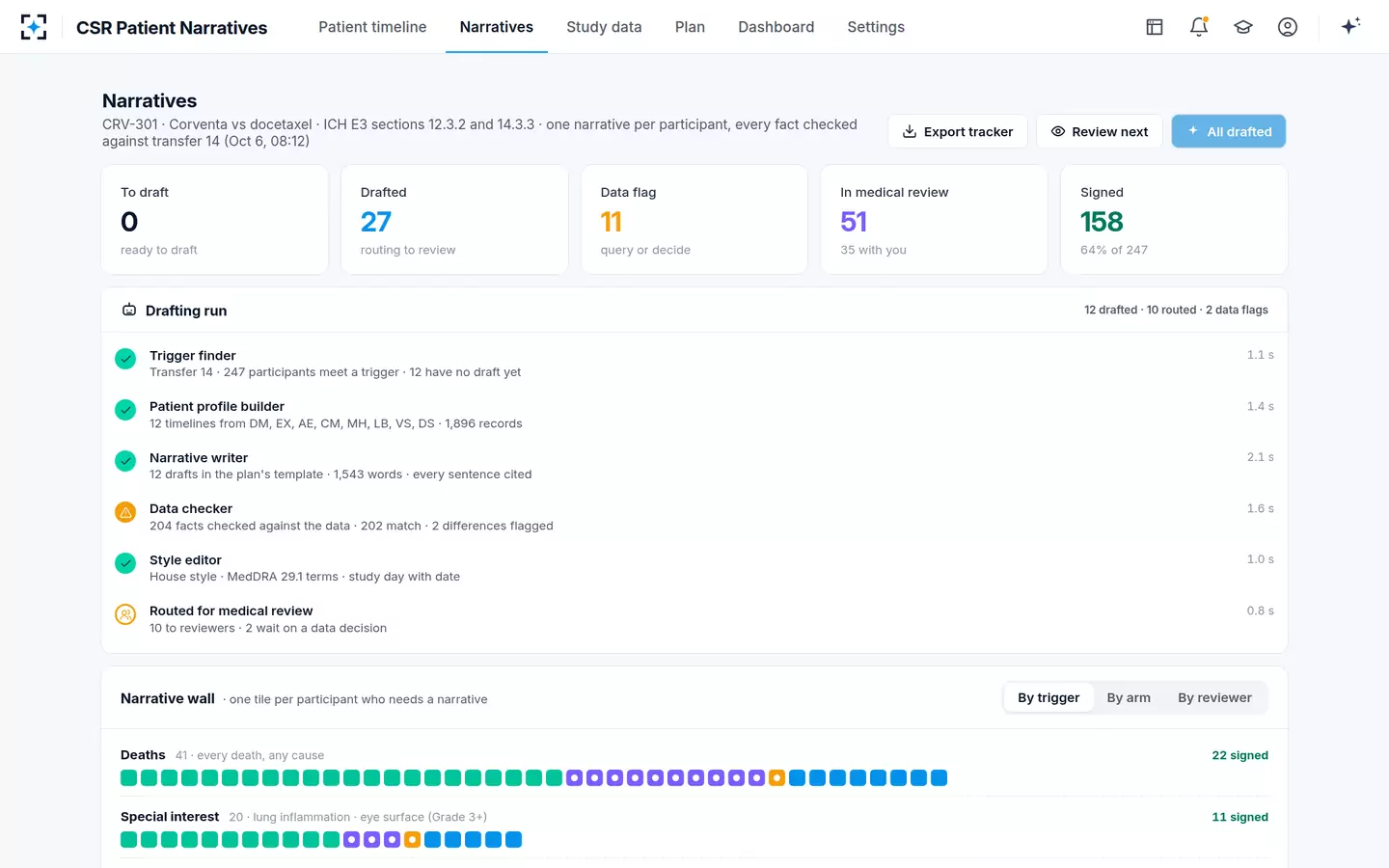
Facts checkedEvery date, study day, dose, grade, value, outcome and causality statement compared with the record it cites.
Never: A difference is flagged, never corrected silently.
Agent
House style appliedThe same drug names, units, phrasing and coded terms across the whole batch.
Never: Facts are locked; only wording may change.
A person decides
Routed to reviewersClean drafts go to the study physician; drafts with an open data difference wait for a decision.
Never: A narrative with an unsettled difference cannot be signed.
One drafting run, step by step
What the template may not decide
A template decides form, not findings. It may not decide a causality opinion, and it may not contain a field that would force one — a field called "assessment of relatedness", with no named source, invites exactly that. It may not decide whether an event was clinically important enough to need a narrative at all; that is the trigger question, and it belongs to the narrative plan. And it may not decide what the data say: where a record is missing or contradictory, the template's job is to make that visible, not to produce a sentence that reads as though it were not.
One last thing a template should not try to do is freeze a dictionary version into its prose. The sample study codes to one MedDRA release, which is correct for that study and will not be the current release when you read this; the template names the version as a field, so the version travels with the narrative rather than being assumed. To see the template, the field map and a drafting run together, start from CSR Patient Narratives.
Questions people ask
What sections does a patient narrative have?
Commonly eight: participant and disease, exposure, the event and its course, investigations, action taken, concomitant treatment, outcome, and causality. That structure is the sponsor's, not ICH's — ICH E3 §12.3.2 gives an element list and leaves the arrangement open. What matters is that every element lands in exactly one section and no element is lost between two of them.
Which study-data domains are used to write patient narratives?
Demographics for the identifier, age and sex; medical history for the disease and concomitant illnesses; exposure for the doses actually given; the adverse-event domain for the term, grade, dates, outcome and investigator causality; concomitant medicines for countermeasures; laboratory, vital-sign, procedure and microbiology records for the investigations; and disposition for when and why treatment stopped. The sponsor's medical review form and any adjudication minutes supply the causality fields no domain holds.
Should the study day or the calendar date come first?
Study day first, with the calendar date in brackets, at first mention in each paragraph: "Day 80 (30 May 2026)". The order matters less than doing both every time, because the listings a reviewer checks against are keyed on one or the other. Name the anchor in the template too — study days computed from the first dose — so every interval in the narrative derives from the same date.
How do you show a missing value in a narrative?
Say it is missing, in the text, and raise a query. "The dose and frequency were not recorded" is accurate and actionable; a plausible dose is neither, and it will fail the check against the record. Give the template a defined missing-value text per field so that two writers produce the same sentence for the same gap.
Do you include normal ranges with lab values in a narrative?
Yes, as a template field rather than a writer's option, and read from the same record as the value. Ranges vary between laboratories and sometimes between visits, so a range attached to the test rather than to the measurement can be wrong. The same applies to grades: name the criteria set, because the same number means different things under different scales.
How do you test a narrative template before writing the batch?
Write five narratives against it — a straightforward serious event, a death, an adjudicated event of special interest, a participant with a missing value, and the study's most complicated course — then check each against the ICH E3 element list and all five against each other. Differences between the five that are not differences between the participants are style rules still missing from the plan.