Database lock in a clinical trial is the point at which a trial's data set is declared final for an analysis and access to it is normally reduced to read-only. It is not the point at which the data become correct, and it is not a wall: a change after lock is still possible, but from then on it has to be justified, authorised by the investigator, written into the audit trail and — where the trial has been unblinded — reported in the clinical trial report. For anyone who writes patient narratives, the useful question is narrower than "has the database locked". It is: which of the sentences I have already written does this transfer touch? Botminds' CSR Patient Narratives answers that at sentence level, because every sentence in every narrative is tied to the records it was built from, so a correction that arrives ten days before lock costs minutes rather than a re-read of two hundred drafts.
The rules below are quoted from ICH and from the European Medicines Agency's inspectors. The worked numbers come from the solution's own sample study, which is invented: study CRV-301, Corventa against docetaxel, 612 participants, 247 narratives, database lock on 16 October and the report due on 13 November. Nothing here is a customer's measured result.
What is database lock in a clinical trial?
It is the end of a defined set of activities, not a single switch. ICH E6(R3) describes the work rather than the moment: data of sufficient quality for interim and final analysis "should be defined and are achieved by implementing timely and reliable processes for data capture, verification, validation, review and rectification of errors", and the activities that finalise the data sets "should be confirmed and documented in accordance with pre-specified procedures". The guideline lists what those activities usually include — reconciliation of entered data and data sets or of relevant databases, rectification of data errors and omissions, medical coding, and compiling and addressing the impact of noncompliance issues including protocol deviations (ICH E6(R3) §4.2.6).
Two things follow from that definition and are worth stating plainly. First, lock is a documented claim about quality, so the evidence that the claim is true has to exist: the reconciliations, the closed queries, the coding sign-off. Second, because lock is the end of a list of activities, it can be reached for part of a data set and not another, which is why trials routinely have more than one lock date on the calendar.
The access change is the part most people picture. The EMA's guideline on computerised systems puts it in one sentence: "Access to the data may be amended to read-only as part of the database lock process." The same passage adds a condition sponsors sometimes miss. Before the investigator's read-only access is revoked, a copy including the audit trail "should be made available to the investigator in a complete and comprehensive way", the period between handing over that copy and closing access "should allow sufficient time for the investigator to review the copy", and access should not be revoked until that review has happened.
What a weekly transfer actually changes
In the weeks before lock a study's data arrive as a series of validated transfers, and the interesting number is not how many records they contain but how few of them have moved. In the sample study, transfer 14 arrived on 6 October at 08:12 with 53,216 records covering all 612 participants. Fourteen records had changed. Those fourteen touched nine narratives that had already been written.
One weekly transfer, ten days before lock
53,216
records in the transfer, for all 612 participants
14
records changed since the transfer before it
9
already-written narratives those 14 records touch
1
of the nine was already signed, and reopened
The ratio is the point. Fourteen changed records out of 53,216 is less than three-hundredths of one per cent of the transfer, and a medical writer who re-reads drafts to find them is searching nine documents out of two hundred and forty-seven with no way to know which nine. The work is not hard, it is unfindable: nothing in the transfer says "this moved a sentence", and nothing in a finished draft says "this sentence rests on that record".
What changes is also predictable in kind. Onset and outcome dates move when a site answers a query. Laboratory and culture results arrive late because a culture takes days to grow. Coded terms change when a coder revises a selection. Causality assessments change when an investigator reconsiders or an adjudication committee reports. Dose records change when a held or reduced dose is recorded properly. Each of those feeds a different kind of sentence, which is why the number of narratives touched is far smaller than the number of narratives in the study — and far larger than nothing.
What transfer 14 did to the nine narratives it touched
Nine narratives touched
- Tracked change ready for review (5) · 55.6%
- Re-checked, text unchanged (1) · 11.1%
- Waiting to update (3) · 33.3%
Soft lock, hard lock and the read-only switch
Soft lock and hard lock are industry practice, not regulatory terms. Neither ICH E6(R3) nor the EMA guideline uses them; what the guidelines describe is the read-only change to access and the requirement that any change afterwards be justified and authorised. A team that treats the two phrases as rules will eventually argue about which one it is in rather than about what it is allowed to do.
In the way most sponsors use the words, a soft lock freezes the data for an analysis while leaving a defined route open for corrections still in flight — queries already raised, coding under review, a laboratory result expected. A hard lock closes that route, and from then on changes follow the exceptional-circumstances path below. The useful question for a narrative team is not the label but the answer to three questions: can a record still change, who has to agree, and will a change still reach the person who signed a narrative built on it.
It is worth writing those answers down before the lock date, because they decide the narrative schedule. If corrections can still arrive in the week after a soft lock, narratives signed before it will reopen, and the sign-off plan has to leave room for the second signature. The rhythm of signing — and why one signature on everything just before lock is a poor plan — is the subject of signing a narrative and stating what the signature means.
What happens after database lock in clinical trials?
After lock the analysis runs, the tables and listings are produced, and the report is written. Data can still change, but only on a narrow path. ICH E6(R3) sets the standard for changes made after the trial has been unblinded, and the standard is high.
The rule, in substance: deviations from the planned statistical analysis, and changes made to the data once the trial has been unblinded, should be clearly documented and justified, and should happen only in exceptional circumstances — the guideline's example is a data discrepancy that has to be resolved for the trial's results to be reliable (ICH E6(R3)).
Three words in that rule do the work. Documented: the change and its reason are written down, not remembered. Justified: a reason that stands up, which is why "the site sent a correction" is not one on its own. Exceptional: the example the guideline offers is a discrepancy that must be resolved for the results to be reliable, which is a much narrower case than any error a team would like to fix.
For narratives, the consequence is practical rather than philosophical. A late correction will usually be made because it is a real discrepancy, and a real discrepancy in a serious adverse event is exactly the kind of fact a narrative states in its first sentence. So the narratives most likely to be touched after lock are the ones a regulator is most likely to read.
Post-lock changes: who authorises them, and where they are reported
The same paragraph of ICH E6(R3) answers both questions in two sentences: "Such data changes should be authorised by the investigator and reflected in an audit trail. Post-unblinding data changes and deviations from the planned statistical analyses should be reported in the clinical trial report." The investigator authorises, the audit trail records, and the report discloses. A sponsor-side correction nobody at the site agreed to does not meet the first; a correction made in a working copy rather than the database does not meet the second; and a correction that never reaches the report's own account of deviations does not meet the third.
The audit trail standard for changes arising from queries is set out separately in the EMA guideline, and it covers the clarification process as well as the change itself: "The audit trail should record all changes made as a result of data queries or a clarification process. The clarification process for data entered should be described and documented. Changes to data should only be performed when justified. Justification should be documented." ICH E6(R3) adds the attribution rule for corrections generally — they "should be attributed to the person or computerised system making the correction, justified and supported by source records around the time of original entry and performed in a timely manner".
Inspectors do look here, and they find things. In the European inspectors' 2023 annual report, data management produced 48 findings across the inspections conducted that year, five of them critical — the largest critical count of any sub-category under trial management — while the clinical study report itself produced 13 findings, one critical (EMA/INS/GCP/164938/2024, Table 4). The two sit next to each other in the table for a reason: the report is where a data-handling problem becomes visible.
Serious events cross-checked with the sponsor’s medical review, before lock
Which narratives a changed record touches, and how to find them
There are only three ways to answer the question, and two of them are bad. The first is to re-read every draft against the new transfer, which is accurate and costs days. The second is to re-generate every narrative from the new data and diff the text, which is fast and loses the review history — a reviewer who accepted a sentence last week has no way to see that it changed. The third is to keep, for every sentence, the records it was built from, and to let a changed record name its own sentences.
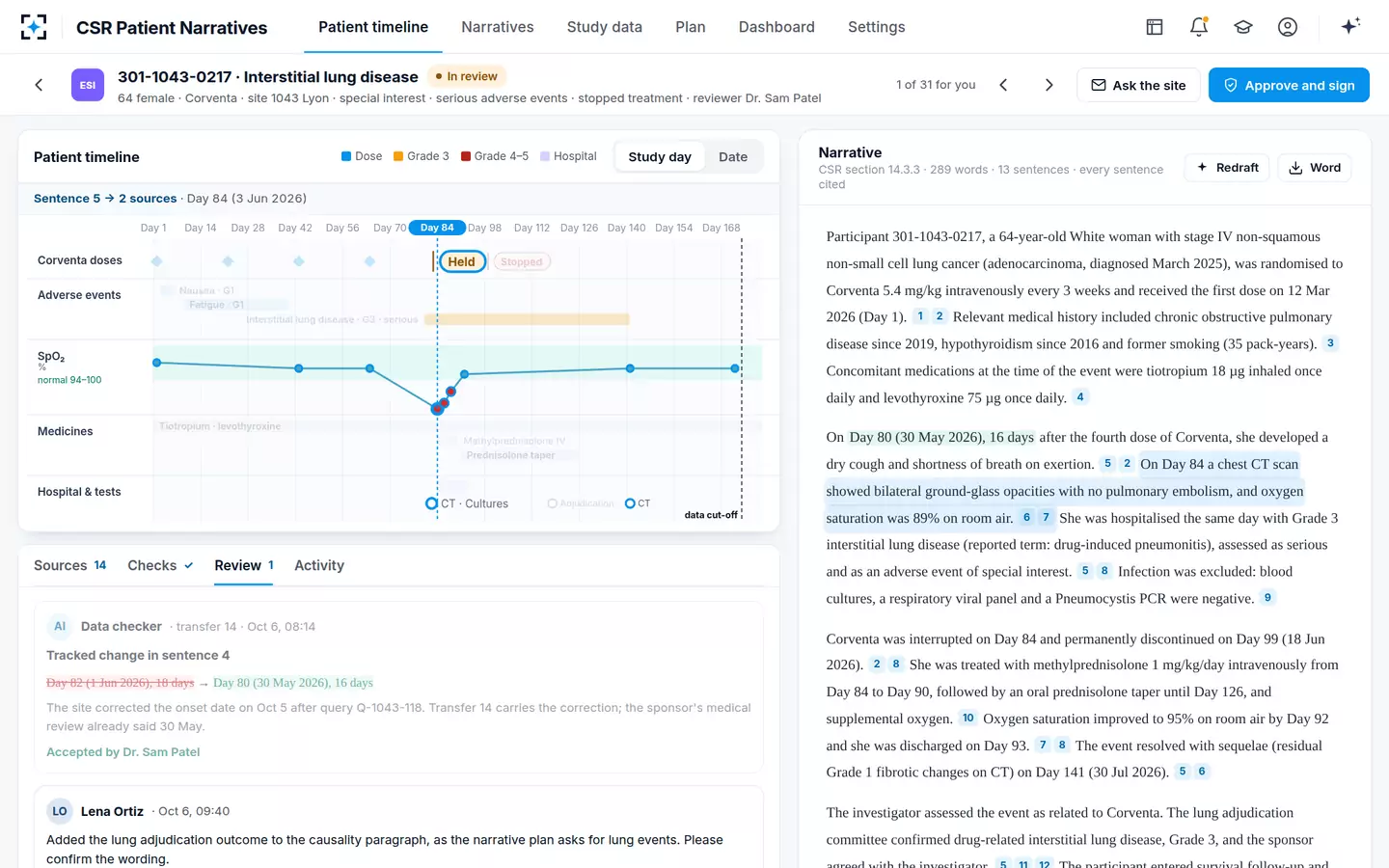
The third way is what makes the arithmetic bearable. In the sample study it turned fourteen changed records into nine named narratives and, inside those, into the handful of sentences that use them. One correction shows what that means in practice: after query Q-1043-118 the site moved the onset date of a participant's lung inflammation, and the change arrived as a tracked edit to a single sentence — "Day 82 (1 Jun 2026), 18 days" becoming "Day 80 (30 May 2026), 16 days". The rest of that narrative was untouched, and the reviewer could see that it was untouched.
What the latest transfer changed, and which narratives it touched
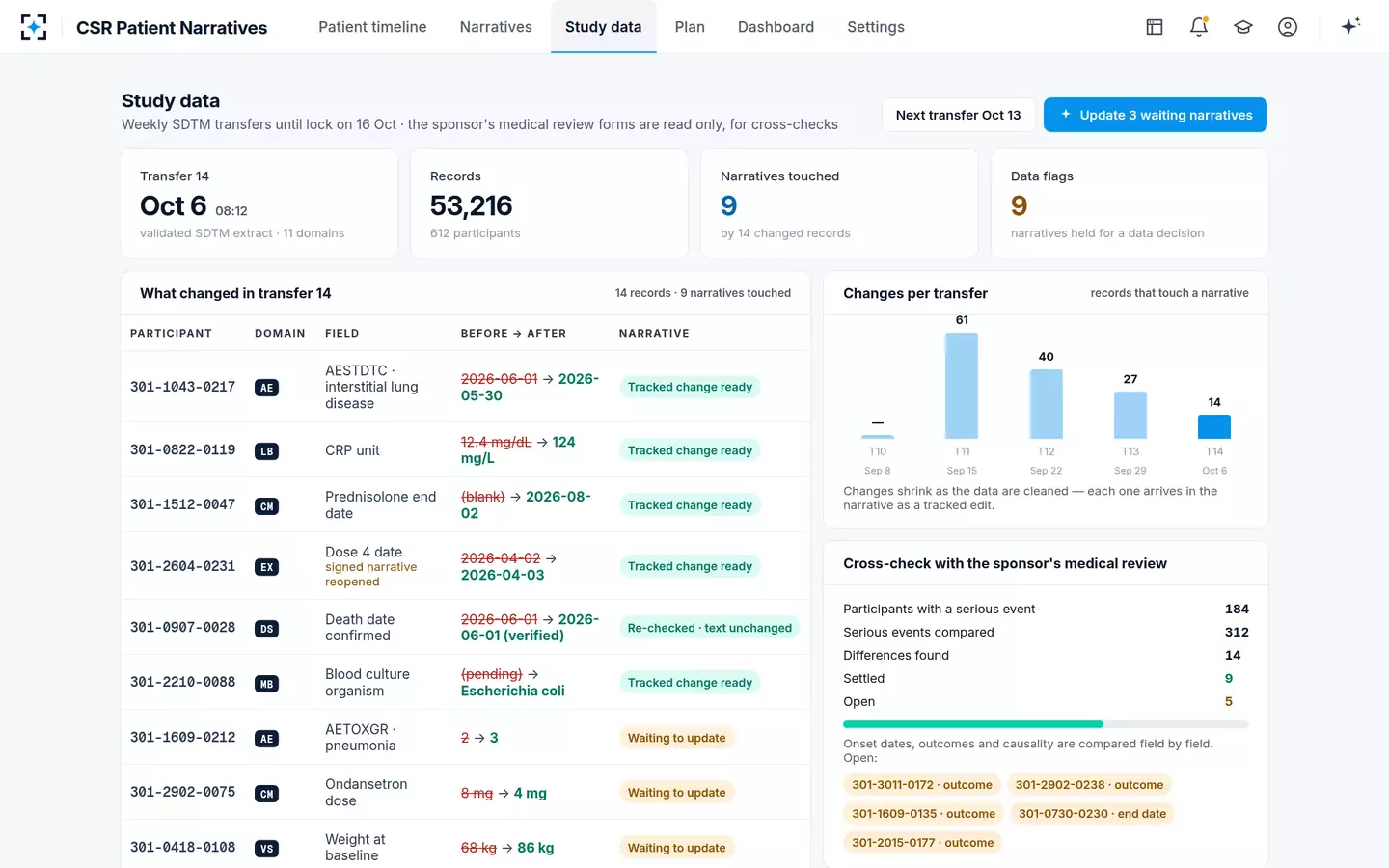
The same link is what makes a reviewer's second reading short. A narrative where one sentence changed is a narrative with one sentence to re-read, and the sentence arrives with the record behind it. How that link is built and what it is good for beyond lock week is set out in data traceability from the sentence back to the record.
Reopening a signed narrative as a tracked change
A signed narrative that has to change is the awkward case, and it has only one safe shape: the change is a proposal, not an edit. In the sample study, 301-2604-0231 had been signed when transfer 14 moved a dose date by a day. The narrative reopened as a tracked change on the sentences that used that date, addressed to the reviewer who had signed it, for them to accept or reject; the signed text stayed readable alongside the proposal, and signing again put a second signature and a second time on the record.
One changed record, from the transfer to a second signature
Agent
Changed records identified in the transferThe transfer is compared with the one before it, and each changed record is named with the participant and the domain it belongs to.
Never: Never edits study data
Agent
Affected sentences foundEach changed record names the sentences built from it, in the narratives that use it, across the whole study.
Agent
Only those sentences re-draftedThe rest of the narrative is left exactly as the reviewer last saw it, so the change is small enough to read.
Never: Never re-writes text the change does not touch
A person decides
Accepted or rejected by the reviewerThe reviewer sees the old wording, the new wording and the record behind the change, and decides. A query to the site is the other option.
A person decides
Re-signed, with the change on the audit trailThe reviewer signs again. Both signatures, the change between them and the reason stay readable.
Interim locks, and the narratives written twice
A trial with an interim analysis has at least two locks, and some narratives will be written against the first and re-stated against the second. The EMA guideline is explicit that data have to be confirmed before interim as well as final analysis, and that for a planned interim analysis — it gives filing for a marketing authorisation as the example — all submitted data need to be signed off by the investigator or a designated and qualified representative before the data are extracted for analysis.
For a narrative team that means two things. A narrative written for an interim data set is a complete document for that cut-off and will usually gain sentences later, as the participant's course continues: a Grade 3 event that was ongoing at the interim has an outcome by the final lock. And a participant whose narrative was final at the interim because they had died does not change, which is why death narratives are the ones worth finishing first.
The practical rule is to date the cut-off inside the narrative work rather than in a side spreadsheet, so that a reader always knows which data set a given draft was built from. A narrative that silently mixes two cut-offs is worse than one that is out of date, because nothing on its face says so.
The data lock point in safety reporting is a different thing
Searches for "data lock point" and "database lock" collide, and the two are not the same. A database lock is a trial event. A data lock point is a periodic-reporting cut-off in pharmacovigilance: ICH E2C(R2), which defines the periodic benefit-risk evaluation report, says "the DLP is the date designated as the cut-off for data to be included in a PBRER", set from the product's international birth date rather than from any one trial's calendar (ICH E2C(R2) §2.8.1). The guideline then fixes the submission interval from it: reports covering six or twelve months are submitted within 70 calendar days of the data lock point, longer intervals within 90, with the day of the data lock point counted as day zero.
The distinction matters in a conversation with a safety group, because the same word points at two different calendars. A trial's lock serves one clinical study report. A product's data lock point serves a periodic report that may include data from several trials and from marketed use, and recurs for the life of the product. A tool that writes clinical study report narratives sits on the first calendar; where the two kinds of document differ, and what each is for, is the subject of the difference between a case narrative and a report narrative.
A narrative plan for the four weeks before lock
The weeks around lock are predictable enough to plan, and the plan is mostly about order. Finish what cannot change, start what will change least, and keep the transfer-by-transfer work small enough that it never becomes a re-read.
The sample study’s calendar from the last weekly transfer to the report date
- Weekly transfers, queries still closing10 d
- Lock, 16 Oct, then the refresh that follows it5 d
- Analysis and report writing23 d
- Signing continues; reopened narratives re-signed157 signed at this point
- Remainder signed after the post-lock refreshto about 21 Oct
- Narrative section compiled into the report23 d of margin
Four weeks before lock: what to do, and who owns each row
- Week 4 — freeze the triggers, not the text
Confirm the list of participants who need a narrative against the current transfer, and get any change to the trigger rules approved by the owner of the narrative plan. Lead medical writer.
- Week 4 — finish the narratives that cannot change
Deaths with a settled cause, and participants who completed long ago. These are the documents that take two signatures and the longest to schedule. Study physician and medical lead.
- Week 3 — clear the open differences, not the drafts
Every fact that does not match its record is a query or a documented decision. Nothing should be waiting on a reviewer’s memory. Clinical data manager.
- Week 3 — reconcile serious events with the sponsor’s medical review
Onset, outcome and causality, field by field, so a difference is found before it is written into a sentence. Medical monitor.
- Week 2 — handle each transfer as a change list
Read what moved, not the drafts. Accept or reject the tracked changes the same week they arrive. Study physician.
- Week 2 — agree the post-lock route in writing
Who authorises a change after lock, how it reaches the person who signed the narrative, and where it will be reported. Study manager.
- Week 1 — expect the refresh after lock
Plan for one more pass over the narratives the lock-day extract moves, and leave signature capacity for it. Lead medical writer.
- Week 1 — record which cut-off each narrative was built from
So that a reader of a draft, or an inspector a year later, can tell. Study manager.
Three ways to find what a transfer changed, and what each costs
| Method | What it finds | What it costs | What it loses |
|---|---|---|---|
| Re-read every draft against the new data | Everything, if the reader is fresh | Days per transfer, every transfer | Nothing, except the writers’ remaining time before lock |
| Re-generate every narrative and compare the text | Every sentence whose wording moved | Minutes | The review history: an accepted sentence silently becomes a new one |
| Keep each sentence tied to its records | The narratives, and the sentences, a changed record feeds | Minutes, and the discipline of citing every sentence as it is written | Nothing, provided no sentence is ever written without a record behind it |
A tracked change arriving on one sentence, with the record behind it
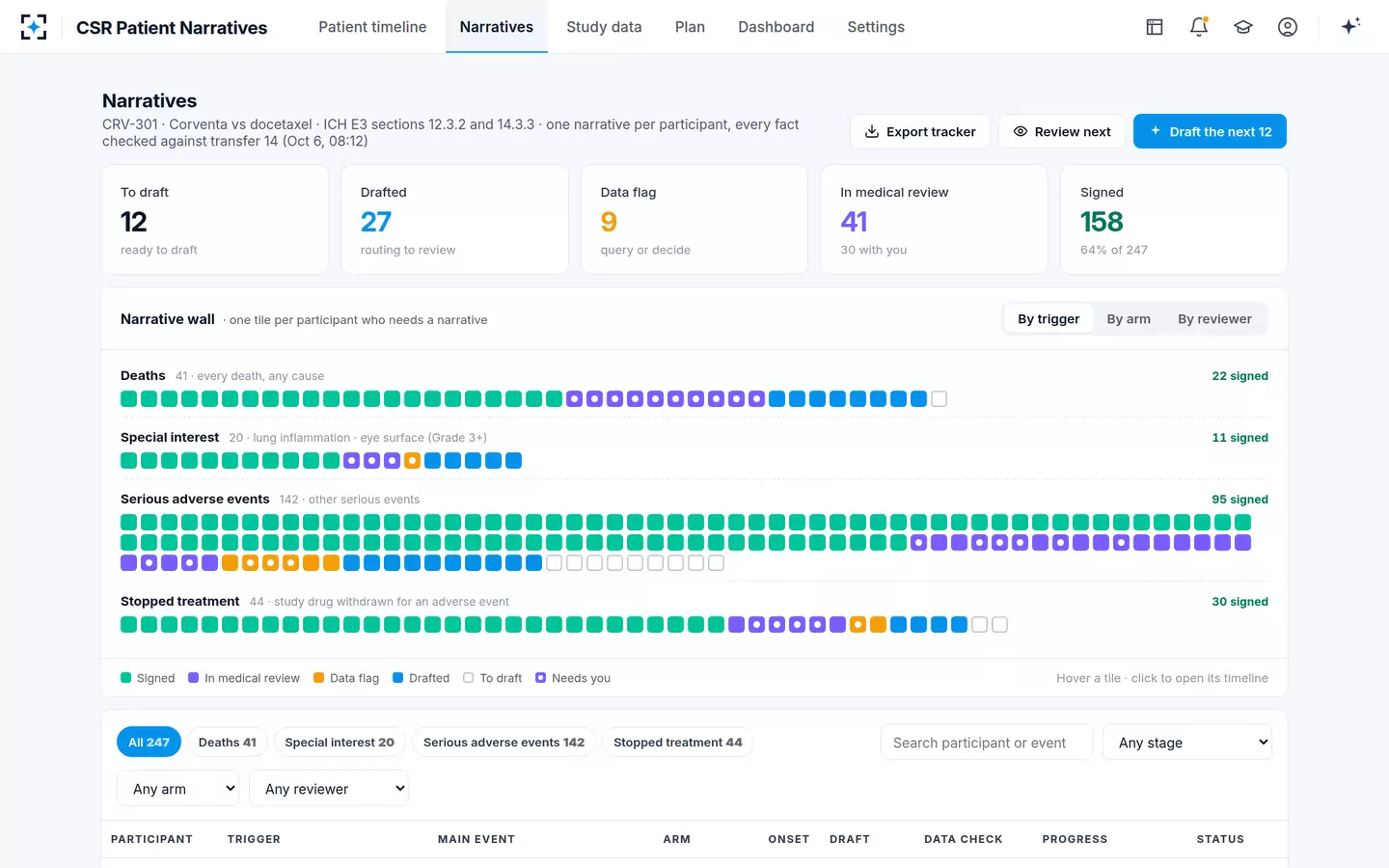
Every participant who needs a narrative, by trigger and stage
Done this way, lock week stops being the week the narrative work happens and becomes the week it finishes. The counts behind the plan — how many narratives a trial of this size triggers at all, and what each one costs to write and review — are worked through in what one patient narrative costs. To see one transfer, nine touched narratives and a reopened signature on one screen, start from CSR Patient Narratives.
Questions people ask
Can data be changed after database lock?
Yes, but narrowly. ICH E6(R3) says changes made to the data after the trial has been unblinded should be documented, justified, and should "only occur in exceptional circumstances", giving as the example a discrepancy that must be resolved for the trial's results to be reliable. Such changes should be authorised by the investigator, reflected in an audit trail, and reported in the clinical trial report.
Who authorises a change after database lock?
The investigator. ICH E6(R3) is explicit: "Such data changes should be authorised by the investigator and reflected in an audit trail." The sponsor documents and justifies the change and discloses it in the report, but the authorisation belongs to the site, which is also where the source records that support it live.
What is an interim database lock?
A lock taken for a planned interim analysis rather than for the final one. The EMA's guideline treats it as requiring the same confirmation of data as the final analysis, and says that for a planned interim analysis all submitted data need to be signed off by the investigator or their designated and qualified representative before the data are extracted. A narrative written at an interim is final for that cut-off and will often gain sentences by the final lock.
What is a data lock point, and is it the same thing?
No. A data lock point is a pharmacovigilance reporting cut-off, not a trial event. ICH E2C(R2) defines it as "the date designated as the cut-off for data to be included in a PBRER", set from the product's international birth date, and sets the submission window from it: 70 calendar days for six- and twelve-month intervals, 90 for longer ones.
What happens to a signed narrative when the data change?
In a system that holds signatures properly, it reopens rather than changes. The signed text stays readable, the change arrives as a proposal on the sentences that use the changed record, the person who signed decides whether to accept it, and a second signature and time are recorded. In the fictional sample study one signed narrative reopened in transfer 14 because a dose date had moved by a day.
What belongs in a database lock checklist?
The activities ICH E6(R3) lists for finalising a data set, with evidence for each: reconciliation of entered data and of relevant databases, rectification of data errors and omissions, medical coding, and the compilation and assessment of noncompliance issues including protocol deviations. Add the access change — read-only, with a copy of the data and audit trail given to the investigator first — and, for a narrative team, the list of narratives still waiting on data.