Supervisory LTV limits are the maximum loan-to-value ratios set in the Interagency Guidelines for Real Estate Lending Policies, which the OCC, FDIC and Federal Reserve each publish as an appendix to their real estate lending rules: 65% for raw land, 75% for land development, 80% for commercial, multifamily and other nonresidential construction, 85% for one-to-four family construction and 85% for improved property. A bank's own internal limits "should not exceed" them. A bank may lend above them case by case, but those loans must be identified, reported to the board at least quarterly, and kept within two caps: in aggregate 100% of total capital, and for commercial, agricultural and multifamily property 30%. For a commercial real estate lender the limits are a ceiling, not a target; Botminds' CRE Deal Screening tests every loan request against the bank's own, lower limits and flags any request that would reach the supervisory ones.
The examples come from a fictional sample bank, a CRE lender in the Carolinas and Virginia, as it runs through the solution. The rule text is quoted from the eCFR and linked where it appears.
The supervisory LTV limits by loan category
What are the supervisory LTV limits?
They are ceilings on a bank's own loan-to-value limits, by type of loan. The text is short: "Institutions should establish their own internal loan-to-value limits for real estate loans. These internal limits should not exceed the following supervisory limits", followed by the table above (12 CFR 34, Appendix A to subpart D).
They come from the Federal Deposit Insurance Corporation Improvement Act of 1991, section 304, which told the agencies to prescribe real estate lending standards; the guidelines date from 1992. Most CRE loans fall in one of three rows. Completed income property, an office building, an apartment complex with five or more units or a warehouse, is "improved property" at 85%. A construction loan on the same building is 80%. A loan to put in streets and utilities before any building is land development at 75%, and land with no improvements is raw land at 65%.
The ceilings are not an endorsement. The guidelines say directly that "the establishment of these supervisory limits should not be interpreted to mean that loans at these levels will automatically be considered sound", and they ask lenders to set lower internal limits "for any subcategory of loans that exhibits greater credit risk than the overall category".
Supervisory LTV limits at the FDIC, OCC and Federal Reserve: one table, three rules
The three agencies adopted the same guidelines, so the limits are identical; what differs is where they sit and how "total capital" is defined for the exception caps. National banks and federal savings associations follow 12 CFR part 34, subpart D (OCC). State non-member banks follow 12 CFR part 365 (FDIC). State member banks follow 12 CFR part 208, subpart E (Federal Reserve).
Where the supervisory LTV limits live for each charter
| Charter | Rule | Guidelines | "Total capital" for the exception caps |
|---|---|---|---|
| National banks and federal savings associations | 12 CFR 34.62 (OCC) | Appendix A to subpart D | As defined at 12 CFR 3.2 |
| State non-member banks | 12 CFR 365.2 (FDIC) | Appendix A to subpart A of part 365 | As described in the FDIC's capital rules |
| State member banks | 12 CFR 208.51 (Federal Reserve) | Appendix C to part 208 | "Total risk-based capital" under the Board's capital rules |
One difference catches people out. The exception caps in these guidelines are measured against total capital. The 2006 CRE concentration screens are now measured against a different denominator, tier 1 capital plus the allowance for credit losses, under a 2020 interagency statement (OCC Bulletin 2020-29). A bank's LTV exception report and its concentration report therefore divide by different numbers, and a screen that mixes them reports the wrong headroom.
How is supervisory LTV calculated?
Loan to value is the loan, plus any senior liens, divided by the value of the property at origination. The definition: the ratio "derived at the time of loan origination by dividing an extension of credit by the total value of the property(ies) securing or being improved by the extension of credit", and "The total amount of all senior liens on or interests in such property(ies) should be included".
Three details decide the numerator and denominator. The "extension of credit" is the total commitment, not the amount drawn so far. "Value" is an appraisal or evaluation of market value, and for a purchase it is "the lesser of the actual acquisition cost or the estimate of value". And origination is the moment the bank becomes legally bound to fund, so a later appraisal does not change whether a loan was an exception when made.
Supervisory LTV, calculated on four kinds of CRE loan
| Loan | Calculation | Result against the limit |
|---|---|---|
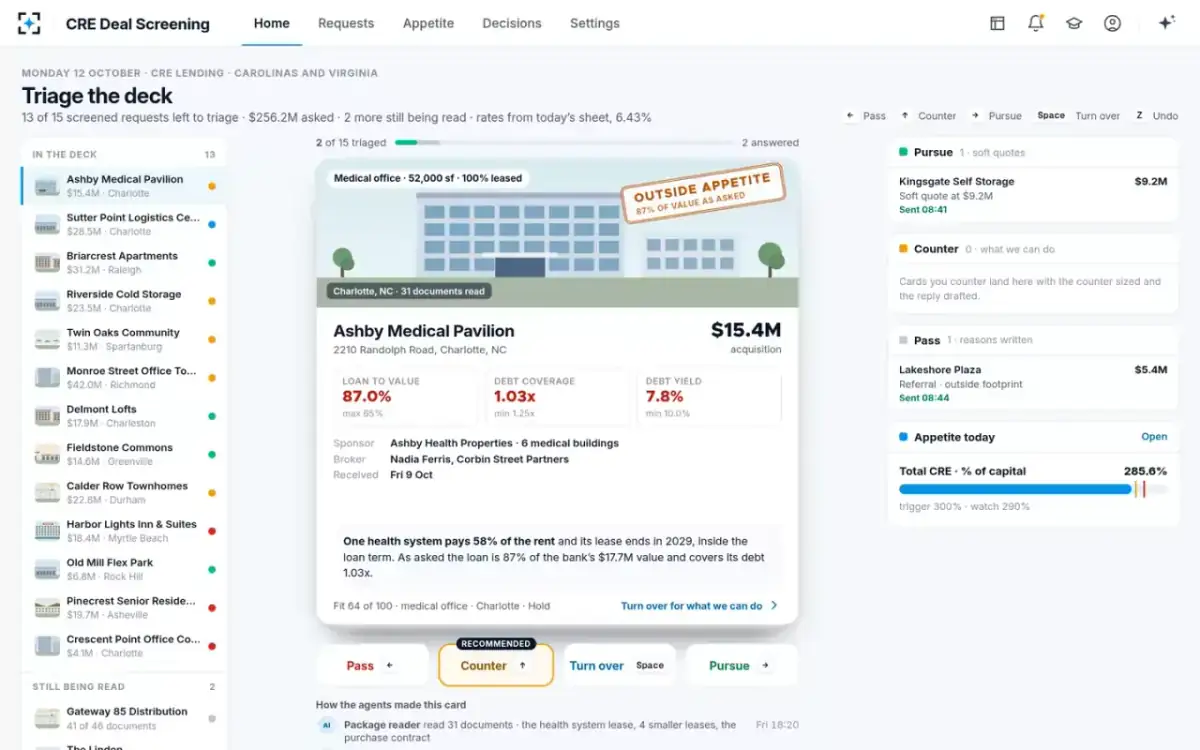
| Acquisition: $15.4M on a medical office bought for $17.9M, appraised at $17.7M | $15.4M ÷ lesser of $17.9M and $17.7M | 87.0% against 85% improved property: a supervisory exception |
| Refinance with a $2.0M senior lien held by another lender | ($9.0M + $2.0M) ÷ $14.0M value | 78.6% against 85%: within the limit |
| One loan for land development and construction of an office building | Committed amount ÷ value; the limit is that of the final phase funded | Tested against 80% for commercial construction |
| Two properties cross-collateralised | Maximum = Σ (value − senior liens) × each property's limit | Re-test whenever collateral is substituted |
Do supervisory LTV limits apply to construction loans?
Yes: 80% for commercial, multifamily and other nonresidential construction and 85% for one-to-four family residential construction. Where one loan funds several phases, such as land development and then construction of an office building, "the appropriate loan-to-value limit is the limit applicable to the final phase of the project funded by the loan; however, loan disbursements should not exceed actual development or construction outlays".
That last clause matters as much as the ratio. It ties the LTV rule to draw control: a construction loan within 80% of the completed value can still be over-advanced if draws run ahead of the work in place. Construction loans also tend to sit in the 100% construction screen of the 2006 concentration guidance, which is a separate test with a separate denominator.
Can a bank exceed the supervisory LTV limits?
Yes, as a documented exception, within two aggregate caps. The guidelines allow that "it may be appropriate in individual cases to originate or purchase loans with loan-to-value ratios in excess of the supervisory loan-to-value limits, based on the support provided by other credit factors", but: "The aggregate amount of all loans in excess of the supervisory loan-to-value limits should not exceed 100 percent of total capital. Moreover, within the aggregate limit, total loans for all commercial, agricultural, multifamily or other non-1-to-4 family residential properties should not exceed 30 percent of total capital."
How fast the 30% bucket fills: exception capacity at a bank with $1.04 billion of total capital
| Item | Arithmetic | Amount |
|---|---|---|
| All loans above the supervisory limits | 100% × $1,040M | $1,040.0M |
| Of which commercial, agricultural and multifamily | 30% × $1,040M | $312.0M |
| One $15.4M medical office acquisition at 87% of value, if booked as asked | The whole loan counts, not the 2% above the limit | 4.9% of the $312M |
| Twenty such loans | 20 × $15.4M | $308.0M, 98.7% of the bucket |
The counting rule is what makes the bucket smaller than it looks. Banks must "Include all loans secured by the same property if any one of those loans exceeds the supervisory loan-to-value limits", so a loan two points over the line consumes its whole balance. Conversely, a loan comes out of the total once principal reduction, released senior liens or added collateral or equity bring it back within the limit. And as either cap is approached, "An institution will come under increased supervisory scrutiny".
How are supervisory LTV exceptions reported?
Individually identified in the bank's records, reported in aggregate to the board at least quarterly, and, for exceptions of significant size, reported loan by loan. Each needs "a written justification that clearly sets forth all of the relevant credit factors that support the underwriting decision", kept in the permanent loan file.
What the guidelines expect for every loan above a supervisory LTV limit
- Identify it in the bank's records
The OCC's examination procedures ask whether loans in excess of the limits are identified, and examiners test it.
- Count every loan on the same property
Including any recourse obligation on such a loan sold with recourse.
- Report the aggregate to the board at least quarterly
Against both caps: 100% of total capital overall, 30% for commercial, agricultural and multifamily.
- Report significant exceptions individually
The board sets the standards for reviewing and approving exception loans.
- Write the justification and keep it in the file
All the relevant credit factors that support the decision: equity, recourse, other collateral, cash flow.
- Take it out when it comes back within the limit
Principal reduction, a released senior lien or added collateral or equity can bring a loan into compliance.
Which loans are excluded from the supervisory LTV limits?
The guidelines list situations where "other factors significantly outweigh the need to apply the supervisory loan-to-value limits". For CRE lenders the important ones are renewals and refinancings without new money, workouts, government-guaranteed portions and loans where real estate is only abundance-of-caution collateral.
Loans excluded from the supervisory LTV limits, and what each means for a CRE lender
| Excluded | Condition | In CRE practice |
|---|---|---|
| Government-guaranteed or insured loans | The guaranty covers at least the portion above the limit | For example, the guaranteed portion of a government-backed loan |
| Loans sold promptly after origination | Without recourse, to a financially responsible third party | Loans originated for sale |
| Renewals, refinancings and restructurings | No new funds beyond reasonable closing costs; or a documented workout | A maturity extension at the same balance; a cash-out refinance does advance new funds |
| Loans to sell the bank's own foreclosed real estate | Property acquired collecting a debt in good faith | Financing the sale of other real estate owned |
| Abundance-of-caution liens | Real estate taken as extra collateral; low value relative to other collateral | A blanket lien on a business borrower's assets |
| Loans not relying principally on real estate | Not used to acquire, develop or construct improvements | Working capital lines with a real estate lien |
The refinance row is the one a screening tool must get right. A maturity extension at the existing balance is excluded; a cash-out refinance advances new funds and is not. The sample bank's $28.5 million industrial request was a refinance with cash out of a $22.1 million loan, so its loan to value is tested like a new loan: at the counter, $24.3 million on a $35.54 million value is 68.4%, inside both the bank's 70% and the 85% ceiling.
A request stamped outside appetite at 87% of value, before anyone reads the memo
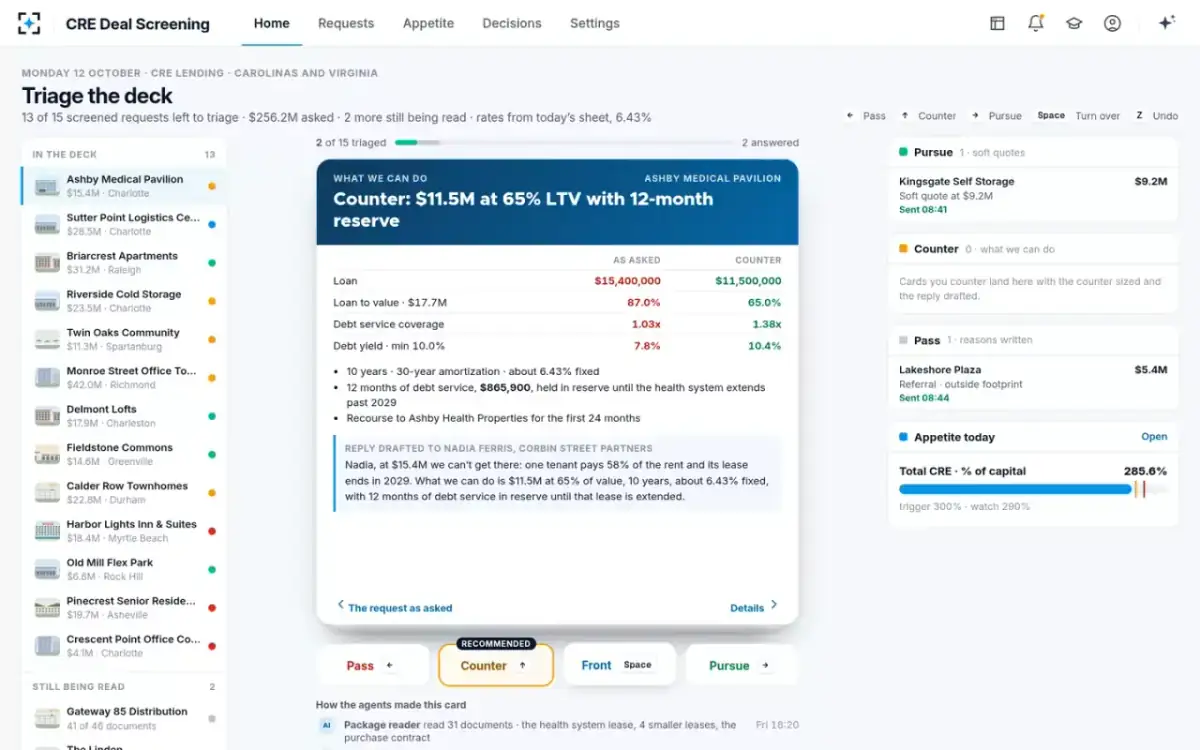
Turned over, the same request shows the loan that stays inside both lines: $11.5 million at 65% of value, which keeps it out of the bank's exception count altogether rather than spending part of the 30% bucket on it.
The counter that keeps the loan inside the bank's limit and out of the exception bucket
Internal LTV limits vs supervisory LTV limits
A bank's own limits are where the work happens; the supervisory limits are the line its own limits may not cross. The guidelines expect internal limits to reflect the bank's market and portfolio, and lower ones for riskier subcategories. Research gives a reason to set them by structure as well as by property type: Federal Reserve economists find bank recourse loans carry "loan-to-value ratios that are around 3 percentage points higher than non-recourse loans" (FEDS 2021-079), and that higher LTVs are associated with increased delinquency risk, "particularly for office loans" (FEDS 2024-072).
Supervisory LTV limits against one bank's internal limits
Supervisory ceiling: 85% improved property
The sample bank's internal limit: 70% on the bank's value at its own cap rate; non-recourse only to 65%
Supervisory ceiling: 85% improved property
The sample bank's internal limit: 65%
Supervisory ceiling: 80%
The sample bank's internal limit: Set lower by property type; draws limited to work in place
Supervisory ceiling: 65%
The sample bank's internal limit: Usually lower, or not offered
Supervisory ceiling: An exception, counted against 100% and 30% of total capital and reported quarterly
The sample bank's internal limit: A policy exception needing a named structure and approval, flagged at the first look
The gap between the two columns is the bank's margin for error. On the sample bank's industrial settings, a property whose value falls 18% after closing at 70% would still sit at the 85% ceiling; one closed at 85% has no margin at all. For how loan to value sits among the other two sizing tests, see the lesser of three tests.
Questions people ask
What is the supervisory LTV limit for raw land?
65%. Land development, the work of putting in streets, sewers and utilities before buildings, is 75%. A loan that funds several phases takes the limit of the final phase it funds.
What is the supervisory LTV limit for commercial real estate?
85% for completed, income-producing commercial property (improved property) and 80% for commercial, multifamily and other nonresidential construction. Most banks set internal limits well below 85%.
Are supervisory LTV limits the same at the FDIC and OCC?
Yes. The OCC (12 CFR 34, subpart D), FDIC (12 CFR 365) and Federal Reserve (12 CFR 208) adopted the same Interagency Guidelines; only the definition of total capital for the exception caps follows each agency's capital rules.
Does a refinance count as a supervisory LTV exception?
A renewal, refinancing or restructuring without new funds beyond reasonable closing costs is excluded from the limits, as are documented workouts. A cash-out refinance advances new funds and is tested like a new loan.
How often must supervisory LTV exceptions be reported to the board?
At least quarterly, in aggregate, with significant exceptions reported individually. The OCC lists "Supervisory LTV exceptions" among the CRE reports management and boards typically review.