In place vs pro forma is the difference between income a commercial property earns now and income it is projected to earn: in-place NOI starts from the current rent roll and actual operating statements, while pro forma NOI adds rent for vacant space as if leased, renewals priced at market before anyone signs, rent growth and often thinner vacancy and expense assumptions. Brokers and sellers lead with pro forma because it supports a higher price and a bigger loan. Banks size loans on an underwritten NOI built from rents in place, because the OCC lists "projections that rely on speculative or unrealistic assumptions relative to current market conditions such as higher than current rents or occupancy rates" among the signs of weak underwriting. Botminds' CRE Deal Screening rebuilds every loan request's income from the rent roll in place and the trailing-12, and shows the bridge from the memo's figure to the bank's.
The worked example is a fictional sample request, a $28.5 million refinance of two multi-tenant industrial buildings, at a sample bank as it runs through the solution. Supervisory and rulebook text is quoted and linked where it appears.
Where the memo's $2.70 million of NOI goes: 86% is in place, 14% is not the bank's
Memo pro forma NOI, $2,700,000
- Supported by leases and history · 85.6%
- Vacant suite leased in the memo · 6.7%
- Renewals priced before signing · 2.9%
- Bank's vacancy, management and reserve floors · 4.9%
What is the difference between in place and pro forma?
In place describes what is true today: tenants in occupancy, rents in their leases, the operating history in the statements. Pro forma describes a projected year: vacancies leased, below-market leases renewed at market, rents grown, expenses normalised. Both are legitimate tools. They answer different questions, and only one is evidence.
In-place NOI and pro forma NOI, line by line
In place: Contract rent in today's leases
Pro forma: Often marked to market at the next renewal, signed or not
In place: Earns nothing
Pro forma: Leased at an assumed rent from an assumed date
In place: Actual, or the lender's floor if higher
Pro forma: Often a thin market figure applied to a full building
In place: Market fee, even if the owner self-manages
Pro forma: Often the owner's actual fee, or none
In place: Imputed whether funded or not
Pro forma: Often left out
In place: Rent roll, leases, trailing-12, statements
Pro forma: The broker's or seller's assumptions
What is pro forma NOI, and what is a pro forma rent roll?
Pro forma NOI is a projected net operating income for a future year under stated assumptions; a pro forma rent roll is the tenant schedule those assumptions produce, with vacant suites filled and renewals repriced. In an offering memorandum both are usually presented beside, or instead of, the actual figures, and the summary page's NOI and cap rate are typically pro forma.
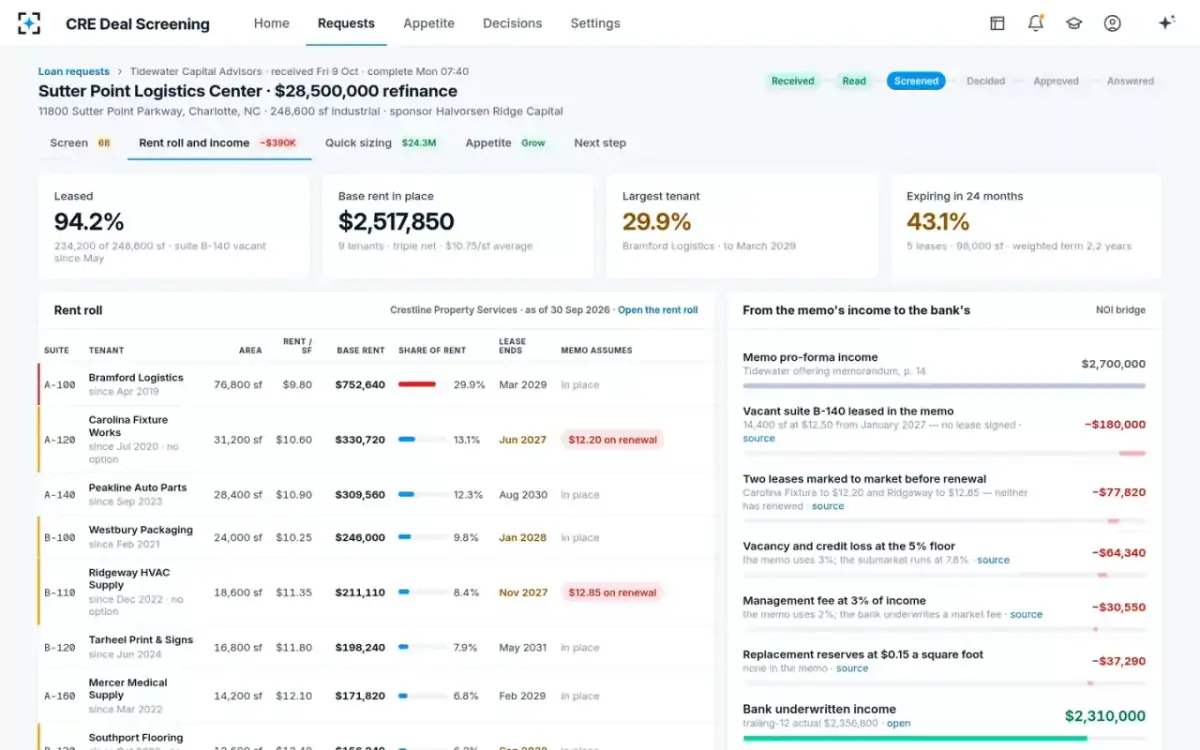
The tell is in the detail. On the sample memo, suite B-140 is shown at $12.50 a square foot from January 2027, while the rent roll shows it vacant since May with no lease signed: 14,400 square feet and $180,000 of income that does not exist yet. Two tenants whose leases end in 2027 are shown at higher renewal rents, $12.20 and $12.85 a foot; neither has an option, and neither has renewed. That is $77,820 more.
From the memo's income to the bank's: the in-place bridge, step by step
| Step | What changes | Effect |
|---|---|---|
| Memo pro forma NOI | As presented in the offering memorandum | $2,700,000 |
| Vacant suite B-140 leased in the memo | 14,400 sf at $12.50 from January 2027; no lease signed | −$180,000 |
| Two renewals marked to market | Repriced to $12.20 and $12.85 before either tenant renewed | −$77,820 |
| Vacancy and credit loss at the 5% floor | The memo used 3%; the submarket runs at 7.8% | −$64,340 |
| Management fee at 3% of income | The memo used 2%; the bank underwrites a market fee | −$30,550 |
| Replacement reserves at $0.15 a square foot | None in the memo | −$37,290 |
| Bank underwritten NOI | Trailing-12 actual for comparison: $2,356,800 | $2,310,000 |
Two things stand out. The bank's figure is slightly below the trailing-12, not far below it: the in-place rebuild is not a punishment, it is a return to what the property has actually been earning, plus reserves and a market fee. And the biggest single item is a vacant suite, which is exactly the OCC's "higher than current … occupancy rates".
Do lenders underwrite pro forma rents?
Banks generally do not size a permanent loan on them. The OCC's guidance is that NOI analysis should be challenged where it is weak, "Inadequately supported or questionable analysis should be challenged", and that "An important objective of the underwriting process is to develop an NOI that represents a stabilized estimate of income and expenses" (OCC, Commercial Real Estate Lending). Stabilized is not the same as pro forma: it means a sustainable year, with a vacancy factor that "should consider vacancies in comparable properties in the same market".
Rulebook lenders spell it out. Fannie Mae's multifamily guide starts gross rental income from "actual rents in place for occupied units, plus market rents for vacant units based on a current rent roll", then deducts the vacant units' rent again as physical vacancy, and requires vacancy, concessions and bad debt together to equal at least "5% of GPR" or the gap between gross potential rent and the trailing three months' actual collections, whichever is greater (Fannie Mae Multifamily Guide, Section 203). Market rent for vacant space appears on the page and then comes straight back off it.
The guide goes further on recent trends: if net rental income over the trailing three months has fallen more than 2% against the trailing six or twelve, the lender "must adjust the NRI downward to an amount that is 2% less than the lowest NRI" for those periods. Pro forma looks forward; the rulebook looks at the latest months first.
In place cap rate vs pro forma cap rate: the same building, two values
A cap rate applied to pro forma NOI produces a pro forma value, and a loan-to-value ratio measured against it looks lower than it is. On the sample request the memo capitalised its $2.70 million at 6.45%, a value of $41.86 million, against which the $28.5 million ask is 68%. The bank capitalised its own $2.31 million at 6.50%, the midpoint of its market file's 6.25% to 6.75% range for the submarket, a value of $35.54 million, against which the same ask is 80.2%.
One request measured on the memo's numbers and on the bank's
| Measure | On the memo's pro forma | On the bank's in-place figures |
|---|---|---|
| NOI | $2,700,000 | $2,310,000 |
| Cap rate | 6.45% | 6.50% |
| Value | $41.86M | $35.54M |
| $28.5M ask as loan to value | 68.1% | 80.2% |
| $28.5M ask: coverage at 6.43%, 30 years | 1.26x | 1.08x |
| $28.5M ask: debt yield | 9.47% | 8.11% |
| Most the bank's tests allow | about $28.4M | $24.3M |
On the memo's numbers the request almost passes every test, which is why it was asked at that amount. On the bank's it fails all three. The distance between the two columns is the pro forma. The lesser-of-three sizing method explains why the bank's loan lands at $24.3 million rather than at any one test's figure.
Why is pro forma income higher than actual?
Because it is built to describe the property after the things that would improve it have happened, and in 2025 fewer of those things were happening on schedule. The FDIC's 2026 Risk Review found that across commercial property "net operating income growth continued to slow, reflecting elevated vacancy rates, higher property operating costs, and tepid rent growth" (FDIC, 2026 Risk Review). A pro forma that assumes vacancies fill and renewals step up is betting against that.
There is a structural reason too. A seller's income figure sets the price, and a broker's sets the loan, and both are paid on closing. None of that makes a pro forma dishonest. It makes it the opening position in a negotiation, and a bank that sizes on it has accepted the other side's opening position as its own credit analysis.
How to haircut a pro forma: rules a lender can write down
A good haircut is a set of rules applied the same way to every request, not a judgment made deal by deal. The sample bank's rules are its underwriting floors and its tenant rules, applied by the solution's income agent to every rent roll; the checklist generalises them.
Seven rules for turning pro forma NOI into lendable income
- Vacant space earns nothing until a lease is signed
A signed lease not yet in occupancy can count with a reserve; an assumed lease cannot.
- Renewals at contract rent until signed
Mark-to-market belongs in the upside case, not the sizing case.
- Vacancy at the higher of actual, market and the bank's floor
The sample bank uses 5%; Fannie Mae's multifamily floor is 5% of gross potential rent or the recent collections gap.
- A market management fee, whoever manages
The sample bank underwrites 3% even where the owner charges 2%.
- Reserves imputed whether funded or not
The OCC: the replacement reserve is imputed "irrespective of whether it is actually funded".
- Read the lease, not the label
The OCC warns that net lease terms "lack universally agreed-upon definitions"; the lease decides who pays.
- Check the latest months against the year
A trailing-3 below the trailing-12 is a reason to cut, as Fannie Mae requires for multifamily.
The rent roll in place beside the bridge from the memo's income
The in-place risk a pro forma hides: rollover and the largest tenant
In-place income is not the end of the analysis; it is income that has to survive the loan term. A pro forma rent roll usually shows every lease renewing, so it hides the two numbers a lender most needs from the rent roll in place: how much rent expires soon, and how much depends on one tenant.
On the sample request, 43.1% of base rent, five leases and 98,000 square feet, expires within 24 months, with a weighted remaining term of 2.2 years. The largest tenant pays 29.9% of base rent on a lease to March 2029, inside a ten-year loan. The sample bank's credit box flags any request where more than 35% of base rent rolls within 24 months, and any single tenant above 25%; each flag calls for a named structure. Here that meant the $250,000 leasing reserve and the cash trap tied to the largest tenant's renewal. Neither changes the loan amount; both protect the in-place income the loan was sized on. A pro forma that assumed every renewal at market would have shown none of this.
When pro forma income is legitimate: structure instead of size
Pro forma is the right lens for lease-up, construction and repositioning, where the whole point is income that does not exist yet. The OCC expects lenders on those loans to compare "actual lease rates and other key terms with the underwriting pro forma projections" as leasing proceeds. Even then, the projected income is usually handled with structure rather than loan size: a reserve, an earn-out or a cash trap that releases money as the projected income becomes real.
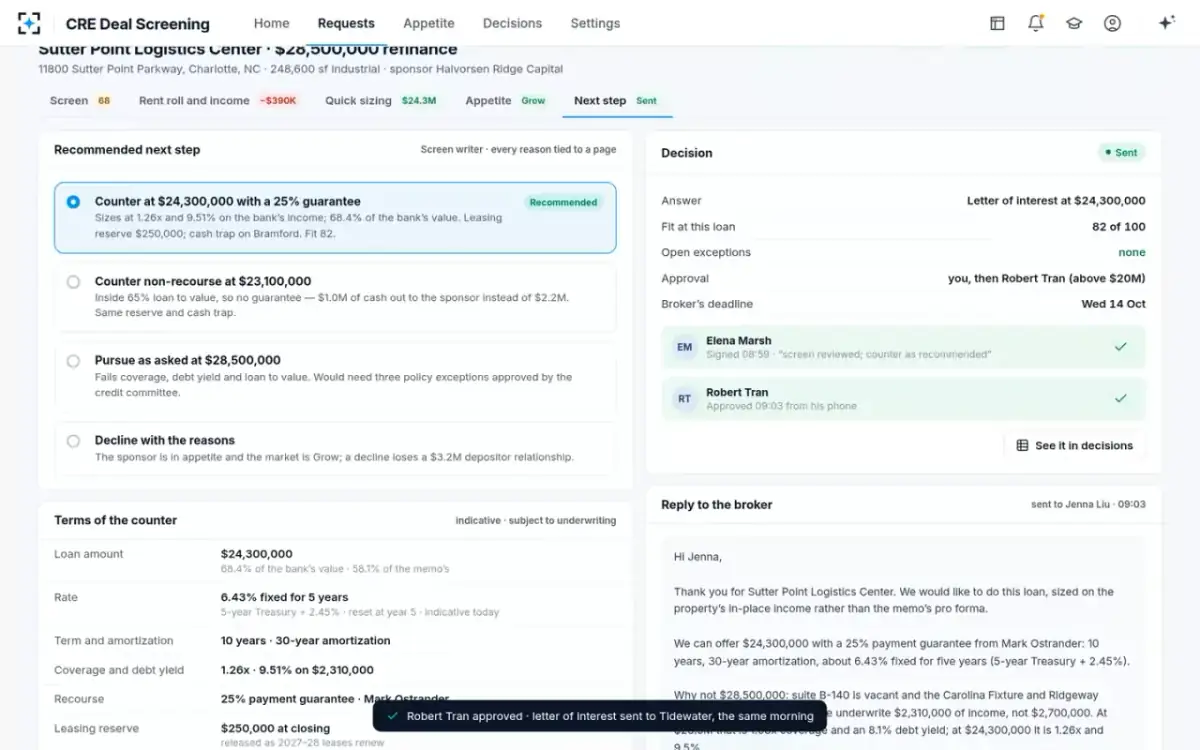
The sample bank did that with the parts of the memo's story it found plausible. Its counter at $24.3 million came with a $250,000 leasing reserve released as the 2027–28 leases renew, and a cash trap if the largest tenant, paying 29.9% of base rent, has not renewed by 31 March 2028. If the vacant suite leases and the renewals sign, the borrower can come back with the leases and ask for more; the bank will have the evidence the memo did not.
The reply to the broker says why, in plain words
Questions people ask
What does in-place NOI mean?
Net operating income on the leases and expenses a property has today: contract rents from current tenants, nothing for vacant space, and actual operating costs. A lender's underwritten NOI starts there and adds its own vacancy, management and reserve assumptions.
Is pro forma NOI the same as stabilized NOI?
No. Stabilized NOI is a sustainable year at normal occupancy with market vacancy and reserves, which the OCC describes as the objective of underwriting. Pro forma NOI is a projection that may assume lease-up, renewals at market and rent growth that have not happened.
What is the difference between an in-place cap rate and a pro forma cap rate?
An in-place cap rate divides current NOI by the price; a pro forma cap rate divides projected NOI by the same price, so it looks higher. On the sample request the memo's pro forma gave a $41.86 million value; the bank's in-place figures gave $35.54 million.
Can a bank lend on pro forma income for a value-add deal?
It can lend against a business plan, but usually sizes on in-place income and uses structure, such as reserves, earn-outs or a later upsizing once leases are signed, for the rest. Loans above the bank's own limits become documented policy exceptions, which interagency guidance expects to be limited and reported.
How much should you haircut a pro forma?
There is no standard percentage; haircut the assumptions, not the total. Remove rent for unsigned space and unsigned renewals, apply the lender's vacancy, management and reserve floors, and compare with the trailing-12. On the sample request that removed 14.4% of the memo's NOI, and left the bank's figure within 2% of the trailing-12.