A DSCR loan sizing calculator finds the largest loan a property's net operating income can carry: divide the NOI by the minimum debt service coverage ratio to get the most the borrower may pay each year, then divide that by the loan constant, the annual payment per dollar borrowed at the given rate and amortization. On $2.31 million of NOI, a 1.25x minimum and a 6.43% rate over 30 years, that is $2.31 million ÷ 1.25 ÷ 7.53% = about $24.54 million. A calculator, a spreadsheet and a set of agents all do that division correctly; they differ in everything around it, which is where a commercial real estate lender's real cost and risk sit. Botminds' CRE Deal Screening sizes every loan request on three tests at today's rate sheet and keeps the reasons, and this guide sets out what each option leaves the bank to own.
The worked figures come from a fictional sample bank, a CRE lending team in the Carolinas and Virginia, sizing a $28.5 million industrial refinance in the solution. Rules are quoted from the regulator and linked where they appear.
How to calculate the maximum loan amount from DSCR, in four steps
| Step | Formula | Sample refinance |
|---|---|---|
| 1. Net operating income | income in place − vacancy − operating expenses − reserves | $2,310,000 on the bank's floors, not the memo's $2,700,000 |
| 2. Most the property can pay | NOI ÷ minimum DSCR | $2,310,000 ÷ 1.25 = $1,848,000 a year of debt service |
| 3. Loan constant | annual payment per $1 borrowed at the rate and amortization | 6.43%, 30 years: 0.0753, or 7.53% |
| 4. Maximum loan on DSCR | step 2 ÷ step 3 | $1,848,000 ÷ 0.0753 = $24,540,000, before the other two tests |
How to calculate loan amount from DSCR
Maximum loan = NOI ÷ (minimum DSCR × loan constant). The ratio itself is defined by the OCC as "calculated by dividing the NOI by the annual debt service requirements" (OCC, Commercial Real Estate Lending), and sizing simply runs that definition backwards: fix the ratio at the bank's minimum and solve for the debt service, then for the loan.
The loan constant is where most hand calculations go wrong. It is not the interest rate; it includes principal. At 6.43% over 30 years it is 7.53%, over 25 years 8.05%. Use the interest rate alone and the calculator sizes an interest-only loan, which the OCC says should not be done: "Even if the terms of a loan permits interest-only payments, the property should nonetheless meet the bank's repayment capacity (debt service coverage) requirements as though the loan were amortizing".
Loan constants at common rates, and what $1 million of NOI supports at a 1.25x minimum
| Rate | Constant, 30-year | Constant, 25-year | Max loan per $1M NOI, 30-year | Max loan per $1M NOI, 25-year |
|---|---|---|---|---|
| 5.00% | 6.44% | 7.02% | $12.42M | $11.40M |
| 6.00% | 7.20% | 7.73% | $11.12M | $10.35M |
| 6.43% | 7.53% | 8.05% | $10.62M | $9.94M |
| 7.00% | 7.98% | 8.48% | $10.02M | $9.43M |
| 7.50% | 8.39% | 8.87% | $9.53M | $9.02M |
Why do two lenders size the same deal differently?
Because the formula has four inputs and lenders choose every one: the income, the minimum ratio, the rate and the amortization. The arithmetic is identical everywhere; the inputs are policy. Federal Reserve stress-test documentation notes that "lenders generally require a minimum DSCR between 1.2 and 1.5 to qualify for a loan", depending on property type, collateral, borrower and market (Federal Reserve, Credit Risk Models), and that range alone moves the answer by a fifth.
Income is the input that moves most, and the one a calculator never questions. The same refinance, the same 1.25x and the same rate give three different answers depending on which income is typed in.
The same DSCR calculator, three incomes, three loans
The first bar is close to the broker's ask, and that is not a coincidence: a broker who sizes the loan on the memo's income gets the memo's loan. The gap between the first and third bars is one vacant suite the memo leases, two renewals priced before signing, and the bank's vacancy, management and reserve floors, all explained in the guide to in-place and pro forma income.
Is a DSCR calculator enough for a credit decision?
No. Coverage is one of the standards a bank's policy has to set, not the only one. The Interagency Guidelines require "Minimum standards for net worth, cash flow, and debt service coverage" alongside "Loan-to-value limits by type of property" and limits on non-amortizing loans and recourse (12 CFR 34, Appendix A), and the OCC adds minimum debt yield and maximum tenor to the list.
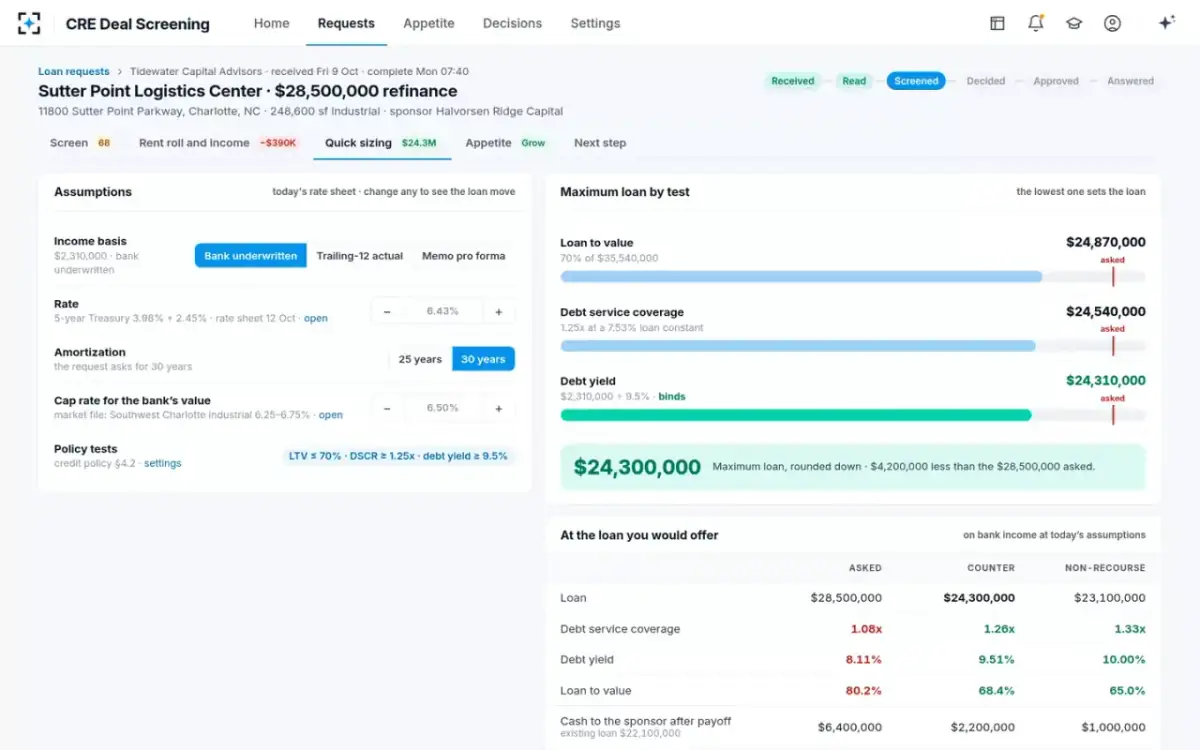
The OCC's description of debt yield explains why coverage alone is dangerous: loan amounts set by DSCR and LTV "may be prudent only as long as the low rate environment is sustained". On the sample refinance, coverage alone allows $24.54 million; debt yield binds at $24.31 million, and at a 5% rate coverage would allow $28.7 million while debt yield still holds the loan at $24.3 million. A coverage-only calculator would have sized that loan on today's rate and left the refinance risk for the day it matures. Debt yield against DSCR works through when each one binds.
Calculator, spreadsheet or agents: what each leaves the bank to own
All three get the division right. The difference is how much of the surrounding work each one takes on, and how much it leaves with people who are also answering brokers.
Three ways to size CRE loan requests, and what each leaves the lender owning
| Online DSCR calculator | The bank's sizing spreadsheet | CRE Deal Screening | |
|---|---|---|---|
| Tests it sizes on | Coverage, sometimes LTV | Whatever the template holds: usually coverage, LTV and debt yield | Coverage, LTV and debt yield; takes the least, shows which binds, rounds down |
| Income it is fed | Whatever is typed in | Retyped from the memo, rent roll and trailing-12 by an analyst | Rebuilt from rents in place and the trailing-12 on the bank's floors, each step tied to its page |
| Rate | Typed in | Typed in; goes stale with the sheet | Today's rate sheet; open requests re-sized each business morning |
| Policy and appetite | None | Checked separately, often from memory | Every policy rule, footprint, appetite and concentration headroom |
| Counter structure | None | Worked out by hand | Proposed for each exception: smaller loan, guarantee, reserve, cash trap |
| Changes to the standards | Not applicable | Anyone with the file; versions multiply | Versioned settings, second person required, kept on the audit trail |
| The written reason for a no | None | An email, if anyone writes one | Kept for every pursue, counter and decline, with the policy clause |
The spreadsheet is the incumbent at most banks, and it deserves credit: it is transparent, cheap and under the bank's control. Its weakness is not arithmetic. It is the analyst-hours spent feeding it, the copies that drift apart, and the fact that it says nothing about whether the bank wants the deal. Under the 2026 interagency model risk guidance, ordinary spreadsheet arithmetic is outside the definition of a model (OCC Bulletin 2026-13), so nothing in model governance will catch a stale template either.
Why a loan sized last month can fail coverage today
A sizing number is only true at the rate it was sized on. Coverage depends on the payment, and the payment depends on the rate, so a quote sized on one rate sheet can fail the minimum by the time it reaches credit if the index has moved. A calculator has no way to know; a spreadsheet knows only if someone re-opens it.
The same $24.3 million loan, the same income, coverage at three rates
That is why the sample bank's open requests are re-sized at 07:00 every business day from the daily rate sheet, index plus spread, and why a reply quotes a rate as indicative. It is also why debt yield sits beside coverage in the bank's policy: it is the one test that does not move with the sheet, so a loan that clears it has a floor under it when rates rise between the quote and the closing.
What does commercial underwriting software cost against a spreadsheet?
No public source prices CRE underwriting software, and list prices vary by bank size and scope, so compare costs in hours rather than in a vendor's quote. The cost of the spreadsheet route is mostly people: the first looks given to requests that will be declined, the retyping, and the answers that arrive after the broker has gone elsewhere.
A frame for the full cost of sizing CRE requests by hand
First-look hours
requests a month × hours per first look × loaded hourly cost
At the sample bank's pace, about 72 requests a month. Our estimate of 2 to 3 hours each by hand is 144 to 216 hours.
Head of CRE lending
Rework from wrong inputs
deals re-sized after underwriting × hours to re-size and re-quote
Memo income carried into a term sheet, then cut in underwriting.
Credit
Deals lost to slow answers
good requests lost × expected relationship value
The hardest term to measure and often the largest.
Relationship managers
The tool
subscription + set-up + the bank's review hours
Including the pilot on the bank's own packages.
Operations and IT
Put the bank's own numbers in each term and the decision usually turns on the first and third. If first looks are few and slow answers rarely lose a deal, a well-kept spreadsheet is the right tool. If the desk sees dozens of requests a month and brokers shop them, the hours and the lost deals dominate.
What a screen adds that no calculator has: the reason for every answer
A calculator produces a number; a credit decision needs a reason. Banks must "document how the transaction does not conform" for every exception they grant, and a decline, once a request is an application, carries Regulation B duties: for a business with revenue over $1 million, notice of the action and, if the applicant asks in writing within 60 days, a written statement of the reasons (12 CFR 1002.9(a)(3)).
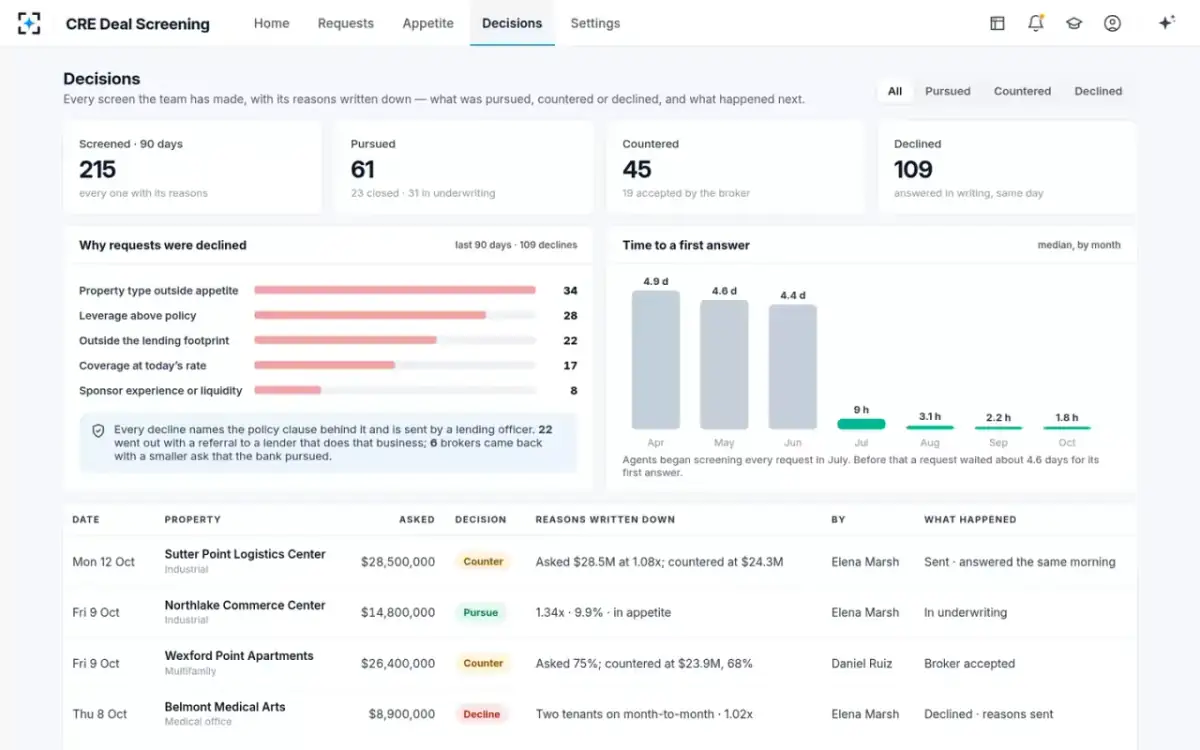
That is the work a calculator leaves entirely to people. At the sample bank, every screen keeps its reasons and the policy clause behind them, and the decisions view counts declines by reason: 34 for property type outside appetite, 28 for leverage above policy, 22 outside the footprint, 17 on coverage at today's rate and 8 on the sponsor, out of 109 in 90 days. Those 17 coverage declines are the only ones a DSCR calculator could have produced.
Why requests were declined, counted: coverage is one reason in five
Sizing in CRE Deal Screening: three tests, the binding one marked, and every input adjustable
Before you choose a sizing tool: a checklist
Whatever the route, the same questions decide whether a sizing number can be trusted. These are the ones to answer before committing to any of the three.
Seven questions to ask of any DSCR loan sizing calculator, spreadsheet or software
- Does it use the loan constant, not the rate?
An interest-only payment sizes a bigger loan than the OCC says a bank should.
- Does it size on all three tests and take the least?
Coverage, loan to value and debt yield; the binding one tells you what the bank is exposed to.
- Which income is it fed, and who rebuilt it?
Memo, trailing-12 or the bank's underwritten NOI. A 17% gap in income is a 17% gap in the loan.
- Is the rate today's?
A quote sized on last month's sheet can fail coverage by the time it reaches credit.
- Are the minimums the bank's, and who can change them?
Versioned, approved by a second person, visible after the fact.
- Does it round down and say so?
The sample bank rounds to the lower $100,000 so no quote exceeds the tests.
- Does it keep a reason for every no?
The decline reasons are what an examiner and the head of lending will ask for.
Questions people ask
How do you calculate the maximum loan amount using DSCR in Excel?
Use =PV(rate/12, years×12, −NOI/DSCR/12). With $2,310,000 of NOI, a 1.25x minimum, 6.43% and 30 years, that returns about $24.54 million. Remember it is coverage only; a bank then checks loan to value and debt yield and takes the lowest.
What is a loan constant in commercial real estate?
The annual debt service per dollar of loan, including principal: at 6.43% over 30 years it is 7.53%. Dividing NOI by the DSCR minimum and then by the constant gives the maximum loan on coverage.
Should a DSCR calculator use pro forma income?
Not for a bank. The OCC lists projections relying on "higher than current rents or occupancy rates" as an underwriting weakness. On the sample refinance, pro forma income sized a loan $4.15 million larger on coverage than the bank's own income did.
Does amortization change the DSCR loan amount?
Yes, a lot. At 6.43%, $1 million of NOI supports about $10.62 million over 30 years and $9.94 million over 25 at a 1.25x minimum. Interest-only terms should still be sized as if amortizing, the OCC says.
Is a DSCR loan sizing calculator accurate?
The arithmetic is exact. The answer is only as good as the income, rate, amortization and minimum typed in, and it tests one of the three ratios a bank's policy sets.