Debt service coverage ratio minimum requirements for commercial real estate are set by each bank, not by regulators: the interagency real estate lending standards require a bank's board-approved policy to establish "minimum standards for net worth, cash flow, and debt service coverage of the borrower or underlying property", and leave the level to the bank (12 CFR Part 34, subpart D, Appendix A). In practice the Federal Reserve's own stress model describes lenders as generally requiring a minimum between 1.2x and 1.5x, higher for volatile property. For a chief credit officer, the harder work is not choosing 1.20x or 1.25x but defining what the ratio is measured on (whose income, which payment, which rate) and making the floor hold on every request, including the ones a lending officer answers in an afternoon. Botminds' CRE Deal Screening applies the bank's own floor, by property type and on the bank's own definitions, to every loan request before anyone replies to the broker.
The worked figures come from a fictional sample bank, a commercial real estate lender in the Carolinas and Virginia, as it runs through the solution. The rules and research are real and linked where they appear.
What the Federal Reserve's own CRE model assumes about coverage
1.2–1.5x
the minimum DSCR lenders "generally require" to qualify for a loan
1.2x
"a typical minimum underwriting threshold"
×4
uplift to projected default risk for income loans nearing maturity below 1.2x
Where do debt service coverage ratio minimum requirements come from?
From the bank's own real estate lending policy, which the regulation requires and the board must approve at least annually. Part 34 says the policy must be "reviewed and approved by the bank's board of directors at least annually" and must establish "prudent underwriting standards, including loan-to-value limits, that are clear and measurable". Its appendix lists coverage among the standards the policy should address, beside equity, non-amortizing loans, interest reserves and pre-leasing. Loan to value gets supervisory numbers; coverage does not.
That asymmetry is deliberate and it puts the burden on the bank. An examiner reviewing a CRE book does not ask whether 1.25x is the right number in the abstract. The examiner asks whether the bank set a number that fits its book, wrote down what it means, applied it consistently, and governed the exceptions. A minimum that exists only in lending officers' heads, or one applied to whatever income each memo chose, fails the "clear and measurable" test whatever its level.
What should a bank's DSCR minimum depend on?
On how much the income can move and how fast the loan pays down. The OCC puts it plainly: "The determination of an appropriate DSCR should consider the loan amortization period and the expected volatility of the cash flow. In some cases, a lower DSCR may be a prudent trade-off for a shorter amortization period or appropriate for properties with stable and certain cash flows, such as those with long-term net leases to highly creditworthy tenants. Properties that have volatile cash flows, such as hotels or owner-occupants with uneven earnings, may warrant a higher ratio" (OCC Comptroller's Handbook, Commercial Real Estate Lending).
A policy that follows that guidance has a schedule, not a single figure: a core minimum, and property types that sit above or below it for stated reasons. The reasons belong in the policy too, because they are what lets a credit committee decide whether a particular building, a net-leased warehouse with nine years left on a strong tenant's lease, say, belongs in the lower row or is an exception.
What pushes a bank's DSCR minimum up or down, by property type
| Property | What drives the minimum | Direction against the core minimum |
|---|---|---|
| Stabilized multifamily | Many small leases, short terms, steady demand | At or below the core minimum |
| Industrial, multi-tenant | Lease rollover and the largest tenant's share of rent | At the core minimum; higher with heavy rollover |
| Single-tenant net lease | The tenant's credit and lease term beyond the loan | Can be lower: the OCC's "long-term net leases to highly creditworthy tenants" |
| Grocery-anchored retail | Anchor lease term and co-tenancy clauses | At or slightly above |
| Office and medical office | Large tenants, expensive re-leasing, vacancy | Above |
| Hotel | Income re-priced nightly; high operating leverage | Well above: the OCC's example of volatile cash flow |
Why 1.20x is where refinancing gets hard
Because most CRE loans end in a balloon that has to be refinanced, and the next lender applies its own minimum. The Federal Reserve's documentation notes that most loans on income property "are not fully amortizing and often have a significant balloon payment due at maturity", that the standard practice "is to roll this ballon payment over into a refinance loan", and that "lenders generally require a minimum DSCR between 1.2 and 1.5 to qualify for a loan (depending on various factors such as property type, collateral value, borrower creditworthiness, and market conditions)" (Federal Reserve, Credit Risk Models).
The supervisory model then does something a credit officer should notice: income-producing loans that "approach maturity with DSCR below 1.2 (a typical minimum underwriting threshold)" have their projected probability of default "adjusted upwards by a factor of four". The Federal Reserve is telling banks, in its own arithmetic, that the industry's floor is also its refinancing cliff. A bank that originates at 1.20x on today's rate has built a loan that sits on that cliff if rates rise or income slips before maturity, which is the argument for either a higher floor or a test at a stressed rate.
The definitions matter more than the number
A minimum is meaningless until the policy says which income, which payment and which rate it is tested on. Two banks with a 1.25x floor can lend very different amounts on the same building, and one bank can lend different amounts on the same building in the same week, if those three definitions are left to whoever writes the memo.
The income should be underwritten net operating income, not the broker's. The OCC says "an important objective of the underwriting process is to develop an NOI that represents a stabilized estimate of income and expenses", built from rents in place and actual history with the bank's own vacancy, management and reserve assumptions. The payment should be amortizing even where the loan is not, as the OCC's stress guidance below sets out; Fannie Mae's multifamily guide writes the same rule into its own sizing, on "a level debt service payment, including amortization", at the greater of the note rate and its underwriting rate floor, and for a loan with an interest-only period uses "the same level debt service payment, including amortization, regardless of the length of the interest-only period" (Fannie Mae Multifamily Guide, Section 203). And the rate should be the one the bank will actually quote on the day, or a stated floor above it.
One sample loan, one income, five coverage ratios: the policy definition decides
| Debt service defined as | Annual payment on $24.3M | DSCR on $2.31M of bank NOI |
|---|---|---|
| Interest only at 6.43% | $1,562,000 | 1.48x |
| Amortizing, 30 years at 5.00% | $1,565,000 | 1.48x |
| Amortizing, 30 years at 6.43% (the sample bank's policy) | $1,830,000 | 1.26x |
| Amortizing, 25 years at 6.43% | $1,956,000 | 1.18x |
| As asked: $28.5M, 30 years at 6.43% | $2,146,000 | 1.08x |
The table is the case for writing definitions into the policy rather than into training. An interest-only payment flatters coverage by 0.22x on this loan; a five-year-shorter amortization takes away 0.08x. Covenant coverage is a further definition again: the OCC notes that "debt-service coverage calculations for covenant compliance may differ from the DSCR used for underwriting", and a policy should say how, so a borrower is not tested on one basis at origination and another at the first annual review. The income side is taken apart line by line in in-place against pro forma NOI.
Should the DSCR minimum be tested at a stressed rate?
Yes: the OCC expects coverage to be examined under stress as well as at origination. Each underwriting factor "should be considered under both normal and stressed conditions", and "as real estate income and prices rise in periods of economic growth, capitalization rates, interest rates, and DSCRs should be stress-tested to determine whether a property will likely remain viable during a period of economic stress". A floor tested only at today's rate answers whether the loan works today, not whether it refinances.
The same handbook explains why the stress matters most on the loans that look best. Interest-only terms and long amortization "can decrease the likelihood of payment default by providing higher debt-service coverage", but "can increase the loss given default and the balloon or full repayment risk at maturity". Its remedy is a definition, not a number: even where a loan allows interest-only payments, "the property should nonetheless meet the bank's repayment capacity (debt service coverage) requirements as though the loan were amortizing". And it adds a warning that turns up in workout files years later: "a renewal, refinancing, or extension of a loan on an interest-only basis can indicate a troubled loan."
In practice a policy states two numbers: the floor at the quoted rate, and a lower floor at a stressed rate, for example 1.00x at a rate 200 basis points above the quote, both chosen by the bank. A request that clears the first and fails the second is not declined automatically; it is flagged, so the committee sees that the loan is rate-sensitive before it approves it rather than at the first renewal. The OCC's companion point, that loan amounts set by coverage and loan to value "may be prudent only as long as the low rate environment is sustained", is the reason the sample bank pairs coverage with a debt yield minimum that does not move with the rate.
What a step in the minimum costs in loan size
On a level-payment loan, every 0.05x step in the floor moves the maximum coverage-sized loan by about 4%. That is the commercial trade-off a credit committee is making when it sets the schedule, and it should be priced in dollars against the bank's pipeline, not argued in ratios.
The same income at six DSCR minimums: how much the bank can lend
Coverage is also only one of three sizing tests. The sample bank sizes each request on loan to value, coverage and debt yield and lends the least. On the industrial refinance, the 1.25x floor allowed $24.54 million but the 9.5% debt yield minimum allowed $24.31 million, so the counter was set by debt yield at 1.26x. A committee lowering its coverage floor in a high-rate year may find the loan size barely moves, because another test was binding; the crossover is worked through in debt yield against DSCR.
How should exceptions to the DSCR minimum be governed?
Loan by loan, with a written justification, an approver with authority and reporting the board can read as a trend. The interagency guidelines quoted in the OCC handbook allow "prudently underwritten exceptions to its lending policies ... on a loan-by-loan basis", require the board to establish "standards for the review and approval of exception loans", and say any such approval "should be supported by a written justification that clearly sets forth all the relevant credit factors that support the underwriting decision".
Examiners then read the exceptions as a signal about the policy itself. The handbook tells them to assess "the frequency and nature of policy exceptions" and warns that "an excessive or significantly increasing number of exceptions to the CRE lending policy could indicate that the bank is unduly relaxing its underwriting practices, needs to revise its loan policy, or that its policies are inconsistent with the board's risk tolerance". It adds that it is prudent to age exceptions "with sufficient stratification to identify trends in volumes, loan officer, and types". A coverage exception granted on an email and never coded as one is the version of that problem examiners find most often in file review, because it never reaches the report.
Six things a DSCR section of a CRE credit policy should state
- The minimum by property type, with the reason for each row
A core floor and the types above or below it, tied to cash-flow volatility and amortization as the OCC frames it.
- The income it is tested on
Underwritten NOI on rents in place and actual history, with the bank's floors for vacancy, management and reserves stated as numbers.
- The payment and the rate
Amortizing debt service even through an interest-only period, at the quoted rate or a stated underwriting floor, whichever is higher.
- A stress test beside the floor
Coverage at a higher rate or lower income, so a loan that clears 1.25x today is not on the 1.2x refinancing line at maturity.
- Who may approve a loan below it, and on what record
Named authority levels, a written justification of the credit factors, and an exception code that reaches the board report.
- How a change to the floor is made
In the policy, approved and dated by the board or its delegate, never by a run of exceptions that becomes the practice.
Do banks lower their DSCR minimums when competition rises?
They loosen standards with the cycle, and supervisors watch for it. In the Federal Reserve's July 2026 Senior Loan Officer survey, "moderate and modest net shares of banks reported having eased standards for loans secured by nonfarm nonresidential (NFNR) properties and multifamily properties, respectively", although banks still described CRE standards as "at the tighter end of the range" since 2005 (SLOOS, July 2026).
The last time competition ran hot, the agencies said so in writing: "The competition for loans has resulted in an easing of underwriting standards and increases in underwriting exceptions" (OCC Bulletin 2015-51). The two phrases in that sentence are different failures. Easing standards is a policy decision a board can make and defend. Increasing exceptions is the same easing made without a decision, one deal at a time, and it is the one that surprises a board when the exception report finally shows the trend.
Holding the floor at first look, not at credit committee
Most coverage problems are decided long before credit committee, in the hour a lending officer gives a broker a first answer. If that answer is made on the memo's income and an interest-only payment, the bank has signalled a loan size its policy will not support, and the choice later is between disappointing the sponsor and writing an exception. Screening each request against the policy's own definitions at intake moves the conversation to the start.
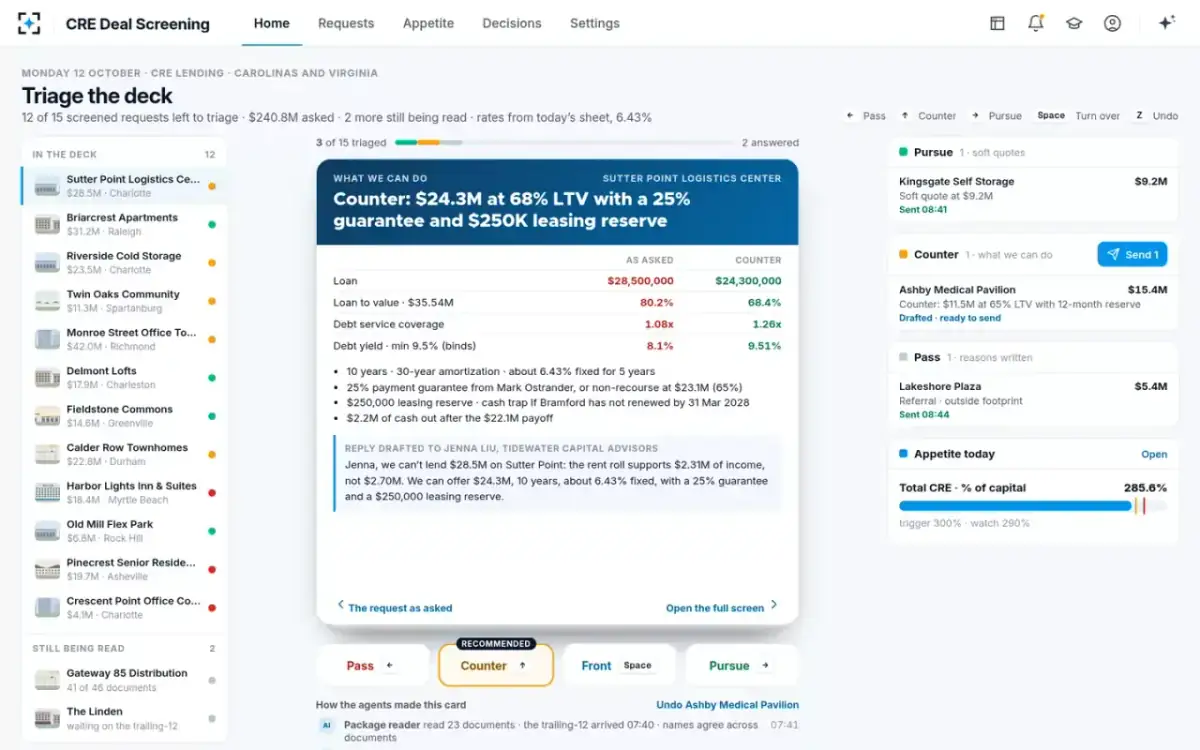
At the sample bank, CRE Deal Screening tests every request at the day's quoted rate on the bank's underwritten income, against the bank's minimum for that property type, alongside debt yield and loan to value. The industrial refinance above arrived asking for $28.5 million at 1.08x; the screen proposed $24.3 million with a guarantee and a leasing reserve in under two minutes, and the counter went to the lending officer and the head of CRE for signature. Over 90 days the sample bank screened 215 requests this way, pursuing 61, countering 45 and declining 109 in writing, each with the tests and reasons it was decided on.
As asked against the counter, every test at today's rate in CRE Deal Screening
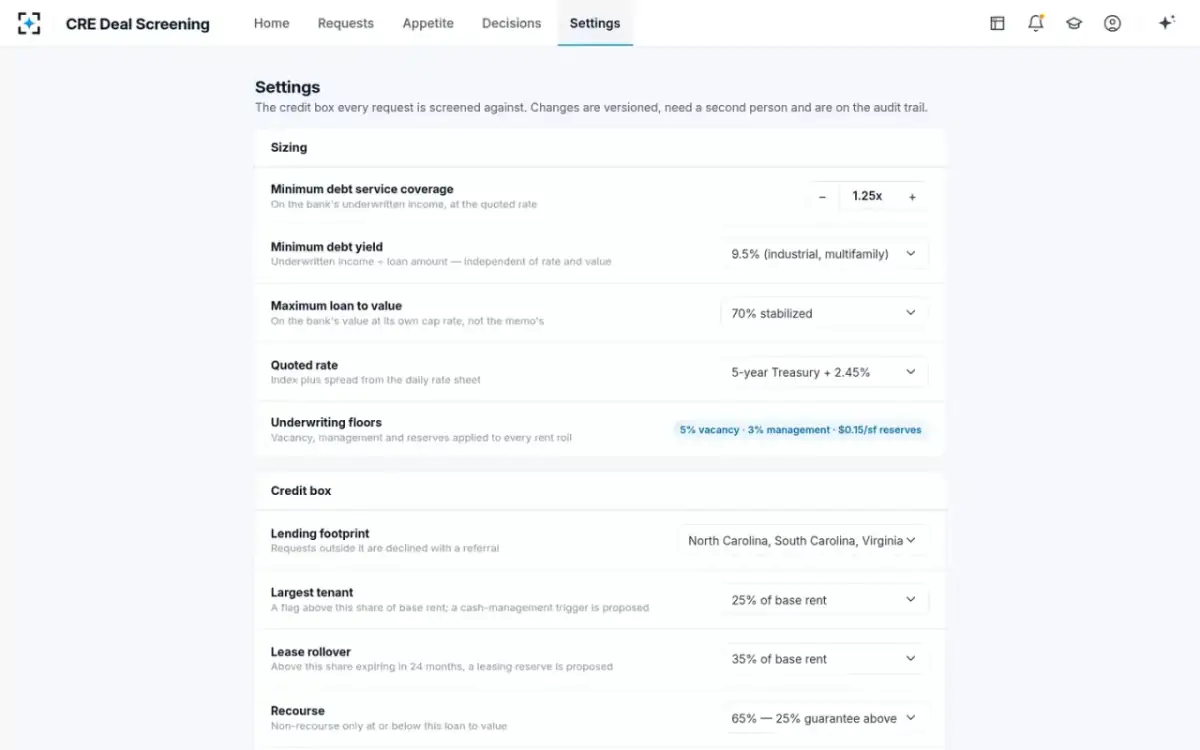
The DSCR floor as a versioned setting the credit officer controls
Where CRE Deal Screening fits, and what stays with credit
The solution's agents read the package, rebuild the income on the bank's floors, size the loan on each test at the day's rate, check the request against the bank's appetite by property type and market, and draft the counter or the decline with its reasons. A lending officer signs every reply, and anything outside the policy goes to the person with authority to approve it, carrying the screen's numbers with it. The floor, the definitions and the schedule stay where Part 34 puts them: with the board and the credit officers it delegates to.
What changes for a chief credit officer is the evidence. Every screened request, passed, countered or declined, keeps the coverage it was tested at and the policy version in force, so a question from an examiner about how consistently the minimum was applied has an answer drawn from every request rather than a sample of approved files. The full intake picture is in commercial real estate loan sizing; to see the screen on your own pipeline, start from CRE Deal Screening.
Questions people ask
Is there a regulatory minimum DSCR for commercial real estate loans?
No. The interagency real estate lending standards require each bank's policy to set minimum standards for debt service coverage, approved by the board at least annually, but give no number. Supervisory numbers exist for loan to value, not for coverage.
What minimum do most banks use?
The Federal Reserve's stress-test documentation describes lenders as generally requiring 1.2x to 1.5x, depending on property type, collateral value, borrower creditworthiness and market conditions, and calls 1.2x "a typical minimum underwriting threshold". Hotels and other volatile income sit at the top of a bank's schedule.
Should coverage be tested on interest-only payments?
A prudent policy says no: Fannie Mae's multifamily guide uses the same amortizing payment regardless of an interest-only period. On the sample loan above, an interest-only test shows 1.48x where the amortizing test shows 1.26x.
How many DSCR exceptions are too many?
No rule sets a count. The OCC tells examiners that an excessive or significantly increasing number of exceptions may mean the bank is relaxing its underwriting or that its policy no longer matches the board's risk tolerance, and expects exceptions to be aged and stratified by volume, loan officer and type.
Does a lower rate let a bank keep the same floor and lend more?
Yes, because the payment falls: the sample $24.3 million loan shows 1.26x at 6.43% and about 1.48x at 5%. That is why many banks pair coverage with a debt yield minimum, which does not move with the rate.
How often should the DSCR minimum be reviewed?
At least annually, because Part 34 requires the board to review and approve the real estate lending policy at least once a year. A rise in exceptions, a change in the bank's loss experience, or a move in rates large enough to change which sizing test binds are all reasons to revisit it sooner.