Debt yield and DSCR both measure a commercial real estate loan against the property's net operating income, but against different things: the debt service coverage ratio divides NOI by the year's loan payments, while debt yield divides NOI by the loan amount. So DSCR changes whenever the rate or amortization changes, and debt yield does not. The OCC puts it plainly: debt yield "provides a measurement of risk that is independent of the interest rate, amortization period, and capitalization rate". A lender sizes on both and lends the smaller result, so which one decides the loan amount depends on the rate: below a crossover rate debt yield binds, above it DSCR does. Botminds' CRE Deal Screening sizes every loan request on both, plus loan to value, at the day's rate sheet and marks which test binds.
The worked figures come from a fictional sample request, a $28.5 million industrial refinance, at a sample bank as it runs through the solution. Definitions and supervisory statements are quoted and linked where they appear.
Debt yield vs DSCR, side by side
Debt service coverage ratio (DSCR): NOI ÷ annual debt service
Debt yield: NOI ÷ loan amount
Debt service coverage ratio (DSCR): Yes: a higher rate raises the payment and lowers the ratio
Debt yield: No
Debt service coverage ratio (DSCR): Yes: a shorter schedule raises the payment
Debt yield: No
Debt service coverage ratio (DSCR): No
Debt yield: No
Debt service coverage ratio (DSCR): Income too thin to pay the loan at its own terms
Debt yield: Leverage that only works while rates and cap rates are low
Debt service coverage ratio (DSCR): $2.31M ÷ $1.83M of payments = 1.26x
Debt yield: $2.31M ÷ $24.3M = 9.51%
Debt service coverage ratio (DSCR): 1.25x
Debt yield: 9.5% for industrial and multifamily
What is the difference between debt yield and DSCR?
DSCR asks whether this loan, on these terms, can be paid from the property's income; debt yield asks how much income the property earns per dollar lent, whatever the terms. The OCC defines DSCR as "calculated by dividing the NOI by the annual debt service requirements" and debt yield as "the ratio of NOI to debt … calculated by dividing the NOI by the loan amount with the quotient expressed as a percent" (OCC, Commercial Real Estate Lending).
The two are linked by one identity that makes the comparison easy: DSCR equals debt yield divided by the loan constant, the annual payment per dollar borrowed. On the sample loan, 9.51% ÷ 7.53% = 1.26x. Debt yield is the part of coverage that belongs to the property; the loan constant is the part that belongs to the terms. That is why the two ratios disagree exactly when the terms are unusual: very low rates, long amortization or interest-only periods.
One identity links the two ratios on every loan
9.51%
debt yield on the sample loan: $2.31M of NOI ÷ $24.3M
7.53%
loan constant at 6.43% over 30 years
1.26x
DSCR = debt yield ÷ loan constant
Debt yield formula and DSCR formula, with the sample loan
Debt yield = NOI ÷ loan amount. DSCR = NOI ÷ annual debt service, where annual debt service = loan amount × loan constant. To size a loan, run each backwards: maximum loan on debt yield = NOI ÷ minimum debt yield; maximum loan on DSCR = NOI ÷ minimum DSCR ÷ loan constant.
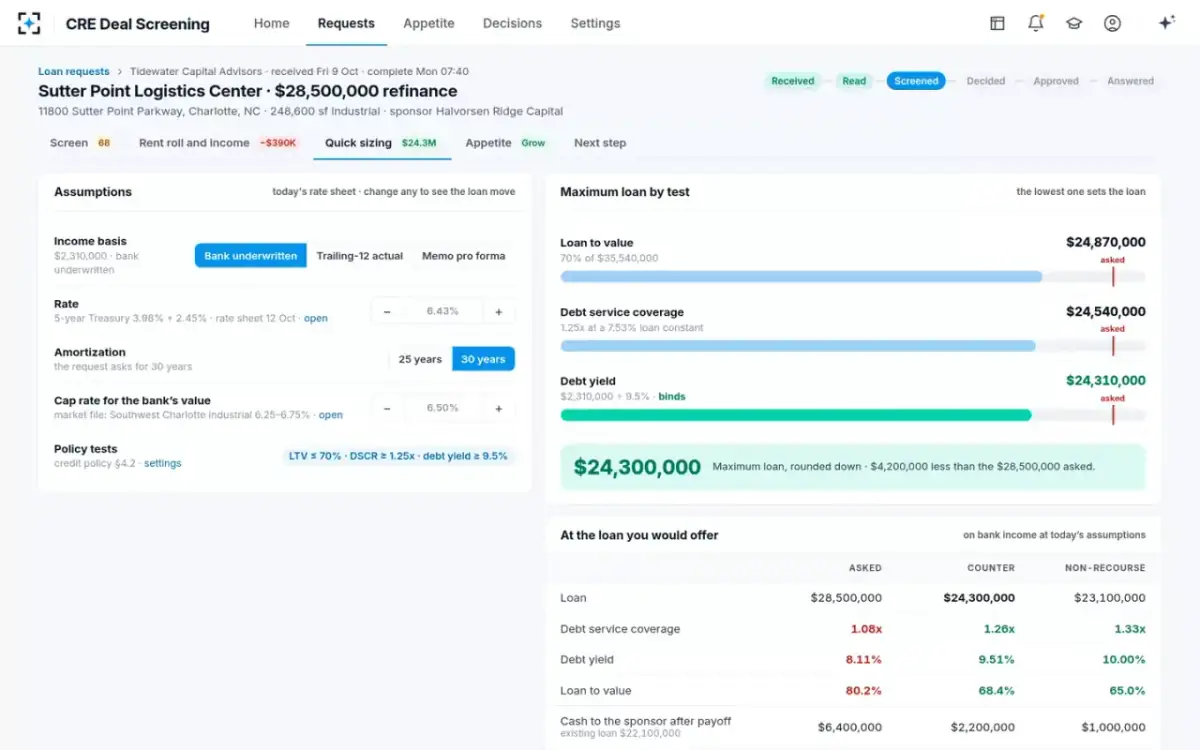
On the sample request the bank's income is $2,310,000 after rebuilding the memo's $2.70 million on rents in place and the bank's floors. Debt yield at 9.5% allows $24.31 million. Coverage at 1.25x and a 7.53% constant allows $24.54 million. Loan to value at 70% of the bank's $35.54 million value allows $24.87 million. Debt yield is lowest, so it decides: the loan is $24.3 million against $28.5 million asked. The lesser-of-three method covers the third test and the rounding.
Debt yield and coverage side by side on one request, with the binding test marked
Does DSCR change with interest rates?
Yes, and quickly. The same loan on the same income shows a very different coverage ratio as the rate moves, while its debt yield does not move at all. That is the whole case for keeping both tests.
The same $24.3 million loan on the same income: DSCR at six rates, debt yield at 9.51% throughout
Read the chart from the top and it explains the OCC's caution. At 4% the loan looks comfortably covered at 1.66x; a coverage-only lender in a 4% world would have lent far more than $24.3 million on this income, roughly $32 million at 1.25x. When that loan matured into a 6.43% world, the same income would cover the refinanced payment well under the minimum. The OCC's words: loan amounts set using DSCR and LTV "may be prudent only as long as the low rate environment is sustained", and "Debt yields that reflect normalized or higher-rate levels can be used to establish stressed loan amounts that are less vulnerable to higher-rate environments".
When does debt yield bind instead of DSCR?
Debt yield binds whenever the loan constant is below the minimum debt yield divided by the minimum DSCR. Above that constant, coverage binds. Because the constant depends on the rate and the amortization, every pair of minimums has a crossover rate, and a bank can read its own from the table.
The crossover rate: below it debt yield binds, above it DSCR does
| Minimum debt yield | With a 1.20x minimum | With a 1.25x minimum | With a 1.30x minimum |
|---|---|---|---|
| 8.0% | 5.30% (4.50%) | 4.94% (4.10%) | 4.60% (3.73%) |
| 9.0% | 6.39% (5.68%) | 6.01% (5.26%) | 5.65% (4.87%) |
| 9.5% | 6.92% (6.25%) | 6.52% (5.82%) | 6.15% (5.41%) |
| 10.0% | 7.43% (6.81%) | 7.02% (6.36%) | 6.64% (5.95%) |
Two readings follow. A bank whose debt yield floor crosses well above today's rates has made debt yield its working constraint, and its loans will not grow when rates fall. A bank whose floor crosses well below today's rates has a debt yield minimum that never binds, and is in practice a coverage lender. Neither is wrong; the point is to know which one the policy has chosen.
Why do lenders use debt yield, and why it matters for refinancing now
Lenders use debt yield because it is the one sizing test that does not depend on today's rate, which makes it the test that still holds when a loan has to be refinanced at a different one. The OCC calls it "a common metric to quickly size up a loan or assess its risk", recommends higher debt yields "for riskier properties", and adds that it "should be considered along with other criteria and loan amounts and be supported by prudent DSCR and LTV ratios" (OCC).
Refinancing is where the difference shows. The OCC's Spring 2026 risk report notes that "A substantial volume of CRE loans originated in a lower-interest environment will mature in the next several years and will need to be refinanced at prevailing rates" (OCC, Spring 2026). The Mortgage Bankers Association counts $875 billion of commercial and multifamily mortgages scheduled to mature in 2026 alone (MBA). A loan sized on coverage at a low rate meets its refinance with a debt yield that was never tested; a loan sized on both meets it with a floor under its income per dollar.
"Debt yield provides a measurement of risk that is independent of the interest rate, amortization period, and capitalization rate. Lower debt yields indicate higher leverage."
OCC, Comptroller's Handbook, Commercial Real Estate Lending
What is a good debt yield?
No regulation sets one; it is each bank's policy, by property type, and the OCC only says that debt yields "vary according to market conditions and property types, with higher debt yields recommended for riskier properties". In the sample bank's credit box the choices are 9.0%, 9.5% or 10.0%, with 9.5% for industrial and multifamily and 10.0% for medical office.
The useful way to judge a debt yield minimum is through the identity above. At a 9.5% minimum and a 7.53% constant, the implied coverage is 1.26x; at 8.0% it would be 1.06x, under almost any bank's coverage floor. A debt yield minimum that implies coverage below the bank's DSCR minimum at today's rate is doing no work today, and is there only for the day rates fall.
Interest-only and floating-rate loans: where DSCR flatters and debt yield does not
Interest-only terms and low floating rates both shrink the loan constant, and the identity shows what that does: coverage rises while debt yield stays put. On the sample loan, an interest-only payment at 6.43% would show 9.51% ÷ 6.43% = 1.48x against 1.26x amortizing. Nothing about the property changed; the ratio improved because the borrower stopped repaying principal.
Supervisors close that gap in two ways. For interest-only loans the OCC expects coverage measured "as though the loan were amortizing in a manner that is consistent with the bank's underwriting standards", and generally more conservative requirements than for amortizing loans. For any income property it expects "capitalization rates, interest rates, and DSCRs" to be stress-tested "to determine whether a property will likely remain viable during a period of economic stress" (OCC). Debt yield needs neither adjustment: it was never measured against the payment in the first place, which makes it the steadier test on floating-rate and interest-only loans.
What debt yield vs DSCR tells you about a request
Which test binds tells a lender what the request is closest to failing. When debt yield binds, the request is asking for more leverage per dollar of income than the bank accepts, whatever the rate. When DSCR binds, the payments are the problem: a longer amortization or a lower rate would help, and a higher rate would hurt. When loan to value binds, the property's value is the constraint, usually because the cap rate is high.
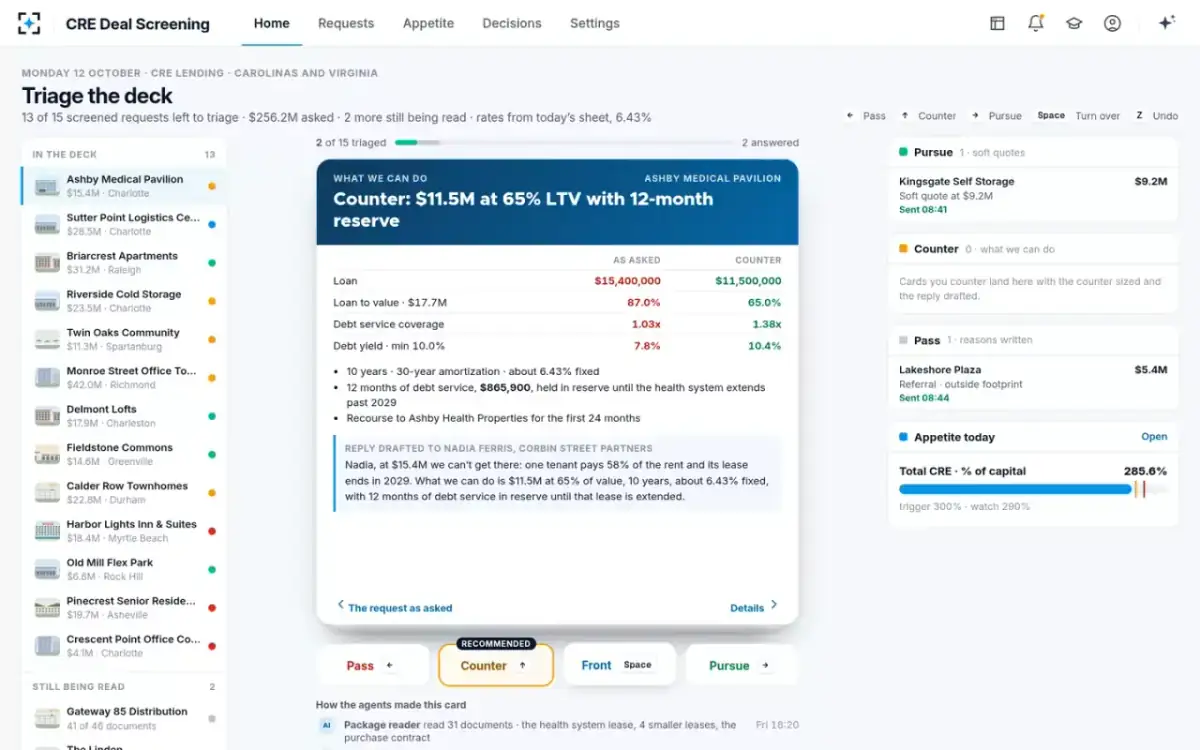
The structure of a counter follows. The sample industrial refinance was debt-yield-bound, so the counter cut the loan to $24.3 million and added a 25% guarantee and a leasing reserve; a longer amortization would not have helped. A sample medical office acquisition at the same bank, asked at $15.4 million, was bound by loan to value: the counter at $11.5 million sits at 65% of value with 1.38x coverage and a 10.4% debt yield, both well clear, plus a reserve of twelve months' debt service because one tenant pays 58% of the rent.
A counter set by loan to value, with coverage and debt yield to spare
Is debt yield a covenant as well as a sizing test?
It can be. The OCC lists debt yield first among "Appropriate financial covenants for income-producing loans", alongside DSCR, LTV, loan to cost and guarantor net worth or liquidity. A debt yield covenant tests the property's income against the outstanding balance each period without reference to the rate, which makes it useful on floating-rate loans where a coverage covenant would swing with the index.
Covenant ratios are not always the underwriting ratios. The OCC warns that "Debt-service coverage calculations for covenant compliance may differ from the DSCR used for underwriting and risk-rating analysis", and that the loan documents should define income and expenses clearly. A request screened at 1.26x on the bank's underwritten income may test differently under a covenant that uses actual cash flow.
Questions people ask
Is a higher debt yield better for a lender?
Yes: a higher debt yield means more income per dollar lent, so less leverage. The OCC notes that "Lower debt yields indicate higher leverage". For a borrower, a higher minimum debt yield means a smaller loan.
What is a good debt yield for multifamily?
There is no regulatory figure; it is set by each lender's policy and market. The sample bank uses 9.5% for multifamily and industrial and 10.0% for medical office, and the OCC recommends higher debt yields for riskier property types.
Can DSCR pass while debt yield fails?
Yes, whenever the loan constant is low: at low rates or long amortization a loan can clear 1.25x with a debt yield well under the bank's minimum. At 4%, a loan sized to 1.25x on the sample income would have been about $32 million, a debt yield of roughly 7.2%.
How do you convert debt yield to DSCR?
Divide the debt yield by the loan constant. A 9.51% debt yield at a 7.53% constant is 1.26x; the same debt yield at 6.44%, the 30-year constant at a 5% rate, is about 1.48x.
Why did lenders start using debt yield?
Because coverage and LTV both loosen when rates and cap rates fall. The OCC describes debt yield as "especially useful during periods of low interest and capitalization rates", when loan amounts set on the other two tests may be prudent only while rates stay low.