Commercial real estate lending software is the set of systems a lender uses to take a CRE loan from request to repayment: something to receive and screen requests, a loan origination system for the application and file, spreading and underwriting tools, credit approval, document preparation and booking to the core, and servicing and portfolio monitoring. Most banks already own most of that stack. The gap is usually at the front: offering memoranda and refinance requests arrive by email faster than a team can read them, the first look is made from memory, and the broker shops the request to whichever lender answers first. Botminds' CRE Deal Screening fills that gap and only that gap. It reads every request, sizes it, tests it against the bank's appetite and drafts an answer for a lending officer to sign; what the bank pursues goes on to the origination system it already has.
The examples come from a fictional sample bank, a CRE lending team covering the Carolinas and Virginia, as it runs through the solution. Supervisory expectations are quoted and linked where they appear.
Commercial real estate lending software as a stack: CRE Deal Screening sits at the front
- 1Request arrivesBroker email, portal, relationship manager
- 2First look: screen and sizeCRE deal screening
- 3Application and loan fileLoan origination system
- 4Spreads and underwritingSpreading tool, underwriting model
- 5Valuation and third-party reportsAppraisal management, report review
- 6Credit approvalCredit memo, committee, approval workflow
- 7Closing and bookingDocument preparation, core banking system
- 8MonitoringServicing, covenants, portfolio and concentration reports
What is commercial real estate lending software?
It is every system a CRE lender touches between a request and a repaid loan, and in most banks no single product covers all of it. The search term "commercial real estate lending platform" usually means a loan origination system with CRE features: an application, a loan file, a workflow to approval and a link to the core. Spreading, appraisal management and portfolio monitoring often come from other vendors or from the bank's own spreadsheets.
The regulation behind the stack is short. A bank must keep written real estate lending policies with "Loan portfolio diversification standards", "Prudent underwriting standards, including loan-to-value limits, that are clear and measurable", "Loan administration procedures" and "Documentation, approval, and reporting requirements to monitor compliance" (12 CFR 34.62). Each clause maps to a layer of software: the standards are applied at screening and underwriting, administration lives in servicing, and the reporting runs across everything.
Where does deal screening sit in commercial real estate lending software?
In front of the origination system, between the broker's email and the application. Screening answers a narrower question than origination: should the bank spend underwriting time on this request at all, and if so on what loan? Its output is a decision a person makes, pursue, counter or decline, with the reasons written down.
That position matters legally as well as practically. Under Regulation B's official interpretation, whether a broker's first enquiry has become an application "depends on how the creditor responds … not on what the consumer says or asks" (Regulation B, Supplement I). A screen that evaluates a request and communicates a decline can create an application before the origination system has opened a file. A screening tool therefore needs its own written reasons and a person's signature on every reply; it cannot leave those to the system downstream. What AI agents may and may not do on a CRE request covers that line in detail.
Does deal screening software replace the loan origination system?
No. The origination system is the bank's system of record for an application and its file; a screen is a decision about whether to create one. CRE Deal Screening reads documents, produces a one-page screen and a drafted reply, and hands the request on. The loan file, the credit memo, the approval chain and the booked loan stay where they are.
What CRE Deal Screening reads, what it hands on, and what stays in the bank's systems
| What it is | Where it lives | |
|---|---|---|
| Reads | Offering memoranda and broker packages, the request and term sheet, rent rolls, trailing-12 and annual statements, leases, sponsor statements and schedules of real estate owned | The broker's email or portal, as they arrive |
| Reads | The credit policy, lending appetite, property-type limits and concentration report; the daily rate sheet; the bank's market file of cap rates, vacancy and rents | The bank's own policy documents and reports, refreshed on the bank's schedule |
| Produces | A one-page screen: income bridge, sizing on three tests, appetite and policy result, recommended next step; a drafted reply | CRE Deal Screening, with every figure linked to its page |
| Hands on | Pursued and countered requests, with the screen, the bridge and the open exceptions | To the underwriter and the loan origination system |
| Keeps | Every pursue, counter and decline with its reasons and the policy clause behind it | CRE Deal Screening, exportable for examiners |
| Leaves alone | The application, loan file, spreads, credit memo, approval, documents, booking and servicing | The bank's existing systems of record |
What is a credit risk appetite statement, and why screening needs one?
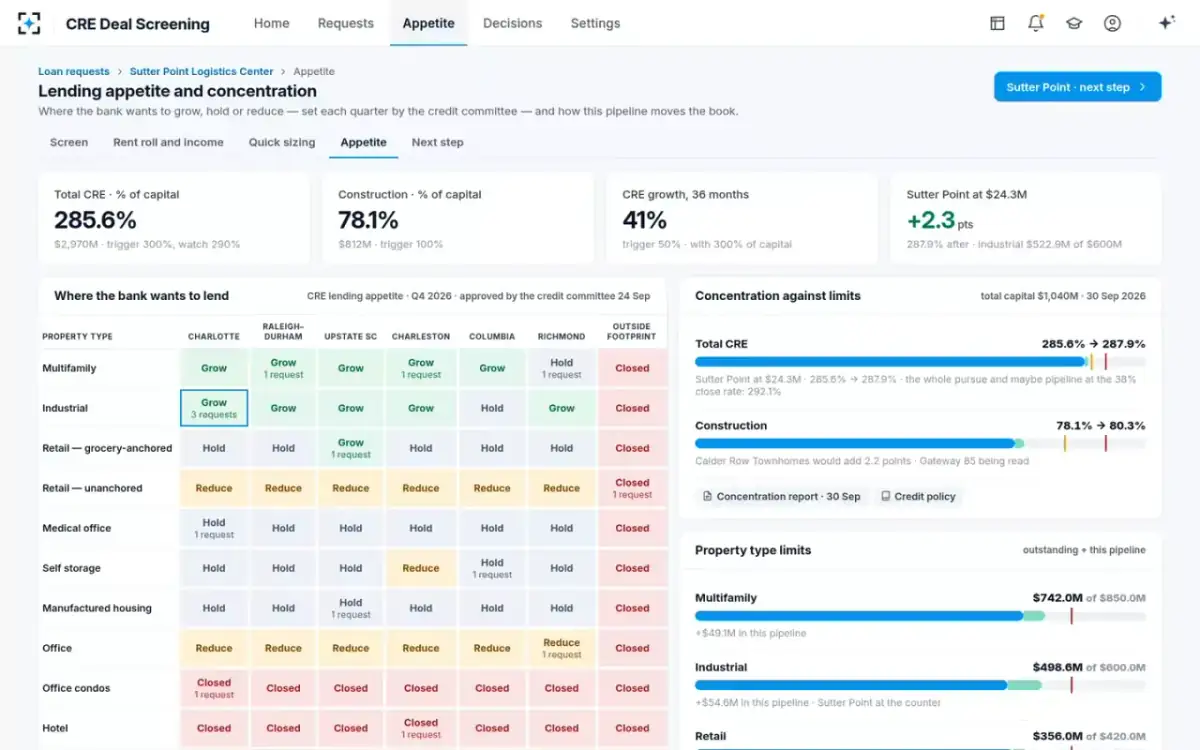
A credit risk appetite statement sets out what the bank wants to lend on, where, and how much, and a screen is only as good as the appetite it tests against. The OCC describes it for CRE: "A CRE strategy typically states the bank's intent by product type, product risk appetite, economic sector, geographic location, and anticipated profitability" (OCC, Commercial Real Estate Lending).
For concentrations the expectations are more specific. The 2006 interagency guidance encourages banks to "stratify the CRE portfolio by property type, geographic market, tenant concentrations, tenant industries, developer concentrations, and risk rating" (71 FR 74580). A 2025 OCC consent order required one bank to set "formal limits and sub-limits for all concentrations of credit based on a percentage of Tier 1 capital plus the allowance for credit losses, stratified by loan type, locality of the borrower and/or collateral" (OCC, AA-WE-2025-20). That denominator has been the agencies' measure since March 31, 2020 (OCC Bulletin 2020-29).
At the sample bank the appetite is a grid the credit committee approves each quarter: property types down the side, markets across the top, each cell Grow, Hold, Reduce or Closed. Industrial in Charlotte is Grow; office everywhere is Reduce; hotels are Closed. Every request lands in a cell before anyone reads the memo, which is why property type outside appetite was the most common decline reason, 34 of 109 in 90 days.
The appetite grid and concentration headroom, checked before anyone pursues a request
How does commercial lending software integrate with core banking?
For screening, mostly by reading, not writing. A screen needs four feeds the bank already produces: the policy and appetite, the daily rate sheet, the market file and the concentration report, which itself is built from the core and the call report. It writes nothing to the core. Its one outbound hand-off is the pursued request, which the origination system picks up as an application.
Integration questions for any CRE lending software that sits in front of origination
- Where do requests arrive, and who sees them?
Broker email, a portal, relationship managers forwarding. The screen should read them where they land, not after someone re-files them.
- How does today's rate reach the sizing?
The sample bank re-sizes open requests at 07:00 each business day from its rate sheet, index plus spread.
- Whose policy settings, and who changes them?
Coverage, debt yield, loan to value, footprint, rollover and recourse rules belong to credit. Versioned, second person, audit trail.
- Which concentration figures does it use?
The bank's own report, on the bank's denominator, refreshed when the report is.
- What does the origination system receive?
The request, the documents and the screen, so the underwriter starts from the bridge rather than from the memo.
- Where do the decline reasons live, and can you export them?
An examiner asks for them by period and category; so will the head of CRE lending.
Commercial real estate lending platform features that matter to examiners
Three features carry most of the supervisory weight: exception tracking, concentration reporting and written reasons. Feature lists that lead with dashboards miss that the OCC's own examination procedures ask whether "the numbers and types of exceptions" are "monitored so the loan policy and lending practices can be periodically evaluated", and whether loans above the supervisory loan-to-value limits are "identified in the bank's records" (OCC).
The OCC also lists what management and the board typically review for CRE: risk ratings, the allowance, rating migration, "Concentrations of credit", "Supervisory LTV exceptions", "Policy, credit, and collateral exceptions" and "Risk layering". Software at the front of the stack should feed those reports, not create a second set of numbers. A screen that counts a requested exception when it is pursued, and records the structure that cleared it when it is countered, gives the board report its earliest data. The supervisory LTV limits and their exception caps shows how quickly those buckets fill.
Extend the origination system, keep the spreadsheet, or add a screening layer?
Banks that want faster first looks have three realistic choices, and each moves the work to a different place. None is wrong for every bank; the right one depends on how many requests arrive, how many become applications, and how much the bank needs to show why the rest did not.
Three ways to handle the first look in a CRE lending stack
| Open every request in the origination system | Keep email and a sizing spreadsheet | Add a screening layer in front | |
|---|---|---|---|
| What happens to a new request | Becomes a loan file, usually keyed by a processor | Sits in an inbox until an officer reads it | Read on arrival, sized and tested against appetite |
| Who reads the package first | A processor, then an underwriter | The lending officer, when the week allows | Agents, then the lending officer reads a one-page screen |
| Cost of a request the bank will decline | A loan file opened and closed | An officer's hours, often an unwritten answer | Minutes of officer time and a signed, written reason |
| Effect on Reg B and exception reporting | Every request is plainly an application | Reasons for declines are rarely kept | Reasons kept for every answer; the bank decides how it treats enquiries |
| Best fit | Low volume, most requests pursued | Low volume, experienced officers, few declines | High volume, many declines, brokers shopping requests |
The first option looks thorough and is expensive: an origination system is built to carry a loan to closing, and filling it with requests that end in a week's time inflates pipelines and processor workload. The second is cheap until volume rises, and leaves no trace of why the bank said no. The third adds a system, which is a real cost, in exchange for putting the bank's own appetite and policy in front of every request before anyone spends underwriting hours on it.
How long does it take to implement commercial lending software at the front of the stack?
Implementation time depends far more on the bank's policy work than on the software. A screen has to be told the bank's credit box, appetite and floors, and has to be checked against recent requests before anyone relies on it. The plan below is how we would sequence a first pilot.
A six-week path from settings to signed screens, most of it the bank's own review
- Credit box and appetite set with creditWeek 1
- Rate sheet, market file, concentration report connectedWeek 2
- Shadow run on recent packagesWeeks 3–4
- Compare with credit's decisions and adjustWeek 5
- Live, every reply signedWeek 6
The shadow run is the part not to shorten. Running the screen on packages the bank has already answered, and comparing with what credit decided, finds the settings that differ from practice before a broker sees a reply. How to test commercial real estate underwriting software sets out the measures.
Why the front of the stack is where the volume is now
The front of the stack is where request volume lands, and refinance volume is high. The Mortgage Bankers Association's 2025 maturity survey found $875 billion, 17% of the $5.0 trillion of outstanding commercial and multifamily mortgages, scheduled to mature in 2026, $396 billion of it serviced by depositories (MBA). A maturing loan is a refinance request, often to a different lender.
The origination system is built for the requests a bank has decided to pursue. The requests it has not decided about yet sit in inboxes. That is the part of commercial real estate lending software most banks have never bought, and the part where a written reason for every answer is hardest to produce by hand.
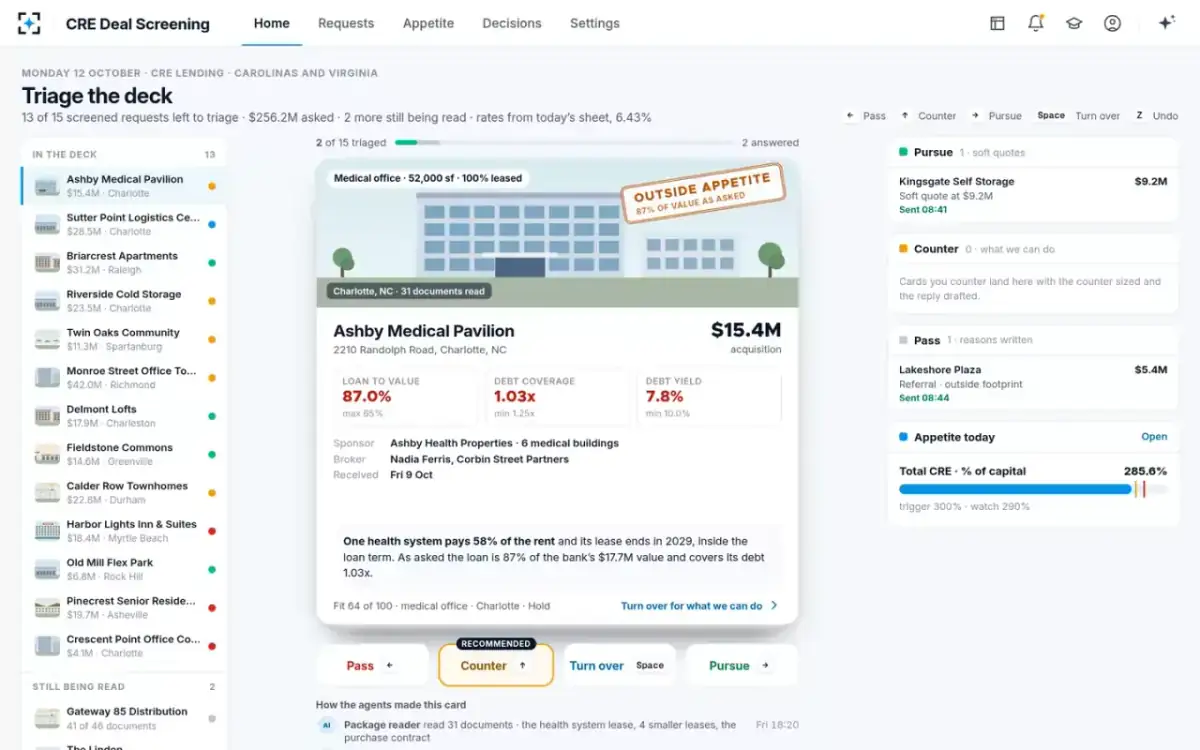
The front of the stack in use: a deck of screened requests, each answered in one of three lanes
Questions people ask
What is commercial real estate loan origination software?
A loan origination system handles a CRE application from intake to closing: the loan file, documents, underwriting workflow, approvals and the hand-off to the core. Deal screening sits before it, deciding which requests become applications at all.
Does screening software need to integrate with the core banking system?
Not directly. It reads the bank's concentration report, which is built from the core and call report data, and hands pursued requests to the origination system, which books to the core. Nothing is written to the core by the screen.
What should a CRE credit appetite statement include?
The OCC describes a CRE strategy stating intent "by product type, product risk appetite, economic sector, geographic location, and anticipated profitability". In practice that is a grid of property types against markets with a stance for each, plus property-type limits and concentration limits measured against tier 1 capital plus the allowance.
Can deal screening software send letters of interest?
It can draft them. In CRE Deal Screening a lending officer signs every reply, the head of CRE lending approves above the officer's limit, and a letter of interest is never called a commitment.
Who owns the settings in CRE lending software?
Credit. Real estate lending policies must be approved by the board at least annually, so minimum coverage, debt yield, loan to value and appetite are the bank's settings. In the sample bank's set-up each change is versioned and needs a second person.