AI commercial real estate underwriting means software agents doing the reading and arithmetic of a CRE loan request: sorting the offering memorandum, rent roll, trailing-12 and leases, rebuilding net operating income on the bank's own vacancy and expense floors, sizing the loan on loan to value, debt service coverage and debt yield, and testing it against the bank's appetite and policy. What AI should not do is decide. Approving, countering, declining and telling the borrower why are credit decisions with legal duties attached, and regulators in 2026 describe bank AI as working with "human-in-the-loop accountability". Botminds' CRE Deal Screening is built on that split: six agents screen every request and draft the answer, and a lending officer reads it, decides and signs.
The examples below come from a fictional sample bank, a CRE lending team in the Carolinas and Virginia, as it runs through the solution. The rules are quoted from the regulations and supervisory documents, linked where they appear.
Who does what on one CRE loan request: six agents, then people
Today
An analyst sorts 23 documents and checks names and numbers by hand.
With agents
Sorts and reads the package, checks that names and figures agree across documents, and marks it complete only when the rent roll and trailing-12 are in.
Still theirs: Never fills a missing number from the memo into the bank's figures.
Today
The memo's pro forma income is retyped into a spreadsheet.
With agents
Rebuilds income from rents in place and the trailing-12 on the bank's floors, with a bridge from the memo's figure, each step tied to its page.
Still theirs: Never underwrites pro forma rent; never changes a tenant's contract rent.
Today
Sizing and appetite are done from memory, often after committee.
With agents
Size at today's rate sheet, take the least of three tests, place the request in the appetite and propose a structure for each exception.
Still theirs: Never quotes a rate that is not on the sheet; never treats an exception as cleared without a named structure.
Today
Reads forty packages a month to find ten worth underwriting.
With agents
Reads the one-page screen and the drafted reply, chooses pursue, counter or decline, and signs.
Still theirs: The decision, the signature and the reply.
Today
Hears that a request was declined, but not why.
With agents
Approves anything above the officer's $20 million limit with the screen and its reasons in front of them.
Still theirs: Approval above the limit, and the bank's credit box.
What can AI do in commercial real estate underwriting?
AI can do the mechanical half of a first look well: read, reconcile, rebuild, compute and draft. Each of those steps has a rule a bank already applies to people, and the useful design question is not "can the model do it" but "which rule bounds it, and can a reviewer see that the rule was applied".
Each task in a CRE first look, and the rule that bounds it
| Task | What the agent does | The rule it works inside |
|---|---|---|
| Read the package | Sorts the memorandum, request, rent roll, statements, leases and sponsor papers; checks names and figures agree | The OCC wants each loan file's primary source of repayment identified and evaluated |
| Rebuild income | Starts from rents in place; applies the bank's vacancy, management and reserve floors; shows the bridge from the memo | NOI is "a stabilized estimate of income and expenses"; projections above current rents are a named weakness |
| Check the market | Compares the memo's rents, vacancy and cap rate with the bank's own market file | Cap rates "should reflect reasonable expectations … under normal, orderly, and sustainable market conditions" |
| Size the loan | Computes the most the bank can lend on loan to value, coverage and debt yield at today's rate; takes the least | Policies must set "clear and measurable" standards, including LTV limits and minimum coverage (12 CFR 34, Appendix A) |
| Test appetite and policy | Places the request by property type and market, checks concentration headroom and every policy rule | A CRE strategy states "product risk appetite … geographic location"; exceptions are documented and reported |
| Draft the screen and reply | Writes a one-page screen with a recommendation and a plain-words reply to the broker | Nothing goes out until a lending officer signs; adverse action carries Reg B duties |
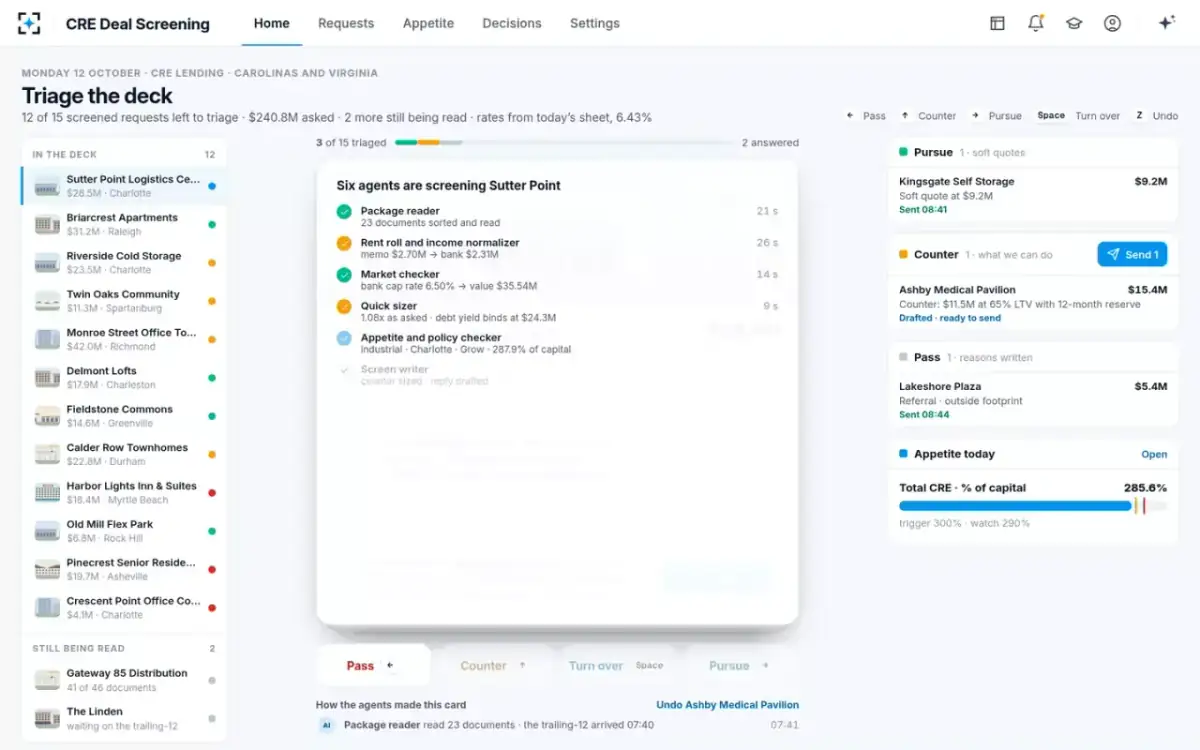
On the sample bank's $28.5 million industrial refinance, those six steps took 1 minute 48 seconds from the moment the trailing-12 arrived. The income came down from the memo's $2.70 million to $2.31 million, the market check put value at $35.54 million on a 6.50% cap rate, and the sizing at a 6.43% rate allowed $24.3 million, with debt yield binding. Every figure on the screen opens the page it came from. That last property matters more than the speed: a first look an officer cannot check is a first look an officer cannot sign.
Six agents at work on one request, each step with what it found
Can AI decline a commercial real estate loan?
It should not. A decline is a credit decision, and once the request counts as an application it carries Regulation B notice duties that someone at the bank has to own. Under Regulation B, adverse action includes "a refusal to grant credit in substantially the amount or on substantially the terms requested in an application unless the creditor makes a counteroffer … and the applicant uses or expressly accepts the credit offered" (12 CFR 1002.2(c)). A decline, and a counter the broker turns down, are both adverse action once there is an application.
When a broker's first enquiry becomes an application is the question that matters for a screening tool, and the official interpretation answers it by conduct, not by label: "if in giving information … the creditor also evaluates information about the consumer, decides to decline the request, and communicates this … the creditor has treated the inquiry or prequalification request as an application". It adds that "Whether the inquiry or prequalification request becomes an application depends on how the creditor responds … not on what the consumer says or asks" (Regulation B, Supplement I, comment 2(f)-3). The commentary to the small business rule says the same for businesses: a prequalification request "may become an 'application' … if the creditor evaluates information about the business, decides to decline the request, and communicates this to the business".
Inquiry or application: what decides whether a CRE screen carries Reg B duties
Treated as an inquiry: Explains its general terms: rates, LTV and coverage policy, what it would need to see
Treated as an application: Evaluates this borrower's information, decides it will not lend as asked, and says so
Treated as an inquiry: Describes terms the bank offers in general
Treated as an application: A counteroffer on this request; if the applicant does not accept, notice is due within 90 days of the counter
Treated as an inquiry: Not applicable: nothing has been decided
Treated as an application: Adverse action; timing and form of the notice follow the business-credit rows below
Treated as an inquiry: No notice
Treated as an application: Notice of the action within a reasonable time, orally or in writing; written reasons if the applicant asks in writing within 60 days
Treated as an inquiry: No notice
Treated as an application: The consumer-style rules apply, including notice within 30 days of a completed application; the statement of action may be oral or written
The design consequence is simple. A screening agent that emailed "we will not lend on this" would have made the bank's decision and started its notice clock without anyone choosing to. In CRE Deal Screening the screen writer drafts and never sends; a lending officer signs every reply, and a counter is written as a letter of interest, never called a commitment. The bank's adverse action process, its notice forms and its timing stay where they are. A combined counteroffer and adverse action notice is allowed, and the commentary notes that a creditor sending one "need not send a second adverse action notice if the applicant does not accept the counteroffer".
Is AI underwriting covered by model risk guidance?
Partly, and the 2026 guidance leaves the generative part out on purpose. The revised interagency guidance on model risk management, issued April 17, 2026 as OCC Bulletin 2026-13 and Fed SR 26-2, says that "Generative AI and agentic AI models are novel and rapidly evolving. As such, they are not within the scope of this guidance" (OCC Bulletin 2026-13). It also narrows what counts as a model: the term "excludes simple arithmetic calculations, such as those found within spreadsheets, as well as deterministic rule-based processes and software where there are no statistical, economic, or financial theories underpinning their design or use".
For a CRE screen that splits cleanly. The sizing step, the least of three ratios at a stated rate, and the policy tests are arithmetic and deterministic rules; they sit outside the model definition, and a bank can test them the way it tests a spreadsheet. The reading and extraction steps are where language models work, and those are exactly what the guidance excludes for now. The agencies say they "plan to issue in the near future a request for information" on AI; as of October 2026 none had been published. Until it is, a bank governs the reading with ordinary controls: every extracted figure tied to its page, and a person who checks it before signing.
The guidance is also explicitly not a rulebook: it "does not set forth enforceable standards or prescriptive requirements". That cuts both ways. A bank is not criticised for failing to validate an extraction agent like a scoring model, but it remains responsible for what the agent's output leads it to do, and its existing third-party risk management still applies to any vendor.
How do regulators view AI in credit decisions?
Supervisors describe AI in banks as useful, early and supervised by people. The OCC's Spring 2026 Semiannual Risk Perspective says banks "are taking a measured approach to the adoption of generative AI (genAI) and agentic AI, with usage generally limited to specific use cases with guardrails and human-in-the-loop accountability to manage risk" (OCC, Spring 2026), and names "lack of explainability … and validation challenges" among the risks.
The Federal Reserve's Vice Chair for Supervision drew the line at the decision itself in July 2026: using AI "in a way that has more direct impact on credit decisions affecting individual customers—presents more substantial legal compliance challenges than other AI use cases" (Bowman, July 14, 2026). The FDIC's supervision director told Congress in March that "some banks have used AI and cash flow data to assist in underwriting" (FDIC, March 26, 2026). Read together, the message is that AI assisting an underwriter is ordinary; AI deciding is where the scrutiny starts.
One CRE request through CRE Deal Screening: agents prepare, people decide
Agent
Package readerReads 23 documents and holds the request until the rent roll and trailing-12 are in.
Never: Fills a gap from the memo
Agent
Income normalizerTakes the memo's $2.70M down to the bank's $2.31M, line by line.
Never: Sizes on pro forma rent
Agent
Market checkerValues the property at the bank's 6.50% cap rate, $35.54M.
Never: Uses a cap rate below the market file's range
Agent
Quick sizerTests $28.5M as asked: 1.08x, 8.1%, 80.2%. Finds $24.3M where debt yield binds.
Never: Quotes a rate not on today's sheet
Agent
Policy checker and screen writerPlaces it in appetite, proposes a guarantee and leasing reserve, drafts the screen and reply.
Never: Sends anything
A person decides
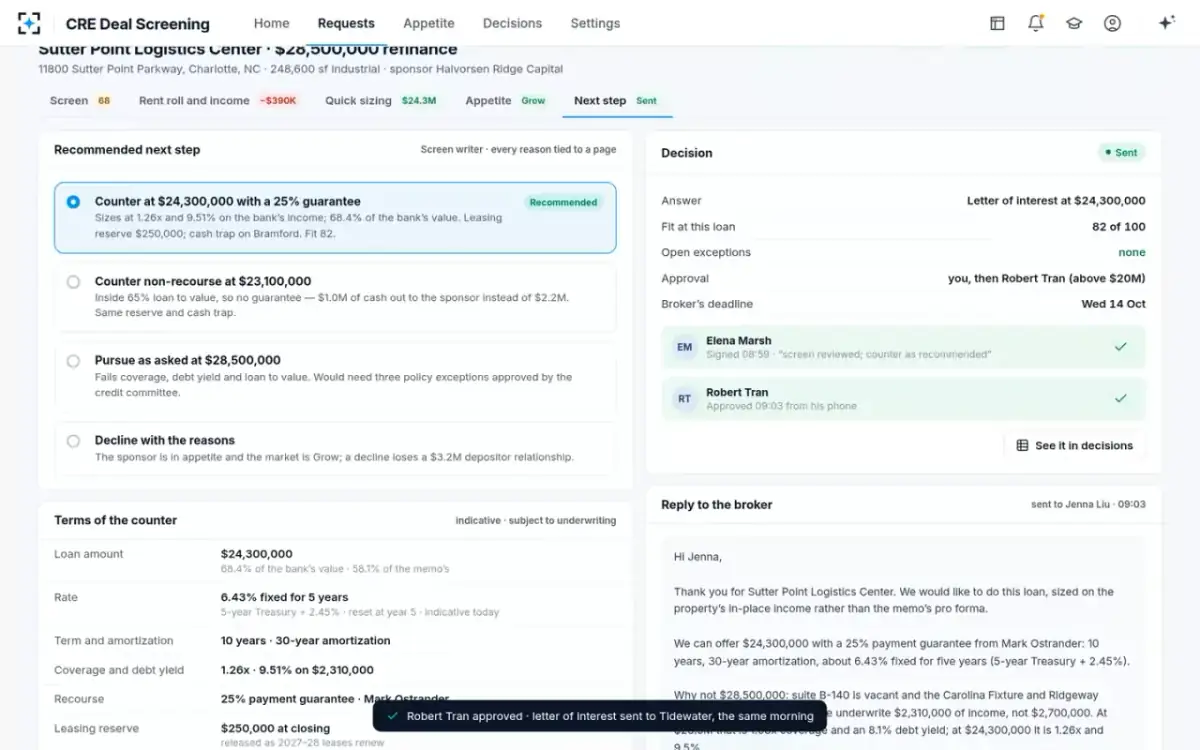
Lending officerReads the screen, chooses the counter, signs at 08:59.
A person decides
Head of CRE lendingApproves at 09:03 because the loan is above the $20M limit; only then does the reply go.
What are the risks of AI underwriting, and the controls that answer them?
The risks are concrete and mostly old ones in a new form: a wrong number read confidently, income taken from the wrong column, a rate or policy setting out of date, and a decision nobody can explain afterwards. Treasury's 2024 report on AI in financial services warns that generative models "can be susceptible to 'AI hallucinations,' producing confidently stated but incorrect output" (Treasury, December 2024). The controls below are the ones a credit officer can verify on a single screen.
Six risks in AI commercial real estate underwriting, and the control that answers each
- A figure read wrongly or invented
Every figure on the screen links to the page it came from, and a missing figure stays missing: the package waits for the document instead of borrowing the memo's number.
- Pro forma income treated as actual
Income is rebuilt from rents in place and the trailing-12; the memo's figure appears only as the start of a bridge whose every deduction is shown.
- A stale rate or policy setting
Sizing uses today's rate sheet, re-run each business morning on open requests; the credit box is versioned and changes need a second person.
- An exception waved through
An exception counts as cleared only when a named structure clears it: a smaller loan, a guarantee, a reserve or a cash trap.
- A decision nobody can explain
Each pursue, counter and decline keeps its reasons and the policy clause behind them, and exports for examiners.
- A message sent without authority
Agents draft only. A lending officer signs, the head of CRE lending approves above the limit, and a letter of interest is never called a commitment.
The decision stays with people: four options, one recommended, two signatures
Who sets the agents' standards? The credit box stays the bank's
The agents apply the bank's standards; they do not choose them. Every test a request is screened against is a setting the bank controls, and the regulation says whose job that is: real estate lending policies must be "reviewed and approved by the bank's board of directors at least annually" and must set "Prudent underwriting standards, including loan-to-value limits, that are clear and measurable" (12 CFR 34.62). A screening tool that carried its own coverage or leverage targets would be importing someone else's credit policy.
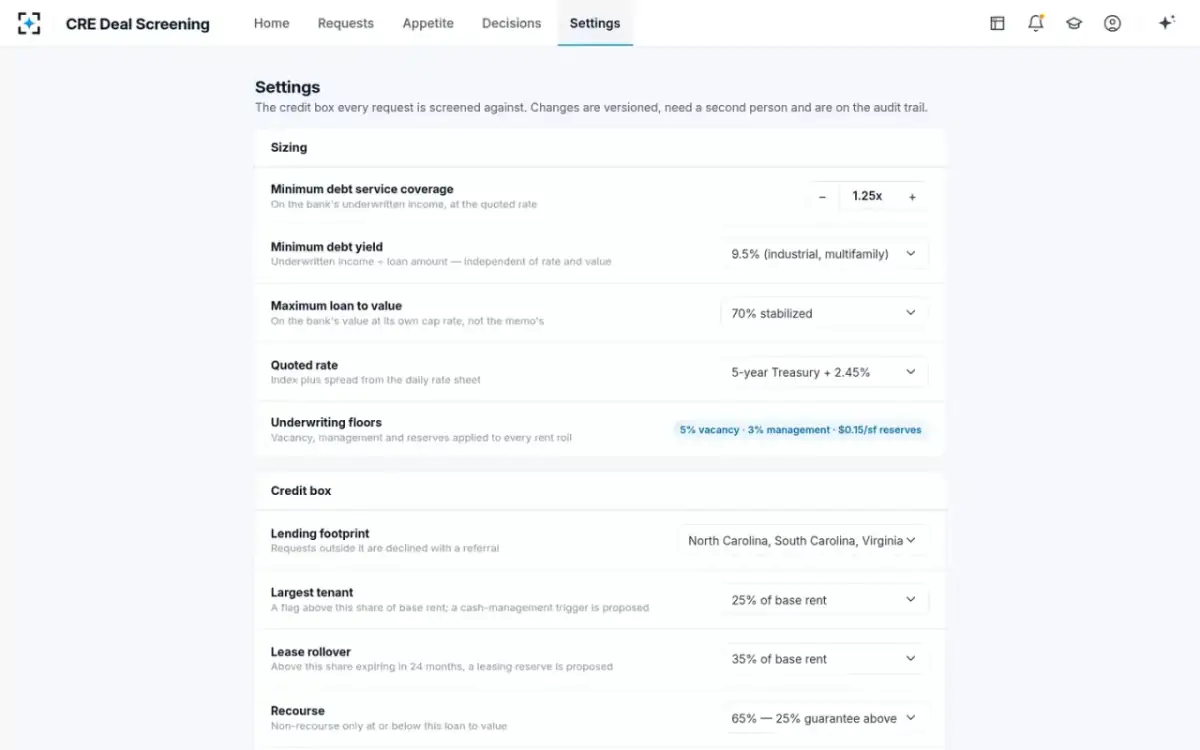
In the sample bank's set-up the box reads: minimum coverage 1.25x, minimum debt yield 9.5% for industrial and multifamily, maximum loan to value 70% on a stabilized value at the bank's cap rate, a lending footprint of North Carolina, South Carolina and Virginia, a flag when more than 35% of base rent expires within 24 months, non-recourse only to 65% loan to value, and a $20 million lending officer limit. Each is versioned, needs a second person to change and stays on the audit trail, so an examiner can see which standard a request was screened against on the day it was screened.
The credit box every request is screened against, set by the bank
Will AI replace commercial real estate underwriters?
The evidence points to fewer hours on first looks, not fewer underwriters making decisions. The Bureau of Labor Statistics projects loan officer employment to grow 1% from 2025 to 2035 and expects "productivity-enhancing technology in loan processing" to slow growth (BLS). That is a statement about processing, the reading and retyping that agents do well.
What an underwriter brings that an agent does not is judgment about the things a package cannot prove: whether a sponsor will support a property through a bad year, whether a tenant's renewal is likely, whether a market's rents are about to turn. The underwriter's week, and where screening changes it, is laid out in the commercial real estate underwriter's week.
Best AI for commercial real estate underwriting: what to ask before you buy
The best tool for a bank is the one whose every number can be traced, whose limits are written down and whose output a lending officer will sign. Ask vendors to run your own closed and declined packages and show, for each, the income bridge, the sizing and the policy flags. Ask what the agent does when a rent roll is missing. Ask who can change the minimum coverage and what record of the change remains.
A scoring approach for that pilot, with pass lines for sizing error and policy flags, is set out in how to test commercial real estate underwriting software. Investor-side "deal analyzers" answer a different question, whether to buy; a bank needs its own income, its own cap rate and its own credit box.
Questions people ask
Can AI underwrite a commercial real estate loan on its own?
It can produce a full first look: rebuilt income, value, sizing and policy tests. It should not approve or decline, because those are credit decisions with Reg B notice duties and bank lending authority attached. Regulators in 2026 describe bank AI use as human-in-the-loop.
Does a declined broker screen need an adverse action notice?
It depends on whether the bank treated the request as an application. Under the Reg B commentary, an enquiry becomes an application if the bank evaluates the borrower's information, decides to decline and communicates that. For a business with revenue over $1 million, the bank must notify the action and give written reasons if asked in writing within 60 days.
Is a CRE sizing calculation a "model" under SR 26-2?
Generally not. The 2026 guidance excludes "simple arithmetic calculations, such as those found within spreadsheets" and deterministic rule-based processes from the definition of a model. Generative and agentic AI are outside its scope altogether, pending a promised request for information.
What documents does AI need to screen a CRE loan request?
At least the offering memorandum or request, a current rent roll and a trailing-12 operating statement; leases for the largest tenants and the sponsor's financial statement and schedule of real estate owned make the screen complete. In CRE Deal Screening a package is held as still being read until the rent roll and trailing-12 arrive.
How fast can AI screen a commercial real estate deal?
On the fictional sample refinance, six agents read 23 documents and produced a one-page screen in 1 minute 48 seconds. The officer's decision and the head of CRE lending's approval followed within minutes, but those times depend on people, not software.