Commercial real estate loan sizing is the calculation of the largest loan a lender will make on an income property, and banks do it by running three tests and taking the lowest result: loan to value (the bank's maximum LTV times its own value for the property), debt service coverage (net operating income divided by the minimum DSCR, divided by the loan constant) and debt yield (net operating income divided by the minimum debt yield). Each test protects against a different risk: a fall in value, a rise in payments, and leverage at any rate. Which one sets the loan tells a credit officer which risk the deal is closest to. Botminds' CRE Deal Screening runs all three on every loan request at the day's rate sheet, takes the lowest and shows which test binds, before a lending officer answers the broker.
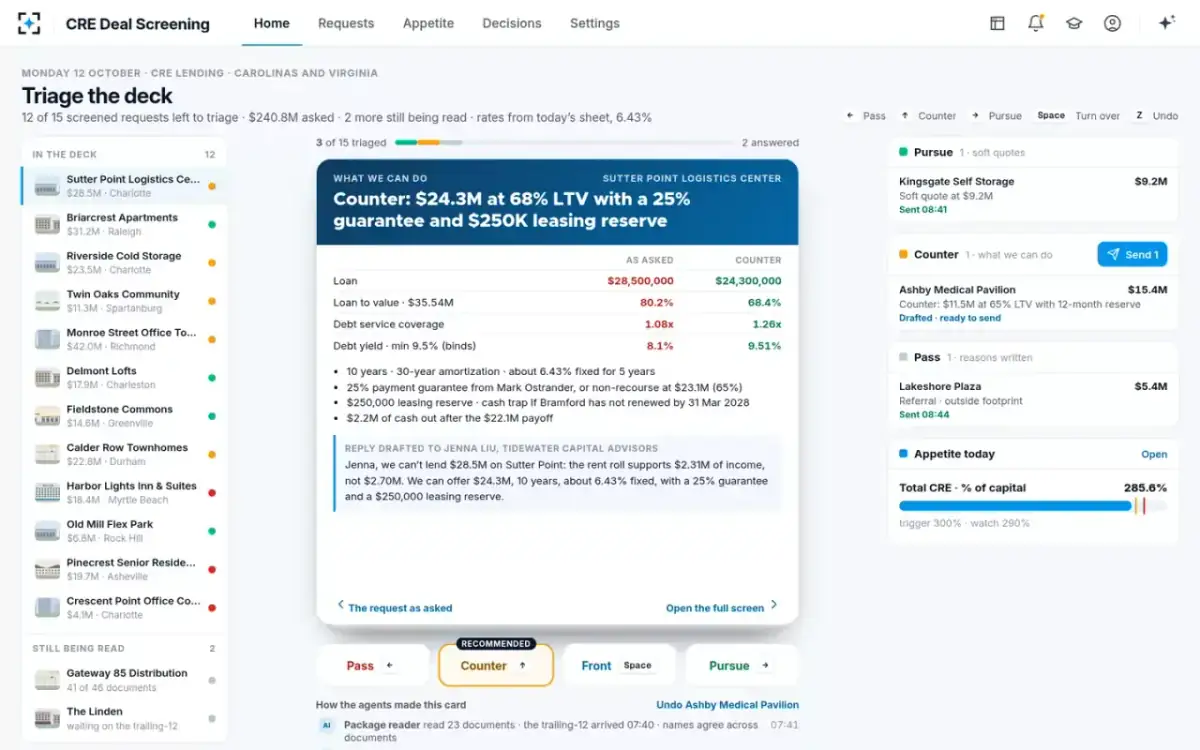
The worked example is a fictional sample request, a $28.5 million refinance of two industrial buildings in Charlotte, as it runs through the solution at a sample bank. The rules come from the OCC and the Interagency Guidelines, linked where they appear.
The lesser-of-three sizing chain, worked on one sample request
Agent
IncomeRebuild NOI from rents in place and the trailing-12 on the bank's floors: $2,310,000.
Never: Use the memo's pro forma $2.70M
Agent
ValueCapitalise the bank's NOI at the bank's 6.50% cap rate for the submarket: $35,540,000.
Never: Use a cap rate below the market file's range
Agent
Loan to value test70% × $35.54M = $24,870,000.
Agent
Coverage test$2.31M ÷ 1.25 ÷ 7.53% constant (6.43%, 30 years) = $24,540,000.
Agent
Debt yield test$2.31M ÷ 9.5% = $24,310,000. The lowest of the three.
Agent
Take the least, round downMaximum loan $24,300,000: debt yield binds, $4.2M below the $28.5M asked.
A person decides
Lending officerDecides whether to counter at that amount, with what structure, and signs the reply.
How do lenders size a commercial real estate loan?
They compute the maximum loan under each of their policy tests and lend the least. The regulation requires the tests to exist: a bank's real estate lending policy must set "Prudent underwriting standards, including loan-to-value limits, that are clear and measurable", and for completed commercial property "Minimum standards for net worth, cash flow, and debt service coverage" (12 CFR 34, subpart D and Appendix A). The OCC adds "Minimum debt yield" to the list of what effective CRE policies set for each property type (OCC, Commercial Real Estate Lending).
The three commercial real estate loan sizing tests, as formulas
| Test | Maximum loan | What it protects against | Sample request |
|---|---|---|---|
| Loan to value | maximum LTV × (NOI ÷ cap rate) | A fall in the property's value | 70% × $35.54M = $24.87M |
| Debt service coverage | NOI ÷ minimum DSCR ÷ loan constant | Payments the income cannot cover at the loan's rate | $2.31M ÷ 1.25 ÷ 0.0753 = $24.54M |
| Debt yield | NOI ÷ minimum debt yield | Leverage that only works while rates are low | $2.31M ÷ 0.095 = $24.31M |
Every test uses the same income, which is why the income comes first. On the sample request the memo's own figure was $2.70 million; sized on that, the three tests would allow about $29.1 million, $28.7 million and $28.4 million, and the broker's $28.5 million ask is essentially the memo's own sizing. The bank's tests on the bank's income produce $24.3 million. The difference is all income: a vacant suite leased in the memo, renewals priced before signing, and the bank's vacancy, management and reserve floors.
Three tests, three answers: debt yield sets the sample loan
Which sizing constraint binds, and why?
The binding test is predictable from three comparisons, and they are worth knowing by heart because they tell an officer what a request is exposed to before any spreadsheet is opened. Each one compares two tests by cancelling the income, which appears in both.
Which commercial loan sizing test binds: three rules that need no spreadsheet
| Comparison | The rule | At the sample bank's settings |
|---|---|---|
| Debt yield against loan to value | Debt yield binds when the cap rate is below max LTV × min debt yield | 70% × 9.5% = 6.65%. At the bank's 6.50% cap rate debt yield binds; above 6.65% loan to value would |
| Coverage against debt yield | Coverage binds when the loan constant is above min debt yield ÷ min DSCR | 9.5% ÷ 1.25 = 7.60%, a rate of about 6.52% on 30-year amortization or 5.82% on 25-year |
| Loan to value against coverage | Loan to value binds when the cap rate is above max LTV × min DSCR × loan constant | 70% × 1.25 × 7.53% = 6.59% at today's rate |
Read the sample request through those rules. Its cap rate, 6.50%, is below 6.65%, so debt yield beats loan to value. Its rate, 6.43%, gives a constant of 7.53%, just below 7.60%, so debt yield also beats coverage. A rise of about ten basis points in the rate sheet would hand the loan to the coverage test. That is the practical meaning of the OCC's warning that loan amounts set by DSCR and LTV "may be prudent only as long as the low rate environment is sustained": debt yield is the test that does not move when rates do. Debt yield against DSCR follows that crossover in detail.
Commercial real estate loan sizing example: three property types, three binding tests
Property type changes all three inputs at once: the cap rate, the minimum coverage the bank asks for and the minimum debt yield. Run the same $1 million of NOI through three illustrative credit boxes and each property is set by a different test.
The same $1 million of NOI, three property types, three different tests binding
| Property | Cap rate and value | LTV test | Coverage test | Debt yield test | Loan |
|---|---|---|---|---|---|
| Multifamily | 5.75% → $17.39M | 75% → $13.04M | 1.20x → $11.07M | 8.5% → $11.76M | $11.0M, coverage binds |
| Industrial | 6.50% → $15.38M | 70% → $10.77M | 1.25x → $10.62M | 9.5% → $10.53M | $10.5M, debt yield binds |
| Hotel | 8.50% → $11.76M | 65% → $7.65M | 1.50x → $8.85M | 12.0% → $8.33M | $7.6M, loan to value binds |
The pattern is general. Low cap rates, typical of multifamily, inflate value, so loan to value rarely binds and payments do. High cap rates, typical of hotels, keep value low, so loan to value binds before income does. Industrial sits between, where a bank's debt yield floor often decides. A loan officer who knows which test usually binds for each property type can answer most requests within a few percent before anyone runs a model.
How does amortization change commercial loan size?
Shorter amortization raises the loan constant and cuts the coverage test's answer; it does nothing to the loan to value or debt yield tests. At 6.43%, moving from 30-year to 25-year amortization lifts the constant from 7.53% to 8.05%, and the coverage test on the sample request falls from $24.54 million to about $22.96 million, which would then bind below debt yield.
Interest-only terms do not escape the test. The OCC says that even where a loan permits interest-only payments, "the property should nonetheless meet the bank's repayment capacity (debt service coverage) requirements as though the loan were amortizing", and it gives the arithmetic for the balloon risk: a $1 million loan at 6% on 25-year amortization has a balance of $899,000 after five years, so an interest-only loan of the same risk would be sized at $899,000 to begin with (OCC).
"Generally, LTV and as-if amortizing debt-service coverage requirements for interest-only loans are more conservative than LTV and debt-service coverage requirements for amortizing CRE loans."
OCC, Comptroller's Handbook, Commercial Real Estate Lending
Four sizing mistakes, and what each would have done to the sample loan
Most oversized quotes come from one wrong input, not from bad arithmetic. Each mistake below makes one of the three tests too generous; because the loan is the least of the three, a single generous test does no harm until it happens to be the binding one, which is why these errors survive in templates for years.
Common commercial real estate loan sizing mistakes, priced on the sample request
| Mistake | The test it inflates | Answer with the mistake | Answer done right |
|---|---|---|---|
| Sizing coverage on the interest rate instead of the loan constant | Coverage | $2.31M ÷ 1.25 ÷ 6.43% = $28.74M | $24.54M at the 7.53% constant |
| Valuing on the memo's income and cap rate | Loan to value | 70% × ($2.70M ÷ 6.45%) = $29.30M | 70% × ($2.31M ÷ 6.50%) = $24.87M |
| Leaving out replacement reserves | All three, through income | Debt yield $24.70M | $24.31M with $37,290 of reserves at $0.15 a square foot |
| Taking the result to the dollar and rounding up | Whichever binds | $24.4M, debt yield 9.47% | $24.3M, debt yield 9.51% |
The first two are the expensive ones: each would have let a coverage-only or LTV-only calculation agree with the broker's $28.5 million. A sizing tool that runs all three tests protects against a single bad input only if the inputs are independent; income errors flow into all three at once, so the income bridge remains the place to look first.
Why round a loan amount down?
Because a quoted amount should clear every test, and rounding up breaks the one that binds. The sample bank rounds to the lower $100,000: $24,310,000 on debt yield becomes $24,300,000, which gives a 9.51% debt yield, 1.26x coverage and 68.4% loan to value. Rounded up to $24.4 million, debt yield would fall to 9.47%, below the 9.5% minimum, and the quote would carry an exception nobody intended.
Rounding also makes a quote robust to small changes in the inputs between screen and underwriting. A loan sized to the last dollar at exactly 1.25x fails the moment the underwriter finds one more expense; one rounded down has a little room.
Asked against counter: the sized loan, and the structure that makes it work
How much can I borrow on a commercial property?
Run the bank's three tests on the bank's view of your income and take the lowest; then check the structure. For a borrower the most useful number is the lender's minimum debt yield, because it needs no rate or amortization: divide your in-place NOI by it and you have a ceiling that holds whatever the rate sheet does.
Structure can move the answer. In the sample bank's credit box, non-recourse lending stops at 65% of value, $23.1 million on this property, while a 25% payment guarantee allows the full $24.3 million. Federal Reserve research finds the same trade in bank data: "recourse loans have rate spreads that are at least 20 basis points lower and loan-to-value ratios that are around 3 percentage points higher than non-recourse loans" (Glancy, Kurtzman, Loewenstein and Nichols, FEDS 2021-079). And no structure moves a bank past its regulatory ceiling: the supervisory LTV limits cap improved property at 85% of value, with exceptions reported to the board.
Where CRE Deal Screening does the sizing, and what it leaves to people
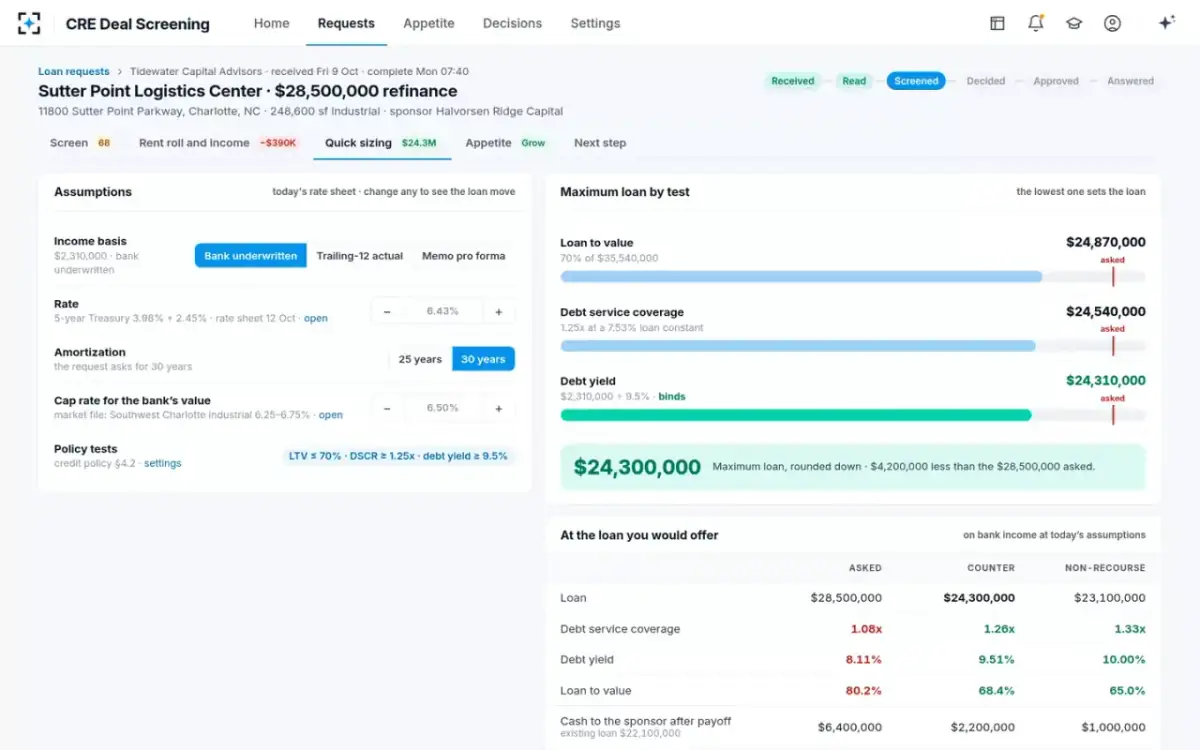
On every request, the solution's quick sizer runs the three tests at today's rate sheet on the bank's underwritten income and the bank's value, takes the least, rounds down to $100,000, and shows which test binds and the cash to the sponsor after payoff. The officer can switch the income basis, rate, amortization or cap rate and watch the loan move. The minimums themselves are the bank's settings, versioned and changed only with a second person.
What stays with people is the choice among structures: a smaller loan, a guarantee, a reserve, a cash trap or a decline. Sizing says what the bank can lend; it does not say whether the bank wants this sponsor, in this market, on these terms.
The sizing panel: change any input and watch which test binds
Questions people ask
What does "lesser of LTV, DSCR and debt yield" mean?
The lender computes the maximum loan under each of its three tests and lends the smallest. On the sample request, $24.87 million, $24.54 million and $24.31 million gave a $24.3 million loan, with debt yield binding.
Is loan sizing based on purchase price or appraised value?
Banks measure loan to value against the value of the property, and the Interagency Guidelines define the ratio at origination, including senior liens. For a quick screen the bank capitalises its own NOI at its own cap rate; the appraisal later confirms or replaces that value.
Does interest-only change loan sizing?
It should not increase it. The OCC expects interest-only loans to meet coverage "as though the loan were amortizing", and generally with more conservative LTV and coverage requirements than amortizing loans.
Why do lenders use three tests instead of one?
Each protects against a different risk: value falling, payments outrunning income, and leverage that only works at low rates. The OCC describes debt yield as useful when loan amounts set on DSCR and LTV "may be prudent only as long as the low rate environment is sustained".
What cap rate should a lender use to size a loan?
Its own, for the submarket, not the broker's. The OCC says cap rates should reflect expectations under "normal, orderly, and sustainable market conditions"; the sample bank never goes below its market file's range.