Commercial real estate underwriting software reads a CRE loan request, rebuilds the property's income, sizes the loan and tests it against a lender's policy; to evaluate it, run it on your own past requests and compare its answers with what your credit team actually decided and what the loans then did. Vendor demos run on packages chosen to succeed. Your closed, countered and declined files show how the software handles the requests your bank actually gets, written by the brokers who actually send them. Botminds' CRE Deal Screening, which gives every request a first look before underwriting starts, is offered for exactly that kind of test, and the plan below is the one we would want it judged by.
The worked figures come from a fictional sample bank, a CRE lending team covering the Carolinas and Virginia, as it runs through the solution. The research on income overstatement is peer-reviewed and linked where it appears.
Why a test on your own files matters: underwriting quality differs by lender
39,522
CMBS loans compared, projected income against the first year's actual
29%
overstated projected income by at least 5%
35%+
of loans overstated by 5% or more at each of the eight worst originators
32%
of CMBS loans in financial distress, April 2020 to April 2021
What is commercial real estate underwriting software?
It is software that turns a borrower's or broker's package into an underwriting answer: income, value, loan size and policy fit. Two families sell under the same words, and they answer different questions. Investor-side tools model whether to buy a property; lender-side tools decide whether and how much to lend against it.
Two kinds of commercial real estate underwriting software, and the question each answers
Investor-side deal analysers: Should we buy this property, and at what price?
Lender-side screening and underwriting: Should we lend on it, how much, and on what structure?
Investor-side deal analysers: The investor's business plan, often including rent growth and lease-up
Lender-side screening and underwriting: Rents in place and the trailing-12, on the lender's vacancy, management and reserve floors
Investor-side deal analysers: The investor's target return or exit cap rate
Lender-side screening and underwriting: The lender's cap rate for the submarket, never below its own range
Investor-side deal analysers: Returns: IRR, equity multiple, cash-on-cash
Lender-side screening and underwriting: Maximum loan by loan to value, coverage and debt yield, and the policy exceptions
Investor-side deal analysers: The investment committee
Lender-side screening and underwriting: The credit officer, the board's exception report and the examiner
The distinction is not academic. The OCC lists "projections that rely on speculative or unrealistic assumptions relative to current market conditions such as higher than current rents or occupancy rates" among underwriting weaknesses (OCC, Commercial Real Estate Lending). A tool built to model an investor's upside will, by design, start from the numbers a bank's policy tells it to challenge.
How to evaluate commercial real estate underwriting software: build the test from your own files
Assemble a test set from requests your bank has already answered, run the software on the packages exactly as they arrived, and compare. The set should include deals you closed, deals you countered and deals you declined, because each tests something different: closed deals test sizing, counters test structure, and declines test whether the software would have turned away the same requests for the same reasons.
Use your own files rather than a vendor's or a market database for a reason Federal Reserve research makes plain. Banks, life insurers and CMBS lenders "compete in the same market" but "specialize in loans with different characteristics" (Glancy, Krainer, Kurtzman and Nichols, FEDS 2019-079), and a 2024 Fed study warns that aggregate loan-to-value levels say little about standards "only after controlling for aggregate risk perceptions" (FEDS 2024-019). A tool that looks accurate on someone else's loans has been tested on someone else's credit box.
Four measures for a CRE underwriting software pilot, and how to score each
| Measure | How to compute it | A reasonable pass line |
|---|---|---|
| Sizing error | Software's maximum loan against the amount credit approved, on the same terms, for every closed or countered deal | Within a few percent on most deals; every larger gap explained by a named difference in income, value or rate |
| Income bridge agreement | Software's underwritten NOI against the NOI in the final credit write-up, line by line | Each difference traceable to a document or a stated floor, not to an unexplained adjustment |
| Policy flags caught | Exceptions the software flagged against those the write-up listed | Every listed exception caught; extra flags reviewed, not dismissed |
| False declines | Requests the software would decline that the bank funded and that performed | Few, and each with a reason the bank would defend in its own policy |
| Traceability | Share of figures on the screen that open the page they came from | All of them; a figure without a source is a figure an officer should not sign |
How accurate is automated underwriting? Sizing error inherits income error
Automated sizing is exact arithmetic, so its accuracy is the accuracy of its inputs, and income is the input that moves most. Under the coverage and debt yield tests the maximum loan is proportional to net operating income, and under loan to value it is proportional to value, which is income divided by a cap rate. A 5% error in income becomes a 5% error in the loan, whichever test binds.
One property, the same tests: how the maximum loan moves with the income it is fed
Two things follow for a pilot. First, score the income bridge before the loan amount: a software that lands near credit's loan by making two offsetting errors has not passed. Second, the most valuable test cases are the ones where the broker's income and the bank's differed most, because those are the deals where a tool that trusts the memo produces the 17% error at the bottom of the chart. On the sample refinance that gap came from one vacant suite leased in the memo, two renewals priced before signing, and three floors the memo did not apply. The difference between in-place and pro forma income is where to look for it.
What to test in an underwriting software pilot
Test the behaviours that cost money when they go wrong, not just the happy path. The checklist below is the one we would bring to any vendor, including ourselves.
What to test in a commercial real estate underwriting software pilot
- Run packages exactly as they arrived
Missing rent rolls, scanned leases, a memo with a different square footage from the rent roll. Clean inputs prove nothing.
- Remove the trailing-12 from one package
The right behaviour is to wait for it, not to size on the memo's income and call the screen complete.
- Include deals the bank declined
Check the software declines them for the same reasons, and does not decline deals the bank funded and that performed.
- Include counters
Does it propose a structure that clears each exception: a smaller loan, a guarantee, a reserve, a cash trap? Compare with what credit actually did.
- Change the rate and re-run
Coverage should move and debt yield should not. A tool that shows the opposite has a definition problem.
- Change a policy setting and look for the trail
Who can change the minimum coverage, does it need a second person, and can you see which setting a past screen used?
- Open every figure on one screen
Each should open the page of the memo, rent roll, statement, policy or rate sheet it came from.
- Read the drafted declines
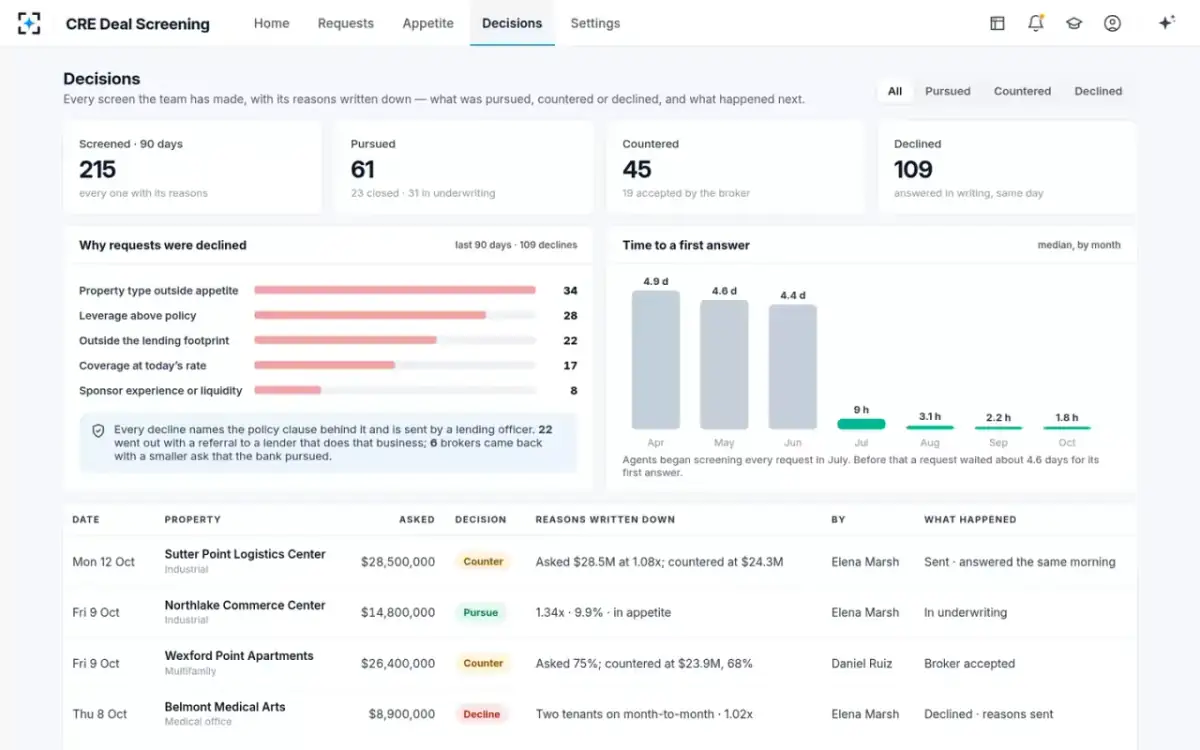
Do they give specific reasons in plain words, tied to a policy clause, and does anything go out before a person signs?
How many deals do you need to test underwriting software?
Enough to cover your property types, your brokers and your reasons for saying no; for most community and regional lenders that means dozens, not hundreds. A practical set is the last quarter's requests in full, so that the share of declines in the test matches the share in real life, plus older declines for any property type the quarter did not include.
Stratify the results the way examiners stratify exceptions. The OCC calls it prudent to age exceptions "with sufficient stratification to identify trends in volumes, loan officer, and types" (OCC). Do the same with the pilot's misses: a tool that is accurate on multifamily and wrong on medical office is a different purchase decision from one that is slightly off everywhere.
What a pilot should produce for every request: one page you can check against your own write-up
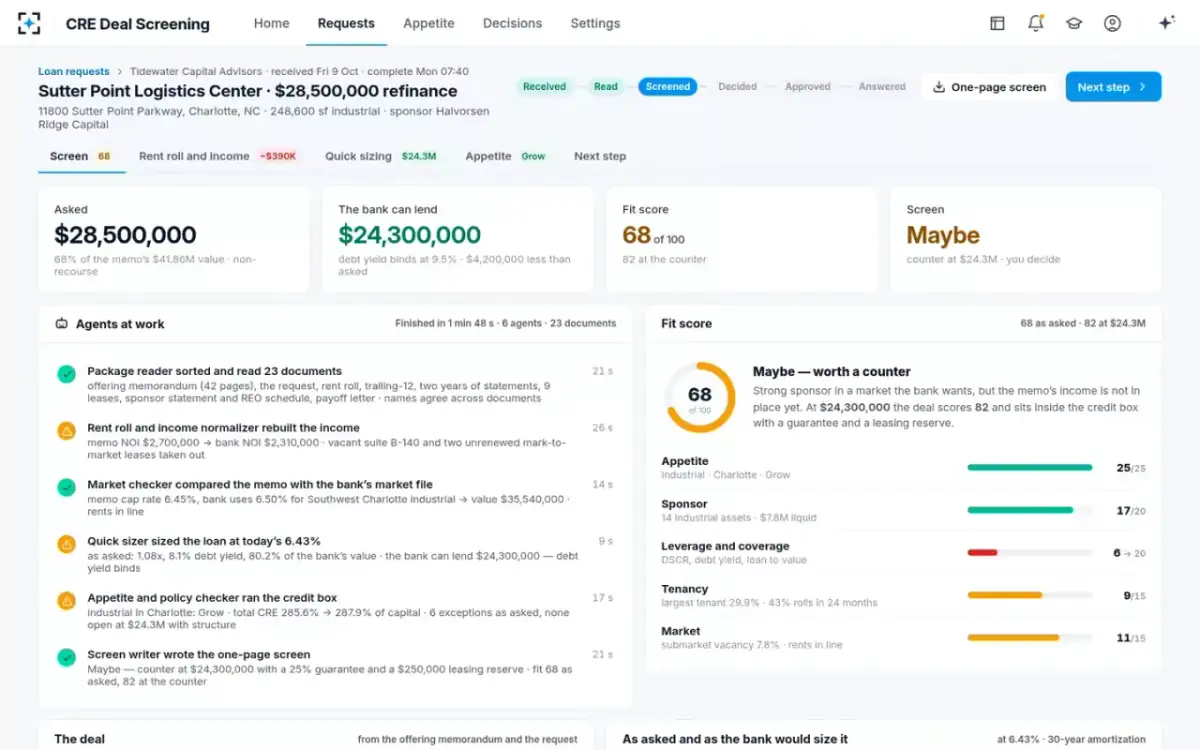
How to lay out the pilot results so credit can read them
One row per request, the software's answer beside the bank's, and a column for the reason they differ. The reason column is the one that decides the purchase: a difference explained by a document the software read and your team missed is a finding in its favour, and a difference explained by nothing is a defect.
A pilot comparison sheet, laid out on four of the sample bank's decisions
| Request | What the screen said | What to set beside it from your own file |
|---|---|---|
| Industrial refinance, $28.5M asked | Counter at $24.3M: 1.08x and 8.1% as asked; debt yield binds on $2.31M of in-place income | The approved amount, the NOI in the write-up and which test your credit team found binding |
| Industrial acquisition, $14.8M asked | Pursue: 1.34x and 9.9% debt yield, in appetite | Whether the deal closed as asked, and any exception credit listed that the screen did not |
| Apartments, $26.4M asked at 75% of value | Counter at $23.9M, 68% of value | The counter credit approved and whether the broker accepted it |
| Medical office, $8.9M asked | Decline: two tenants on month-to-month, 1.02x | The reason your officer gave, in the words sent to the broker, and whether the borrower came back |
Add two summary lines under the sheet: the share of requests where the decision matched (pursue, counter or decline), and, for those that matched, the median gap between the software's maximum loan and the approved amount. Then read every mismatch and group them. Misses that cluster, on one property type whose floors were set differently from the bank's, or on one broker's unusual rent roll layout, point to configuration that can be fixed before go-live; misses scattered across everything point to the software.
Does underwriting software need model validation?
Under the 2026 interagency guidance, most of a screening tool is not a model at all, and the parts that might be are outside the guidance's scope for now. The revised guidance says the term model "excludes simple arithmetic calculations, such as those found within spreadsheets, as well as deterministic rule-based processes" and that generative and agentic AI "are not within the scope of this guidance" (OCC Bulletin 2026-13).
It is also pitched at large banks: the guidance "is expected to be most relevant to banking organizations with over $30 billion in total assets", and the OCC states that its model risk guidance does not "require community banks to perform annual model validation". None of that removes the need to test. It means the test a community bank owes is the practical one on this page, documented and repeated when the software or the credit box changes, rather than a full model validation programme. A scoring model that rates borrowers statistically would be a different matter.
What should underwriting software show for each number?
Its source, its rule and its effect. A screen that says "NOI $2.31 million" tells a credit officer nothing they can check; one that shows the memo's $2.70 million, each deduction with the page or policy it came from, and the effect of each on the loan lets the officer agree or disagree line by line.
That standard is not ours alone. The 2006 interagency guidance expects exceptions to be documented with "how the transaction does not conform to the institution's policy or underwriting standards" and reported with "the number, nature, justifications, and trends" (71 FR 74580). Software that cannot say why it flagged something cannot feed that report, and software that cannot say where a number came from will be retyped by the underwriter who receives it, which removes most of the reason to buy it.
Where CRE Deal Screening fits, and where it does not
CRE Deal Screening is lender-side and narrow: it gives every request a first look before underwriting starts. Six agents read the package, rebuild the income on the bank's floors, check the memo against the bank's market file, size the loan at today's rate sheet, test appetite and policy, and draft a one-page screen and reply for a lending officer to sign. On the sample refinance the screen took 1 minute 48 seconds.
It does not replace full underwriting, appraisal review, environmental due diligence or the bank's loan origination system. It hands pursued deals to the underwriter with the bridge, the sizing and the open exceptions attached. The honest pilot is the one described here: a sample of your own recent broker packages, run as they arrived, compared with what your team decided. For the economics of that choice against a calculator or spreadsheet, see the full cost of sizing tools; for where it sits in a lending stack, where deal screening fits.
After a pilot, the reasons behind every answer, counted
Questions people ask
What is the difference between underwriting software for banks and for investors?
Investor tools ask whether to buy and usually model the business plan's rent growth and exit. Bank tools ask how much to lend and should start from rents in place, the bank's own cap rate and its policy minimums. The OCC names projections above current rents as an underwriting weakness, so a bank should not size on an investor's model.
How long should a pilot of CRE underwriting software take?
The software's part is quick: on the sample refinance, a screen took under two minutes. The time goes on assembling the test set from your files and comparing results with your credit write-ups, so plan for the credit team's review hours rather than the software's run time.
Should a pilot include declined deals?
Yes. Declines test the false-decline rate and whether the software's reasons match your policy. A pilot made only of closed deals can show the software sizes well while hiding that it would have turned away loans your bank was right to make.
What accuracy should automated CRE sizing reach?
The arithmetic itself should be exact; the question is income and value. Because the maximum loan moves one for one with income under the coverage and debt yield tests, set the pass line on the income bridge first and agree it with the chief credit officer before the results are in.
Does CRE underwriting software replace the underwriter?
Not in a bank. It removes reading and retyping from the first look; the underwriter still owns the full analysis, the valuation review and the credit recommendation, and a person with lending authority still decides.