In a bank's commercial real estate underwriting process, the underwriter takes a loan request on an office building, an apartment complex, a warehouse or a shopping centre and works out whether the property's own income can carry the debt: they rebuild net operating income from the rent roll and operating statements, check the value, size the loan against the bank's limits on loan to value, debt service coverage and debt yield, and write up every exception for the credit officer who decides. The hard part is not the arithmetic. It is that requests arrive faster than anyone can read them, broker packages are written to sell, and a good share of the week goes on deals the bank will never do. Botminds' CRE Deal Screening gives every request a first look before the underwriter sees it, so the deals that reach the underwriter's desk are the ones the bank wants.
This guide follows that week. The examples come from a fictional sample bank, a CRE lending team covering the Carolinas and Virginia, as it runs through the solution; the people, brokers and properties are invented. The rules and research are from regulators and peer-reviewed work, linked where they appear.
A quarter of an underwriter's week can go on first looks the bank mostly declines
- First looks12 h
- Rebuilding income13 h
- Write-ups, committee10 h
- Brokers6 h
- Reviews4 h
- Check3 h
- Rebuilding income17 h
- Write-ups, committee14 h
- Brokers5 h
- Reviews6 h
What does a commercial real estate underwriter do?
A commercial real estate underwriter decides whether a property's cash flow and value support the loan being asked for, and on what terms. The work runs in a fixed order: read the package, rebuild the income, value the property, size the loan, test it against policy, and write it up. The underwriter recommends; a loan officer or committee with lending authority approves.
The official occupational descriptions cover the pieces but not the property. The Department of Labor's O*NET profile for credit analysts lists tasks such as "Generate financial ratios, using computer programs, to evaluate customers' financial status" and "Complete loan applications, including credit analyses and summaries of loan requests … and submit to loan committees for approval" (O*NET 13-2041.00). The loan officer profile adds "Approve loans within specified limits, and refer loan applications outside those limits to management for approval" (O*NET 13-2072.00). Neither mentions rent rolls, leases, cap rates or site visits, which is most of what a CRE underwriter actually reads.
The regulator's description is closer. When an OCC examiner reads a CRE loan file, the instruction is to "Determine the primary source of repayment of each loan and evaluate its adequacy", and for income property to "Review current rent rolls and leases and assess the quality and mix of tenants. Note any significant volume of leases scheduled to expire. Analyze the potential effect on future debt-service coverage from tenant turnover" (OCC, Commercial Real Estate Lending, v2.0). That is the underwriter's job description in one paragraph, written from the side that checks the work afterwards.
The people who do this work, as the government counts them
283,000
loan officer jobs in 2025, all types of lending
BLS Occupational Outlook Handbook
64,390
credit analysts employed, May 2025
BLS OEWS 13-2041
1%
projected growth in loan officer jobs, 2025 to 2035
BLS Occupational Outlook Handbook
Monday: the package, and what a commercial real estate underwriter looks at first
The first thing to read is not the offering memorandum's summary page; it is the rent roll, then the trailing-12 operating statement, then the leases behind the largest tenants. The memorandum is the broker's case for the deal. The rent roll is what tenants are actually paying, and the trailing-12 is what the property actually earned.
A broker package for one multi-tenant industrial refinance at the sample bank holds 23 documents: the memorandum, the request, the rent roll, the trailing-12, two years of statements, nine leases, the sponsor's statement and schedule of real estate owned, and a payoff letter. Before anyone can answer the broker, someone has to sort them, check that names and numbers agree across them, and notice what is missing. A package without a rent roll or a current operating statement cannot be screened at all, however strong the memorandum reads.
What a commercial real estate underwriter looks at first, and the rule behind each check
| Check | What to look for | Why it comes first |
|---|---|---|
| Rent roll against the memo | Suites the memo shows as leased that the rent roll shows as vacant; renewals priced at market before anyone has signed | The OCC names "higher than current rents or occupancy rates" as an underwriting weakness |
| Trailing-12 against the memo income | A pro forma NOI that is higher than any year the property has actually earned | Underwritten NOI is meant to be "a stabilized estimate of income and expenses", not a projection |
| Largest tenant and expiries | One tenant paying a quarter or more of the rent; a large share of leases expiring inside the loan term | Examiners are told to "note any significant volume of leases scheduled to expire" |
| Ask against the bank's limits | Loan to value, coverage and debt yield on the bank's income, not the memo's | Policies must set "clear and measurable underwriting standards" (12 CFR 34, Appendix A) |
| Property type and market against appetite | Whether the bank is growing, holding or shrinking this property type in this market | A CRE strategy "states the bank's intent by product type, product risk appetite … geographic location" |
Each of those checks can end a request in minutes, which is why the order matters. A medical office request that asks for 87% of value on one tenant paying 58% of the rent is outside most banks' appetite before anyone opens the trailing-12. An industrial refinance whose memo leases a vacant suite is not outside appetite at all; it is simply asking for a loan sized on income that is not there yet, and the right answer is a smaller loan, not a no. Telling those two apart is the judgment, and the gap between in-place and pro forma income is where most of it is made.
Tuesday: rebuilding the income on the bank's own floors
The underwriter's central task is to turn the broker's income into the bank's: start from rents in place, apply the bank's vacancy, management fee and replacement reserve, and document every step. The OCC is explicit that the analysis should be challenged where it is weak: "Inadequately supported or questionable analysis should be challenged" (OCC).
On the sample industrial refinance the memo shows $2.70 million of income. The rebuild takes out $180,000 for a suite the memo leases from January but that has been vacant since May, $77,820 for two renewals marked to market before either tenant signed, and then applies the bank's floors: vacancy at 5% where the memo used 3%, management at 3% where the memo used 2%, and reserves of $0.15 a square foot where the memo had none. The bank's income is $2,310,000, against $2,356,800 the property actually earned over the trailing twelve months.
The rebuild on one page: rent roll in place on the left, the bridge from the memo's income on the right
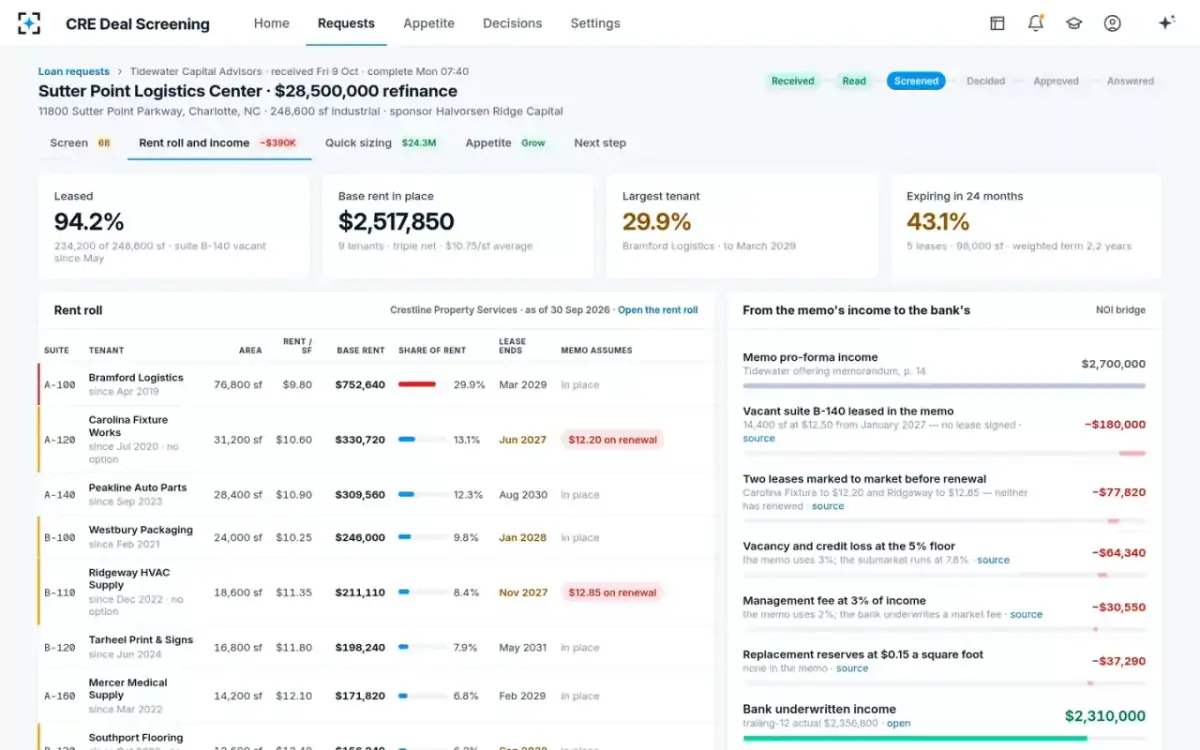
This is the work underwriters are hired for, and research says it matters. In a study of 39,522 loans pooled into commercial mortgage securities between 2013 and 2019, Griffin and Priest found underwritten income "commonly overstated relative to actual property income", with overstatement varying "widely and persistently across originators" and "highly predictive of pre- and COVID-period loan distress" (Journal of Finance, 2023). The rebuild is where a bank decides whether it will be one of the originators that overstates.
Wednesday: sizing the loan, and why the answer is usually smaller than the ask
Sizing turns the rebuilt income into a maximum loan: the most the bank can lend on loan to value, on debt service coverage and on debt yield, and the lowest of the three. On the sample refinance, at a 6.43% rate and 30-year amortization, the three tests allow $24.87 million, $24.54 million and $24.31 million; debt yield binds and the loan is $24.3 million, $4.2 million less than the $28.5 million asked.
The ask was not careless. Sized on the memo's $2.70 million of income, the same three tests would have allowed about $28.4 million, almost exactly the request. The broker sized the loan correctly on the wrong income. That pattern is common enough that the first sentence of most counters is about income, not leverage. The lesser-of-three sizing method is worked through in full on its own page, including which test binds for which property type.
"We would like to do this loan, sized on the property's in-place income rather than the memo's pro forma."
The fictional sample bank's lending officer, in the reply drafted to the broker
Thursday: credit write-ups, committee and the exceptions file
A deal the bank pursues becomes a credit write-up: the income bridge, the valuation, the sizing, the sponsor and guarantor analysis and every exception to policy, with its justification. The exceptions part is not optional. The 2006 interagency guidance says that when a bank permits an exception "it should document how the transaction does not conform to the institution's policy or underwriting standards, obtain appropriate management approvals, and provide reports to the board of directors or designated committee detailing the number, nature, justifications, and trends for exceptions" (71 FR 74580).
The OCC adds the reason examiners read those reports closely: "An excessive or significantly increasing number of exceptions to the CRE lending policy could indicate that the bank is unduly relaxing its underwriting practices" (OCC). It also expects exceptions aged and stratified "to identify trends in volumes, loan officer, and types". An underwriter's Thursday is therefore partly for the deal and partly for the bank's own reporting: every exception granted this week is a line in next quarter's board report.
How many deals does a commercial real estate underwriter review?
There is no published benchmark for how many requests a CRE underwriter reviews; it depends on the bank's size, its markets and whether first looks are done by lending officers or by underwriters. What a bank can measure is its own funnel, and the funnel is the argument for screening: most requests do not become loans.
215 requests in 90 days at the sample bank, and how few became loans
The decline reasons are the useful part. Property type and footprint alone account for 56 of the 109 declines, and neither needs an underwriter: they are answered by the bank's appetite and a map. Leverage and coverage account for another 45, and those need the income rebuilt, but only far enough to see that no structure works. An underwriter who gives first looks to all 215 spends most of that effort on requests whose answer is in the bank's own policy.
The volume is not falling. The Mortgage Bankers Association's 2025 maturity survey found that $396 billion, 21% of the commercial and multifamily mortgages serviced by depositories, was scheduled to mature in 2026 (MBA). Every one of those is a refinance request somewhere, often to a bank that did not make the original loan.
Friday: the replies nobody writes down
The week ends with answers to brokers, and the declines are the ones that go missing. A pursue becomes a term sheet and a file. A decline is often a phone call, and then nobody can say, a quarter later, why the bank turned down a sponsor who keeps money on deposit, or whether two similar requests were treated alike.
Written reasons matter for more than memory. Under Regulation B, a refusal "to grant credit in substantially the amount or on substantially the terms requested" is adverse action unless the bank counteroffers and the applicant accepts (12 CFR 1002.2(c)), and for business credit the applicant can ask for the reasons. Whether a broker's first enquiry is yet an application is a separate question, and one that the guide to AI in commercial real estate underwriting takes up, because it decides what an automated first look may and may not send.
Five people touch the same request in CRE Deal Screening, and what each keeps
Today
Reads forty packages a month to find the ten worth underwriting, and answers brokers four or five days later.
With agents
Works through a deck of screened requests with the counter and reply already drafted, and decides pass, counter or pursue.
Still theirs: The decision and the signature on every reply, up to the officer's limit.
Today
Starts from the memo's pro forma income and finds the gaps alone.
With agents
Receives only pursued deals, with the income bridge, sizing and open exceptions on a one-page screen.
Still theirs: The full underwriting, the valuation review and the credit write-up.
Today
Hears a request was declined, but not why.
With agents
Approves anything above the officer's limit with the screen and reasons in front of them.
Still theirs: Approval above the limit, and the decline reasons by category.
Today
Learns how a deal moves concentration when it reaches committee.
With agents
Sees each request placed against property-type limits before anyone pursues it.
Still theirs: The appetite, the limits and any change to the bank's sizing tests.
Today
Worries a slow first look will lose a depositor.
With agents
Sees every request from the bank's clients and is copied on the reply.
Still theirs: The client conversation.
Where does the pressure on a CRE underwriting desk come from?
The pressure comes from the clock and the asymmetry, not the arithmetic. A broker can send the same package to several lenders, and a slow answer gives the others a head start on the good deals. A careless first look loses money later. And the underwriter is the person in the middle of both.
The regulators' own warnings describe the pressure from the other side. In 2015 the agencies observed that "the competition for loans has resulted in an easing of underwriting standards and increases in underwriting exceptions" (OCC Bulletin 2015-51), and the OCC booklet notes that "Increasingly liberal underwriting can be a response to increased competition among banks for loans or an increase in risk appetite". Speed and discipline pull against each other on every request, and the underwriter holds both.
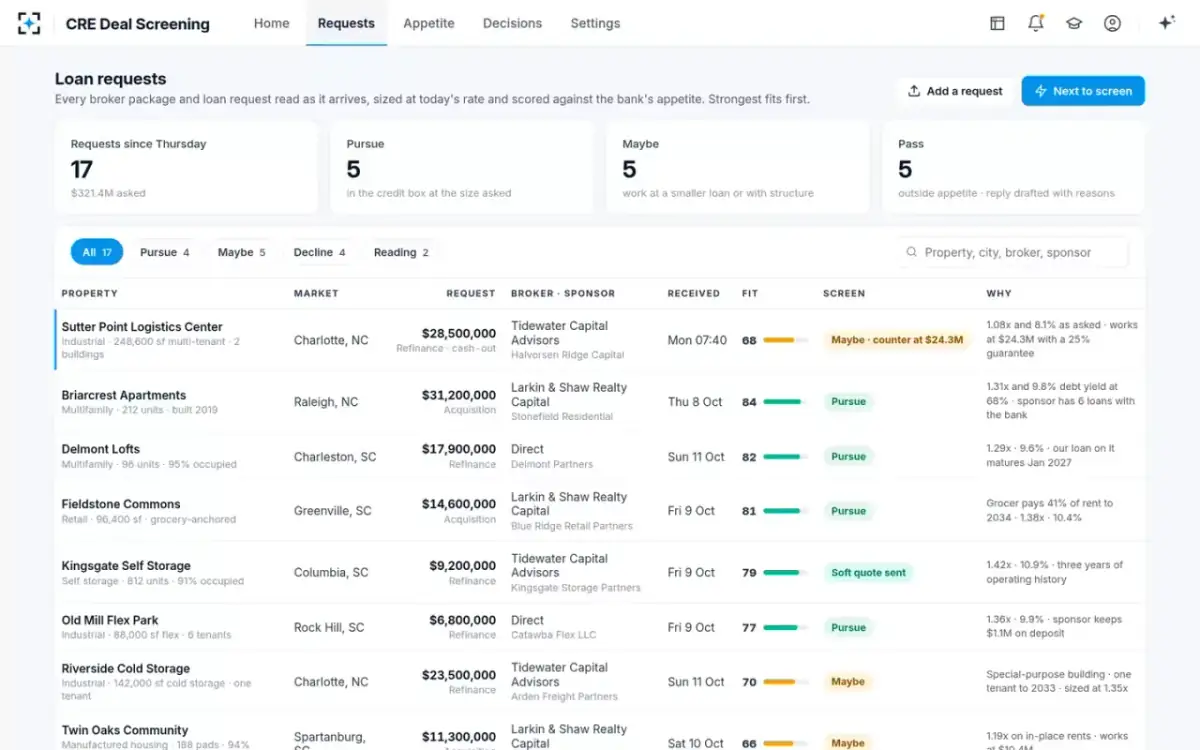
Seventeen requests since Thursday, ranked so the strongest fits come first
Where CRE Deal Screening fits in the underwriter's week, and where it does not
The solution takes the first look, not the underwriting. Six agents read the package, rebuild the income on the bank's floors, check the memo's rents and cap rate against the bank's market file, size the loan at today's rate sheet, test it against appetite and policy, and draft a one-page screen and a reply. A lending officer decides and signs. On the sample refinance that took 1 minute 48 seconds from a complete package.
What stays with the underwriter is everything after "pursue": the full credit analysis, the appraisal review, the sponsor and guarantor work, the site visit and the write-up. The screen hands those on with its reasoning attached, so an underwriter can start where it stopped or disagree with it line by line. It does not replace the bank's loan origination system or spreading tool; it sits in front of them.
For an underwriting team the gain is concentration: the hours in the top lane of the week above move to deals the bank is likely to close. For the bank the gain is a written reason for every answer, which the sample bank's decisions view counts by category, as in the chart above. For the policy behind the minimums, debt service coverage ratio minimum requirements explains where a coverage floor comes from and how it is governed.
Questions people ask
What does a CRE underwriter own in the underwriting process?
A CRE underwriter analyses income-producing property loans: reads the rent roll, leases and operating statements, rebuilds net operating income, reviews the value, sizes the loan against the bank's policy and writes a credit recommendation with any exceptions. The OCC's file-review instruction, to determine "the primary source of repayment" and review "current rent rolls and leases", is a fair summary of what the job checks.
What is the difference between a commercial real estate underwriter and a credit analyst?
Many banks use the titles for the same seat. Where they differ, the credit analyst spreads financial statements and computes ratios for the borrower and guarantors, while the CRE underwriter owns the property side: rent roll, leases, NOI, value and sizing. Both recommend; neither usually approves.
How long does it take to underwrite a commercial real estate loan?
No regulator publishes a benchmark, and full underwriting depends on the appraisal, environmental and third-party reports. The first look is the part a bank can shorten: at the sample bank the median time to a first answer fell from 4.9 days in April to 1.8 hours in October once requests were screened on arrival, sample data rather than a customer result.
Will AI replace commercial real estate underwriters?
Not on the evidence regulators give. The OCC describes bank use of generative and agentic AI as "generally limited to specific use cases with guardrails and human-in-the-loop accountability". AI can read packages and draft the arithmetic; the judgment on a sponsor, a market and an exception, and the signature, stay with people.