The most cited small business loan statistics start here: US lenders reported about 9.1 million small-business loans of $1 million or less in 2024, worth about $276.6 billion, under the Community Reinvestment Act, and only the larger banks report. The SBA guaranteed another 84,400 loans in fiscal 2025. Behind them, FDIC-insured banks held $2.54 trillion of commercial and industrial loans in June 2026. Every one of those loans began as an application someone had to assemble into a credit file, and most of them were small. That is the arithmetic behind commercial loan origination: for a $60,000 loan, the hours spent requesting, chasing and sorting documents can take a real share of a year's margin. Botminds' Commercial Loan Origination exists to cut that intake work per file. This page sizes the work from public data and shows how to cost it.
What US banks hold: commercial balances, June 30, 2026
How many small business loans are made each year?
About 9.1 million were reported for 2024 under the Community Reinvestment Act, a floor rather than a total. CRA "small business loans" are loans of $1 million or less, and only banks above an asset threshold ($1.564 billion for 2024) report them: 731 lenders in 2024. Smaller banks, credit unions and nonbank lenders also lend to small businesses and are not in the count. The reported loans totalled about $276.6 billion, and the number originated rose 8.3% on 2023.
The flow of new business lending, from four public series
9.1M
small-business loans reported under CRA in 2024, $276.6 billion
reporting banks only
84,400
SBA 7(a) and 504 loans guaranteed in fiscal 2025, $44.8 billion
6.15M
S corporation returns filed in fiscal 2025, more than partnership or C corporation returns
+$46.6B
growth in C&I balances in the second quarter of 2026 alone
The demand side is steady rather than surging. In July 2026, banks told the Federal Reserve they saw stronger demand for C&I loans from large and middle-market firms and basically unchanged demand from small firms, with standards basically unchanged. Business lending growth in 2026 is therefore coming from bigger borrowers. Most of the files, though, still come from small ones.
What is the small business loan approval rate?
About four in ten small firms that applied for financing in 2025 got everything they asked for. In the Federal Reserve Banks' survey of 6,525 small employer firms, 42% of applicants received the full amount, 36% received some or most, and 22% received none. Where they applied mattered: applicants at small banks were fully approved 57% of the time, more often than at any other kind of lender. No regulator publishes a single "approval rate" for business loans; this survey, of firms rather than lenders, is the closest public measure.
Who applies for small business credit, and what happens
60%
of small employer firms applied for financing in the prior 12 months
38%
applied for a loan, line of credit or merchant cash advance specifically
22%
of applicants received none of the financing they sought
46%
of those not fully approved said lender requirements were too strict
The denials say as much about documents as about credit. Among applicants not approved for at least some of what they sought, 46% said lender requirements were too strict, and firms that did not apply because they expected a no most often cited weak business financials. Where firms go is shifting too: the share of applicants that tried online fintech lenders rose from 17% in the 2020 survey to 29% in 2025. For a bank, the statistic that matters is the one it can change: how many good applicants it keeps while their file is being assembled.
The C&I book in 2026
Commercial and industrial loans at FDIC-insured institutions reached $2,540 billion on June 30, 2026, up from $2,390 billion a year earlier, a rise of about 6.3% (our arithmetic). In the second quarter alone the FDIC counted "commercial and industrial loans (up $46.6 billion or 1.9 percent)" among the largest increases. Credit quality was sound: 0.96% of C&I loans were noncurrent, and the year-to-date net charge-off rate was 0.57%.
That book turns over. Lines to small firms rarely run long. An NBER study of supervisory loan data found that among firms with less than $50 million in assets, three-quarters of credit lines mature in a year or less. A large share of the "existing" book therefore comes back through intake every year as a renewal, with the bank asking again for statements, returns and certifications. Much of that is avoidable, as commercial loan renewal: stop asking for documents the bank has argues.
Most loans are small, most dollars are not
Small loans dominate the count, and that is the economic problem in one chart. Of the small-business loans reported under CRA in 2024, 95% by number were under $100,000, yet those loans carried only 44.5% of the dollars. A bank's credit decisions are concentrated in a few large loans, while its intake work is spread across many small ones.
Loans under $100,000: almost all of the count, under half the dollars
By number of loans originated
- Under $100,000 · 95%
- $100,000 to $1 million · 5%
By dollars originated
- Under $100,000 · 44.5%
- $100,000 to $1 million · 55.5%
The revenue cut tells a similar story. CRA reporters said 53.8% of their small-business originations by number, but 34.6% by dollars, went to firms with revenues of $1 million or less. That $1 million line matters twice in commercial origination. Regulation B uses it to decide how a declined business must be notified, and the rewritten Section 1071 rule uses it to define a small business. The rule covers lenders with at least 1,000 originations in each of the two prior years from January 1, 2028, and the CFPB estimates it still captures about 92 to 93% of depository small-business originations. The details are on our page about Section 1071 after the 2026 rule.
SBA's share, and what each guaranteed file demands
SBA loans are a small slice of the count but a heavy slice of the paperwork. In fiscal 2025 the agency guaranteed 77,600 7(a) loans for $37 billion and 6,750 504 loans for $7.8 billion, an average of about $477,000 and $1.16 million (our arithmetic). Each 7(a) file must carry three years of financial history plus an interim, reconciled to IRS transcripts under the SBA's tax verification process, and a credit memo that addresses repayment from the business's cash flow.
Every commercial file starts from tax returns. The IRS recorded 6.15 million S corporation returns, 5.22 million partnership returns and 2.35 million C or other corporation returns in fiscal 2025. Pass-through returns, with K-1s connecting the business to its owners, are what a commercial lender reads first and what a guarantor's personal returns must be read against.
How much does it cost a bank to originate a commercial loan? Intake, built from wages
No regulator or independent study measures how many hours a commercial file takes to assemble, so a bank has to build the figure from its own time study. Public wage data gives it a floor. In May 2025 the mean hourly wage was $25.25 for loan interviewers and clerks, the occupation most coordinators sit in, $42.21 for loan officers and $48.49 for credit analysts, before benefits and overhead.
An illustrative intake cost, set against the margin on three loan sizes
| Line | Assumption | $60,000 loan | $500,000 loan | $6.85 million deal |
|---|---|---|---|---|
| Coordinator time | 6 hours at $25.25 | $152 | $152 | $152 |
| Banker time on documents | 2 hours at $42.21 | $84 | $84 | $84 |
| Analyst time on a returned file | 2 hours at $48.49, on 40% of files | $39 | $39 | $39 |
| Wage cost of intake | Sum, before benefits and overhead | $275 | $275 | $275 |
| First-year margin | Assumed 3.0% net spread | $1,800 | $15,000 | $205,500 |
| Intake as a share of first-year margin | Wage cost ÷ margin | about 15% | about 2% | about 0.1% |
A file's size follows the deal's facts, not its dollar amount
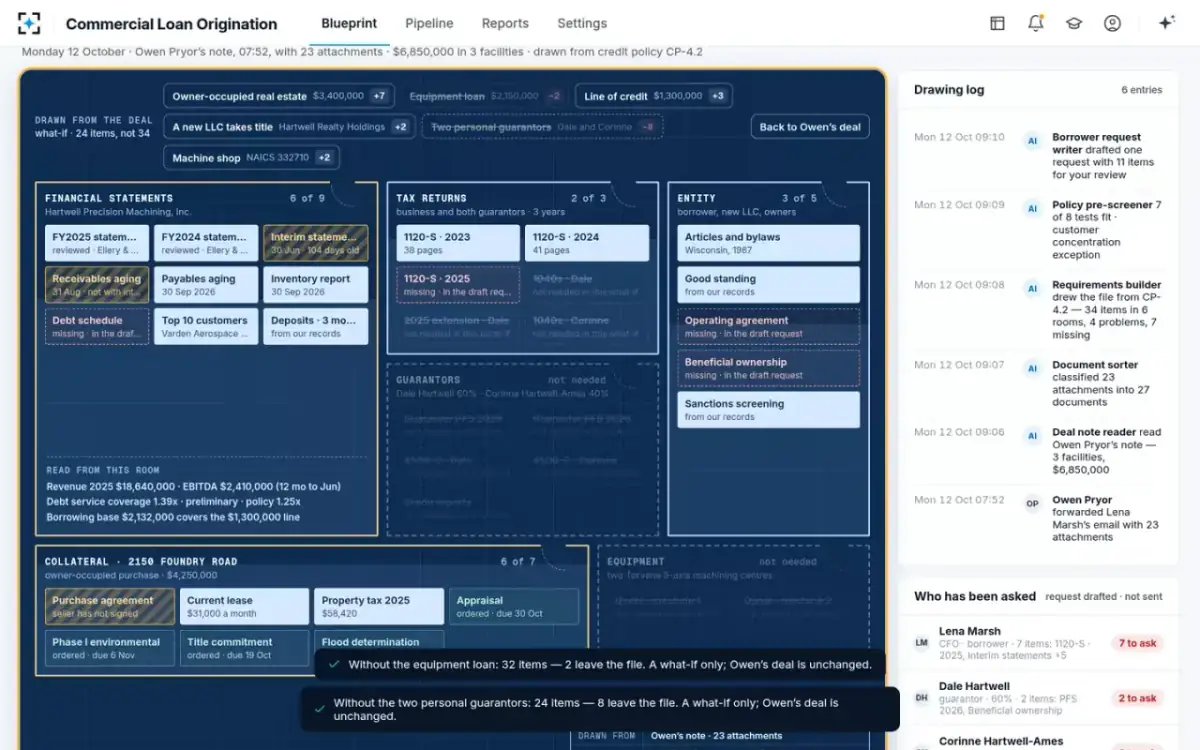
The table is deliberately crude, and its lesson survives any reasonable change of inputs. Intake effort grows with complexity much more slowly than margin grows with size. The same few hours of requesting, chasing and sorting that are trivial on a multi-million-dollar relationship are a real share of the margin on a five-figure loan. That is why many banks steer small loans to scoring, with the analyst's judgement reserved for larger credits. The FDIC found that automated lending "is used almost exclusively for smaller loans", and that fewer than one bank in thirty uses a credit-scoring system to auto-approve. Between full automation and a fully manual file sits the option this solution takes: keep the human credit decision and remove the manual intake around it.
What the numbers mean for an origination desk
A commercial origination desk is a volume operation with a judgement step in the middle. The volume is in the files, most of them small and many of them renewals. The judgement belongs to analysts and committees, and their time should go to the few deals that need it. In a fictional sample bank used to demonstrate the solution, the pipeline on one October morning held eight deals in intake worth $18.32 million, four of them waiting on borrowers and two past the bank's five-day setting.
A pipeline is a count of files, each with its own clock
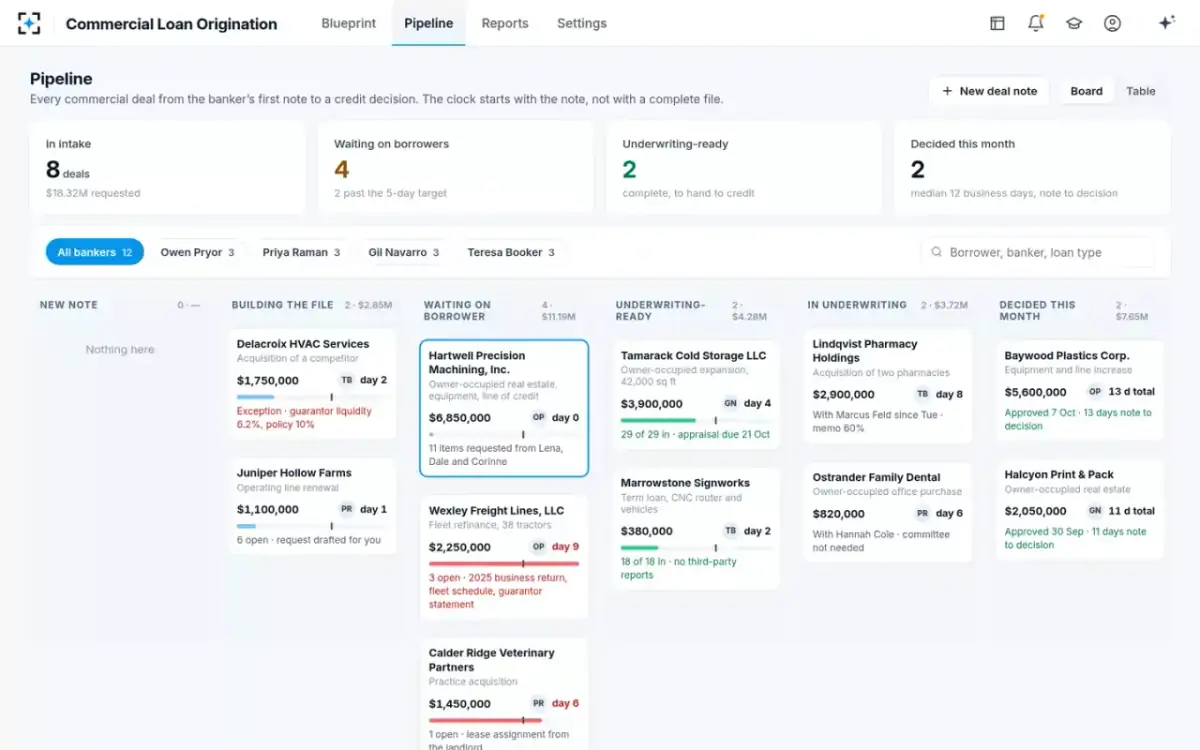
For a bank deciding where software belongs, the public numbers point to intake first, not decisions. The economics of a day in intake are worked through in how long a commercial loan takes to close, and what a day is worth, and the people who carry the files are described in the commercial loan application process, step by step. The solution itself is at Commercial Loan Origination.
Questions people ask
What counts as a small business loan?
It depends on the rule. CRA reporting counts loans of $1 million or less to businesses, whatever the borrower's size. The rewritten Section 1071 rule defines a small business by the borrower instead, as one with gross annual revenue of $1 million or less, and Regulation B uses the same revenue line for its adverse-action tiers.
Where do small businesses apply for loans?
Mostly at banks, but a growing share try online lenders: 29% of applicants in 2025, up from 17% in 2020. Bank and credit union applicants reported more satisfaction than applicants at online lenders and finance companies, and fewer surprises on cost.
How many lenders report small business loan data?
For 2024, 731 lenders reported small-business loans under the Community Reinvestment Act; only banks above the asset threshold must. From January 1, 2028, the rewritten Section 1071 rule will add application-level data from lenders with at least 1,000 covered originations in each of the two prior years, which the CFPB estimates covers 92 to 93% of depository small-business originations.
How many business loans go bad?
Few, at present. On June 30, 2026, 0.96% of C&I loans at insured banks were noncurrent and 1.27% were past due or nonaccrual. Community banks run higher: the FDIC reported their C&I past-due-and-nonaccrual rate at 1.81 percent at the end of 2025, above the pre-pandemic average of 1.62 percent.
How quickly do banks approve small business loans?
Quickly, once they have the file. In the FDIC's survey of about 1,300 banks, three in ten can approve a small, simple loan within one business day, three in four within five, and three in four approve their typical loan within ten. The slower part is usually assembling the file before the decision.