AI loan origination earns its place in commercial lending at intake, and the agent that does it should ask, not guess, whenever the answer is a fact only the borrower or a person at the bank can supply: which period a statement covers, whether a page was signed, who owns 25% of a new company, whether a second equipment quote exists. Commercial loan document collection is the slow middle of origination. A relationship manager forwards a pile of attachments, someone works out what the credit policy needs for this deal, and the bank goes back to the borrower for what is stale, unsigned or missing. Botminds' Commercial Loan Origination puts six agents on that work. This page is about one design choice in them: when the file does not say, they stop and ask, and they ask in a way that gets the answer the first time.
Commercial Loan Origination: who reads, who asks, who decides
Agent
Deal note readerTurns the banker’s note into the request: borrower, facilities, amounts, purpose, collateral, guarantors. Every field cites the sentence it came from.
Never: Sets pricing or terms
Agent
Document sorterSplits combined files, classifies and dates every document, ties it to its party, reads key figures.
Never: Guesses a period it cannot read; it marks it unknown
Agent
Relationship and exposure checkerPulls what the bank already holds: loans, deposits, good standing, sanctions screening.
Never: Pulls a credit report without signed authorisation
Agent
Requirements builderDraws the needs list from the credit policy and tests each item for freshness, signatures and matching dates.
Never: Waives a requirement
Agent
Borrower request writerDrafts one plain-language request for everything still open.
Never: Asks for anything the bank already has
A person decides
Loan coordinatorReviews the draft and sends the first request.
Agent
Borrower request writerChecks each upload as it lands and asks again at once when one fails; sends reminders on the bank’s cadence.
A person decides
Loan coordinatorCertifies the file complete under the policy and sends it to credit.
How does AI collect loan documents from borrowers? By asking, not guessing
It reads everything that arrives, works out what is missing or unusable, and asks the person who can supply it: it says exactly what is needed and why, and records that the item is open. The alternative, filling the gap from something nearby, produces a file that looks complete and is wrong. In commercial lending that wrong file reaches the credit analyst, who either catches it and sends it back or does not catch it and underwrites on it.
The risk is not hypothetical for language models. The U.S. Treasury's 2024 report on AI in financial services warns that generative models can produce "confidently stated but incorrect output". The OCC's Spring 2026 risk perspective describes how banks are responding: use cases "generally limited to specific use cases with guardrails and human-in-the-loop accountability to manage risk". An intake agent that asks rather than infers is that principle made concrete. Where the documents are silent, it declines to make something up.
Take a fictional sample deal as it runs through the solution. Hartwell Precision Machining asks the fictional Meridel Valley Bank for $6,850,000 in three facilities: a building purchase into a new LLC, two machines and a larger line, with two owners guaranteeing. The CFO sends 23 attachments. The agents read every one, draw a 34-item file from the bank's credit policy, and find 11 items that only the borrower's side can close.
How is AI used in loan origination today?
In commercial lending, AI is used today mostly to read and organise documents, extract figures, check files against policy and draft messages and memos, with people making the credit decision. Automated decisions remain rare above small loans. The FDIC's survey of about 1,300 banks found that "less than one in thirty banks use a credit-scoring system to auto-approve loans, and less than one in one hundred banks will auto-approve a loan of $250,000". Commercial credit is still judged by people reading a file.
AI in loan origination: much reading, little deciding
1 in 10
banks with a scoring system that can partly or fully automate some non-card underwriting
< 1%
of banks will auto-approve a $250,000 business loan
11%
average share of banks using AI, 2017 to 2022, in Census Bureau research
$30B
bank size above which the 2026 model-risk guidance expects to be most relevant
The adoption pattern regulators describe fits that division of labour. The OCC's Spring 2026 risk perspective reports that banks are taking "a measured approach to the adoption of generative AI (genAI) and agentic AI", and that the use cases it has seen are "primarily productivity and customer experience enhancement tools". Census Bureau researchers found that on average 11% of banks used AI from 2017 to 2022, and that banks using more AI lent more to distant borrowers. The productive place for AI in origination is the work that sits between a banker's handshake and an analyst's first look: the document work.
Agentic AI in loan origination means software that pursues a task through several steps on its own, such as reading 23 attachments, drawing a needs list, drafting a request and checking each upload, rather than answering one prompt. That autonomy is exactly why its limits must be explicit. In Botminds' Commercial Loan Origination each of the six agents has a written boundary, shown in the flow above: the deal note reader never sets terms, the sorter never guesses a period, the requirements builder never waives an item, and the request writer never asks for what the bank already holds.
Four gaps an agent must never fill on its own
Each of the 11 open items in the sample deal had a tempting shortcut. Four kinds recur on almost every commercial file, and the table sets out the shortcut a careless system would take and the question the agents ask instead.
Each gap has a guess that looks harmless, and a question that closes it
| Gap in the sample file | The tempting guess | What the agents do instead |
|---|---|---|
| Interim statements dated 30 June, 104 days old against a 90-day rule | Use them; they are the latest the borrower sent | Mark the item stale under the policy rule and ask for interims to 30 September |
| Receivables aging dated 31 August, not the interim date | Accept it; an aging is an aging | Ask for an aging at the same date as the new interims, so the borrowing base ties |
| A guarantor’s personal statement signed 14 May, 151 days old | Roll it forward from the business figures | Ask the guarantor for a new signed statement |
| Purchase agreement the seller has not signed | Treat the unsigned draft as the contract | Hold the item open and say so in the request |
| A new LLC taking title, with no ownership form | Copy the owners of the operating company | Ask for the beneficial ownership certification for the new entity |
| One equipment quote for two machines | Double the first quote | Ask for the second quote |
| A document whose period cannot be read | Assume a calendar year-end | Mark the period unknown and put it in front of a person |
Stale is a policy fact, not an opinion
The agents test freshness against the bank's own rule, here interim statements no older than 90 days and personal statements signed within 90 days. The OCC's 2026 lending handbook lists "stale financial statements, tax returns, or borrowing base certificates" among credit administration exceptions. A stale document is an exception the bank will have to explain, so the agent flags it and asks.
Ownership has a legal definition
Beneficial ownership is a regulated fact. FinCEN's rule defines a beneficial owner as each individual who owns "25 percent or more of the equity interests" of a legal entity, plus one individual with significant control, identified when a new account is opened. A new LLC is a new legal entity customer, so the bank needs a certification for it. That the owners are probably the same people as at the operating company is a guess the rule does not allow.
Some answers require consent
Tax transcripts are a case where asking is the only route. The IRS "only provides tax records to a third party with the consent of the taxpayer", through Form 4506-C. In the sample deal, one guarantor's 4506-C was missing, so the request asked her to sign it. The same rule governs credit reports: the relationship checker pulls a report only for a guarantor who has signed an authorisation.
The request that replaces eleven emails
Asking well matters as much as asking at all. A file built one discovery at a time turns into a series of emails, each discovered a day or two after the last, and each one costs the borrower's patience. The solution's design target is one request to the borrower for everything missing, drafted by the borrower request writer and reviewed and sent by a person.
One email per discovery: As each gap is found, over days
One request for everything open: The morning the file is drawn
One email per discovery: Whatever the coordinator noticed last
One request for everything open: Every open item, each with the policy reason and the person it is for
One email per discovery: Often asked again
One request for everything open: Never asked; pulled from the bank’s records
One email per discovery: The coordinator, from scratch
One request for everything open: The coordinator, after reviewing the agent’s draft
One email per discovery: Found when someone opens it
One request for everything open: Checked as it lands; sent straight back to whoever uploaded it
One email per discovery: When someone remembers
One request for everything open: On the bank’s cadence; the banker told if items stay open
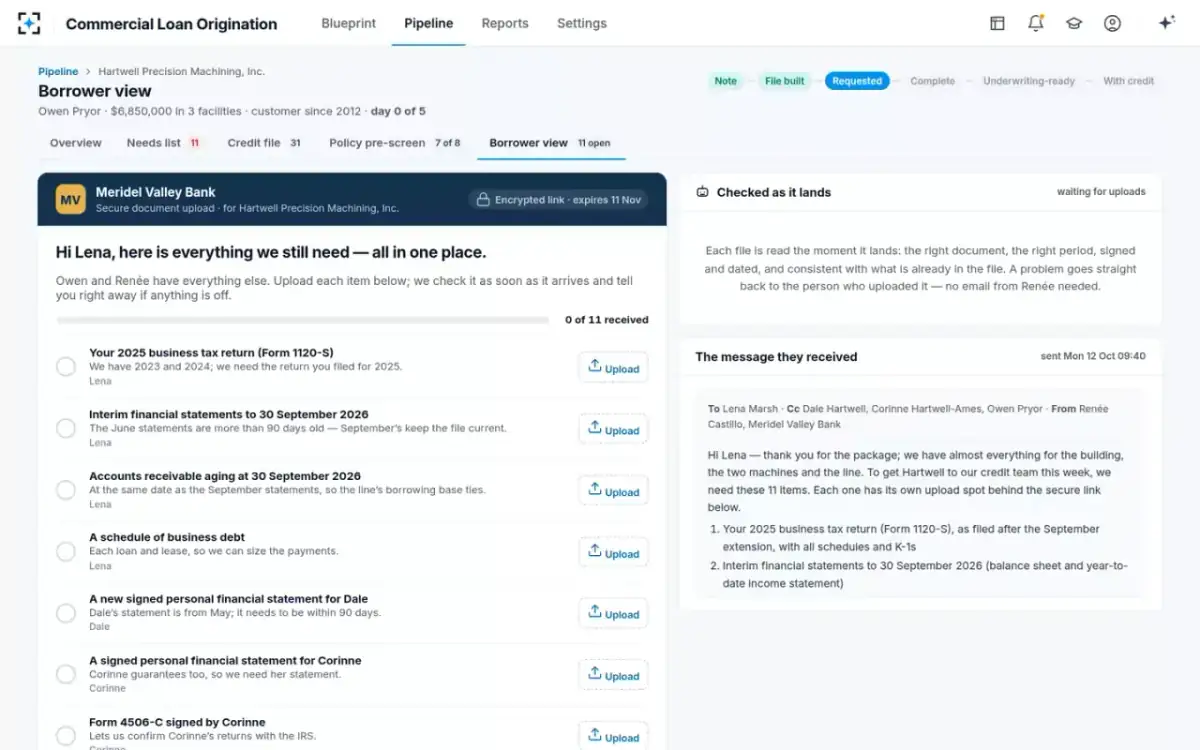
In the sample deal the request went out at 09:40 on the Monday, addressed to the CFO with both guarantors and the banker copied. It listed 11 items, for three people, each in plain words: "Your 2025 business tax return (Form 1120-S), as filed after the September extension, with all schedules and K-1s", "Interim financial statements to 30 September 2026". It did not ask for the 2023 and 2024 returns, the deposits or the good standing certificate, because the bank already had them.
What the borrower sees: the whole list, once, with a reason on each line
Checked on arrival: the unsigned page four
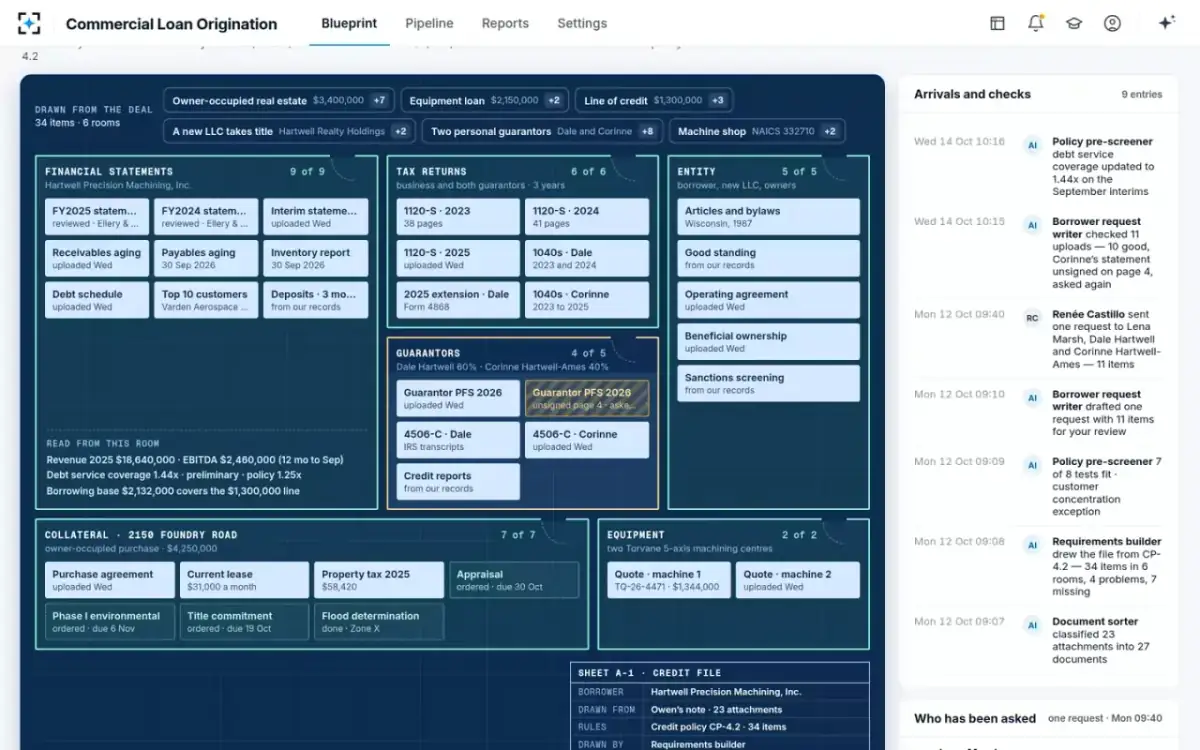
Asking once only works if answers are checked as they come in. Otherwise a fresh round of discoveries starts the day the documents arrive. The borrower request writer reads each upload the moment it lands: the right document, the right period, signed and dated, and consistent with what is already in the file.
The sample deal's borrower side, Monday to Thursday
11
items in one request, for three people
10of 11
uploads good on arrival, Wednesday
1
sent straight back: a statement unsigned on page 4
Day 3
file ready for underwriting, Thursday 09:12
On Wednesday the CFO uploaded 11 files. Ten were good. One guarantor's personal financial statement came back unsigned on page 4, and the agent asked her again at once, without an email from the coordinator. With the September interims in, the preliminary debt service coverage updated from 1.39x to 1.44x. She signed page 4 on Thursday morning, the last open item turned good, and the file reported itself ready for underwriting on day 3.
Uploads land in their places as they are checked
Can AI make credit decisions in commercial lending?
No federal rule forbids it, but every duty that applies to a credit decision still applies when software makes it, and those duties are hard to meet with a model that cannot explain itself. The clearest is adverse action. Regulation B requires a creditor that declines a business applicant to give the reasons: for a business with revenue above $1 million, a written statement of specific reasons if the applicant asks within 60 days of the notice. The CFPB's 2022 circular saying those rules apply "regardless of the technology used" was withdrawn in May 2025, but the regulation it interpreted was not.
Supervisors draw the same line. The Federal Reserve's Vice Chair for Supervision said in July 2026 that AI "that has more direct impact on credit decisions affecting individual customers" presents "more substantial legal compliance challenges than other AI use cases". The April 2026 interagency model-risk guidance went further in the other direction: it says generative and agentic AI models "are not within the scope of this guidance", and that its definition of a model excludes "deterministic rule-based processes". A policy test such as "interims older than 90 days are stale" is a rule, auditable line by line. A model's judgement that a borrower is creditworthy is not.
That is the design reason the solution's policy pre-screener runs fixed tests from the bank's own credit policy and labels every figure preliminary, and never approves or declines. Underwriting, the risk rating and the decision remain with the credit analyst and the approver with authority. Third-party software changes nothing about who answers for the decision: interagency guidance states that "the use of third parties does not diminish or remove banking organizations' responsibilities".
Reg B already defines what "asking" means
A bank's request to a commercial borrower sits inside a federal definition. Regulation B calls an application complete when the creditor "has received all the information that the creditor regularly obtains and considers" for the credit requested, "including … any additional information requested from the applicant", and adds that "the creditor shall exercise reasonable diligence in obtaining such information". A bank that discovers gaps one email at a time is using up the time that diligence is supposed to cover.
The rule also describes the request itself. When an application is incomplete, the creditor may send a written notice "specifying the information needed, designating a reasonable period of time for the applicant to provide the information", and stating that failure to provide it will end consideration of the application. For a business with gross revenues of $1 million or less, the notice timing follows the 30-day rule that applies to consumers. Above $1 million, notice of action is due "within a reasonable time". Whether a bank uses its document request as the formal notice is a decision for its compliance team. Either way, a request that names every missing item, its reason and a date is easy to evidence later. Eleven separate emails are not.
What to look for in AI loan origination software
Judge AI loan origination software by what it does when the documents are silent, by whether each output can be traced to its source, and by which decisions it refuses to make. Speed claims are easy to stage on a clean file; the questions below separate a tool that will hold up in an exam from one that will not. Ask a vendor to show each answer on one of your own closed files, not on its own sample.
Seven questions for any AI loan origination vendor
| Ask | Why it matters | A good answer looks like |
|---|---|---|
| Show me where this figure came from | Examiners and credit ask the same question | Every extracted field links to its page and line |
| What happens when a period or signature cannot be read? | A filled gap is a hidden error | The item is marked unknown and put before a person |
| Where do your requirements come from? | A generic checklist misses your policy | Drawn from your credit policy, each item citing its rule |
| Who can waive an item, and is it recorded? | Waivers are exceptions credit must see | Only a named person, with a reason that travels with the file |
| Does it decide anything about credit? | Adverse action needs specific reasons | No; tests are labelled preliminary and the approver decides |
| What happens to a deal when policy changes? | Mid-deal rule changes confuse the file | Settings are versioned; open deals keep the rules they started with |
| What does it need from our systems? | Write access widens the risk | Read-only access to core and the loan system; credit reports only with signed authorisation |
Then measure it. The fairest test is a replay of closed loans whose outcome the bank already knows, scored by its own credit staff, before any live deal is touched. How to run that test in four weeks is set out in commercial loan origination software: test it on last quarter's loans.
Where a person decides
The agents ask the borrower; they never decide for the bank. Three decisions in intake carry accountability, and in the solution each one belongs to a named person, recorded with a name and a time.
Five rules for an intake agent that asks well
- Ask only for what only the borrower can supply
Anything the bank already holds, from deposits to good standing, is pulled from its own records instead.
- Say why, in the borrower’s words
“The June statements are more than 90 days old” gets a faster answer than a policy code.
- Mark the unknown, never fill it
An unreadable period or a missing signature stays open and visible until a document or a person closes it.
- A person sends the first request
The coordinator reviews the draft before the borrower sees it. Reminders may then go on their own.
- Only a person waives
If an item will not come, a person can waive it with a reason, and the waiver travels with the file to the credit analyst.
The certification is the last of them. The coordinator certifies that the file is complete under the policy, and the credit analyst accepts or returns it. Why a file can look complete and still fail that certification is the subject of the commercial loan underwriting checklist: complete is not ready. The rule that the agents never ask for what the bank already holds gets a page of its own, commercial loan renewal: stop asking for documents the bank has. To watch the whole request and upload cycle on the sample deal, see Commercial Loan Origination.
Questions people ask
Will AI replace commercial loan officers?
The evidence points to fewer processing hours, not fewer bankers. The BLS projects loan officer jobs to grow 1% from 2025 to 2035, citing productivity-enhancing technology in loan processing as a brake. Relationship lending depends on judgement and on meeting the borrower, which at nine in ten small banks is done by the decision-maker.
Is AI in lending regulated?
There is no federal rule written for AI in commercial lending; the existing rules apply to whatever tool is used. Regulation B governs notices and reasons, Bank Secrecy Act rules govern customer due diligence, and interagency third-party guidance governs vendors. The 2026 model-risk guidance leaves generative and agentic AI outside its scope, and the agencies have said they plan a request for information on AI.
Can AI underwrite commercial loans?
AI can prepare most of the inputs an underwriter uses: spreads, ratio tests, a draft memo and a list of exceptions. Very few banks let software decide: fewer than one in a hundred auto-approves a $250,000 loan. The underwriting judgement and the approval stay with credit staff who can state the reasons.
Can the borrower upload documents the agent did not ask for?
Yes. Anything that arrives is classified, dated and tied to its party; the document sorter never discards a document. If it satisfies an open item, the item turns good; if it is new, a person sees it in the file.
What happens if the borrower never sends an item?
Reminders go on the bank's cadence and the relationship manager is told when items stay open past the bank's setting. If the item cannot be obtained, a person decides whether to waive it, with a reason, or to stop. The agents never close it themselves.
Does the agent contact guarantors directly?
Only through the request a person approved and the secure upload page it links to. Each item names the person it is for, so a guarantor sees what is needed from them.