A commercial loan file can tick every box on the underwriting checklist and still be unfit for underwriting, because a checklist asks whether a document is there and underwriting asks whether it can be relied on. Interim statements that are four months old, a guarantor's statement signed in May, an aging dated a month before the balance sheet and an unsigned purchase agreement each count as "received". Each will send the file back from credit. Commercial loan origination is the work of turning a banker's note into a file credit can use. Botminds' Commercial Loan Origination draws that file from the bank's own credit policy and tests every item for fitness as well as presence. This page sets out the difference and the tests.
Present is one question, fit for use is another: one sample file, sorted both ways
Received and fit for use
19 items
The 2023 and 2024 returns, the CPA-reviewed year-end statements, the payables aging and inventory report, articles and bylaws, and what the bank pulled from its own records.
Checklist ✓ · Underwriting ✓
Received, but not fit for use
4 items
Interims 104 days old; a receivables aging at a different date; a guarantor statement 151 days old; a purchase agreement the seller never signed.
Checklist ✓ · Underwriting ✗
Not received, and the borrower owes it
7 items
The 2025 return, the debt schedule, the second guarantor’s statement and 4506-C, the new LLC’s operating agreement and ownership form, a second machine quote.
Checklist ✗ · Underwriting ✗
Not received, and the bank orders it
4 items
Appraisal, Phase I environmental, title commitment, flood determination. Nothing to ask the borrower for.
Checklist ✗ · Underwriting: on order is fine
What do commercial lenders look for? The checklist behind the file
Commercial lenders look for five things before they commit: the borrower's capacity to repay from cash flow, its financial condition and capital, the strength of any guarantor, the value of the collateral, and the borrower's character and willingness to repay. That list is not folklore. The interagency safety and soundness guidelines expect underwriting to consider, "prior to credit commitment, … the borrower's overall financial condition and resources, the financial responsibility of any guarantor, the nature and value of any underlying collateral, and the borrower's character and willingness to repay as agreed". Bankers call it the five Cs of credit: capacity, capital, collateral, character and conditions.
Which C weighs most depends on the bank and the loan. In the FDIC's survey, 74 to 82 percent of small banks named the business's financial position the most important part of an application, whatever the loan size; for small loans, large banks were far more likely to lean on credit bureau information (59 percent against 11 percent). A commercial loan underwriting checklist is therefore every C turned into documents, and every document turned into a test.
The five Cs as a commercial loan underwriting checklist
| What lenders look for | The documents | The test applied | In the sample deal |
|---|---|---|---|
| Capacity: repayment from cash flow | Three years of business returns, year-end statements, current interims, debt schedule | Debt service coverage against the policy floor; global cash flow with guarantors | Coverage 1.39x on June interims, 1.44x on September, against 1.25x |
| Capital: financial condition | Balance sheets, agings, inventory report | Leverage and liquidity trends across the years | Revenue $18.64M in 2025; aging had to be re-dated to tie |
| Collateral: value and control | Appraisal, title commitment, environmental report, equipment quotes, flood determination | Loan to value and advance rates; lien position; borrowing base | Building 80.0% of price; machines 80.0% of quotes; line within a $2.13M base |
| Character: guarantors and history | Personal financial statements, personal returns, 4506-C, credit authorisations, ownership certification | Guarantor liquidity and net worth; credit history; who owns and controls | Liquidity $1.24M against a $685K need; a second guarantor’s statement missing |
| Conditions: purpose, industry, concentration | Purchase agreement, top-customer list, the banker’s note | Purpose and source of repayment stated; concentration and industry flags | One customer at 38% of revenue against a 25% flag, sent to the memo |
What ratios do banks look at for business loans?
Banks look first at debt service coverage, then loan to value for real estate, advance rates and the borrowing base for lines, leverage, and guarantor liquidity. Debt service coverage is cash available for debt service divided by the year's principal and interest on all debt, new and existing. Each bank sets its own floor in policy; the SBA writes one into its rules: an applicant's coverage "must be equal to or greater than 1.15 on a historical and/or projected cash flow basis and 1:1 on a global basis", and its required spread lists the current ratio and debt to tangible net worth beside it.
Loan to value has federal ceilings for real estate. The interagency real estate lending guidelines set supervisory loan-to-value limits of 65% for raw land, 75% for land development, 80% for commercial construction and 85% for improved property, and cap loans above those limits at 100% of total capital in aggregate. Each institution is expected to set its own internal limits, which "should not exceed" the supervisory ones; the sample bank lends 80% of the lower of price or appraised value on owner-occupied buildings.
Each ratio is only as good as the documents behind it, which is the link to the rest of this page. The sample deal's coverage was first computed on June interims. When the September interims arrived, coverage moved from 1.39x to 1.44x. Had the June figures gone to credit unchallenged, the analyst would have underwritten a quarter-old picture of the business, and the memo would have carried a stale ratio.
Why a ticked checklist still bounces back from credit
Because the checklist and the analyst are testing different things. The checklist was built to stop a file going to credit with something missing. The analyst reads it to decide whether the borrower can repay. A document can satisfy the first and fail the second, and the gap between them is where files get sent back.
The supervisory standard is about use, not presence. The interagency safety and soundness guidelines expect loan documentation practices that "enable the institution to make an informed lending decision and to assess risk" and "identify the purpose of a loan and the source of repayment". The OCC's 2026 lending handbook tells examiners to determine whether "the documentation and analysis are sufficient to make an informed credit decision". A May personal financial statement is documentation. Whether it is sufficient in October is a separate question.
The cost of the gap shows up as returns. Take the fictional sample bank whose deal fills this page. From January to May, before the agents, credit sent 21 of 52 deals back as incomplete, and the median deal spent four business days in that loop. Each of those files had passed someone's checklist.
One sample file, and the sample bank's returns before and after
23of 34
items already in the file on the first morning
4of 23
of those failed a fitness test: stale, unsigned or mismatched
21of 52
deals sent back by credit as incomplete, January to May, by hand
0of 46
sent back since June, with the agents testing fitness
Present versus fit: a two-by-two for every item
Every item on a needs list sits in one of four states, and only one of them is safe to send to credit. The matrix above sorts the sample file. Nineteen items were in and fit. Seven were missing, which a checklist shows honestly. Four were ordered by the bank itself, which a checklist often gets wrong by putting them on the borrower's list. The four in the second quadrant are the reason this page exists: received, ticked, and unusable.
A checklist cannot see that quadrant, because it has no idea what the document says. To place an item there, the system has to read the date, the signature block, the period and the party, and compare them with the policy rule and with the rest of the file. That is reading work, and it is why the solution's requirements builder reads every document rather than counting them.
Five tests an item must pass beyond "received"
In the solution, an item turns "in and good" only when it passes five tests. Each comes from the bank's credit policy or from a federal rule the policy reflects, and each item names the rule it was tested against.
The five tests behind “in and good”
| Test | What it checks | How it failed in the sample file | Where the rule comes from |
|---|---|---|---|
| Right document | It is what it claims: a filed 1120-S, not a draft; a quote, not a brochure | Passed on all 23; the sorter split two combined PDFs into their parts first | The policy’s list of what each loan type needs |
| Right party | It belongs to the borrower, the guarantor or the new entity the item is for | The operating company’s ownership could not stand in for the new LLC’s | Beneficial ownership is identified for each legal entity customer (31 CFR 1010.230) |
| Current | Its date is within the policy’s age limit on the day the file goes to credit | Interims 104 days old; a guarantor statement 151 days old, against 90 | The policy’s freshness rules; examiners treat stale statements as exceptions |
| Signed and complete | Every signature block signed and dated, every page present | Purchase agreement unsigned by the seller; later, a statement unsigned on page 4 | Loan documentation must make claims legally enforceable (12 CFR 30, App. A) |
| Consistent | It agrees with the rest of the file: same date, same figures, same parties | Receivables aging at 31 August against interims to 30 June, so the borrowing base could not tie | Policy pairing rules; SBA requires statements to agree with filed returns |
Current means current on the day it goes to credit
Freshness has a moving reference date. A statement within 90 days when it arrived can be outside 90 days by the time the file reaches the analyst, so the test is run against the day the file goes to credit, not the day the document was uploaded. In the sample deal the interims were dated 30 June and were 104 days old on the morning the file was drawn, so the request asked for statements to 30 September.
Consistent is where a file is checked against itself
The consistency test compares documents with each other. An aging must be dated with the interim balance sheet, or the borrowing base cannot be computed from one point in time. Business figures should agree with the filed returns. For SBA loans this is explicit: tax verification exists to determine whether "the Applicant's financial statements provided as part of the application agree with the business tax returns submitted to the IRS".
What examiners call stale documentation
Examiners have a name for the second quadrant. The OCC's 2026 handbook sorts loan exceptions into financial and administrative, and its examples of administrative exceptions start with "stale financial statements, tax returns, or borrowing base certificates" and "missing lien recordation". The handbook also warns that unidentified exceptions "are often the result of errors, miscalculations, breakdowns in the pre- or post-closing review process, or system failures".
An item that a checklist ticked and nobody read is exactly how an exception goes unidentified. The Federal Reserve's examination manual asks the policy to "detail the minimum acceptable amount of information to be included in a borrower's credit file". The minimum is meaningless if the information in the file is out of date. A file that names, for each item, the rule it was tested against and the result gives an examiner or loan reviewer the evidence directly.
“A completed application means an application in connection with which a creditor has received all the information that the creditor regularly obtains and considers in evaluating applications.”
Regulation B, 12 CFR 1002.2(f)
Regulation B's definition supports the same reading. An application is complete when the creditor has the information it "regularly obtains and considers", which means information it can actually consider. A stale statement is something the creditor would not consider without a fresh one, so receiving it does not make the application complete.
The fraud cases that pass a checklist
A checklist cannot catch a document that is present, current, signed and false. In a March 2026 indictment described by the FDIC's Inspector General, a developer who bought a Manchester building for $2.7 million is alleged to have "claimed he purchased the Chase Block Building for $4.7 million and sent the lender fabricated bank statements, leases, and checks" to obtain a $3.8 million loan. In another case, a construction company's CEO sought more than $18 million in commercial credit on an application with "false statements and omissions". Both are allegations. In both, every box on a document list could have been ticked.
Fitness tests are not fraud detection, and the solution does not claim to be. They are, though, where inconsistencies show first. A stated purchase price can be checked against the purchase agreement, the appraisal and the title commitment. Bank statements from an existing customer can be checked against the bank's own deposit records, which the relationship and exposure checker reads. A rent roll can be checked against the leases. When a figure in one document disagrees with another, the item is flagged, and an analyst sees the disagreement with both documents cited.
How the file decides it is ready
In the solution, "ready for underwriting" is a defined state with three conditions: every borrower item is in and good, every bank order is placed with a date, and every exception is flagged for the memo. A person then certifies it. The file in the sample deal met those conditions on Thursday, day 3, with 30 of 34 items in and good and four bank orders on their dates.
Every item with its rule, status, owner and source
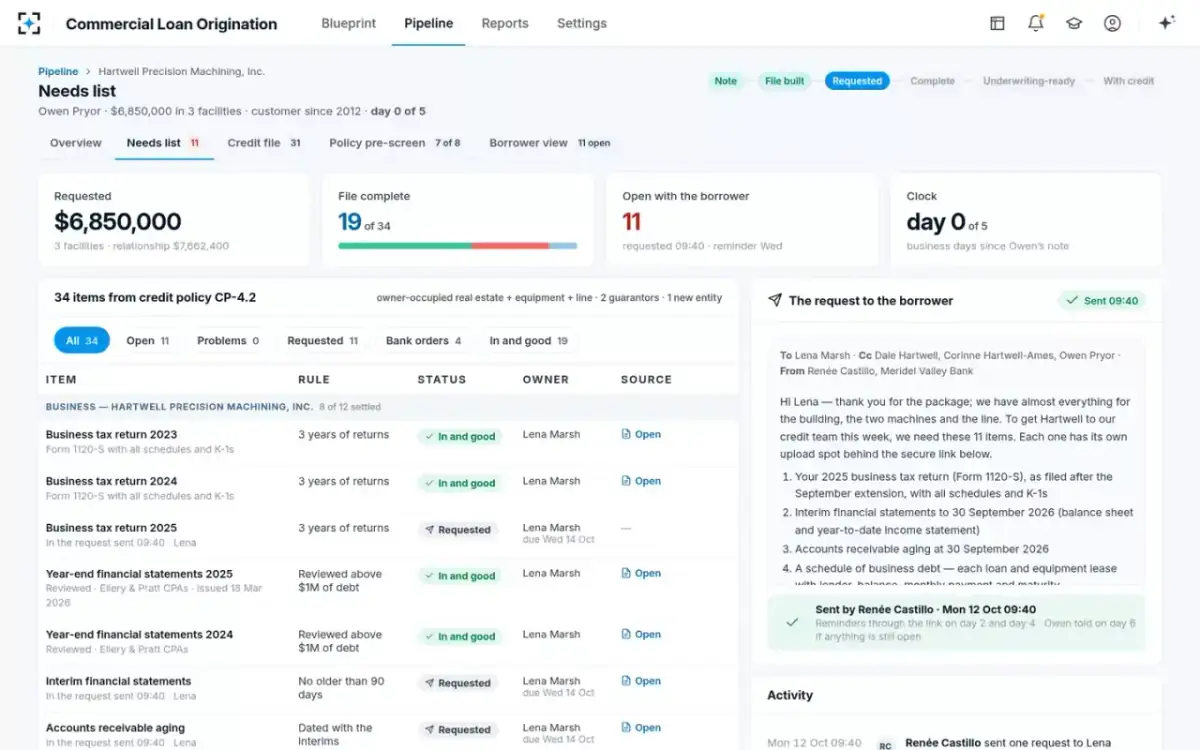
Bank orders are treated differently on purpose. An appraisal is engaged by the bank, not supplied by the borrower. The rule is that a fee appraiser "shall be engaged directly by the regulated institution or its agent". Underwriting may start while it is on order. Counting it as "missing" would hold the file for something the borrower cannot provide. Which bank orders can be placed on the first day, alongside everything else, is the subject of commercial loan processing software: what it should run at once.
The certification names what is in, what is ordered and what is flagged
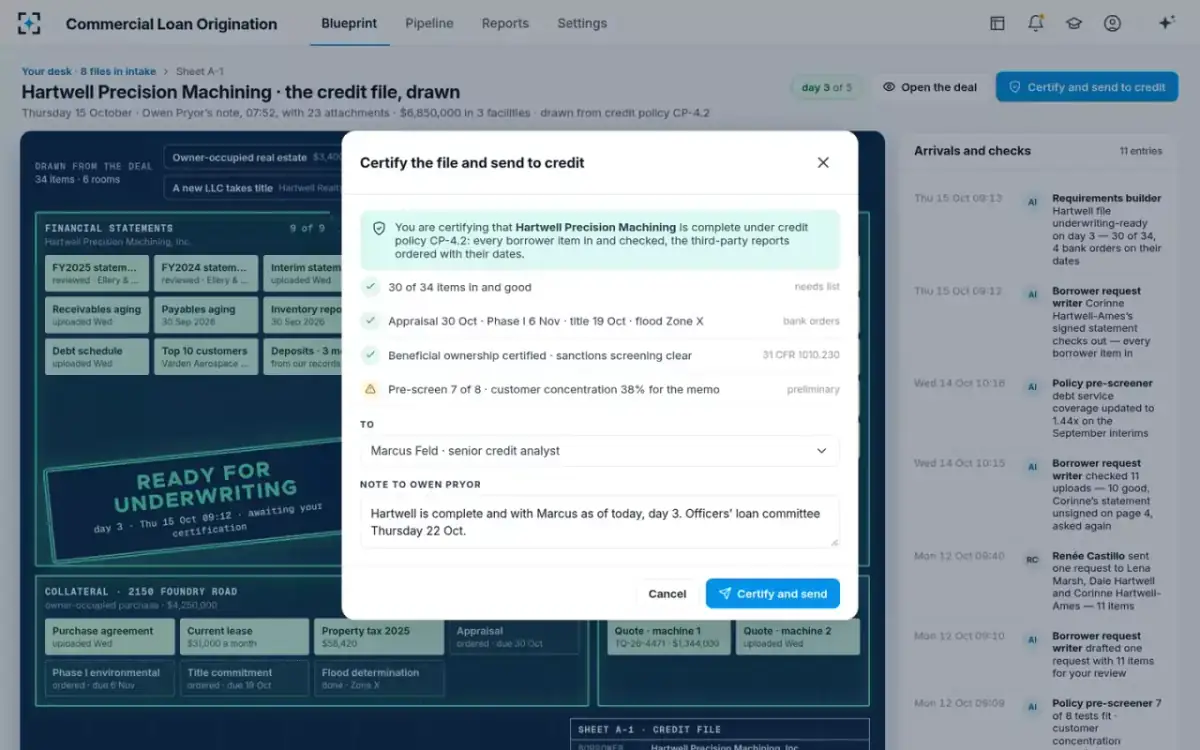
Turning a commercial loan checklist into a readiness test
- Give every item a rule, not just a name
“Interim statements” cannot be tested. “Interim statements no older than 90 days on the day the file goes to credit” can.
- Test age against the send date
Documents age while the file is assembled; re-test before certification.
- Pair documents that must share a date
Agings with the interim balance sheet, the borrowing base with both.
- Tie each document to its party
Borrower, each guarantor and each new entity have their own items; one cannot stand in for another.
- Separate bank orders from borrower items
Appraisal, environmental, title and flood are the bank’s to order and date, not the borrower’s to send.
- Flag exceptions; do not hide them in “complete”
A file can be ready with an exception, provided the exception travels to the memo by name.
A file built this way can be checked by anyone, because every item carries its rule and its result. The same principle of naming the rule applies to the borrower request: AI loan origination: an intake agent that asks instead of guessing sets out how the open items are asked for. To see the whole file drawn from the policy, start from Commercial Loan Origination.
Questions people ask
What is a commercial loan needs list?
The list of documents and reports a specific deal requires under the bank's credit policy, which depends on the facilities, the collateral, the guarantors and sometimes the industry. In the sample deal an owner-occupied building, an equipment loan, a line, a new LLC and two guarantors produced 34 items; without the equipment loan it would have been 32, and without the guarantors 24.
What is the commercial loan underwriting process?
The analyst spreads the statements and returns, measures repayment capacity and collateral coverage, assigns a risk rating, and writes a credit memo with a recommendation for the approver with authority. Banks move fast once a file is complete: the FDIC found that three in four banks approve their typical small-business loan within ten business days. Most of the elapsed time sits before underwriting starts.
How old can financial statements be for a commercial loan?
It is a policy choice, not a federal number. The Federal Reserve's manual expects the loan policy to set financial-statement requirements by borrowing level, and many banks set an age limit for interims and personal statements. The sample bank uses 90 days for both, with a range of 30 to 180 days available for interims.
Do commercial lenders check personal credit?
For guarantors, usually yes, and only with their signed authorisation. Small banks weigh the business's financial position most heavily, while large banks lean far more on credit bureau information for small loans. Personal credit matters because most small-business debt carries a personal guarantee.
Can underwriting start before the appraisal comes back?
In most policies, yes: the appraisal is a bank order with a due date, and the file can go to the analyst while it is outstanding. The approval or closing conditions then depend on it, and the loan-to-value test stays preliminary until the appraised value arrives.