The way to evaluate commercial loan origination software before committing to it is to run it on your own closed loans, where you already know what the credit file ended up needing, and compare. A four-week pilot does that. In weeks one to three the software replays intake on about 30 commercial loans closed last quarter, and credit scores what it produced against what actually happened. In week four it runs beside the team on live deals. The decision then rests on pass marks agreed before day one. Botminds' Commercial Loan Origination is built for this kind of test. Its six agents draw each file from the bank's own credit policy, and every item they draw names the rule behind it, so each result can be checked line by line. The plan below works for any intake tool.
The pilot in four numbers
30
closed commercial loans from last quarter, chosen for mix, not for ease
4weeks
three replaying closed files, one beside the team on live deals
6
measures agreed with credit before the first file is replayed
0
borrowers contacted during the replay
What is a loan origination system, and what does it do?
A loan origination system is the software a lender uses to carry an application from first request to a booked loan: capturing the request, collecting documents, spreading financials, running credit analysis, routing approvals, producing loan documents and passing the loan to the core system. Commercial versions add what consumer ones rarely need: multi-facility deals, guarantors, collateral of several kinds, credit memos and committee packages. Whatever the vendor, the system has to produce the credit file supervisors expect. The Federal Reserve's manual says that file should give "the loan officer, loan committee, and internal and external reviewers with all information necessary to analyze the credit before it is granted".
Most commercial lenders already own some of this, which shapes what they should buy next. The time a deal loses rarely sits in the parts a classic system automates well, such as approvals routing or document generation; it sits in intake, where a banker's note must become a complete, current file. Botminds' Commercial Loan Origination is built for that stage. It reads the bank's core and loan records without writing to them, draws the file from the credit policy, and hands credit a certified file, so it can run beside an existing system rather than replace it.
What a classic loan origination system centres on: An application entered into the system
What intake software adds in front of it: The banker’s note and the borrower’s email, as they arrive
What a classic loan origination system centres on: Checklists configured by loan type
What intake software adds in front of it: A needs list drawn from the credit policy for this deal’s facts
What a classic loan origination system centres on: Stored and indexed when someone uploads them
What intake software adds in front of it: Read, dated, matched and checked for signatures on arrival
What a classic loan origination system centres on: Emails written by staff
What intake software adds in front of it: One drafted request for everything open, sent by a person
What a classic loan origination system centres on: Spreads, memo, approval workflow
What intake software adds in front of it: A preliminary pre-screen and a certified file handed to that workflow
How to choose the best commercial loan origination software
Choose on evidence from your own files, not on a demonstration deal. The best commercial loan origination software for a bank is the one that finds what your credit policy requires on your deals, says where every item and figure came from, leaves every credit decision with your people and can be shown to an examiner. Five tests separate the candidates before any pilot starts.
Five tests for commercial loan origination software, before you pilot
| Test | What to ask the vendor | Why it matters |
|---|---|---|
| Your policy, not theirs | Load our credit policy and show the needs list for one of our closed deals | Supervisors expect files to meet the bank’s own documentation standards |
| Traceability | Click any figure or item: where did it come from, and under which rule? | Documentation must support an informed credit decision, and someone will ask |
| Decision boundary | Which decisions does the software make, and which does it only prepare? | Adverse action reasons and approval authority stay with the bank |
| Change control | What happens to open deals when we change a policy setting? | A file judged by a rule that did not exist when it was drawn cannot be defended |
| Future data | Can it hold small business applicant data separately from the credit file? | Section 1071 data collection begins January 1, 2028 for covered lenders |
Vendor due diligence is not optional either. The 2023 interagency guidance on third-party relationships sets out a life cycle of planning, due diligence, contract negotiation, ongoing monitoring and termination, and a proposed replacement was published for comment on September 15, 2026. A pilot on closed files is good due diligence because it produces evidence the bank owns.
Why replay closed files before live deals
A closed file has an answer key. The bank knows which documents credit eventually required, which ones were stale or unsigned when they arrived, which deals were sent back and why, and how many requests the borrower received. Replaying intake on those files measures the software against that record without involving a single borrower. A live deal has no answer key until it closes, which is why live use belongs at the end of the pilot, not the start.
The bank also owns the evidence. The interagency guidance on third parties is explicit that "the use of third parties does not diminish or remove banking organizations' responsibilities" to operate safely and within the law. The 2026 model risk guidance that replaced SR 11-7 states that "generative AI and agentic AI models … are not within the scope of this guidance", and excludes "deterministic rule-based processes" from its definition of a model. No federal text prescribes how to validate an intake agent. A replay on the bank's own files, scored by its own credit staff, is the evidence a bank can show an examiner.
The pilot is also how the OCC describes banks adopting AI in 2026: specific use cases "with guardrails and human-in-the-loop accountability". Intake suits that pattern. The agents draft and check, a coordinator sends and certifies, and the analyst accepts or returns.
How long does loan origination software implementation take? Four weeks to a verdict
A full loan origination system replacement is a conversion project: data migration, integrations, document templates and training, measured in months and set by the vendor's plan and the bank's own change calendar. An intake layer that reads the bank's systems rather than replacing them can be judged far sooner, which is what the schedule below does. Four weeks will not finish an implementation; they will tell you whether one is worth starting.
Four weeks: set up, replay, score, then run beside the team
- Load policy, pick 30 filesWeek 1
- Review replays as they finishWeek 2
- Credit scores every fileWeek 3
- Live deals, side by sideWeek 4
- Settings mirror the policySettings
- Replay intake on 30 filesReplay
- Fix settings, re-run missesRe-run
- Draft requests on new dealsLive
Week 1: load the policy and choose the files
The credit policy's requirements become settings: what each loan type needs, freshness limits for interim and personal statements, the beneficial ownership threshold, the approval authority. The Federal Reserve's examination manual expects the policy already to "detail the minimum acceptable amount of information to be included in a borrower's credit file", so this is transcription, not invention. Where the policy is ambiguous, the pilot has found its first result.
The 30 files should reproduce the real mix: owner-occupied real estate, equipment, lines and term loans, at least one acquisition, renewals, deals with new entities and personal guarantors, and some files that credit sent back. Choosing only clean files tests nothing.
A sample of 30 that tests what goes wrong, not what goes right
Suggested mix of 30 closed files
- Real estate · 27%
- Equipment · 20%
- Lines · 20%
- Renewals · 20%
- Acquisition · 13%
Of which, deliberately hard
- Sent back by credit · 33%
- New legal entity · 20%
- Two or more guarantors · 27%
- Ordinary · 20%
Weeks 2 and 3: replay, then score
For each closed file, the software receives what the banker originally sent: the note or forwarded email and the attachments as they arrived. It draws the file, flags what is stale, unsigned or mismatched, and drafts the borrower request it would have sent. A credit analyst then scores each replay against the closed file. Misses go back into the settings, and the affected files are re-run in week three.
Week 4: beside the team on live deals
New deals run through both paths. The software draws the file and drafts the request; the coordinator reviews, edits if needed and sends; uploads are checked as they land. The team compares elapsed days and requests with comparable deals handled the usual way. One week will not settle the elapsed-time question, but it shows whether the drafts are usable as written.
What should a loan origination software pilot measure? Six measures, agreed first
Each measure compares the software's output on a closed file with what the bank's own record shows. They are chosen so that a credit analyst can score them without a statistician, and so that each one maps to a day or a request saved.
What to measure on each replayed file
| Measure | Scored as | Compared against | Why it matters |
|---|---|---|---|
| Required items found | Items drawn that the final file did need, and any it needed that were not drawn | The closed credit file | A missed item is a later request and a later day |
| Items drawn in error | Items drawn that the deal did not need under the policy | The policy and the analyst’s judgement | An extra item is a needless request to the borrower |
| Problems caught | Stale, unsigned or mismatched documents flagged on arrival | What credit actually found later, including returns | These are the files that came back |
| Already held | Items the bank had on file that were asked for anyway | Core records, prior credit files | Each is a re-ask the borrower notices |
| Request usable as drafted | Whether the coordinator would have sent the draft, and what was edited | The coordinator’s judgement | The draft is what saves the coordinator’s day |
| Reasons stand up | Each item’s cited policy rule is the right one | Credit administration review | An item without a sound reason cannot be defended |
What you need to bring
The inputs are documents the bank already has. The credit policy, or the part of it that says what each loan type requires. The approval authority table. For each of the 30 closed files: the banker's original note or email and the attachments as received, the final credit file, the history of requests to the borrower and any returns from credit. And two named people: a coordinator who will review drafts, and an analyst who will score.
The policy becomes settings the bank can read
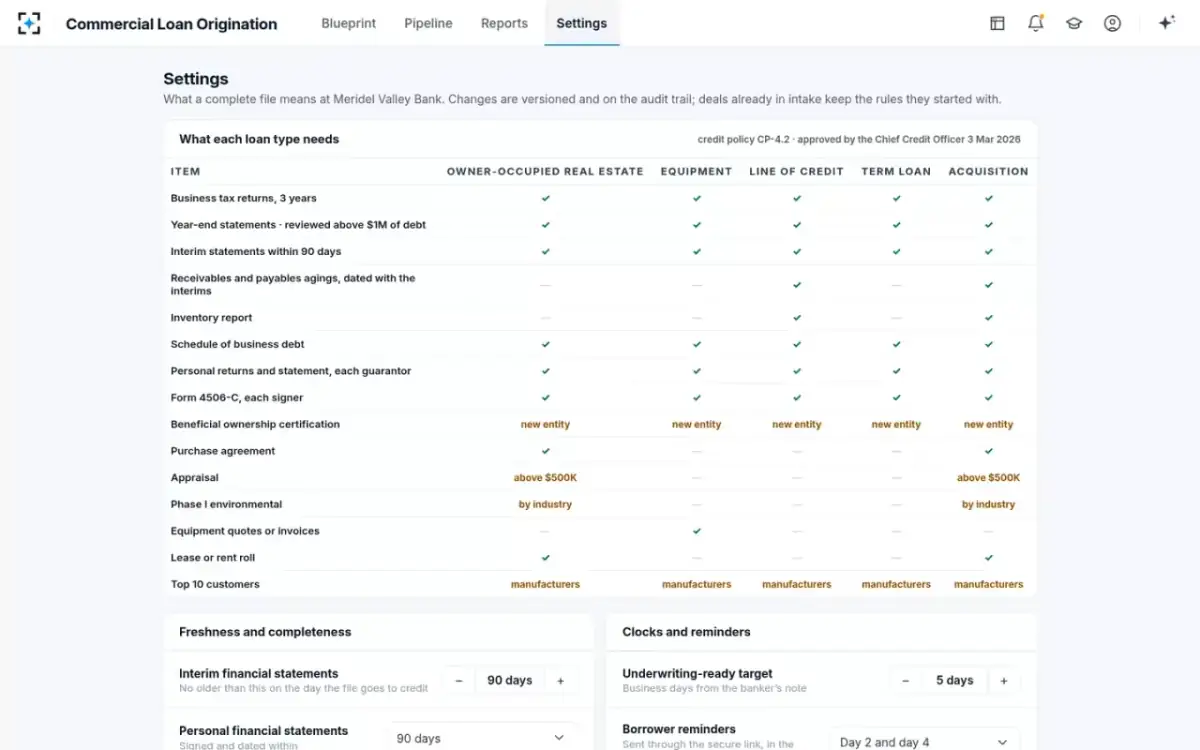
Pass marks, and what failing looks like
Pass marks should be set before the first replay, written down and signed by credit, so the result cannot be argued afterwards. The checklist below proposes a set. The thresholds are suggestions for the bank to adjust, not industry standards.
Proposed pass marks for a 30-file replay and a live week
- No unexplained miss
Every required item the software did not draw is traced to a cause (usually a policy setting) and is drawn correctly on re-run.
- Every stale, unsigned or mismatched document that credit found later is flagged on arrival
The returned files in the sample are the hardest test; each should now be caught before credit.
- Nothing the bank already held is requested
Across all 30 files.
- Drafts sendable with light edits
The coordinator would have sent most drafts with only wording changes; none with a wrong item.
- Every reason stands up
Credit administration agrees with the policy rule cited on each item it samples.
- No decision moved
In the live week every request was sent, every waiver granted and every file certified by a named person.
Failure tends to come in two kinds, and they mean different things. Misses traced to a setting, such as a requirement the policy states only by example, are fixed by tightening the setting and re-running, and they often improve the policy itself. Misses that recur after the setting is right, or flags that credit disagrees with, are failures of the software, and they should count against it. The pilot should record which is which.
After the pilot
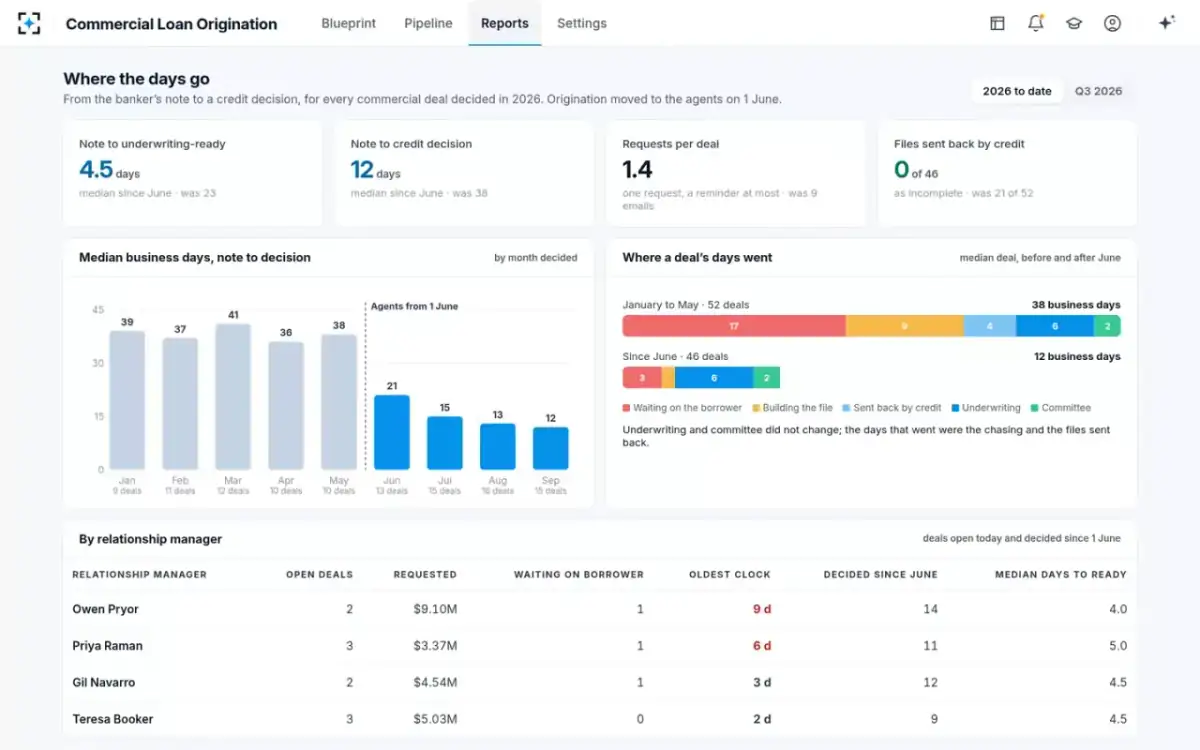
A passed pilot is followed by a phased start, not a switch. Run one loan type or a few bankers first, and keep measuring the same things on live deals: days from note to underwriting-ready, requests per deal and files sent back by credit. A change in intake reaches every level a file passes through, and in the FDIC's survey 73% of banks can route a loan in their main small-business product through three or more approval levels. Problems introduced at intake travel just as far.
The measures, kept after go-live
The pricing case for a pilot's result is laid out in how long a commercial loan takes to close, and what a day is worth. What the agents test on each document, and why presence is not enough, is in the commercial loan underwriting checklist: complete is not ready. The solution and a walk-through on sample deals are at Commercial Loan Origination.
Questions people ask
Does loan origination software need core banking integration?
For intake, read-only access is enough and is the safer design, because the check on items the bank already holds depends on deposits, existing loans and prior files. If it is not available in the pilot, an extract of those records for the 30 borrowers serves for the replay. Write access to core belongs to booking, not intake.
What is the difference between commercial loan origination software and underwriting software?
Underwriting software helps the analyst decide: spreads, ratios, risk rating and the credit memo. Origination software covers the whole path from the request to a booked loan, and its intake stage decides what the file needs and gathers it. A bank can buy them separately; the hand-off between them is the certified file.
How many files are enough for a pilot?
Enough to cover every loan type, collateral type and guarantor pattern the bank writes, with returned files over-represented. Thirty is a practical number for a community bank's quarter; a larger bank may replay more per loan type.
Who should score the replays?
A credit analyst who did not work on the original deals, with a credit administration reviewer checking the reasons on a sample. The coordinator scores whether drafts were sendable.
Can small banks use commercial loan origination software?
Yes, and the case is often stronger, because the same few people sell, process and decide. The FDIC found that at small banks, approval for larger loans often involves executive officers or the board, so every hour the file saves in intake is an hour returned to the people who also make the decisions.