A commercial loan renewal, or a new loan to an existing customer, should ask the borrower only for what has changed or expired since the bank last looked: the latest returns and interim statements, a current personal statement from each guarantor, and anything about new collateral or a new entity. Earlier returns, formation documents, an existing entity's ownership certification, deposit history, the existing loans and the bank's own screening are already in the bank. Asking for them again costs the borrower time and tells them the bank does not know them. Commercial loan origination, the work of turning a banker's note into a credit file, is where that re-asking happens. Botminds' Commercial Loan Origination has an agent whose job is to pull what the bank already holds before anyone writes to the borrower.
Asked of the borrower again: “Please send your last three years of returns”
Already held by the bank: Two of the three are in last year’s credit file; only the newest is asked for
Asked of the borrower again: Articles and bylaws requested on every deal
Already held by the bank: On file since the account was opened; only changes are asked for
Asked of the borrower again: A fresh certification for each new loan
Already held by the bank: Not required again by default since February 2026, unless facts or risk call for it
Asked of the borrower again: Three months of statements from the borrower
Already held by the bank: The bank’s own deposit records
Asked of the borrower again: Listed by the borrower on the debt schedule
Already held by the bank: Read from core banking: balances, payments, maturities
Asked of the borrower again: Certificate requested from the borrower
Already held by the bank: Pulled from the state registry and the bank’s screening
What does a commercial loan renewal really need from the borrower?
Only what is new or out of date. Renewal is not underwriting from scratch: the bank already knows the borrower, holds years of statements and returns, and has watched the account. The Federal Reserve's examination manual expects the loan policy to set out "what information the borrower will be required to submit while the credit remains outstanding", and expects banks to run "a file documentation tickler system to help bank personnel obtain updated information on borrowers". In a bank that follows its own policy, a well-kept file already has most of what a renewal needs.
Renewals are frequent. Among firms with less than $50 million in assets, an NBER study of supervisory loan data found that "three-quarters of credit lines have maturity of 1 year or less at origination". For a community bank's small-business book, that means most lines come back every year. Each one is a chance to ask the borrower for the whole list again, and an annual reminder of whether the bank knows its customer.
Why re-asking is a volume problem, not a courtesy problem
3 in 4
credit lines to firms under $50M in assets mature in a year or less
NBER w27945
59%
of small firms with debt used a personal guarantee, so each renewal reaches the owners too
SBCS 2026
1.4
requests per deal in a sample bank with the agents, down from nine emails
0
items the bank already held asked for in the sample deal’s request
What happens when a commercial loan matures? Renew, extend, modify or repay
When a commercial loan or line matures, the balance falls due, and the bank and borrower choose between four outcomes: renew it for a new term, extend it briefly, modify its terms, or repay it from cash or a refinancing elsewhere. The bank is not obliged to renew unless the loan agreement says so. Each outcome asks for different documents, and confusing them is how a borrower ends up re-sending a full application for a 90-day extension, or a bank rolls over a weakening credit without looking.
Four outcomes at maturity, and what each usually needs
| Outcome | What it is | Underwriting | What the borrower is usually asked for |
|---|---|---|---|
| Renewal | A new term on the same facility, often with new pricing or covenants | Yes: a fresh credit decision under policy | Newest returns and interims, current guarantor statements, borrowing base for lines |
| Extension | A short new maturity while a renewal or payoff is arranged | Often administrative, within policy limits | Little or nothing, if the file is current |
| Modification | Changed rate, amortisation, collateral or covenants | Depends on the change; a concession to a weak borrower needs analysis | Whatever the change touches |
| Repayment or refinance | The balance is paid from cash or another lender | No | A payoff request |
The difference matters to supervisors because repeated extensions can hide a problem loan. The FDIC Inspector General's review of First NBC Bank, whose failure cost the deposit insurance fund about $1 billion, found that "risk management deficiencies related to loan extensions and loan reviews were the most prevalent", including "numerous renewals with little or no repayment of principal". The 2023 interagency policy statement on commercial real estate workouts asks banks renewing a stressed loan to have analysed "the borrower's global debt service coverage, including realistic projections of the borrower's cash flow". A renewal is a credit decision; the documents serve that decision, and should be limited to it.
What the bank already holds
More than most request templates assume. In the fictional sample deal, the borrower, Hartwell Precision Machining, had banked with the fictional Meridel Valley Bank since 2012 and came in for a building purchase, two machines and a larger line. Before the request was drafted, the relationship and exposure checker read the bank's own records. It found the existing line of $1,000,000 with $640,000 drawn, an equipment loan with $812,400 outstanding, $1.94 million in deposits, good standing with the state, no sanctions matches and two credit reports on file.
The relationship checker reads the bank before the request is written
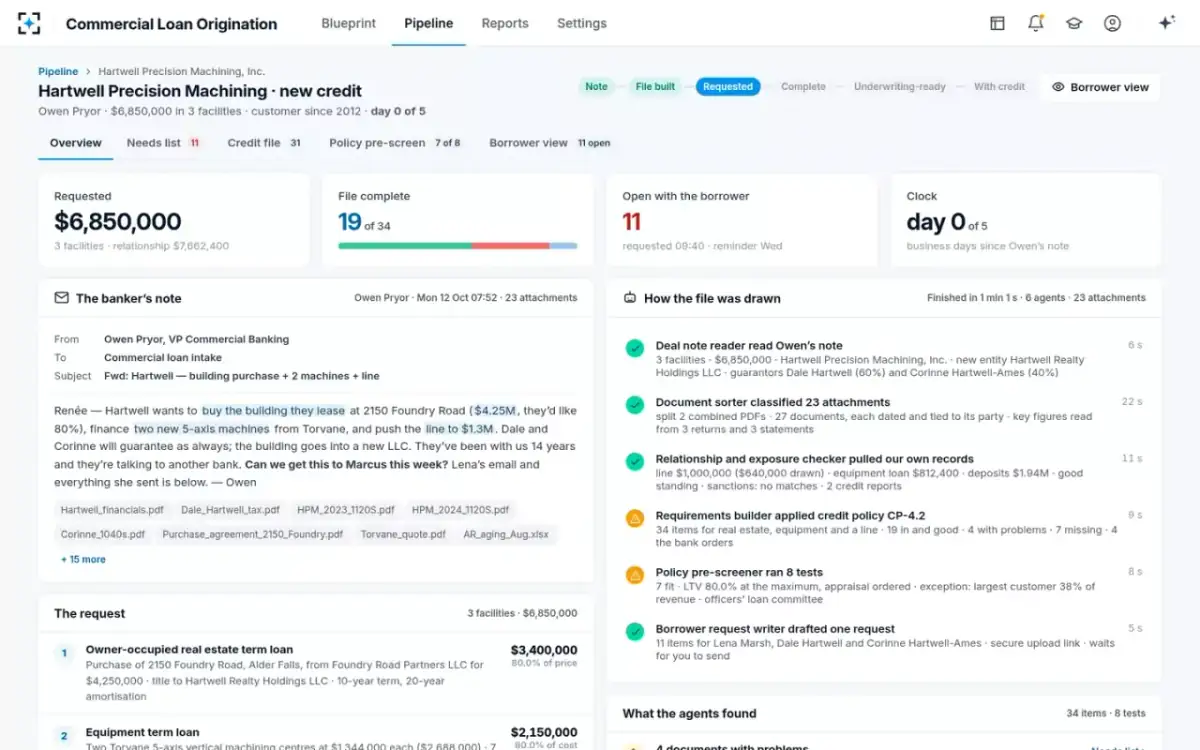
The 2023 and 2024 business returns had come with the CFO's email, so the request said "We have 2023 and 2024; we need the return you filed for 2025". The articles and bylaws were already in the file, and the deposit history and existing debt were in the bank's own systems; none of them appeared on the list. The total relationship, $7,662,400 with the new facilities and the existing equipment loan, was computed from the bank's own books. That total set the approval route, and no one had to ask the borrower for it.
Where each item lives, and when a fresh one is genuinely needed
| Item | Where the bank already holds it | Ask the borrower when |
|---|---|---|
| Business tax returns | Prior credit files | A newer year has been filed since the last review |
| Year-end and interim statements | Prior credit files, covenant reporting | The latest held is older than the policy’s age limit |
| Personal financial statement, each guarantor | Prior credit files | The latest held is older than the policy’s age limit, or a guarantor is new |
| Articles, bylaws, operating agreement | Account opening records | The entity has amended them, or a new entity is involved |
| Beneficial ownership certification | Account opening records | The entity is new to the bank; facts call the old one into question; or risk-based procedures require it |
| Deposits and existing loans at this bank | Core banking | Never; read them |
| Good standing, sanctions screening | State registry, the bank’s screening | Never; pull them |
| Credit reports on guarantors | Bureau, with signed authorisation | Only the authorisation, if none is on file |
Is beneficial ownership required for a loan renewal? Not by default since February 2026
Since February 13, 2026, an existing business customer opening a new loan account no longer has to re-certify its owners by default. FinCEN's order "excepts covered financial institutions from the requirement to identify and verify the beneficial owners of a legal entity customer each time the customer opens a new account". Under the order, identification and verification are required when an entity first opens an account, when the bank "has knowledge of facts that reasonably call into question the reliability of previously obtained beneficial ownership information", and as the bank's risk-based procedures require.
That ends a duty many banks treated as a fixed item on every loan. The underlying rule requires identification "at the time a new account is opened", and a new loan has generally counted as a new account. FinCEN had already narrowed it in 2018. Its 2018 relief covered renewals, modifications and extensions of loans and commercial lines "that does not require underwriting review and approval", and a 2018 FAQ let banks rely on an earlier certification if the customer confirmed it was still accurate. The 2026 order goes further. A bank may still choose to re-certify at every account. It is a policy choice now, though, and a borrower who has already certified will notice when it is asked again.
A new entity is still new. In the sample deal, the owners formed a new LLC to take title to the building, so the request asked for that LLC's certification and its operating agreement. The operating company's ownership was on file and was not asked for.
When a fresh document is genuinely needed
Not asking for what the bank holds does not mean accepting stale information. The OCC's 2026 lending handbook lists "stale financial statements, tax returns, or borrowing base certificates" among credit administration exceptions, and a renewal approved on last year's figures repeats last year's analysis. The test is whether what the bank holds is current under its own policy on the day the file goes to credit, not whether the bank holds something.
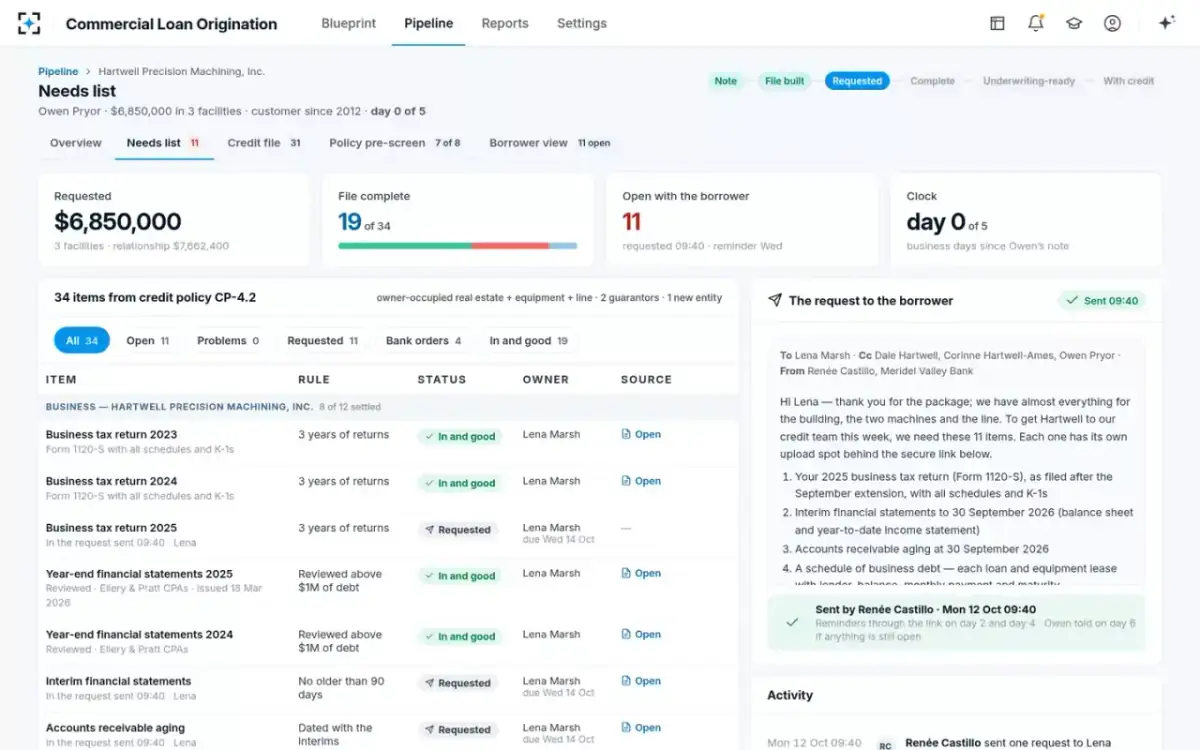
In the sample deal that test produced both answers. The bank held a personal financial statement from one guarantor, signed 151 days earlier, against a 90-day rule, so it asked for a new one, and the request said why: "Dale's statement is from May; it needs to be within 90 days." It held the 2024 return and asked only for 2025. It held deposits and existing loans and asked for neither. Each decision followed from the date on a document the bank already had.
Every item names where it came from: the borrower, the bank, or a bank order
Finding it before the borrower is asked
The mechanics are simple to state and hard to do by hand. Before any request is drafted, read the bank's own records for the borrower and every guarantor, test each held document against the policy's age limits, and ask only for what fails. A coordinator doing that manually has to search old credit files, core banking and the account-opening record for each item, which is why templates that ask for everything persist.
Before a renewal or new-facility request goes out
- Read core banking first
Deposits, existing loans and their payments are the bank’s own data. They never go on a borrower list.
- Open the last credit file
Returns and statements already reviewed are held; ask only for the years and periods since.
- Test each held document’s age against policy
Current under the policy: use it. Stale: ask, and say why in one line.
- Check ownership against the 2026 order and your procedures
Existing entity, nothing changed: no new certification by default. New entity: certify it.
- Pull good standing and sanctions screening yourself
Both are public or internal checks, not borrower documents.
- Ask for authorisations, not reports
The bank pulls credit reports; the guarantor signs the authorisation if none is on file.
What re-asking costs the relationship
The cost is mostly reputational, which makes it easy to ignore and expensive to lose. The relationship manager in the sample bank put it in one line:
“Tell me what's missing once, and tell me before the borrower does.”
Owen Pryor, relationship manager in the fictional sample bank
Banks start with an advantage. In the Federal Reserve Banks' 2025 survey, bank and credit union applicants were more satisfied with their experience than applicants at online lenders and finance companies. A renewal request that asks for documents the borrower sent last year spends that advantage on paperwork. The rule the solution's request writer follows, never ask for what the bank already has, appears in AI loan origination: an intake agent that asks instead of guessing. How the ownership and screening work runs alongside everything else is covered in commercial loan processing software: what it should run at once. The sample deal is at Commercial Loan Origination.
Questions people ask
What documents are needed to renew a business line of credit?
Typically the latest business tax return and interim statements, a current personal financial statement from each guarantor, and for a borrowing-base line a recent receivables and inventory aging. What the bank already holds from earlier years should not need to be sent again, and existing deposits and loans at the same bank never should.
Is a bank obliged to renew a commercial loan at maturity?
Generally no: at maturity the balance is due, and renewal is a new credit decision unless the agreement commits the bank. Small firms are especially exposed: in Federal Reserve supervisory data, more than one-quarter of loans to firms under $50 million in assets were demand loans, immediately callable by the lender. Starting the renewal file early leaves time to refinance if the answer is no.
Can a renewal be approved without new financial statements?
That is a policy question for each bank. Some short extensions are handled administratively, but a renewal that is re-underwritten generally needs current figures, and stale statements are an exception examiners look for.
How does annual review relate to renewal?
For most lines they coincide. The Federal Reserve's manual expects the loan policy to require "an annual review of borrowers, including a reassessment of the appropriateness of credit lines". A bank that keeps its review current already holds most of what the renewal needs, which is why a renewal request should be short.
Do loan renewals count for Section 1071 small business reporting?
Not usually. Under the CFPB's rule, a covered application does not include "reevaluation, extension, or renewal requests on an existing business credit account, unless the request seeks additional credit amounts". A renewal that increases the line is a different matter, so the request type should be recorded at intake.