Commercial loan processing software is worth buying for one reason above the rest: most of the commercial loan application process can run at the same time, and software can start it all at once. Identifying the beneficial owners of a new entity, screening names against sanctions lists, asking guarantors to sign the IRS transcript consent, deciding whether the collateral needs an appraisal, ordering the flood determination and title work, and running a preliminary policy screen each need only the deal's basic facts, and none waits for another's result. Many banks still do them in a line, because each belongs to a different person and each person starts when the last one finishes. Botminds' Commercial Loan Origination, intake and processing software for commercial lenders, reads the banker's note and attachments, works out what the deal needs under the bank's credit policy and starts every lane at once. This page sets out the true dependencies, the appraisal decision, what has to wait, and what to look for when you buy.
One sample deal, every lane started on the banker's first morning
- All in3 days
- Certified2 days
- Re-run1.39x, 1.44x
- Title commitment5 days
- Engaged by the bank14 days
- Ordered by the bank19 days
What is commercial loan processing?
Commercial loan processing is the work between a banker's first conversation and the credit decision, and again between approval and closing: gathering the borrower's documents, ordering the bank's own reports, running the identity, ownership and flood checks, and assembling a credit file the policy says is complete. It is clerical in form and consequential in effect. The Federal Reserve's examination manual expects each bank's loan policy to say "what information will be required from the borrower during the application process" and "which bank personnel are responsible for obtaining the information", which makes processing a policy duty, not a courtesy.
The people who do it are usually titled loan processor, loan assistant or credit coordinator. The BLS counts most of them among loan interviewers and clerks: 164,790 jobs in May 2025, with a median wage of $50,020, or $24.05 an hour, across consumer and commercial lending. In a commercial bank, one processor often supports several relationship managers, so the processor's queue, not the analyst's, is frequently where a deal waits.
A commercial loan process flow chart, drawn as lanes
A commercial loan application is several workstreams that meet at underwriting, not one queue. Drawn as lanes, the elapsed time is set by the longest lane, usually the appraisal or an environmental report. Drawn as a queue, it is set by the sum of all of them. The difference is days of calendar that no one decided to spend.
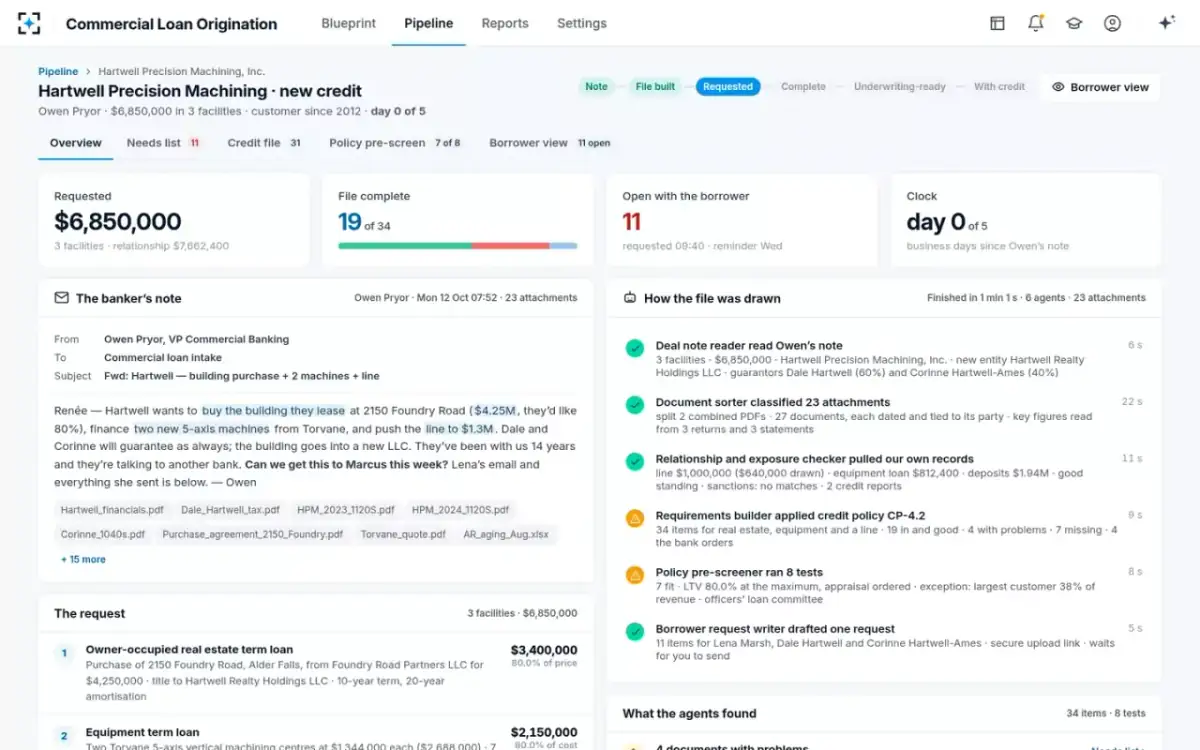
Take the fictional sample deal: Hartwell Precision Machining asks for $6,850,000, to buy the building it leases into a new LLC, finance two machines and raise its line, with two owners guaranteeing. On the Monday morning the banker's note arrives, six agents read it and the 23 attachments in about a minute. By 09:40 the borrower has one request for every open document, the bank has ordered four third-party reports, sanctions screening has been run from the bank's records and a preliminary pre-screen sits in the file. On Thursday, day 3, the file goes to credit. The longest lanes, the appraisal and the Phase I, are still running, and their due dates go with the file.
What started on day zero in the sample deal
4
third-party reports ordered by the bank: appraisal, Phase I, title, flood
11
borrower items in one request, sent at 09:40
7of 8
policy tests fit on preliminary numbers, the same morning
Day 3
file to credit, with the reports on order and dated
What truly depends on what
Very little in intake depends on anything else in intake. Each check needs facts the bank has on the first morning (the parties, the collateral address, the amounts) or a signature it can ask for on the first morning. The table sets out each workstream's real prerequisite and the thing it is commonly, and needlessly, made to wait for.
The real prerequisites, and the false ones
| Workstream | Really needs | Often waits for, needlessly | Rule behind it |
|---|---|---|---|
| Beneficial ownership, new entity | The entity, its owners of 25% or more and one control person | The rest of the borrower’s documents | 31 CFR 1010.230: identify at account opening |
| Sanctions screening | Names of the entities and owners | Credit approval | The bank’s sanctions program |
| IRS transcripts | A signed Form 4506-C from each signer | Receipt of the returns themselves | IRS IVES: records only with taxpayer consent |
| Appraisal or evaluation decision | Collateral type, transaction value, source of repayment | Underwriting | 12 CFR 34.43 thresholds |
| Flood determination | The property address | Approval | Standard flood hazard determination form |
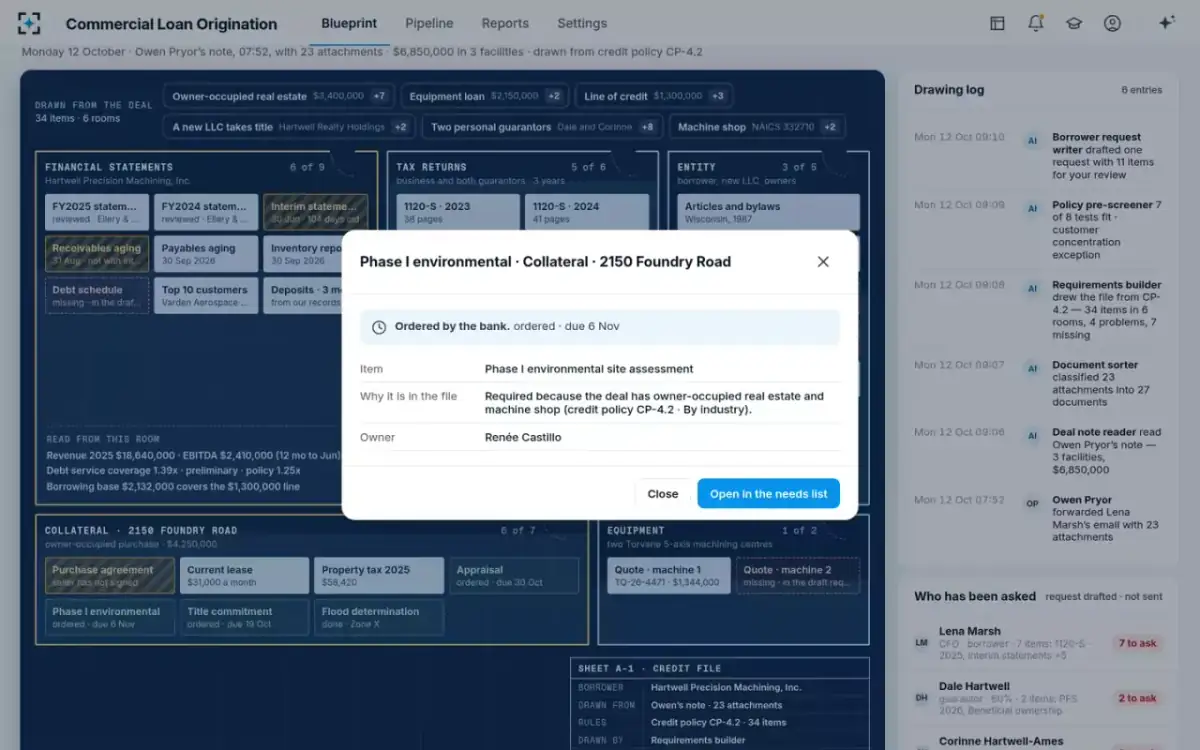
| Title, environmental | The property and the bank’s policy | Approval | Bank policy (Phase I “by industry” in the sample bank) |
| Policy pre-screen | Figures read from the statements already in hand | Fresh statements; it re-runs when they arrive | The bank’s credit policy, labelled preliminary |
Ownership: only for a new entity, and only once
FinCEN's rule requires a bank to identify the beneficial owners of each legal entity customer "at the time a new account is opened". Since February 2026, a FinCEN order no longer requires that to be repeated "each time the customer opens a new account"; it is needed when the entity first opens an account, when facts call the earlier information into question, or under the bank's risk-based procedures. In the sample deal, the operating company had banked there since 2012, but the new LLC taking title was a new customer, so its certification went into the first request.
Transcripts: start with the consent
A transcript request cannot run without the taxpayer's signature, because the IRS "only provides tax records to a third party with the consent of the taxpayer", through Form 4506-C. So the signature belongs in the first request, not after the returns arrive. For SBA loans the check is required: tax verification exists to confirm that the applicant's statements "agree with the business tax returns submitted to the IRS".
Appraisal, evaluation or neither: the three-way decision
Whether a commercial loan needs an appraisal depends on the type of transaction, its value and how it will be repaid, and the decision can be made from the deal's facts on day zero. Under the federal banking agencies' rules (the OCC's 12 CFR 34.43, with parallel FDIC and Federal Reserve rules), a business loan of $1 million or less that does not depend on real estate sale or rental income needs no appraisal; a commercial real estate transaction of $500,000 or less needs none either. Below the thresholds the bank must still "obtain an appropriate evaluation of real property collateral that is consistent with safe and sound banking practices".
Does this commercial real estate collateral need an appraisal?
1
Is real estate taking a lien for this facility?
No → no appraisal or evaluation for this facility.
Equipment loan and line: no. Real estate loan: yes.
2
Is it a business loan of $1 million or less, not repaid mainly from selling or renting real estate?
Yes → an evaluation, not an appraisal.
$3,400,000, so no.
3
Is it a commercial real estate transaction of $500,000 or less?
Yes → an evaluation, not an appraisal.
No.
✓
Otherwise: an appraisal by a state certified appraiser, engaged by the bank.
The bank, or its agent, engages the appraiser directly.
Appraisal ordered day 0, due 30 October.
Because the appraisal is the bank's order, it is never an item to chase from the borrower. A fee appraiser "shall be engaged directly by the regulated institution or its agent". Some banks wait until approval to order it, so as not to pay for an appraisal on a deal that dies. That is a reasonable cost choice for a deal in doubt. It should be made deliberately, deal by deal, after the pre-screen, and not by default on every deal.
Orders the bank places on day zero
Four reports in the sample deal belonged to the bank, and all four were ordered on the first morning. The flood determination came back the same day: Zone X, outside the special flood hazard area. The bank must use the standard flood hazard determination form and, where the building is in a flood zone, give the borrower notice "within a reasonable time before the completion of the transaction". Starting early leaves room for both. The title commitment was due in five business days, the appraisal in 14 and the Phase I in 19.
Why the Phase I is in the file: two facts about the deal, both true
What has to wait
Some things do depend on others, and running them early wastes money or breaks a rule. A credit report on a guarantor waits for that guarantor's signed authorisation. Underwriting judgement waits for statements that pass the bank's freshness rules, though the pre-screen can run on what is in hand and be re-run. Approval waits for underwriting. Closing waits for the appraisal, the flood notice where it applies, title and any environmental condition. And a costly third-party report may sensibly wait for a pre-screen that says the deal is worth pursuing.
Run in a line: Asked for after the financial documents arrive
Run in lanes: In the first request, for the new entity only
Run in a line: Requested once the returns are in
Run in lanes: Signed form asked for on day zero
Run in a line: Ordered after approval, by habit
Run in lanes: Ordered after the pre-screen, by decision
Run in a line: Ordered with closing documents
Run in lanes: Ordered on day zero from the property address
Run in a line: Run once, by the analyst, on a complete file
Run in lanes: Run on day zero and re-run as documents arrive, labelled preliminary
Run in a line: A file that still needs things ordered
Run in lanes: A file with every order placed and dated
Running the lanes on one deal
Running lanes in parallel is mostly a question of who notices what the deal needs, and when. In a manual process the coordinator discovers the new LLC when the purchase agreement is read, the Phase I when someone looks up the industry, and the second machine quote when the analyst checks the cost. Each discovery opens a lane a few days late. The solution's requirements builder works it out from the deal's facts in one pass: owner-occupied real estate, an equipment loan, a line, a new LLC taking title, two personal guarantors, and a machine shop by industry code.
How the file was drawn: six agents, about a minute, every lane identified
The banks surveyed by the FDIC say speed of service is one of their main advantages, and three in four can approve a small, simple loan within five business days. That speed only reaches the borrower if the file reaches credit with its lanes already running. How the pre-screen works on day zero, and why it stays preliminary, is in commercial loan prequalification: a one-day pre-screen The ownership lane gets more attention in commercial loan renewal: stop asking for documents the bank has. The full sample deal, lane by lane, is at Commercial Loan Origination.
What does commercial loan processing software do, and what should you look for?
At minimum, commercial loan processing software collects documents and tracks a checklist. The better question for a buyer is whether it decides what the deal needs, starts every lane that can start, and checks what comes back, because that is where the calendar goes. A secure upload portal moves paper faster; it does not stop a coordinator discovering the new LLC on day four. The table separates the two kinds of tool by what each does on the first morning of a deal.
Commercial loan processing software: a portal, or a processor?
| On the first morning | A document portal | Software that processes | Why a buyer should care |
|---|---|---|---|
| Works out what the deal needs | A fixed checklist by loan type | Drawn from your credit policy for this mix of facilities, collateral, guarantors and industry | Missed items are found by credit, days later |
| Bank orders | Not its job | Appraisal decision, flood, title and environmental identified and dated on day zero | The longest lane sets the closing date |
| Ownership and consent | Uploads whatever arrives | Asks for the new entity’s certification and each signer’s 4506-C in the first request | Signatures are the slowest items to chase |
| What comes back | Stored | Dated, matched and checked for signatures as it lands | A bad upload found on day one costs a minute; on day six, a week |
| What the bank already holds | Asked for again | Read from the bank’s records instead | Re-asking costs goodwill on the best relationships |
| Policy screen | None | Preliminary tests on the numbers in hand, re-run as documents arrive | Tells the bank early whether to spend on reports |
Two further tests belong on any shortlist. First, data the bank will soon have to report. The CFPB's rewritten small business lending rule takes effect with a compliance date of January 1, 2028 for lenders that originated at least 1,000 covered transactions in each of the two preceding years, and defines a small business as one with gross annual revenue of $1 million or less. Processing is where those applicant data points will be collected, so software bought now should be able to hold them separately from the credit file. Second, ask how the tool behaves when the bank changes a rule mid-deal. In the sample bank, policy settings are versioned and deals already in intake keep the rules they started with, so a file is never judged by a rule that did not exist when it was drawn.
Finally, measure it on your own closed files before live deals. A four-week replay, scored by your credit staff, shows whether the lanes really start on day zero; the method is set out in commercial loan origination software: test it on last quarter's loans.
Questions people ask
Who pays for the appraisal on a commercial loan?
Commonly the borrower, under the bank's fee arrangements, but the bank must engage the appraiser itself; the borrower cannot commission the appraisal the bank relies on. A borrower-ordered appraisal can inform a negotiation, but it does not replace the bank's.
When is a beneficial ownership certification needed for a business loan?
When the borrowing entity is a new legal entity customer of the bank, and otherwise when the bank's risk-based procedures or new facts call for it. Since FinCEN's February 2026 order, an existing customer opening a new loan account need not certify again by default.
Is flood insurance required on a commercial loan?
If a building securing the loan sits in a special flood hazard area, yes: an FDIC-supervised bank "shall not make, increase, extend, or renew" such a loan without flood insurance on the building and any personal property securing it. The coverage applies to buildings and contents, not the land. That is why the determination belongs on day zero: a building in a flood zone adds an insurance condition to closing.
What is the difference between a loan origination system and loan processing software?
A loan origination system is usually the bank's record of the application through approval and booking. Processing software does the work inside intake: deciding what the deal needs, collecting and checking documents, and placing orders. Many banks run the second beside the first; in the sample bank the solution reads the bank's systems and never writes to them.
Does commercial loan processing software replace the processor?
It replaces the reading, sorting and chasing, not the accountability. The processor still reviews the first request, asks for any waiver and certifies that the file is complete. In the fictional sample bank, requests to the borrower fell from about nine emails per deal to 1.4 requests, and no file has been sent back by credit since June; the processor's time moved from assembling files to checking them.