A commercial loan prequalification should answer one question on the first day: on the numbers the borrower has already sent, does this deal fit the bank's credit policy well enough to justify building a full file? That means running the policy's own tests (debt service coverage, loan to value, advance rates, the borrowing base, guarantor liquidity, concentrations) and naming who would have to approve, then writing the result down as preliminary. It does not mean approving or declining. Botminds' Commercial Loan Origination includes a policy pre-screener that does exactly this, on the morning the banker's note arrives, alongside the agents that draw the file and chase the documents. This page sets out the tests, works one through line by line, and explains why the screen must stay preliminary.
Banks decide small loans quickly, but almost none let a machine decide
What can commercial loan prequalification tell a bank, and what can it not?
It can tell a relationship manager whether the deal, as described, fits the policy, which test is tight, and who will decide. It cannot tell anyone whether the bank will lend, because the numbers are not yet verified, the collateral is not yet valued and no one with authority has looked at it. The FDIC's survey shows how banks treat that boundary: three in ten can approve a small, simple loan within a day, yet "less than one in one hundred banks will auto-approve a loan of $250,000". Speed and human decision coexist, and a pre-screen is where they meet.
The value is in the deals it stops early. A deal that fails coverage by a wide margin, or would breach the legal lending limit, costs the bank and the borrower weeks of document collection if nobody tests it until underwriting. A screen on day one turns that into a conversation about structure, a smaller amount or another guarantor, while the borrower is still engaged.
What is the difference between prequalification and pre-approval for a business loan?
Prequalification is a preliminary view of whether a business would likely qualify and for how much; pre-approval is a commitment to lend up to an amount, subject to stated conditions. Regulation B's official interpretations draw the line in those terms. For business credit they define a prequalification request as one "for a preliminary determination on whether the prospective applicant would likely qualify for credit under a financial institution's standards", and they treat a pre-approval as an application only where the bank's program actually gives written commitments.
The distinction carries a legal consequence a pre-screen must respect. Under the same interpretations, an inquiry or prequalification request becomes an application if the creditor "evaluates information about the business, decides to decline the request, and communicates this to the business", and from then on Regulation B's notice duties apply. For the CFPB's small business data rule, the name a bank gives its process "is not determinative": a review counts as a reportable application if the bank requires a business "to pass through a mandatory screening process" and turns it away when it is ineligible. A bank that runs a first-day screen should therefore decide, on paper, whether its screen is advice to the banker or a hurdle the borrower must clear, because the regulator will look at what it does, not what it is called.
Inquiry, prequalification, pre-approval, application: what each one is under Reg B
| Stage | What the bank does | What the business gets | Regulation B consequence |
|---|---|---|---|
| Inquiry | Explains its terms and products | Rates, advance rates, typical documents | Not an application |
| Prequalification | Gives a preliminary view on the business’s own figures | An indication of fit and amount | Becomes an application if the bank evaluates, declines and says so |
| Pre-approval | Commits to lend up to an amount, subject to conditions | A conditional written commitment | An application where the program gives written commitments |
| Application | Receives a request made under its procedures | A decision, a counteroffer or adverse action | Notice duties; 30 days from a complete file for firms with revenue of $1M or less |
Eight tests on day one
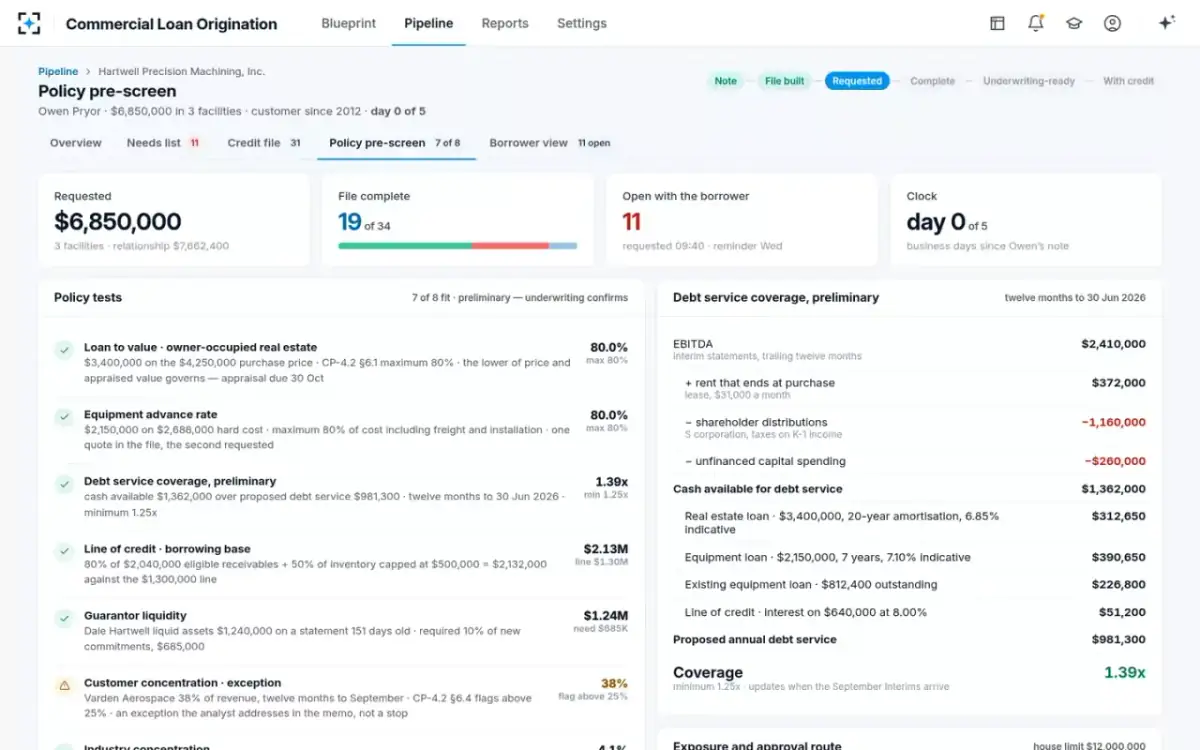
Take a fictional sample deal through the solution. Hartwell Precision Machining asks the fictional Meridel Valley Bank for $6,850,000: a $3,400,000 loan to buy the building it leases, a $2,150,000 loan for two machines and a line raised to $1,300,000, guaranteed by its two owners. The policy pre-screener ran eight tests on the statements and returns the CFO had sent. Seven fit and one was flagged as an exception. The table shows the tests with their working, and the approval route the screen worked out.
The sample deal's pre-screen: each test with its working
| Test | Working, on preliminary numbers | Policy | Result |
|---|---|---|---|
| Loan to value, owner-occupied real estate | $3,400,000 on a $4,250,000 purchase price; the lower of price and appraised value governs | Maximum 80% | 80.0%: fits, at the limit; the appraisal decides |
| Equipment advance rate | $2,150,000 on $2,688,000 hard cost; one quote in the file, the second requested | Maximum 80% of cost | 80.0%: fits |
| Debt service coverage | Cash available $1,362,000 over proposed debt service $981,300 | Minimum 1.25x | 1.39x: fits |
| Borrowing base for the line | 80% of $2,040,000 eligible receivables plus 50% of inventory capped at $500,000 | Covers the $1,300,000 line | $2.13 million: fits |
| Guarantor liquidity | Liquid assets of $1,240,000 on a guarantor statement 151 days old | 10% of new commitments, $685,000 | $1.24 million: fits; statement to be refreshed |
| Customer concentration | One customer is 38% of revenue, twelve months to September | Flag above 25% | Exception: for the analyst to address in the memo |
| Approval route | Relationship of $7,662,400 including the existing equipment loan | Chief credit officer to $5,000,000; house limit $12,000,000 | Officers’ loan committee |
Two different 25% lines
The concentration flag in the sample deal is a risk inside the borrower: one aerospace customer accounts for 38% of its output. That is distinct from the bank's own concentration limits. The OCC defines a credit concentration in the bank's portfolio as obligations "exceeding 25 percent of a bank's tier 1 capital plus the allowance for credit losses". Both are worth testing on day one. They answer different questions, and the policy should name both.
The legal limit is a test, not an afterthought
For a national bank, total loans to one borrower "may not exceed 15 percent of the bank's … capital and surplus", plus 10% more if fully secured by readily marketable collateral. Most banks set a house limit below that. The relationship total, new facilities plus existing exposure, is known on day one from the bank's own records, so there is no reason to discover a limit problem at committee.
How is debt service coverage calculated? The build, line by line
Debt service coverage is the test most often argued about, because the inputs are choices. The pre-screen shows its working so the analyst can disagree with a line rather than with a ratio. In the sample deal, the building purchase ends $372,000 a year of rent, so that rent is added back. The borrower is an S corporation whose owners draw distributions to pay tax on their K-1 income, so those come out. And capital spending the new loans will not finance comes out too.
Debt service coverage for the sample deal, built from the documents in hand
Each line is a policy question the analyst may answer differently. Is the rent add-back sound if the borrower's lease had years to run? Are distributions above the tax the owners owe a discretionary outflow that a guarantor could stop? Should the line be tested at its limit, not its drawn balance? The SBA's lender rules give one external reference point: coverage "equal to or greater than 1.15" on the business's cash flow "and 1:1 on a global basis". The interagency CRE policy statement defines global coverage as "inclusive of the cash flows generated by both the borrower(s) and guarantor(s)" and their combined obligations. A pre-screen that shows its lines lets each of those questions be asked on day one rather than discovered in week three.
The pre-screen as the analyst receives it: tests on the left, the coverage build on the right
Exceptions are not declines
A test that does not fit is information for the decision-maker, not the decision. The Federal Reserve's examination manual expects loan officers to present "credits they believe are fundamentally sound and worthy of consideration, even though they may not conform with the bank's written lending policy", with the reason for the exception "detailed in writing and submitted for approval to a designated authority". The sample deal's 38% customer concentration did not stop the file. It went to the analyst as an exception for the memo.
There is also a legal reason not to let a screen decline. Under Regulation B, an application is "an oral or written request for an extension of credit that is made in accordance with procedures used by a creditor". Once a borrower has asked for credit in the bank's usual way, turning the request down is adverse action, with notice and reasons owed. A pre-screen that silently ends the conversation may amount to a decline nobody documented. The safer design records the result, shows the working, and leaves the decision and its notice to a person.
The sample deal's screen, at a glance
7of 8
tests fit on preliminary numbers, the morning the note arrived
1
exception flagged for the memo, not a stop
1.44x
coverage when re-run on newer interims two days later, up from 1.39x
0
credit decisions made by the agents
How to pre-screen a commercial loan request against credit policy
A banker gets a useful prequalification by asking the business for the figures the policy tests run on: the last two or three years of statements or returns, a current interim, a schedule of existing debt, the deal's own numbers (purchase price, equipment quotes, the line it wants) and a statement for each owner who will guarantee. With those, the screen can compute coverage, advance rates and guarantor support on the first day. Without them, a prequalification is only a conversation about rates.
The effort pays off for the borrower as much as for the bank. In the Federal Reserve Banks' 2026 survey of small employer firms, 46% of applicants that were not approved for at least some of what they sought said lender requirements were too strict, and firms that did not apply because they expected a no "most often cited weak business financials". A screen that shows which test is tight, and by how much, turns that guess into a specific conversation: a larger down payment, a longer amortisation, another guarantor, or a smaller line.
For the sample deal, the CFO's original email held enough to run all eight tests within the hour: the 2023 and 2024 returns, year-end statements, June interims, agings, the purchase agreement and one machine quote. Two facts were then visibly provisional on the screen: the guarantor statement was 151 days old, and the second machine quote was missing. The borrower learned both on the first morning, in the same request that listed everything else still open.
Who approves, decided on day one
The approval route is a fact the bank can know on the first morning, and knowing it changes the plan. In the sample deal the relationship came to $7,662,400, above the chief credit officer's $5,000,000 authority and within the $12,000,000 house limit, so it needed the officers' loan committee, which met on Thursday 22 October. That date set the real deadline. The file had to be with the analyst early enough for a memo, so it went on day 3, the Thursday before.
In the FDIC's survey, the most demanding approval route for a bank's main small-business product had three or more levels at 73% of banks, and at small banks larger loans often go to executive officers or the board. When the route is known on day one, the banker can tell the borrower when a decision is realistic, and the coordinator can work back from the committee date.
Why the screen stays preliminary
A pre-screen is built from unverified documents, by software, before anyone with authority has looked, and each of those facts argues for restraint. The Federal Reserve's Vice Chair for Supervision said in July 2026 that AI "that has more direct impact on credit decisions affecting individual customers—presents more substantial legal compliance challenges than other AI use cases". A screen labelled preliminary, with every figure traceable to a document and no power to approve or decline, stays on the side of that line that informs a person.
Rules for a first-day pre-screen that helps and does not decide
- Use the bank’s own policy thresholds
The screen tests the policy as written, and names the section behind each limit.
- Show the working, not just the ratio
Each add-back and deduction in coverage is a line an analyst can challenge.
- Label every figure preliminary
Until statements are verified and collateral valued, nothing in the screen is a credit figure.
- Re-run as documents arrive
Newer interims, a fresh guarantor statement or the appraisal change the answer; the screen should say when it last ran.
- Flag exceptions; never stop the file
An exception goes to the memo by name. Ending a request is a person’s decision, with Reg B notice duties.
- Name the approver on day one
Relationship exposure against delegated authority and the house limit sets the timetable.
The pre-screen is one of six agents in the solution, and it sits beside the work of building the file rather than after it, as commercial loan processing software: what it should run at once explains. What the credit analyst receives with it is described in the commercial loan application process, step by step. The full sample deal, including the pre-screen screen, is at Commercial Loan Origination.
Questions people ask
How do banks pre-screen a commercial loan?
By running the credit policy's main tests on the figures the borrower has provided: coverage, leverage or loan to value, advance rates on collateral, a borrowing base for lines, guarantor strength and concentrations, and by checking the relationship against the lending limit and approval authority. The result guides whether and how to structure the deal; underwriting confirms it.
What LTV do banks lend on commercial real estate?
Each bank sets its own limits, which should not exceed the federal supervisory ones: 85% for improved property, 80% for commercial construction, 75% for land development and 65% for raw land. Many policies sit lower by property type. The sample bank lends up to 80% of the lower of price and appraised value on an owner-occupied building, which the sample deal reached exactly.
Can a bank pre-approve a business loan?
Some banks offer it, usually as a conditional written commitment for a defined program. The conditions carry the weight: a pre-approval normally still depends on verified statements, the appraisal, title and the guarantors' documents, and the bank may change terms if those differ from what it was shown.
Is prequalification a commitment to lend?
No. It is a preliminary view on unverified figures. A commitment follows underwriting and approval by someone with authority, and is usually conditioned on items such as the appraisal and title.
How long does commercial loan prequalification take?
With the borrower's recent statements in hand, the tests themselves take minutes; in the sample deal the screen ran in seconds on the morning the banker's note arrived. Banks can move fast at the next stage too: about three in ten can approve a small, simple loan within one business day. The usual delay is missing figures, not the arithmetic.