The commercial loan application process runs through five people, from the banker's first note to the credit committee: the relationship manager who brings the deal, the loan coordinator (often called a loan assistant or processor) who builds the file, the credit analyst who underwrites it, the borrower's owner or CFO who supplies most of it, and the head of commercial banking who answers for how long it all takes. None of them is slow on their own. The delay sits between them, in the requests, re-requests and returns that move a file from one desk to the next. Botminds' Commercial Loan Origination is intake software built for that gap: six agents read the note and attachments, draw the file the bank's credit policy requires and chase what is missing, and the people keep every decision.
The roles are easy to name and hard to staff. The national numbers below are the labour market these seats are hired from.
The seats are filled from three occupations
283K
loan officer jobs in 2025 (about 283,000), commercial and consumer
median pay $76,690
165K
loan interviewers and clerks (164,790), the occupation of most coordinators
median pay $50,020
64K
credit analysts (64,390)
median pay $83,510
1%
projected growth in loan officer jobs, 2025 to 2035
Who is involved in a commercial loan, from note to committee?
Each seat owns one question the bank must answer before it lends. The relationship manager owns "should we want this deal", the coordinator owns "is the file complete under our policy", the analyst owns "can this borrower repay", the borrower owns "here is the evidence" and the manager owns "why is this taking so long". The Federal Reserve's examination manual puts the coordinator's question into policy: the loan policy "should establish what information will be required from the borrower during the application process", and the credit file should give the loan officer, loan committee and reviewers "all information necessary to analyze the credit before it is granted".
The seats are few, and the routes between them are long, which is why they collide. In the FDIC's survey of about 1,300 banks, the most demanding approval route for a bank's main small-business product ran through three or more levels at 73% of banks, exactly three at 41%. The same survey found that "nine in ten small banks, but only four in ten large banks, have loan decision-makers meet with applicants". At a community bank, the person who meets the borrower may also sit on the committee. That keeps decisions close to the customer. It also means the same few people are pulled into document chasing.
To make the seats concrete, this page follows one fictional deal through the solution: a $6,850,000 request from Hartwell Precision Machining to the fictional Meridel Valley Bank, for a building purchase, two new machines and a larger line. The people, bank and company are sample data, and every figure about them on this page comes from the solution running on that data.
Five seats, before and after the agents take the mechanical part
Today
Forwards the borrower’s email, then fields questions about it for weeks. Learns what is missing when the borrower complains.
With agents
Writes the note. Sees the deal’s clock and open items on one board, and gets a plain status without asking.
Still theirs: The relationship, the structure he proposes, and the call to the borrower when something is sensitive.
Today
Works out what the policy requires for this mix of facilities, sorts 23 attachments, and asks for documents one email at a time.
With agents
Starts from a file drawn from the policy with a reason on every item, reviews one request, and certifies when the file says it is ready.
Still theirs: Sending the first request, any waiver request, and the certification that the file is complete.
Today
Opens a “new” deal to find last year’s interims and an unsigned guarantor statement, and sends it back.
With agents
Receives a certified file with a preliminary pre-screen and the exceptions already flagged.
Still theirs: Underwriting, the memo, the risk rating and the right to return a file.
Today
Gets a request, then another, then another. Re-sends what the bank already had.
With agents
Gets one list in plain words with a secure upload link, and hears at once if a file needs fixing.
Still theirs: What the business discloses, and when.
Today
Hears about delays deal by deal, from bankers who cannot say where a file stands.
With agents
Sees where the days go by stage, month and banker.
Still theirs: Targets, staffing and policy changes.
What are the steps in the commercial loan application process?
A commercial loan application moves through seven steps: the first conversation, the needs list, collection, the bank's own orders, the certified file, underwriting and approval, and then the commitment and closing. Banks name them differently, but the order is fixed by dependency: credit cannot underwrite what intake has not gathered, and nobody can approve what credit has not analysed. The table below gives each step its owner and its output, which is the part most process diagrams leave out.
Seven steps, each with one owner and one thing it hands on
| Step | Owner | What it produces | Where it usually stalls |
|---|---|---|---|
| 1. First conversation | Relationship manager | A note: borrower, amounts, purpose, collateral, guarantors | The note lives in an email the rest of the team never sees |
| 2. Needs list | Loan coordinator or processor | The documents the credit policy requires for this mix of facilities | Built from memory or an old checklist, so items are missed |
| 3. Collection | Coordinator and the borrower | Statements, returns, entity papers, guarantor statements | Requests sent one at a time; the borrower answers one at a time |
| 4. Bank orders | Coordinator, with outside providers | Appraisal, title, environmental report, flood determination, tax transcripts | Ordered late because nobody started them on day one |
| 5. Certified file | Coordinator | A statement that the file is complete under policy | Stale or unsigned items found only by credit |
| 6. Underwriting and approval | Credit analyst, then the approver | Spreads, risk rating, credit memo, decision | A file returned as incomplete restarts step 3 |
| 7. Commitment and closing | Loan operations or counsel | Commitment letter, loan documents, funding | Conditions that were knowable at step 2 |
Two legal moments sit inside these steps. Under Regulation B, an application becomes "completed" once the creditor has "all the information that the creditor regularly obtains and considers" for that type of credit, and the creditor must use "reasonable diligence in obtaining such information". For a business with revenue of $1 million or less, the bank then has 30 days to notify it of approval, a counteroffer or adverse action. So step 5 is a compliance event as well as a workflow one: a bank that leaves a file half-built is not stopping that clock by being slow, it is only blurring when the clock began.
In the solution, the steps keep their owners and change their pace. Agents do the reading, sorting, dating and drafting in steps 2 to 5; a person sends the first request, certifies the file and makes every credit decision.
Commercial Loan Origination, step by step: agents prepare, people decide
A person decides
Banker writes the noteForwards the borrower’s email and attachments with one line of intent.
Agent
Read and draw the fileReads the note and 23 attachments, sorts them and draws 34 items from the credit policy, each citing its rule.
Never: Sets pricing or terms.
A person decides
Coordinator sends one requestReviews the drafted list of everything missing and sends it.
Agent
Check each uploadDates, matches and checks signatures as files arrive; sends a problem back at once.
Never: Waives a requirement.
A person decides
Coordinator certifiesConfirms the file is complete under policy and hands it to credit.
A person decides
Credit decidesAnalyst underwrites; the officer or committee with authority approves.
What does a commercial loan officer do? Owns the promise, not the paper
A commercial loan officer, usually titled relationship manager, brings the deal, shapes its structure and keeps the customer. The BLS describes commercial loan officers as people who "analyze the finances of businesses applying for credit"; in most banks that analysis is shared with credit, and the officer's distinctive job is the relationship. The relationship manager's job is to bring good deals and keep good customers, and the paperwork is where that promise is most often broken. In the sample deal, Owen Pryor forwards the CFO's email at 07:52 on a Monday with 23 attachments and one line: "Can we get this to Marcus this week?" He has known the borrower for 14 years. He does not know, and should not have to know, that the interim statements in the pile are 104 days old against a 90-day rule.
What the banker needs from intake is a short answer to two questions: what is still open, and is anyone chasing it. A deal board with a clock on every deal answers both. In the sample bank, the pipeline lists every deal from the first note to a decision, with the business day it has reached and what is still open, so a banker can tell a borrower where things stand before the borrower asks.
The banker's view: every deal, its clock and what is still open
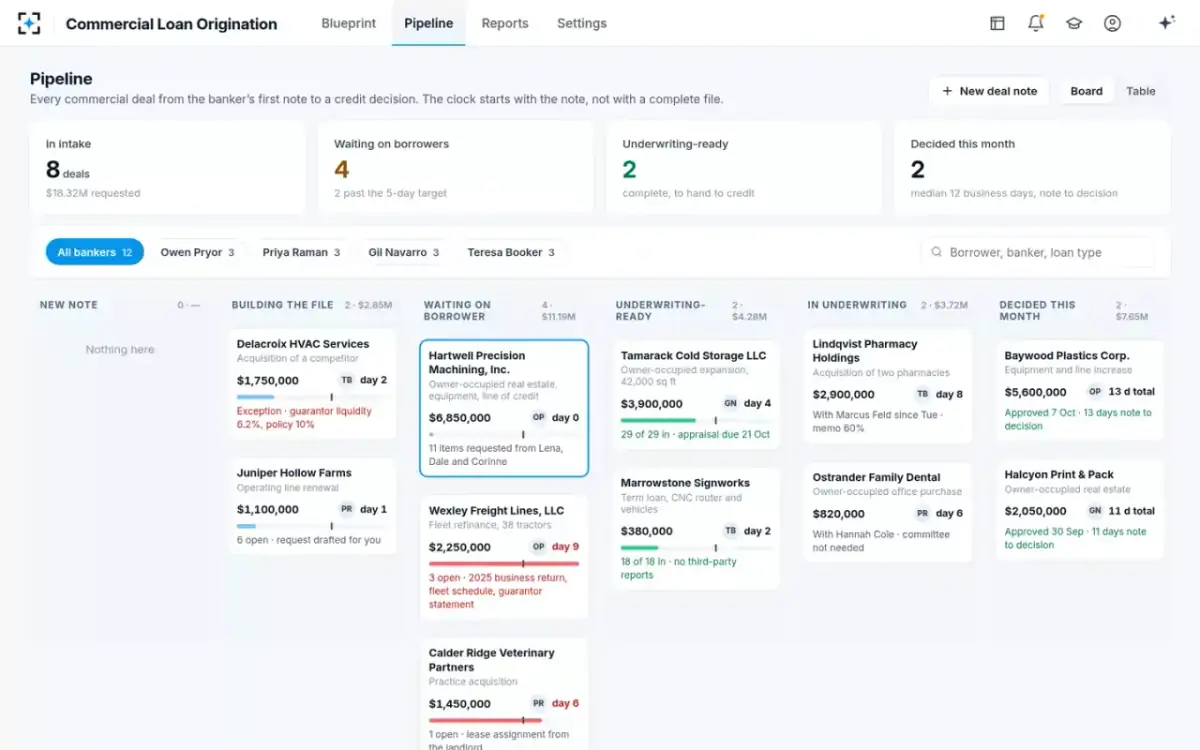
The solution never lets the agents speak for the banker. The deal note reader turns Owen's note into the request (borrower, three facilities, amounts, purpose, collateral, guarantors), with every field citing the sentence it came from. It never sets pricing or terms and never commits the bank. Structure and price stay with the banker and credit.
What does a commercial loan processor do? The coordinator builds the file
The loan coordinator turns a banker's note into a credit file, and in most banks that seat does the work no one else sees. For each deal the coordinator must work out what the credit policy requires for this particular mix of facilities, collateral, guarantors and industry; sort what arrived; date every document; find what is stale, unsigned or missing; and ask for it. That is the part the agents take.
In the sample deal the file appears as six groups of items (financial statements, tax returns, entity, guarantors, collateral and equipment), 34 in all, each tied to a rule in the bank's credit policy. At the first draw 19 were in and good, 4 had a problem, 7 were missing and 4 were reports the bank orders itself. The coordinator, Renée Castillo, reviewed one drafted request for all 11 open items and sent it at 09:40. Her own words describe the old version of the seat:
“I spend my week asking for documents one email at a time.”
Renée Castillo, the sample bank's commercial loan coordinator
The coordinator keeps the decisions that carry accountability. Only a person may waive a requirement, and the waiver travels to the analyst with a reason. A person sends the first request to the borrower. And the coordinator certifies that the file is complete under the policy before it goes to credit. In the sample deal Renée certified it on Thursday, day 3, inside the bank's five-business-day setting. How the agents decide what to ask and when to stop and ask a person is covered in AI loan origination: an intake agent that asks instead of guessing.
What does a credit analyst do in commercial banking? Underwrites a file, not a project
The credit analyst's seat is underwriting, and every hour spent finding out that a file is incomplete is an hour not spent on credit. The Interagency Guidelines on safety and soundness expect underwriting to consider, before commitment, "the borrower's overall financial condition and resources, the financial responsibility of any guarantor, the nature and value of any underlying collateral". An analyst cannot do that on a file with a guarantor statement from May.
The analyst in the sample deal, Marcus Feld, puts it plainly: "Half my 'new' deals come to me missing the latest interims." In the sample bank, from January to May, before the agents, 21 of 52 deals were sent back by credit as incomplete. Since June, with the agents, none of 46 has been. A file returned by credit costs the analyst a first read, the coordinator another round of requests and the borrower another email, and the clock keeps running for all three.
What the analyst receives now is a certified file plus a preliminary pre-screen: eight policy tests run on the numbers read from the documents, each labelled preliminary. In the sample deal seven of eight fit, and the eighth was flagged for the memo: one customer is 38% of the borrower's revenue against a 25% flag. The pre-screen never approves or declines. That boundary is set out in commercial loan prequalification: a one-day pre-screen
Who approves a commercial loan, and how is that decided on day one?
A commercial loan is approved by whoever holds enough delegated authority for the size of the whole relationship: a lending officer, the chief credit officer, an officers' loan committee, a directors' committee or the board. The bank's loan policy sets those limits, and examiners check them. The OCC's 2026 lending handbook asks examiners to confirm "that the approver had sufficient authority based on the bank's established limits", and notes that committees "allow for shared knowledge and reinforce the credit culture but can diminish accountability and can slow a bank's responsiveness". The OCC does not prefer one model over the other.
The route is set by the total exposure to the borrower and its related interests, not by the new loan alone, which is why it can and should be worked out on day one. Existing loans, guarantees and the new request add up; that total is compared with each officer's delegated authority, the bank's own house limit and, above that, the legal limit. A national bank's loans to one borrower may not exceed 15 percent of capital and surplus, plus 10 percent more if fully secured by readily marketable collateral. In the sample deal an existing equipment loan pushed the relationship past the chief credit officer's authority and into committee; the arithmetic is worked in commercial loan prequalification: a one-day pre-screen.
Committees also review differently by bank size. The Federal Reserve's manual observes that "in most banks with loan committees, all new loans are reviewed by the loan committee either before or after funding", with the threshold for prior approval set by the loan or the aggregate debt. The FDIC found that at small banks, approval for larger loans often involves the bank's executive officers or the board. Knowing the route early tells the coordinator which committee date the file must meet, and that date becomes the real deadline for intake.
The borrower is the fifth seat, and the busiest one
The borrower supplies most of the file, usually alongside running a business. Small firms lean on personal backing: in the Federal Reserve Banks' 2025 survey, 59% of firms with debt used a personal guarantee. So the request reaches the owners as individuals as well as the company: personal financial statements, personal returns and transcript authorisations from each guarantor.
In the sample deal that meant three people: Lena Marsh, the CFO, and the two guarantors, Dale Hartwell and Corinne Hartwell-Ames. Lena's line is the borrower's whole case: "Just give me the whole list once." She received one message listing all 11 open items, why each was needed and whom it was for, with a secure upload page. Each upload was checked as it landed, and a problem went straight back to whoever sent it.
The manager sees the days, not the deals
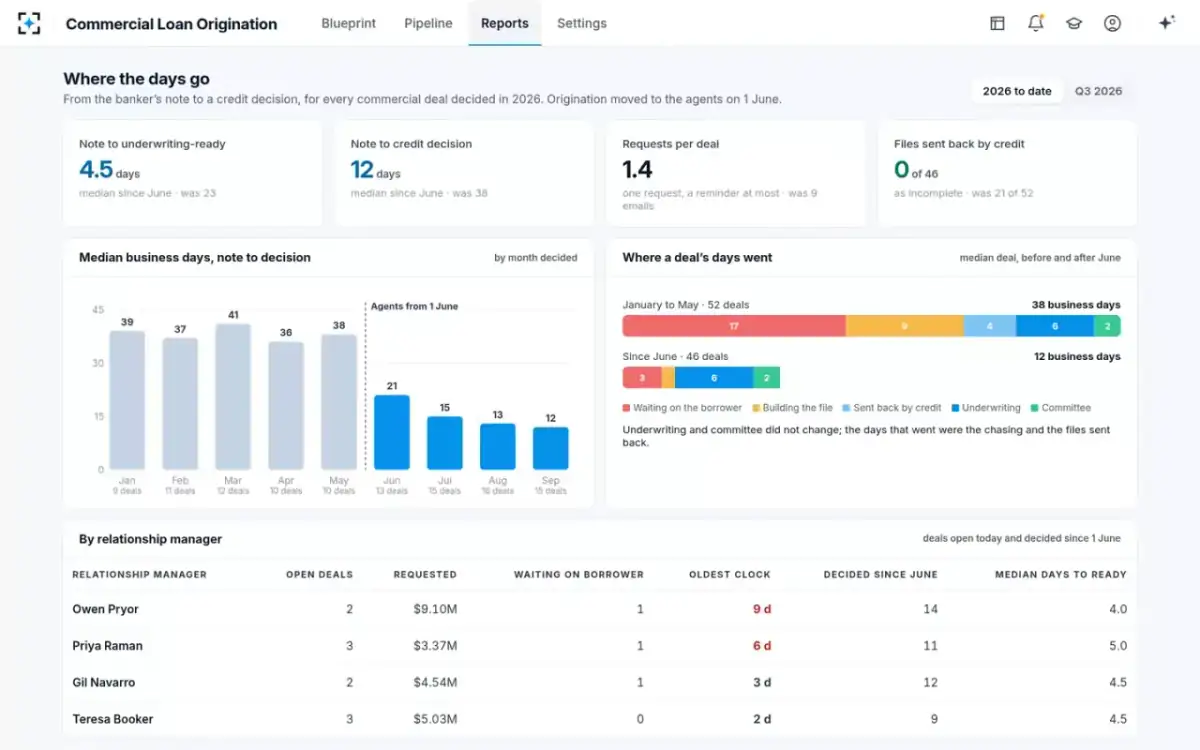
The head of commercial banking answers for growth and for the experience of every borrower, and the measure that ties them is elapsed time. In the sample bank, Joanne Whitaker's complaint is about a gap no one owns: "We lose deals in the gap between Owen's handshake and Marcus's first look." Her report measures that gap by stage, month and banker.
Where a median deal's business days went, by whose desk held it
By hand, January to May · 38 days
- Borrower · 45%
- Coordinator · 24%
- Back from credit · 10%
- Analyst · 16%
- Committee · 5%
With the agents, since June · 12 days
- Borrower · 25%
- Coordinator · 8%
- Analyst · 50%
- Committee · 17%
The lesson of the split is about seats, not speed. Underwriting and committee did not change: six days and two days, before and after. The days that went were the ones spent waiting on the borrower, building the file and sending it back, all of them hand-off time. A manager who staffs more analysts to fix a slow pipeline is adding capacity to the one seat that was not the constraint. What each of those days is worth is priced in how long a commercial loan takes to close, and what a day is worth.
The manager's view: where the days go, by stage and by banker
What each seat still decides
Taking the mechanical work out of the seats does not move any decision. The OCC's 2026 handbook on lending asks examiners to check that "the documentation and analysis are sufficient to make an informed credit decision, and that the approver had sufficient authority". Both halves of that sentence are about people: someone certifies the file is sufficient and someone with authority decides. The solution's agents read, sort, draw, test and draft. Every decision below stays with the seat that owns it today.
What each seat decides, and what the agents only prepare
| Seat | Decides | Agents prepare | Agents may not |
|---|---|---|---|
| Relationship manager | Whether to pursue the deal; the structure proposed | The request read from the note, with each field citing its sentence | Set pricing or terms, or commit the bank |
| Loan coordinator | What is sent to the borrower first; waivers sought; that the file is complete | The policy-driven needs list, one drafted request, checks on every upload | Send the first request, or waive a requirement |
| Credit analyst | Accept or return the file; underwriting and the memo | A preliminary pre-screen with exceptions flagged | Approve or decline credit |
| Borrower | What to supply, and when | A single plain-language list, and a reason for each item | Pull a credit report without the guarantor’s signed authorisation |
| Head of commercial banking | Targets, staffing and policy settings | Days by stage, month and banker | Change policy; settings are versioned and a person changes them |
Two numbers frame how far the seats can change. The BLS expects loan officer jobs to grow 1% from 2025 to 2035 and names "productivity-enhancing technology in loan processing" as one reason. And the FDIC found that automated approval is rare: fewer than one bank in a hundred will auto-approve a $250,000 loan. The work that moves to software is the processing. The judgement stays where it is, with fewer interruptions. To see the five seats on one deal, screen by screen, start from Commercial Loan Origination.
Questions people ask
What is the difference between a loan coordinator and a loan officer?
The loan officer (relationship manager) finds the borrower, proposes the structure and owns the relationship; the coordinator turns that proposal into a complete credit file and manages the borrower's documents. The officer is measured on deals and relationships, the coordinator on files that reach credit complete. At small banks one assistant may support several officers and also prepare closing documents.
What is the difference between a relationship manager and a credit analyst?
The relationship manager argues for the deal; the credit analyst tests it. The analyst spreads the statements, measures repayment capacity and writes the credit memo that the approver reads. Keeping the two seats separate is a control: a Federal Reserve study of large banks found that all of them set relationship managers' pay on the profitability of their relationships, which is why credit staff check the ratings.
What does a commercial loan underwriter do?
In most banks the underwriter is the credit analyst: the person who analyses repayment from cash flow, collateral and guarantor support and recommends a decision and a risk rating. For SBA loans the duty is written down: the lender's credit memorandum must address the applicant's ability to repay from the cash flow of the business, with three years of history plus an interim statement, and a debt service coverage of at least 1.15.
How long does the commercial loan application process take?
Banks can decide quickly once a file is complete: the FDIC found that three in four banks approve their typical small-business loan within ten business days. The longer part is usually before credit, while documents are gathered. In the fictional sample bank, the median from note to decision fell from 38 business days to 12 once intake ran in parallel.
When does a commercial loan application count as complete?
Under Regulation B, when the creditor has all the information it regularly obtains and considers for that amount and type of credit, including reports it orders itself. If something is missing, the bank must either decide or send a written notice naming what is needed and a reasonable deadline, within 30 days of receiving the incomplete application.
Does automation remove the loan assistant's role?
It removes the reading, sorting and chasing, and leaves what needs judgement and accountability: what to send the borrower, what to waive, and when the file is complete. In the sample bank the coordinator's role became reviewing and certifying rather than assembling.