Commercial loan cycle time, how long a loan takes to close, depends far more on how long the file takes to assemble than on how long credit takes to decide. The FDIC's survey of banks found that three in four approve their typical small-business loan within ten business days, and three in ten can approve a small, simple loan within one business day. Neither figure starts the clock when the borrower first asks; both start once the bank is ready to decide. The time before that, commercial loan intake, is when a banker's note becomes a credit file. Botminds' Commercial Loan Origination is software for that stretch: agents that draw the file from the bank's credit policy and chase what is missing, so it reaches credit sooner. This page sets out how to price each day a deal spends there.
Once a bank has the file, approval is quick at most banks
How long does a commercial loan take to close?
There is no reliable public figure for the whole journey. The published survey evidence covers approval: once a bank has what it needs, three in four approve a typical loan within ten business days. We found no government or academic measure of the time from a borrower's first request to a complete file, which is the stretch borrowers complain about. That gap is why a bank has to price delay from its own pipeline.
The regulatory clock reinforces the blind spot. Under Regulation B, a creditor must notify an applicant of its decision within "30 days after receiving a completed application" (for businesses with revenues of $1 million or less; larger businesses are owed notice "within a reasonable time"). The clock the bank reports against starts when the file is complete. The borrower's clock started at the first conversation. Every day of intake shows up on the borrower's clock and on neither the bank's compliance clock nor its credit approval survey.
Why do commercial loans take so long? The calendar before credit
On a typical commercial deal the decision is the short part. Take a fictional sample bank, Meridel Valley Bank, as it runs through the solution. Its median deal from January to May, handled by hand, took 38 business days from the banker's note to a decision. Since June, with the agents, the median is 12. Underwriting and committee took eight days in both periods.
The median deal at a sample bank: the days that went were all before credit
- Waiting on the borrower17
- Building the file9
- Sent back4
- Underwriting and committee6 + 2
- Intake3 + 1
- Underwriting and committee6 + 2
Thirty of the 38 days were intake: 17 waiting on the borrower, nine building the file and four in the loop of being sent back by credit and returned. Those are the days the agents work on. Underwriting and committee are judgement, and they did not change. A bank pricing delay should price intake days, because that is where the days are and where they can be removed.
From credit decision to closing: where a commercial loan's last weeks go
A credit decision is not a closing. After approval, a secured commercial loan still waits for the commitment letter, the loan documents and every third-party report the collateral needs, so the close date is set by the slowest of those, usually the appraisal or an environmental report. That is why two banks with the same approval speed can close weeks apart: one ordered its reports on the first morning, the other after committee.
The sample deal shows the arithmetic. The decision path ran 12 business days by the solution's median. But the building being bought needed an appraisal, because a business real estate loan of $3,400,000 is far above the federal appraisal thresholds, and the bank's policy called for a Phase I environmental assessment for a machine shop. Both were ordered on day zero, due on day 14 and day 19. Ordered after a day-12 decision instead, the same reports would have pushed closing to about day 31. The flood determination came back the same day; where a building is in a flood zone, the borrower must get notice "within a reasonable time before the completion of the transaction", another reason to start early.
From first conversation to funding: what sets each stretch
| Stretch | What sets its length | In the sample bank | Who can shorten it |
|---|---|---|---|
| Note to complete file | How fast missing and stale documents are found and supplied | 3 business days | The bank, by asking once; the borrower, by sending current, signed documents |
| Underwriting | Analyst workload and the file’s complexity | 6 days, unchanged | Mostly fixed; returned files restart it |
| Approval | The committee calendar for the relationship’s size | 2 days; committee met on day 8 of the calendar | Routing the deal to the right committee on day one |
| Reports and closing | The slowest report: appraisal, environmental, title | Appraisal due day 14, Phase I day 19, title day 5 | Ordering on day zero rather than after approval |
Four meters that run while a deal waits
A day in intake costs money in four ways, and they are very different in size. Two are certain but small: staff time and income that arrives later. One is uncertain but large: the deal that leaves. The fourth, rework when credit sends a file back, sits between them. A bank that prices only the staff time will conclude delay is cheap. It is not.
The value of a day taken out of intake, as a sum the bank fills in
Deals kept
Δ win rate per day × deals a year × value of a booked relationship
The deals that would have gone to a faster lender. The largest term, and the only one that needs the bank’s own outcome data.
Your pipeline: withdrawn and lost deals by days in intake
Income brought forward
funded balance × net spread ÷ 365 × days saved
Interest that starts sooner. Timing, not new money, unless the deal would otherwise have been lost.
Your treasury or pricing model
Staff time back
requests and returns avoided × hours each × loaded wage
Coordinator re-requests, analyst re-reads of returned files, banker status calls.
Your time study; BLS wages as a floor
Cost to run it
software + setup + review time
Including the people who review the agents’ drafts and certify files.
Your vendor quote and staffing
Deals kept: the meter that matters most
The borrower is comparing. In the Federal Reserve Banks' 2025 survey, the share of small-business applicants who sought financing at online fintech lenders rose from 17% in the 2020 survey to 29%. The same survey found that 60% of online-lender borrowers said costs were higher than expected, against 37% at small banks and 32% at large banks, and that bank applicants were more satisfied. A bank's offer is usually the better one. The risk is that it arrives later. The only way to price that risk is from the bank's own records: tag each deal that was withdrawn or lost, and note how many days it had spent in intake.
Income brought forward: certain, and easy to compute
Each day a term loan funds sooner, its interest starts a day sooner. The arithmetic is simple. The value is timing, not new income, unless the deal would otherwise have been lost, when it becomes the whole relationship.
Staff time: real, and smaller than it looks
Wages put a floor under the staff meter. In May 2025 loan interviewers and clerks, the occupation most coordinators sit in, averaged $25.25 an hour, and credit analysts $48.49 (mean wages, before benefits and overhead). In the sample bank, requests per deal fell from nine emails to 1.4 and files sent back by credit from 21 of 52 to none. Priced at those wages, the time saved per deal is real but modest. The case for faster intake rests on the deals, not on the hours.
A worked day: the Hartwell deal priced
Apply the structure to one deal. The sample bank's Hartwell Precision Machining request is $6,850,000 across a real estate term loan, an equipment loan and a line. The inputs below are illustrations a bank would replace with its own. They are labelled as assumptions, and none of them is a measured result.
Pricing a day on one sample deal, with stated assumptions
| Meter | Input | Arithmetic | Per day of intake |
|---|---|---|---|
| Income brought forward | Assumed net spread of 3.0% on the two term loans, $5,550,000 | $5,550,000 × 3.0% ÷ 365 | about $456 |
| Staff time back | Sample deal: one request instead of the sample bank’s former nine emails; assume 20 minutes a round at $25.25 an hour | 8 rounds × 1/3 hour × $25.25, spread over the 26 days saved | about $3 |
| Rework avoided | Sample bank: 21 of 52 files used to come back; assume 2 analyst hours a return at $48.49 | 40% × 2 × $48.49, spread over 26 days | about $1.50 |
| Deals kept | Your own data: share of comparable deals withdrawn or lost, by days in intake | Δ loss rate per day × relationship value | the largest term, and yours to measure |
The table makes the point plainly. On a deal this size, the certain meters are dominated by the interest that starts sooner, a few hundred dollars a day, and the staff meters are almost a rounding error. The meter that decides the business case is the third column of a table no vendor can fill in: how often the bank loses a good deal because the file took too long. A bank that has never recorded why deals were withdrawn should start doing so before it buys anything.
The sample bank's intake, before and after
12days
median business days, banker’s note to credit decision, down from 38
1.4
requests to the borrower per deal, down from nine emails
0of 46
files sent back by credit as incomplete, against 21 of 52 before
6days
in underwriting, before and after: unchanged
What the borrower is comparing the bank with
A business that applies to a bank is often applying elsewhere too, and demand is shifting. In July 2026 banks reported to the Federal Reserve stronger demand for C&I loans from large and middle-market firms and basically unchanged demand from small firms, with standards basically unchanged. When standards are similar across banks, the competition is on service and speed. The FDIC's survey found that banks themselves name "customer service, relationships with customers, and speed of service" as their main advantages.
That advantage is spent in intake. A relationship manager who promised a borrower a decision this week, as the sample deal's banker did, is spending the bank's reputation on a file nobody has assembled yet. The agents protect it by telling the borrower once what is needed, checking each upload as it lands, and telling the banker when the borrower has gone quiet.
How to speed up a commercial loan closing without cutting corners
Speed comes from starting everything that can start on the first day and from asking the borrower once, not from shortening underwriting. Every step in the list below keeps the same controls; it only removes waiting. In the sample bank, underwriting and committee took the same eight days before and after, and the whole gain came from intake.
Seven ways to close a commercial loan sooner
- Draw the full needs list on day one
From the credit policy, for this mix of facilities, collateral, guarantors and industry, so nothing is discovered in week two.
- Ask the borrower once
One request for everything open, each item with its reason and the person it is for.
- Order the bank’s reports on day zero
Appraisal decision, flood, title and environmental, unless the pre-screen says the deal is doubtful.
- Check uploads as they land
An unsigned page found in a minute costs nothing; found by credit, it costs a week.
- Route the approval on day one
The relationship total sets the committee, and the committee date sets the real deadline.
- Use the incompleteness notice deliberately
Regulation B lets a bank name what is missing and a reasonable deadline in writing; a dated request is easy to evidence.
- Measure from the banker’s note
A clock that starts at the complete application hides the stretch borrowers feel most.
Measuring it on your own pipeline
Every number this page asks for can be measured from a pipeline that keeps four dates and one reason. The clock should start with the banker's note, not with a complete application, because the borrower's experience starts there.
Days by stage, month and banker, measured from the banker's note
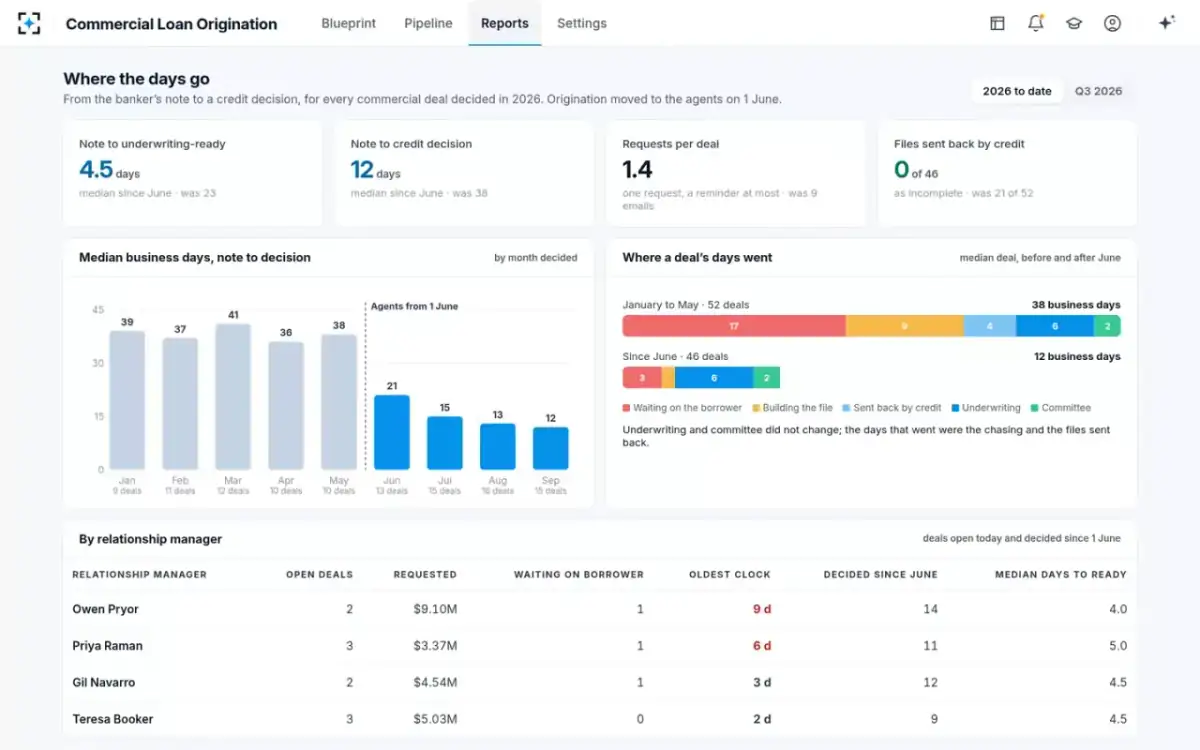
The four dates are the banker's note, the day the file is ready for underwriting, the credit decision and funding. The reason is why any deal that did not fund ended: declined by the bank, withdrawn by the borrower or lost to another lender. With a year of those, the deals-kept term stops being a guess. A four-week way to collect the same measures on closed files before committing to anything is set out in commercial loan origination software: test it on last quarter's loans. The people whose time the staff meter counts are described in the commercial loan application process, step by step, and the solution itself is at Commercial Loan Origination.
Questions people ask
How long does a commercial loan take to get approved?
Once the file is complete, often days rather than weeks: in the FDIC survey three in four banks approve their typical small-business loan within ten business days, and three in ten can approve a small, simple loan within one business day. In the sample bank, underwriting took a median of six business days and committee two.
How long does commercial loan underwriting take?
It depends on the analyst's queue and the deal, but it is rarely the longest stretch. The bigger risk is a file returned as incomplete, which restarts collection: in the sample bank, 21 of 52 deals were sent back before the agents, adding a median four business days.
When does the 30-day Reg B clock start for a business loan?
For a business with revenues of $1 million or less, 30 days run from the creditor's receipt of a completed application, meaning all the information it regularly obtains and considers. If the application is incomplete, the bank must within 30 days either decide or send a written notice naming what is missing and a reasonable deadline.
What is pull-through in commercial lending?
The share of deals entering the pipeline that fund. Measured against days in intake, it shows whether slow files cost the bank deals, which is the largest term in the cost of delay.
Does an SBA loan take longer to close than a conventional loan?
Often, because the file must meet programme rules as well as the bank's: three years of history plus an interim, IRS tax verification through Form 4506-C, and guarantees from each owner of 20% or more. Lenders with delegated authority can approve within their own process; others wait for the SBA's review as well.