In a bank appraisal review, a review appraiser reads another appraiser's report and decides whether its value is credible and adequately supported for the use the bank intends, before the credit decision is made. In a bank, that means checking a commercial appraisal against USPAP, the federal appraisal rules in 12 CFR 34 subpart C, the Interagency Appraisal and Evaluation Guidelines, the engagement letter and the bank's own policy, then asking the appraiser for support or correction where the report falls short, and signing a review that credit can lean on. The reviewer may not change the appraiser's value. The work is hard because a commercial report runs past a hundred pages, the evidence that undermines it often sits in the bank's own files rather than in the report, and the queue never stops. Botminds' Commercial Appraisal Review exists for that gap: six agents read the report, test it against the loan file and the bank's own deals, and draft the questions and the review, while the review appraiser decides and signs.
The examples below follow a fictional bank and its fictional staff through the solution. The rules and the workforce figures come from regulators, linked where they appear.
Four seats carry one commercial appraisal review, and only one of them signs it
Today
Reads the whole report, answers the review checklist by hand, hunts the bank's own closings for a check on the cap rate, writes the questions to the appraiser and the review report, often for eight reports at once.
With agents
Starts from a checklist already answered with page citations, the bank's sales beside the appraiser's grid, and drafted questions to accept, edit or drop.
Still theirs: The conclusion and the signature: accepted, accepted with adjustments, or not accepted.
Today
Sets the review policy, assigns reports, concurs on the hard ones, and answers the examiner when a file is pulled.
With agents
Sees every review with its evidence trail and concurs when the bank's rule says so, for example when a value moves more than 10% between revisions.
Still theirs: Policy, depth criteria, concurrence and the approved appraiser list.
Today
Orders the appraisal, sends the engagement letter, relays questions and revisions, and keeps the loan side away from the appraiser.
With agents
Sends questions that have already passed an independence check, and logs every exchange.
Still theirs: Every contact with the appraiser.
Today
Waits for the reviewed value and often receives the summary page rather than the reasons.
With agents
Receives the signed conclusion with its effect on loan-to-value at the requested amount and at the policy limit.
Still theirs: Sizing and approving the loan. The review states the value; credit decides what to lend on it.
What does a review appraiser do at a bank?
At a bank, the review appraiser is the control between the appraisal and the credit decision. The appraisal rules require that every appraisal for a federally related transaction "be subject to appropriate review for compliance with the Uniform Standards of Professional Appraisal Practice" (12 CFR 34.44(c)), and the Guidelines place that review inside the credit approval process, before the final credit decision. The reviewer's question is narrower than "is this the right value?" and harder to answer: are the methods, assumptions and data sources appropriate and well supported, so that the bank can rely on the conclusion?
In practice the job has four parts. The reviewer establishes compliance (USPAP, the regulation's minimum standards, the engagement letter). The reviewer tests reasonableness: whether the comparables are comparable, whether the capitalization rate fits the market, whether the income approach matches the rent roll the bank holds. The reviewer resolves deficiencies with the appraiser, through the appraisal desk, by asking for support or correction. And the reviewer documents the conclusion so that an examiner reading the credit file a year later can follow it.
A commercial reviewer at a bank is usually a state-certified general appraiser, because the reviews that matter most are of complex income-producing property. The rules do not require a credential for every review: HUD's own multifamily guide notes that "USPAP does not require that reviews to determine USPAP compliance be made by an appraiser" (HUD MAP Guide §7.18.8). The credential becomes necessary when the review is meant to produce a value the bank can use instead of the appraiser's.
Can a review appraiser change the appraised value?
No. A reviewer can find a value unsupported and refuse to accept the report, but cannot rewrite the appraiser's conclusion. The Guidelines put it plainly: "Though a reviewer cannot change the value conclusion in the original appraisal, an appraisal review performed by an appropriately qualified and competent state certified or licensed appraiser in accordance with USPAP may result in a second opinion of market value" (Interagency Guidelines §XV).
That sentence sets the shape of the job. A reviewer who disagrees has three routes: ask the original appraiser for support or correction; obtain a second appraisal; or, if qualified, develop a second opinion of value inside a USPAP Standard 3 review, with the workfile that implies. HUD describes the same boundary for its own review appraisers: "Only licensed appraisers may develop a different value," and the department prefers that its reviewers "only opine on the quality of the work under review and as to whether or not it is reliable" (HUD MAP Guide §7.18.8).
A reviewer cannot change the value conclusion in the original appraisal.
Interagency Appraisal and Evaluation Guidelines, §XV
Most bank reviews take the first route, which is why so much of the reviewer's craft lies in the question. A good question names the page, attaches the document the appraiser did not have, and asks for support. It never suggests a number, a loan amount or a target loan-to-value, because the same Guidelines list each of those among the communications that compromise the appraiser's independence. How agents can draft those questions without crossing that line is the subject of its own guide.
Technical review or administrative review: how a bank decides the depth
The depth of review is a risk decision the bank writes into policy, not a fixed procedure. The Guidelines require "a risk-focused approach for determining the depth of the review" and single out commercial real estate: "Transactions involving complex properties or high-risk commercial loans should be reviewed more comprehensively to assess the technical quality of the appraiser's analysis," naming large-dollar credits, complex or specialized properties, and properties outside the bank's usual market.
Banks usually call the lighter tier an administrative or compliance review: is everything that must be there present, consistent and signed? The deeper tier is the technical review: re-working the analysis, testing each adjustment, rebuilding the income approach, and forming a view on whether the conclusion holds. Lower-risk commercial reviews "may be less technical in nature, but still should provide meaningful results," and the bank "should establish criteria for when to expand the depth of the review." That last sentence is where many policies are thin: they define the tiers but not the triggers that move a report from one to the other.
Where the review depth comes from, and what a reviewer does at each tier
| Review tier | Typical triggers in bank policy | What the reviewer does |
|---|---|---|
| Administrative or compliance | Lower-risk, in-market, typical property, value well below the bank's complex-property line | Confirms the report has every required element, is internally consistent, uses the regulatory definition of market value and meets the engagement letter. |
| Technical | Large-dollar credit, complex or specialized property, out-of-market collateral, a loan near the LTV limit | Tests every adjustment and assumption against market evidence, rebuilds the income approach, and forms a view on whether the conclusion is credible. |
| Escalated | A finding the appraiser cannot resolve, or a value that moves sharply between revisions | Second appraisal, or a USPAP Standard 3 review with a second opinion of value by a qualified appraiser; chief appraiser concurrence. |
A day in the queue: eight reports and one credit committee
A bank reviewer's day is set by credit committee dates, not by the order reports arrive in. Take the example bank's queue on a Friday in October 2026: eight appraisals and evaluations, $139.4 million of value between them, seven due by Wednesday. One is an evaluation of a $640,000 building, fourteen pages long. One is a 176-page hotel appraisal whose revenue-per-room forecast dates from 2024. The one that matters most is a 148-page appraisal of Ridgeline Office Park, Building 2, supporting an $18,500,000 refinance sized to the bank's 65% office limit.
The reviewer's real constraint: the committee calendar
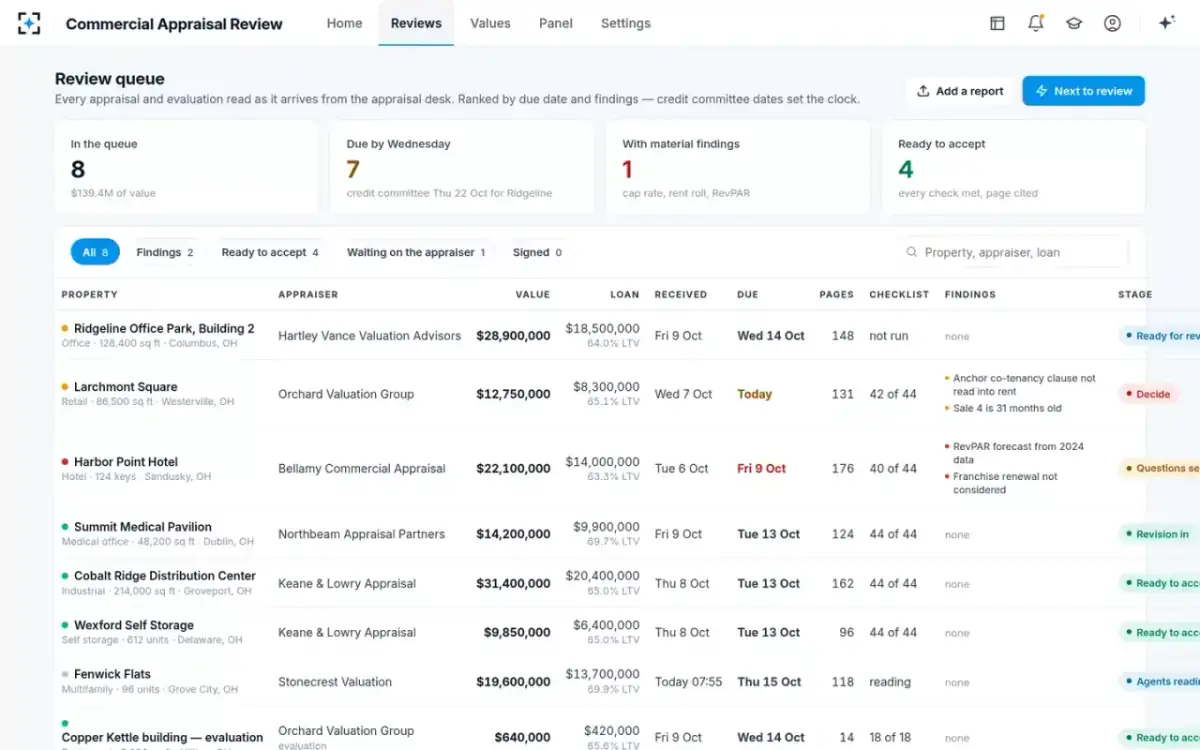
Read by hand, Ridgeline alone would fill most of a day. The report is long, but reading is not the slow part. The slow part is the evidence the report does not contain: the bank's own sales from last quarter, the cap rates on the bank's own 2026 deals, the rent roll in the loan file that is newer than the one the appraiser used, the tenant notice that arrived in August. A reviewer working eight reports does not have time to pull all of that for each, so it is pulled for the ones that look wrong, and a report that looks fine on its own terms is accepted on its own terms.
In the sample, the report looks fine. The value is $28,900,000 on the income approach, the loan-to-value is 64.0%, inside the limit. The problems surface only against the bank's data: the 7.25% cap rate sits 85 basis points below the median of the bank's eight 2026 suburban office data points, and the largest tenant, 25.4% of the building, has served notice that it is leaving, while page 61 says it "is expected to renew".
Where the reviewer's hours go: support, not values
Almost none of a reviewer's time is spent deciding a number, because the reviewer is not allowed to decide one. The hours go on establishing what the report says, finding the evidence that tests it, and writing the questions and the review. In the sample, the agents finish their pass of the 148 pages in a minute and a half and answer the bank's 44-item checklist, 37 items met, 5 not met and 2 open questions, each answer carrying the page that supports it. What is left for the reviewer is the part only a reviewer can do.
The review a reviewer starts from: findings with their pages
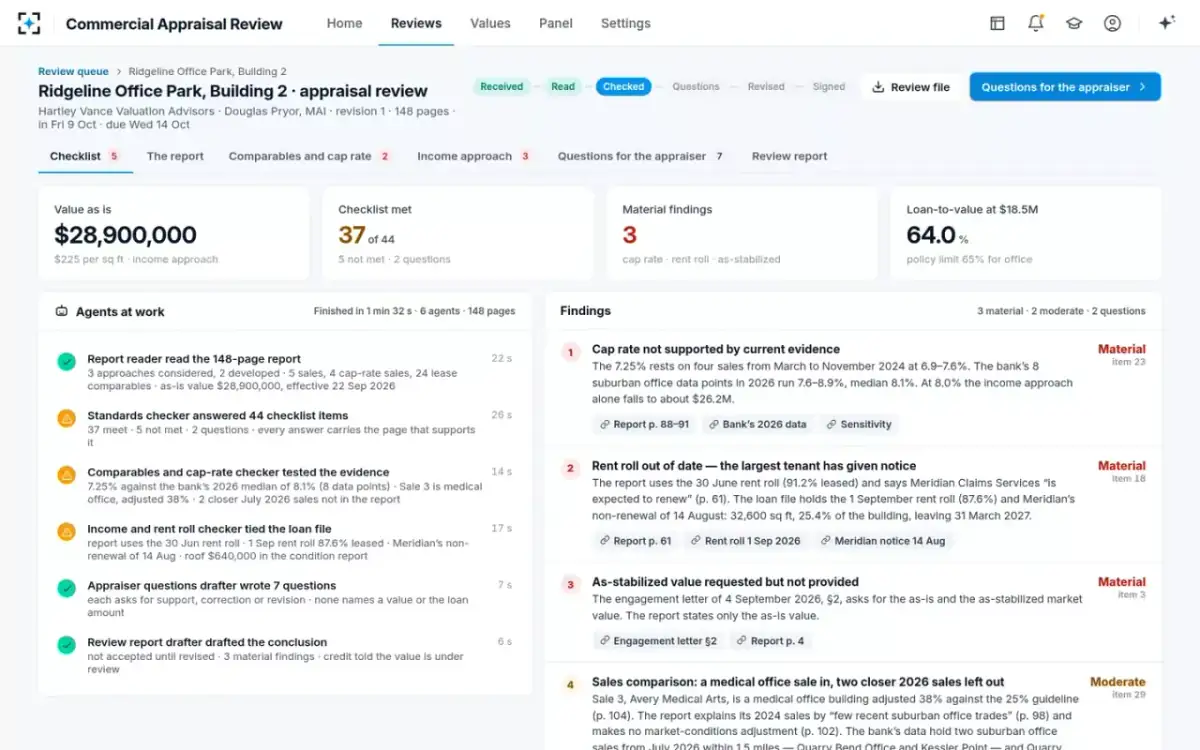
Three findings are material: the cap rate, the stale rent roll and an as-stabilized value the engagement letter asked for and the report omits. Two are moderate: a sales comparison that uses a medical office building with 38% gross adjustments and skips two closer July 2026 sales, and a vacancy rate of 8% that contradicts the report's own market section showing 19.6%. Two are questions: a roof the condition report prices at $640,000 against a page that says there is no deferred maintenance, and the newest leases. Seven questions go to the appraiser through the desk. Revision 2 comes back at $24,100,000 as is.
That revision is the reason the review exists. At $24.1 million the same $18.5 million request is 76.8% loan-to-value, 11.8 points over the office limit; at the limit, the loan is $15,665,000. The reviewer did not produce that number. The reviewer produced the questions that made the appraiser produce it.
Who does a bank review appraiser report to?
A review appraiser reports outside loan production. The Guidelines say reviewers "should be independent of the transaction and have no direct or indirect interest, financial or otherwise, in the property or transaction, and be independent of and insulated from any influence by loan production staff." Most banks put the reviewer under a chief appraiser, who in turn reports to the chief credit officer or the head of credit risk.
Examiners test the line directly. The OCC's internal control questionnaire for commercial real estate asks whether policy requires "that every CRE appraisal be reviewed and each review documented", whether "appraisals [are] reviewed and approved before funds are advanced", and, for reviews done in-house, whether "the employee [is] independent of the loan production and collection functions" (OCC, Commercial Real Estate Lending, ICQ 29–34). In file reviews, examiners weigh the "quality and timing of appraisal review" alongside whether the value assumptions are reasonable and documented.
What a bank review appraiser must be able to show for every commercial report
- The review happened before the credit decision
Dated, with the report version reviewed. Examiners check timing against the approval and the first advance.
- The depth matched the risk
A note of why the review was technical or not, against the bank's written criteria.
- Each deficiency was raised and resolved
The question asked, the appraiser's reply, and whether the revision answered it.
- No communication suggested a value
Every exchange went through the appraisal desk and asked for support, correction or consideration of information.
- The reviewer was independent
No role in producing or approving the loan, and no interest in the property.
- The conclusion is stated and signed
Accepted, accepted with adjustments or not accepted, with the reasons a later reader can follow.
The checklist above is about the review itself. The checklist a reviewer runs against the appraisal, built on the OCC's own worksheet, is a different instrument and has its own guide.
Is the pool of commercial review appraisers shrinking?
The overall appraiser pool is shrinking; the commercial-capable part of it is not, but it is small. The Appraisal Subcommittee's registry held 89,618 appraiser credentials at the end of 2025, "down from 91,036 entries at the end of 2024", and about 65,857 distinct appraisers. Certified general credentials, the ones that cover commercial property of any value, numbered 40,583, a little up on the year (ASC, 2025 Annual Report). Credentials double-count appraisers licensed in several states, so the number of people is lower.
About 40,600 certified general credentials cover all US commercial appraisal and review
Those 40,000-odd credentials serve every commercial appraisal in the country as well as every commercial review, at banks, at review firms, at insurers and in government. The Bureau of Labor Statistics does not count review appraisers separately; it places all property appraisers and assessors at about 68,400 jobs in 2025, a figure that includes tax assessors, and notes that "appraisers employed by banks and mortgage companies generally work in an office, making site visits only when necessary" (BLS Occupational Outlook Handbook). A bank that loses a senior commercial reviewer is recruiting from a small pool, which is one reason outsourced review companies exist.
What Commercial Appraisal Review changes in the reviewer's day
The solution moves the reading and the evidence-gathering off the reviewer's desk and leaves the judgement on it. Six agents do distinct jobs: a report reader that extracts every approach, value, comparable and assumption with its page; a standards checker that answers the bank's checklist; a comparables and cap-rate checker that sets the appraiser's evidence beside the bank's own closings and reviewed appraisals; an income and rent roll checker that ties the income approach to the leases and rent rolls in the loan file; a questions drafter; and a review report drafter. None of them forms a value or signs.
Signed by the reviewer, with the effect on the loan for credit
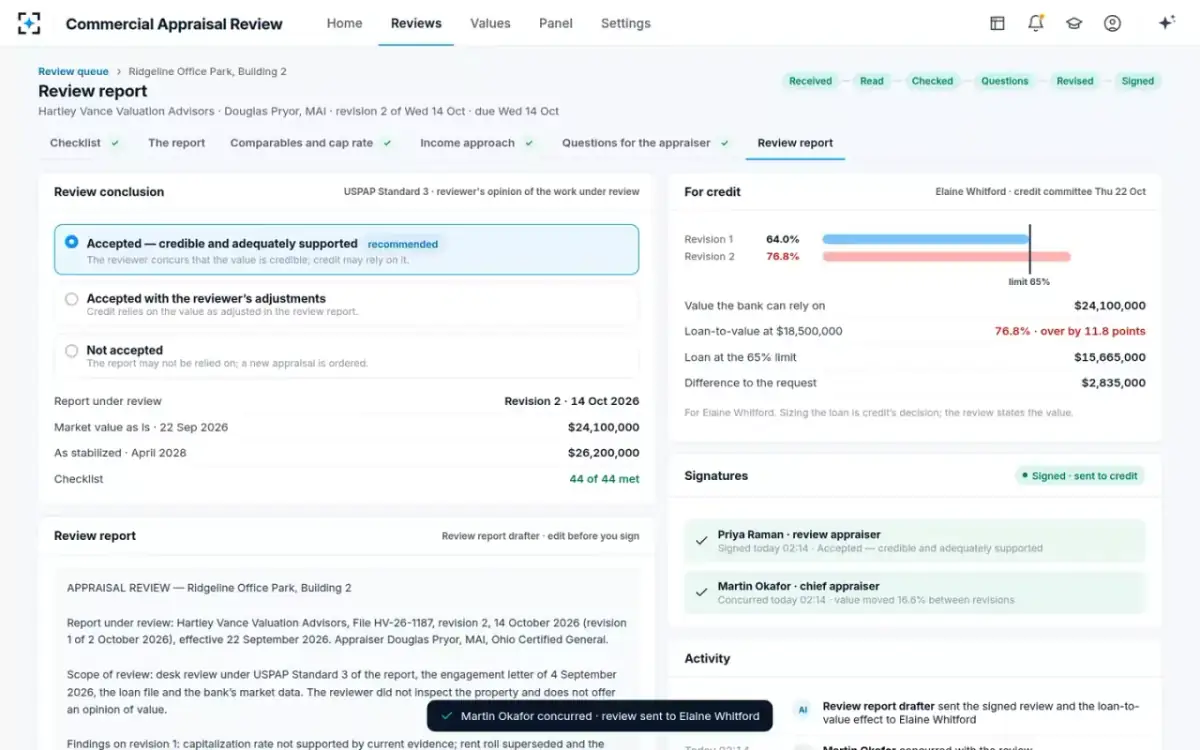
What the reviewer keeps is everything the rules assign to a person: accepting or rejecting the report, deciding which findings matter, editing or dropping any question before the desk sends it, and signing under Standard 3 with the meaning of the signature stated. In the sample, the chief appraiser's concurrence is required because the value moved 16.6% between revisions, a threshold the bank sets, not the software.
For the sample review, the agents' pass took 92 seconds; the review itself still took the reviewer's attention across five business days, because the appraiser had to answer seven questions. That is the right place for the time to go. To see the whole sequence on the example bank's files, start from Commercial Appraisal Review.
Questions people ask
What does a bank's appraisal review function do?
A bank review appraiser reviews appraisals and evaluations before the credit decision for compliance with USPAP, 12 CFR 34 subpart C, the Interagency Guidelines and bank policy; tests their reasonableness; resolves deficiencies with appraisers through the appraisal function; and documents a signed conclusion. Banks commonly require a state certified general credential for commercial work, and independence from loan production.
What is the difference between a technical and an administrative appraisal review?
An administrative review checks that the report is complete, consistent and compliant. A technical review tests the quality of the analysis itself, adjustment by adjustment and assumption by assumption. The Guidelines expect technical review for large-dollar credits, complex or specialized properties and out-of-market collateral.
What does a bank chief appraiser do?
The chief appraiser runs the bank's appraisal and evaluation program: the review policy and depth criteria, the approved appraiser list, engagement standards, concurrence on difficult reviews and the response to examiners. The Guidelines make the board responsible for adopting the program; the chief appraiser is usually the person who operates it day to day.
How many appraisals does a review appraiser review?
No regulator publishes a standard, and caseloads vary with the mix of evaluations, residential and commercial work. What the rules fix is not the count but the order: every appraisal reviewed, and reviewed before the final credit decision. A commercial queue is set by credit committee dates, which is why prioritising by due date and findings matters.
Does a commercial review appraiser need to be certified general?
Not by regulation for every review: a USPAP compliance review need not be performed by an appraiser at all. A certified general credential is needed to appraise commercial property above the thresholds and to develop a second opinion of value in a Standard 3 review, which is why banks usually require it for commercial reviewers.