The Interagency Appraisal and Evaluation Guidelines are the federal banking agencies' supervisory guidance on how a bank should run its real estate valuation program: who orders appraisals and evaluations, how appraisers are chosen and kept independent, what reports must contain, how they are reviewed before the credit decision, and how values are monitored afterwards. They were issued on December 10, 2010 by the OCC, the Federal Reserve, the FDIC, the Office of Thrift Supervision and the NCUA, replacing the 1994 guidelines, and they sit on top of the binding appraisal rules in 12 CFR 34 subpart C and its counterparts (75 FR 77450). As of October 2026 they have not been revised or replaced, despite searches for a 2025 or 2026 version; the agencies added interagency FAQs in 2018, an advisory on evaluations in 2016 and new thresholds in 2018 and 2019, but the Guidelines themselves stand. For a commercial lender, they are the reason every appraisal is reviewed before credit relies on it, which is the work Botminds' Commercial Appraisal Review is built to support.
The rule says what must happen; the Guidelines say how a sound bank does it
12 CFR 34 subpart C (binding rule): An appraisal is required for real estate-related transactions unless an exemption applies; commercial transactions of $500,000 or less need an evaluation instead.
Interagency Guidelines (supervisory guidance): Explains each exemption, when a bank should get an appraisal anyway, and what makes an existing value still valid.
12 CFR 34 subpart C (binding rule): Appraisals must conform to USPAP, support the decision, be reviewed for USPAP compliance and take required deductions.
Interagency Guidelines (supervisory guidance): Sets out minimum appraisal and evaluation content, report options, scope of work and the "as is" and prospective values.
12 CFR 34 subpart C (binding rule): Fee appraisers engaged directly by the bank, with no interest in the property; staff appraisers independent of lending.
Interagency Guidelines (supervisory guidance): Separates ordering, reviewing and accepting from loan production; lists permitted and prohibited communications.
12 CFR 34 subpart C (binding rule): Appraisals must be "subject to appropriate review for compliance with" USPAP.
Interagency Guidelines (supervisory guidance): Review before the credit decision, risk-focused depth, reviewer qualifications, resolving deficiencies, documentation.
12 CFR 34 subpart C (binding rule): The regulator may require an appraisal to address safety and soundness.
Interagency Guidelines (supervisory guidance): Monitoring collateral values, portfolio collateral risk, modifications and workouts, referrals of appraiser misconduct.
What are the Interagency Appraisal and Evaluation Guidelines?
They are a joint supervisory statement of how the agencies expect a regulated institution to obtain and use real estate values. In the agencies' own words they "describe the elements of a sound program for conducting appraisals and evaluations and address supervisory matters related to real estate appraisals and evaluations used to support real estate-related financial transactions" (OCC Bulletin 2010-42). They apply to "all real estate-related financial transactions originated or purchased by a regulated institution" for its own portfolio or for sale, commercial and residential alike.
The Guidelines run to eighteen sections and four appendices. The OCC transmitted them as Bulletin 2010-42, the Federal Reserve as SR 10-16, and the FDIC as FIL-82-2010. They also "clarify standards for the industry's appropriate use of analytical methods and technological tools in developing evaluations", which in 2010 meant automated valuation models and tax assessment values, and which is still the only interagency text on technology in valuation for commercial property.
Is there a 2025 or 2026 version of the Interagency Appraisal and Evaluation Guidelines?
No. The 2010 Guidelines remain the current text; a search of the Federal Register for 2024 to 2026 appraisal documents from the OCC, FDIC and Federal Reserve finds no revision and no rescission, and the OCC's bulletin page carries no replacement notice. Searches for a "2024", "2025" or "2026" version usually reflect confusion with other instruments issued around them.
Sixteen years of appraisal instruments around one unchanged set of Guidelines
| Date | Instrument | What it changed |
|---|---|---|
| December 2010 | Interagency Appraisal and Evaluation Guidelines | The framework itself; replaced the 1994 guidelines. Still in force. |
| March 2016 | Interagency Advisory on Use of Evaluations | Clarified when evaluations may be used and how to support them with few comparable sales. |
| April 2018 | Final rule, Real Estate Appraisals | Raised the commercial real estate threshold from $250,000 to $500,000. |
| October 2018 | Interagency FAQs (SR 18-9) | Collected interpretations on review, renewals, evaluations and other lenders' appraisals. |
| October 2019 | Residential threshold rule | Raised the residential threshold to $400,000. |
| July 2023 | Policy statement on CRE accommodations and workouts | Set when a workout needs a new appraisal or evaluation. |
| August 2024 | AVM quality-control rule | Covers automated valuations of consumer dwellings only; excludes review uses. |
| October 2026 | No revision found | The 2010 Guidelines remain the current text. |
Two of those instruments changed numbers inside the Guidelines without rewriting them. The 2010 text still describes the commercial appraisal threshold as $250,000; the 2018 rule raised it to $500,000 for commercial real estate (83 FR 15019), and the rule governs. The appraisal threshold for commercial real estate has its own guide. The 2024 AVM rule, often mistaken for a Guidelines update, covers only automated valuations of a consumer's principal dwelling.
Are the Interagency Appraisal Guidelines a regulation?
No. They are supervisory guidance that explains how to comply with regulations. The 2018 FAQs are explicit: "The valuation guidelines are not regulations and do not prescribe a set of requirements that financial institutions must meet" (Interagency FAQs, A4). A bank's program "should be commensurate with the complexity and nature of its real estate lending activities, risk profile, and business model."
That does not make them optional in practice. The Guidelines describe what examiners will look for, and say so: institutions that fail to comply with the appraisal regulations "or to maintain a sound appraisal and evaluation program consistent with supervisory guidance will be cited in supervisory letters or examination reports and may be criticized for unsafe and unsound banking practices" (Guidelines §III). The material loss reviews of failed banks read like a list of departures from them. At Seaway Bank, examiners found the bank's policy needed "criteria to determine whether an existing appraisal or evaluation remained valid to support a subsequent transaction," and that values behind many classified loans "were supported by outdated appraisals that were not necessarily accurate" (FDIC OIG, AUD-17-005).
The Guidelines section by section, in plain words
Eighteen sections and four appendices, each in a sentence
| Section | In plain words |
|---|---|
| I–III Purpose, background, supervisory policy | Replaces the 1994 guidelines; rests on FIRREA Title XI; examiners will test methods, assumptions and conclusions and cite weak programs. |
| IV Appraisal and evaluation program | The board adopts a program covering independence, appraiser selection, content, timely review, validity, third parties and monitoring. |
| V Independence | Valuation staff report outside loan production; the bank may ask appraisers to consider, support or correct, never to hit a number. |
| VI Selection of appraisers | Competence for the property and market, approved lists with monitoring, written engagement letters for large or complex commercial work. |
| VII–X Appraisals | When an appraisal is required; minimum standards; scope of work and approaches; report options with enough detail to support the credit. |
| XI–XIII Evaluations | When an evaluation may be used, how it is developed without unsupported assumptions, and what it must contain. |
| XIV Validity | When an existing appraisal or evaluation can support a new transaction, judged on time, market, financing, cap rates and lease terms. |
| XV Reviewing appraisals and evaluations | Review before the credit decision, at a depth that follows risk, by qualified independent reviewers, with deficiencies resolved and documented. |
| XVI Third party arrangements | Outsourcing valuation work, including review, leaves the bank responsible and requires oversight. |
| XVII Program compliance | Controls and testing of the program, including the review process; monitoring collateral, portfolio collateral risk, modifications and workouts. |
| XVIII Referrals | Report appraiser misconduct to the state board, and suspicious activity to FinCEN. |
| Appendices A–D | Appraisal exemptions explained; evaluations based on models and tax values; deductions and discounts; glossary. |
What is an appraisal and evaluation program?
It is the set of board-approved policies and procedures through which a bank obtains, reviews and monitors real estate values. Section IV makes the board, or its designated committee, "responsible for adopting and reviewing policies and procedures that establish an effective real estate appraisal and evaluation program", and lists what the program should do. The list is a useful self-assessment for any chief appraiser.
What the Guidelines say a bank's appraisal and evaluation program should do
- Provide for independence
Of the people ordering, performing and reviewing appraisals and evaluations.
- Select and monitor appraisers
Criteria to choose them and to evaluate their ongoing performance.
- Ensure compliance and sufficiency
Appraisals comply with the regulations and guidance, and contain enough to support the credit decision.
- Govern evaluations
Criteria for their content and appropriate use.
- Review in time
Receipt and review of the appraisal or evaluation in a timely manner to facilitate the credit decision.
- Judge validity
Criteria for when an existing appraisal or evaluation can support a later transaction.
- Control third parties
Internal controls, including monitoring of third-party arrangements.
- Monitor collateral
Criteria for monitoring values, and for obtaining valuations where the rules do not require one.
What do the Guidelines say about appraiser independence?
They make independence a property of the whole valuation function, not only of the appraiser. The collateral valuation program "should be isolated from influence by the institution's loan production staff," and a bank "should establish reporting lines independent of loan production for staff who administer the institution's collateral valuation program, including the ordering, reviewing, and acceptance of appraisals and evaluations" (Guidelines §V). Small or rural institutions that cannot separate the functions must show "prudent safeguards", and the officers involved must abstain from voting on the loans concerned.
Independence also governs what the bank says to the appraiser. Section V lists permitted requests and prohibited communications, and section VI adds that independence is compromised "when a borrower recommends an appraiser" or "when loan production staff selects a person to perform an appraisal or evaluation for a specific transaction." How those rules apply when agents draft the questions is covered in the guide to commercial appraisal AI.
What do the Guidelines say about appraisal review?
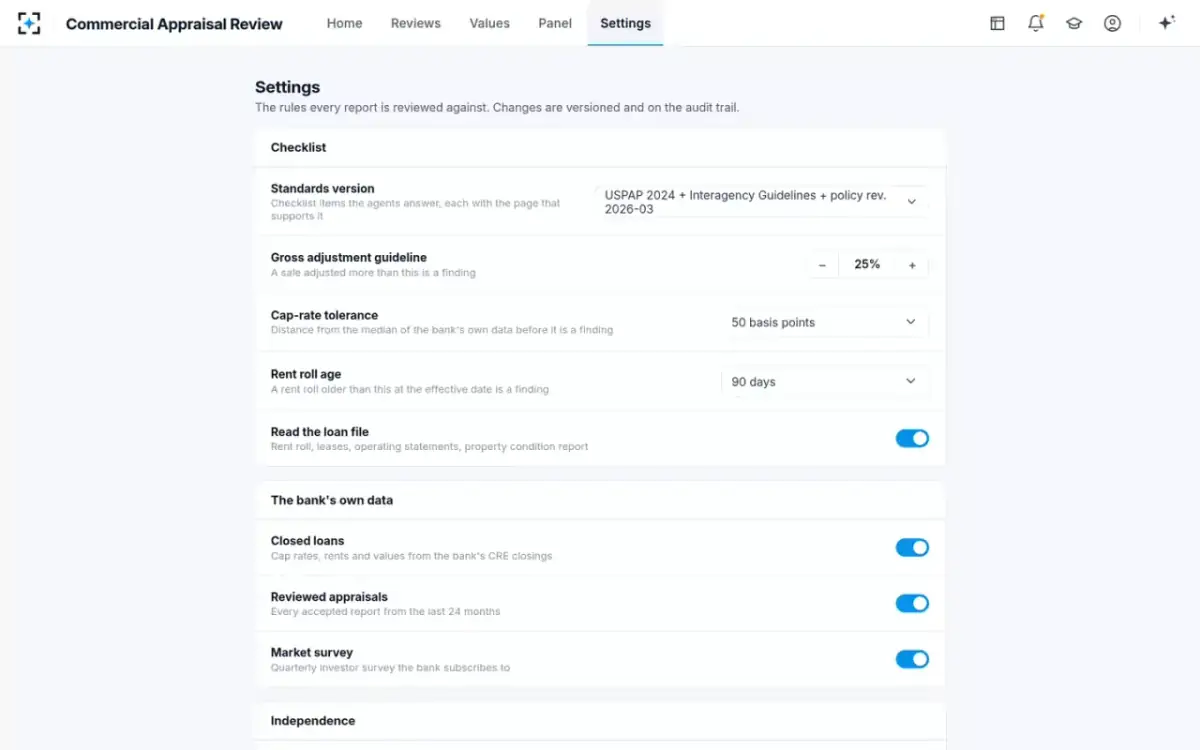
Section XV makes review a precondition of the credit decision. "As part of the credit approval process and prior to a final credit decision, an institution should review appraisals and evaluations to ensure that they comply with the Agencies' appraisal regulations and are consistent with supervisory guidance and its own internal policies." The review should let the bank "assess the reasonableness of the appraisal or evaluation, including whether the valuation methods, assumptions, and data sources are appropriate and well-supported."
It sets four minimum policy elements: the reviewer's independence, qualifications and role; a risk-focused approach to depth; a process for resolving deficiencies; and documentation standards. For commercial property it asks for more comprehensive, technical review of complex, large-dollar and out-of-market credits. When deficiencies cannot be resolved with the appraiser, the bank must obtain an appraisal that meets the rules before deciding, and if it relies on a second opinion of value it must come from a USPAP-compliant review by a qualified appraiser.
The Guidelines' review section, set as the bank's own rules
What must an evaluation contain?
An evaluation must give a reliable market value for the property in its actual condition, with enough analysis to support the credit decision. Section XIII says it should, at a minimum, identify the location; describe the property and its use; estimate market value "in its actual physical condition, use and zoning designation as of the effective date"; describe how the property's condition was confirmed and whether it was inspected; describe the analysis and supporting information; and name the sources and the preparer.
The 2016 advisory added what the Guidelines implied: "An evaluation is not required to be completed by a state-licensed or state-certified appraiser or to comply with USPAP," but its preparer "should, however, be knowledgeable, competent, and independent of the transaction and the loan production function" (Interagency Advisory on Use of Evaluations, 2016). For income property it notes that the income approach "could be appropriate to support a market value conclusion in an evaluation."
Validity, monitoring and workouts: the Guidelines after the loan closes
The Guidelines do not stop at origination. Section XIV says a new appraisal or evaluation is needed when value has changed because of factors including the "Passage of time", "Volatility of the local market" and "Changes in underlying economic and market assumptions, such as capitalization rates and lease terms." Section XVII asks the bank to monitor collateral risk on each credit and across the portfolio, and treats moving capitalization and discount rates as a sign that market conditions have changed. For workouts that advance new money in a materially changed market, an appraisal is required unless another exemption applies.
Monitoring collateral values, month by month
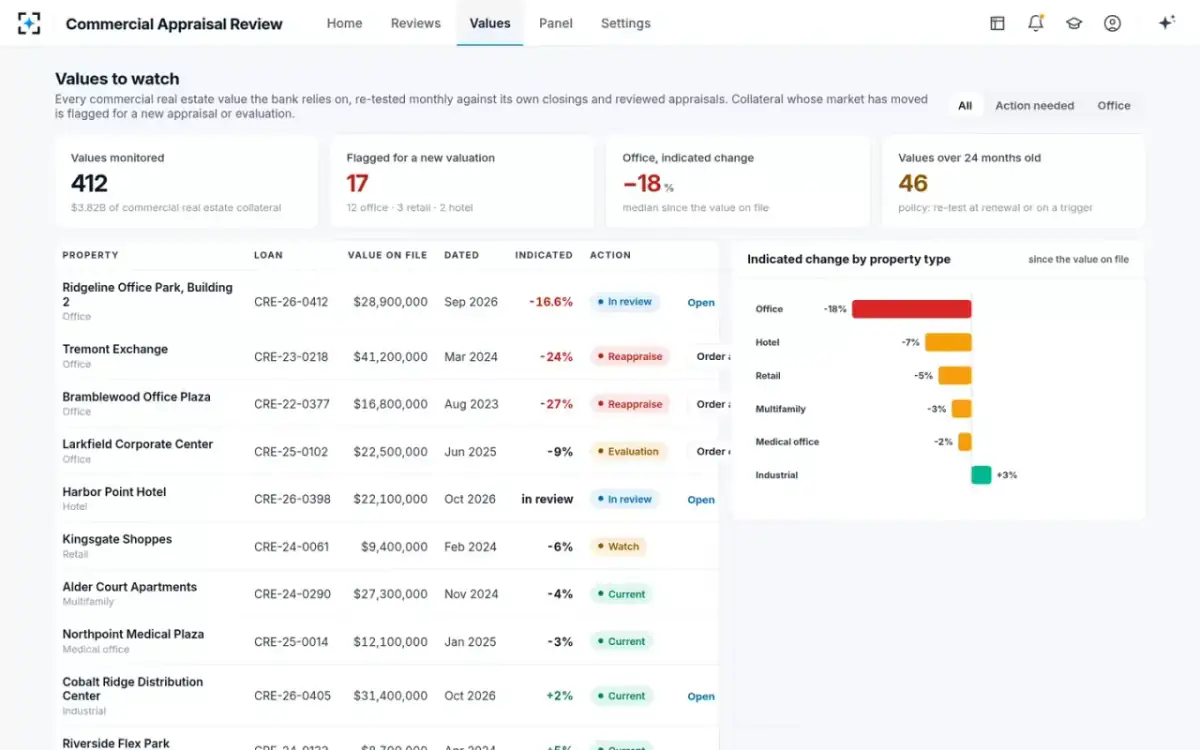
Taken together, the Guidelines describe a loop: obtain an independent value, review it before relying on it, and keep checking it while the loan is on the books. The solution's six agents serve the middle of that loop and its monitoring end: a commercial review that follows USPAP, the Interagency Appraisal and Evaluation Guidelines and the bank's engagement letter and policy, with a page behind every answer, and a monthly re-test of the values already relied on. To see both on sample data, start from Commercial Appraisal Review.
Questions people ask
When were the Interagency Appraisal and Evaluation Guidelines issued?
On December 10, 2010, at 75 FR 77450, by the OCC, Federal Reserve, FDIC, Office of Thrift Supervision and NCUA. The OCC transmitted them as Bulletin 2010-42 and the Federal Reserve as SR 10-16. They replaced the 1994 interagency guidelines and remain in force.
Do the Guidelines apply to credit unions?
Yes. The NCUA joined the 2010 Guidelines, and they note where NCUA's own appraisal regulation in 12 CFR 722 differs, for example on member business loans and existing extensions of credit. The NCUA was not a party to the 2016 evaluations advisory or the 2018 FAQs.
What are the interagency appraisal guidelines FAQs?
A set of 23 questions and answers issued on October 16, 2018 by the OCC, Federal Reserve and FDIC (SR 18-9). They introduce no new policy but collect earlier interpretations on review, renewals, evaluations, independence and appraisals from other institutions, and they supersede the 2005 FAQs.
Do the Guidelines still say the commercial threshold is $250,000?
The 2010 text does, but the regulation changed in 2018: commercial real estate transactions of $500,000 or less may use an evaluation, and above that a state-certified appraiser's appraisal is required. Where the Guidelines' numbers and the current rule differ, the rule governs.
Do the Guidelines cover AI in appraisal review?
Not directly. They address automated valuation models and tax assessment values in evaluations, and allow automated tools for pre-funding review only for lower-risk residential loans with regulator approval. For commercial review, the general requirements still apply: independence, qualified reviewers, risk-based depth and documentation.