The appraisal threshold for commercial real estate at federally regulated banks is $500,000. A commercial real estate transaction with a transaction value of $500,000 or less does not need an appraisal but does need an evaluation "consistent with safe and sound banking practices"; above $500,000, "an appraisal prepared by a State certified appraiser" is required (12 CFR 34.43; FDIC and Federal Reserve rules are parallel). Two further exemptions matter as much in practice: a business loan of $1 million or less that does not depend on selling or renting real estate, and a renewal or refinance of an existing loan without new money or without a material change in the market or the property. The threshold was raised from $250,000 in April 2018 and has not changed since, as of October 2026. Whichever is obtained, appraisal or evaluation, the bank must review it before the credit decision, and that review is where Botminds' Commercial Appraisal Review works: the same review discipline, applied to the standard each kind of valuation must meet.
Appraisal or evaluation? Five questions for a commercial real estate loan
- 1
Is real estate taken as collateral for its value?
If no
No appraisal needed if the loan is unsecured by real estate, or the lien is taken in an abundance of caution or for reasons other than the real estate's value. Document why.
- 2
Is the loan insured or guaranteed by a US government agency, or eligible for sale to one?
If yes
Follow that agency's appraisal requirements instead.
- 3
Is it an existing loan at your bank, renewed or refinanced with no new money beyond closing costs, or with no obvious and material change in the market or property?
If yes
Evaluation required, unless an existing appraisal or evaluation is still valid. An appraisal is optional.
- 4
Is it a business loan of $1 million or less, repaid mainly from the business rather than from selling or renting the real estate?
If yes
Evaluation required. An appraisal is optional.
- 5
Is it a commercial real estate transaction with a transaction value of $500,000 or less?
If yes
Evaluation required. An appraisal is optional.
- →
None of the above applies
Result
Appraisal by a state-certified appraiser, reviewed before the credit decision.
What is the appraisal threshold for commercial real estate?
The threshold is a transaction value of $500,000. The regulation lists the exemption in plain terms: an appraisal is not required where "the transaction is a commercial real estate transaction that has a transaction value of $500,000 or less", and in that case "the institution shall obtain an appropriate evaluation of real property collateral that is consistent with safe and sound banking practices." Above it, "All federally related transactions that are commercial real estate transactions having a transaction value of more than $500,000 shall require an appraisal prepared by a State certified appraiser" (12 CFR 34.43(a)(13), (b), (d)(2)).
Two other lines sit beside it. Any federally related transaction of $1,000,000 or more needs a state-certified appraiser, whatever the property. And residential transactions have their own threshold of $400,000, set in 2019. The OCC also reserves the right to require an appraisal "whenever the agency believes it is necessary to address safety and soundness concerns", which examiners use for problem credits.
The thresholds that decide appraisal or evaluation, and who may perform the appraisal
| Transaction | Valuation required | Who may appraise | Rule |
|---|---|---|---|
| Commercial real estate, transaction value $500,000 or less | Evaluation | Appraisal optional; an evaluation need not be by an appraiser | 12 CFR 34.43(a)(13), (b) |
| Commercial real estate, more than $500,000 | Appraisal | State certified appraiser | 12 CFR 34.43(d)(2) |
| Business loan of $1 million or less, not dependent on real estate sale or rent | Evaluation | Appraisal optional | 12 CFR 34.43(a)(5), (b) |
| Existing loan renewed or refinanced, no new money or no material change | Evaluation | Appraisal optional | 12 CFR 34.43(a)(7), (b) |
| Any federally related transaction of $1,000,000 or more | Appraisal | State certified appraiser | 12 CFR 34.43(d)(1) |
| Residential, 1–4 units, $400,000 or less | Evaluation | Appraisal optional; consumer rules may still require one | 12 CFR 34.43(a)(1), (b) |
What counts as a commercial real estate transaction, and what is transaction value?
A commercial real estate transaction is any real estate-related financial transaction "that is not secured by a single 1-to-4 family residential property", as the 2018 rule defines it (83 FR 15019). That captures office, retail, industrial, hotels and multifamily, and also loans secured by several homes. Construction loans on a single 1-to-4 family home are excluded and follow the residential rules.
For a loan, transaction value is "the amount of the loan or extension of credit", not the property's value (Guidelines, Appendix D). A $420,000 loan on a $640,000 building is under the threshold. Where one loan is secured by several properties not in a tract development, each property is tested on its own value: the Guidelines' example is a loan on seven commercial properties where the two valued above the threshold need appraisals and the five below need evaluations, "even though the aggregate loan commitment exceeds the appraisal threshold."
Commercial evaluation vs appraisal: what changes below $500,000
Below the threshold, the standard changes, not the obligation to value and review. An evaluation must still give a reliable market value of the property in its actual condition and support the credit decision, and it must still be reviewed before the decision. What changes is who may prepare it and what form it takes.
Commercial evaluation vs appraisal, side by side
Evaluation (≤ $500,000 CRE, and other exemptions): Knowledgeable, competent and independent of the transaction and loan production; need not be a licensed or certified appraiser.
Appraisal (above the threshold): A state-certified appraiser for commercial real estate above $500,000, engaged directly by the bank.
Evaluation (≤ $500,000 CRE, and other exemptions): Need not comply with USPAP; must meet the Guidelines' evaluation content.
Appraisal (above the threshold): Must conform to USPAP and the regulation's minimum standards.
Evaluation (≤ $500,000 CRE, and other exemptions): No standard format; enough for a reader to understand the analysis and the value conclusion.
Appraisal (above the threshold): A USPAP appraisal report with the scope of work, approaches and reconciliation disclosed.
Evaluation (≤ $500,000 CRE, and other exemptions): Sales comparison, cost or income approach; analytical tools such as AVMs only with supplemental information and validation.
Appraisal (above the threshold): Every approach applicable and necessary to the assignment, with omissions explained.
Evaluation (≤ $500,000 CRE, and other exemptions): Before the credit decision; depth commensurate with risk.
Appraisal (above the threshold): Before the credit decision; technical review for complex, large or out-of-market credits.
For income property, the 2016 advisory notes that the income approach "could be appropriate to support a market value conclusion in an evaluation", and that where recent comparable sales are scarce, as in rural markets or states that do not disclose sale prices, an evaluator "may consider alternative valuation methods" (Interagency Advisory, 2016). The 2018 FAQs add that "an evaluation for most residential properties could be less detailed than evaluations for commercial properties" (Interagency FAQs, A11): a commercial evaluation is a lighter document than an appraisal, but not a light one.
What is the appraisal threshold for commercial loans that are not real estate deals?
For a business loan secured by real estate, the line is $1 million, if the real estate is not the repayment source. The rule exempts a business loan that "has a transaction value of $1 million or less" and "is not dependent on the sale of, or rental income derived from, real estate as the primary source of repayment" (12 CFR 34.43(a)(5)). The Guidelines expect the bank "to determine that the primary source of repayment for the business loan is operating cash flow from the business rather than rental income or sale of real estate."
The classic case is an owner-occupied building: a manufacturer borrows $900,000 against its own plant and repays from operating profits. An evaluation suffices. A $900,000 loan on a small strip center repaid from tenants' rent does not qualify for the business-loan exemption, because rental income is the repayment source; it is a commercial real estate transaction above $500,000, and it needs an appraisal. The same building can fall on either side depending on who occupies it.
Does a renewal need a new appraisal?
Usually not a new appraisal, but possibly a new evaluation. A renewal or refinance of an existing loan at the same bank is exempt from the appraisal requirement where "There has been no obvious and material change in market conditions or physical aspects of the property that threatens the adequacy of the institution's real estate collateral protection after the transaction, even with the advancement of new monies", or where "There is no advancement of new monies, other than funds necessary to cover reasonable closing costs" (12 CFR 34.43(a)(7)). In either case an evaluation is required, unless an existing appraisal or evaluation remains valid.
The combination that forces an appraisal is new money plus a material change. The FAQs illustrate it with a construction loan renewed at maturity with new money after the market had turned: "The agencies' appraisal regulations would require an appraisal to support the transaction" (Interagency FAQs, A8, example 2). New money means "an increase in the principal amount of the loan over the amount of principal outstanding before the renewal or refinancing" (Guidelines, Appendix A). Whether the old value is still valid is a separate test, and the regulations specify no useful life for an appraisal.
Why was the commercial appraisal threshold raised to $500,000?
Because the old $250,000 line had stopped meaning much. When it was set in 1994, loans of $250,000 or less were about 18% of the dollar volume of nonfarm nonresidential loans at insured institutions; by the end of 2016 they were about 4%. Raising it to $500,000 moved many transactions but few dollars: the agencies' analysis found it would exempt 31.9% of commercial transactions in their sample but only 1.8% of the dollar volume (83 FR 15019).
The 2018 threshold change moved a third of deals into evaluations, but under 2% of the dollars
The agencies' conclusion was that the change "will affect a low aggregate dollar volume, but a material number of transactions." Their small-entity analysis also priced the saving modestly: the FDIC estimated that an evaluation saves about half an hour of loan review compared with an appraisal, worth roughly $67,000 to $173,000 a year across all small FDIC-supervised institutions. The threshold mostly changed the workload in the review queue, not the risk on the balance sheet.
When should a bank get an appraisal anyway?
When the risk justifies it, whatever the threshold says. The Guidelines expect a bank to set policies "for determining when to obtain an appraisal" for transactions that only need an evaluation, and name examples: loans "with combined loan-to-value ratios in excess of the supervisory loan-to-value limits", atypical properties, properties outside the bank's usual market, existing credits with significant risk, and high-risk borrowers (Guidelines §XI). The 2016 advisory adds that an appraisal may be prudent "when the institution's portfolio risk increases."
Examiners look for those criteria in policy. The OCC's questionnaire asks whether the bank "developed appropriate procedures for when and how evaluations may be performed", whether there is "a standard evaluation form", and whether "all evaluations [are] reviewed and is each review documented" (OCC CRE booklet, ICQ 35–42).
Reviewing evaluations: the same review, a different standard
An evaluation is reviewed like an appraisal, before the credit decision, against the standard it must meet. That means checking that it identifies the property and its actual condition, describes how the condition was confirmed, shows the analysis and sources, and supports the value. It does not mean testing it against USPAP, which does not apply.
Evaluations sit in the same queue, with their own checklist
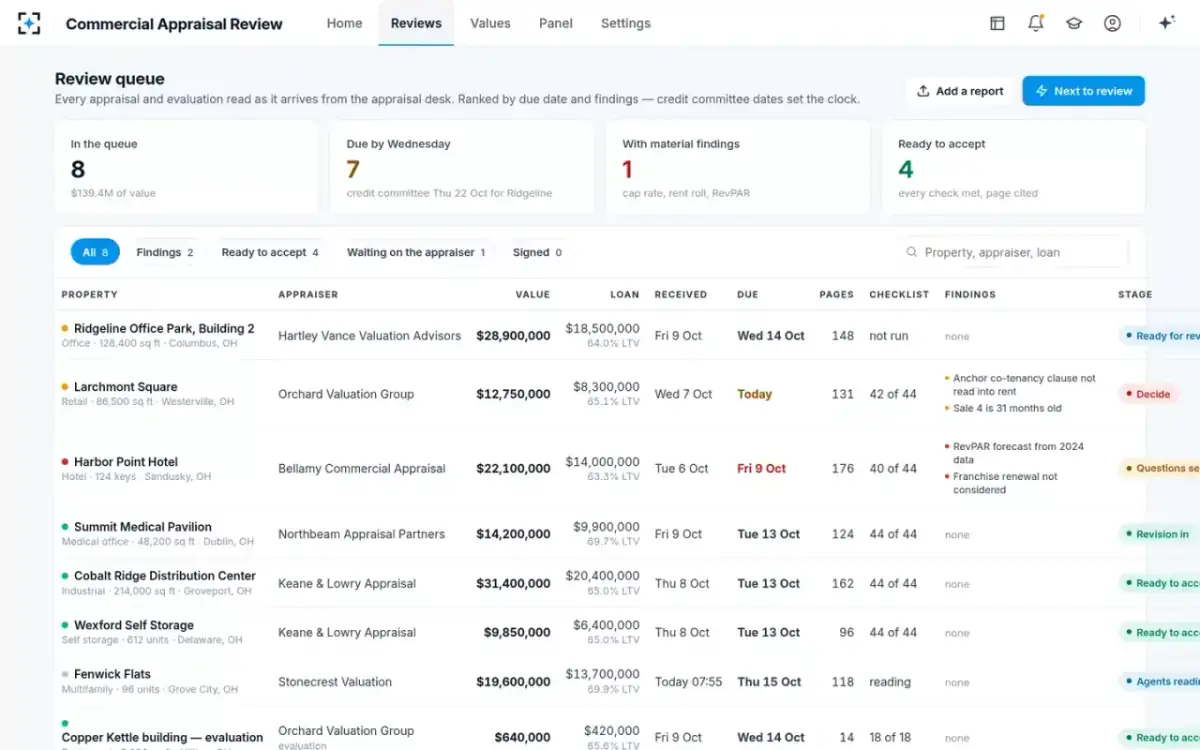
In the example bank's queue, the Copper Kettle building evaluation is 14 pages against 148 for the office appraisal next to it, and its checklist has 18 items against 44. The agents read it, answer the evaluation checklist with page citations and flag anything the Guidelines require that is missing. The review appraiser still signs. Values on the books are watched the same way whether they came from an appraisal or an evaluation, and collateral whose market has moved is flagged for a new appraisal or evaluation by the rules above.
When a value on file stops being valid
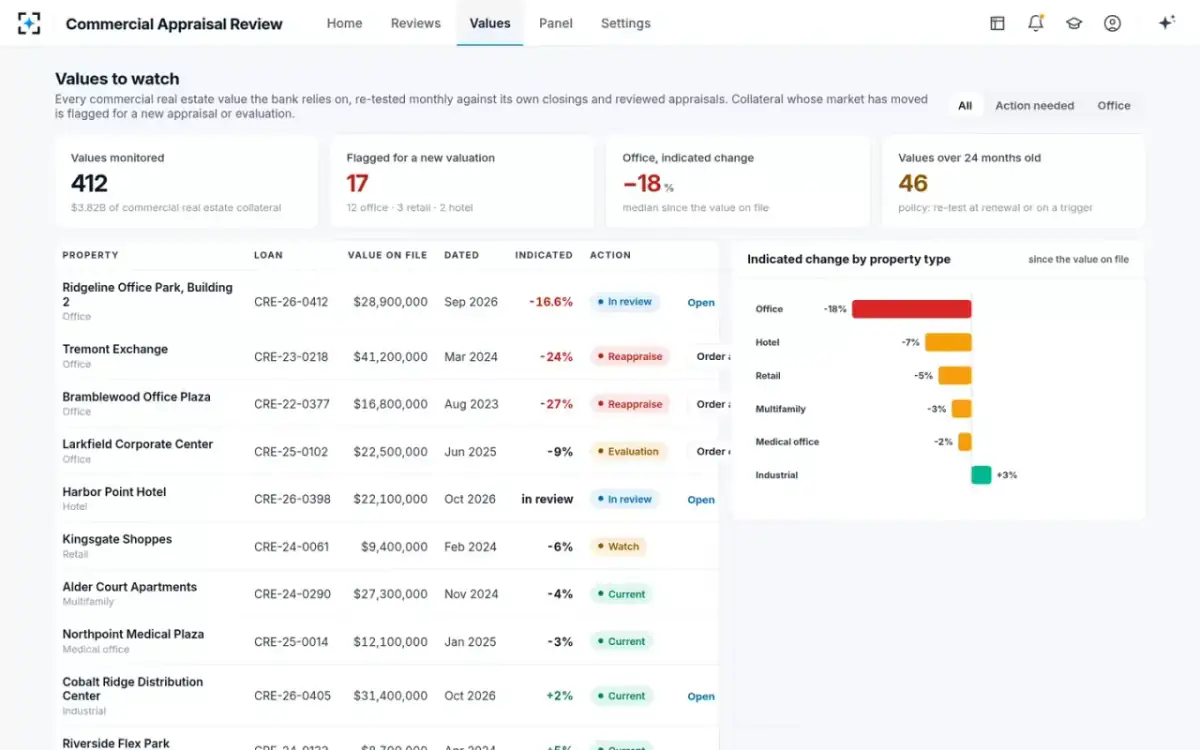
The Interagency Appraisal and Evaluation Guidelines, read section by section, cover the evaluation content and validity rules in more depth. To see an evaluation and an appraisal reviewed side by side on sample data, start from Commercial Appraisal Review.
Questions people ask
What does 12 CFR 34.43 require?
It lists when an appraisal by a state certified or licensed appraiser is required, the exemptions (including commercial real estate of $500,000 or less, business loans of $1 million or less not dependent on real estate, and certain renewals), the requirement to obtain an evaluation for those exemptions, and when a certified rather than licensed appraiser is needed. It is the OCC's rule; FDIC 323.3 and Federal Reserve 225.63 match it.
When is an evaluation enough for a commercial loan?
When the transaction value is $500,000 or less, when it is a business loan of $1 million or less repaid from operations rather than the real estate, or when an existing loan is renewed or refinanced without new money or without a material change in the market or property. The bank's policy may still require an appraisal for higher-risk loans.
Is the commercial appraisal threshold based on the loan amount or the property value?
On the transaction value, which for a loan is the loan amount. A $420,000 loan on a $640,000 building falls under the $500,000 threshold. For a loan secured by several separate properties, each property's value decides whether it needs an appraisal or an evaluation.
Has the commercial appraisal threshold changed since 2018?
No. The OCC, Federal Reserve and FDIC raised it from $250,000 to $500,000 effective April 9, 2018, and no change to the commercial threshold had been proposed or adopted as of October 2026. The residential threshold was raised to $400,000 in 2019.
Do credit unions have the same commercial appraisal threshold?
No. Credit unions follow the NCUA's appraisal rule in 12 CFR 722, which has its own thresholds and, as the Guidelines note, no exemption specific to member business loans. A credit union should apply its own regulation rather than the bank thresholds on this page.