Prospective market value upon stabilization, often called the "as stabilized" value, is an appraiser's opinion of a property's market value as of a future date when it is projected to reach stabilized occupancy, meaning the occupancy it should hold after being offered for lease for a reasonable time on terms like those of similar properties. The Interagency Appraisal and Evaluation Guidelines describe it alongside the "as is" value, which is the market value today in the property's actual condition, and the "as completed" value, which is the value when construction or renovation is finished. A bank may ask for all three, but the Guidelines are specific about how to use them: an institution "should understand the real property's 'as is' market value and should consider the prospective market value that corresponds to the credit decision and the phase of the project being funded" (Interagency Guidelines §VIII). The as-stabilized value is therefore something to read, plan around and test, not a number to size a loan on today. Botminds' Commercial Appraisal Review checks that a report provides the prospective values the engagement letter asked for and that the deductions back to "as is" are taken.
The example follows a fictional bank's review of a fictional suburban office appraisal.
Revision 2 of the sample appraisal: an as-stabilized value $2.1 million above today's
As stabilized, April 2028 · $26.2M
- As is today · $24.1M · 92%
- Lease-up gap · $2.1M · 8%
What is prospective market value upon stabilization?
It is a market value with a future effective date, at the point the property is expected to be leased up. The Guidelines' glossary defines it directly: "The prospective market value 'as stabilized' reflects the property's market value as of the time the property is projected to achieve stabilized occupancy. For an income-producing property, stabilized occupancy is the occupancy level that a property is expected to achieve after the property is exposed to the market for lease over a reasonable period of time and at comparable terms and conditions to other similar properties" (Guidelines, Appendix D).
Two features follow. It is an opinion about the future, so "Prospective market value opinions should be based upon current and reasonably expected market conditions", and the appraisal must give "a point of reference to the market conditions and time frame on which the appraiser based the analysis." And it assumes things that have not happened yet: that the vacant space leases, at the rents projected, within the time projected. Each assumption is something a reviewer can test.
As is vs as stabilized vs as completed
The three values answer three different questions about the same property, and an appraisal that provides more than one must label each clearly. The Guidelines allow "separate opinions of such values so long as they are clearly identified and disclosed", and the regulation requires every appraisal to include the market value "as of the effective date" in the property's actual condition, use and zoning.
Three market values, three effective dates, three uses
| Value | What it measures | Effective date | How a bank uses it |
|---|---|---|---|
| As is | Market value in the property's current physical condition, use and zoning | The appraisal's effective date, today | The value the bank relies on now: loan-to-value at origination, collateral for an existing building |
| Prospective as completed | Market value when construction or renovation is finished | The projected completion date | Sizing and monitoring a construction or renovation loan against the phase being funded |
| Prospective as stabilized | Market value when the property reaches stabilized occupancy | The projected stabilization date | Testing the exit: whether a permanent loan or sale can repay the bank once leased up |
For a building that is already complete and leased, the three values may be the same, and the report need only state "as is". They diverge for a construction or renovation project, which is the case the Guidelines have in mind, and for a completed building with meaningful vacancy or a large lease about to roll, which is the case reviewers more often meet in refinances.
Which value should a bank lend on?
A bank should size a loan against the value that matches what it is funding today, and for an existing income property that is normally the "as is" value. The Guidelines' instruction to "consider the prospective market value that corresponds to the credit decision and the phase of the project being funded" works both ways. A construction loan is advanced as the building rises, so the as-completed value is the relevant ceiling for the final phase, with advances limited to costs actually incurred. A refinance of a building with vacant space funds the building as it is, so the as-is value governs.
The real estate lending rules point the same way. Loan-to-value is "derived at the time of loan origination by dividing an extension of credit by the total value of the property", and for loans funding several phases of one project, "the appropriate loan-to-value limit is the limit applicable to the final phase of the project funded by the loan; however, loan disbursements should not exceed actual development or construction outlays" (12 CFR 34 subpart D, Appendix A). A prospective value can set the ceiling for a phased loan; it cannot fund money ahead of the work.
What a stabilized value must deduct to get back to "as is"
The difference between "as stabilized" and "as is" is the cost and risk of getting there, and the regulation requires the appraisal to show it. Every appraisal must "Analyze and report appropriate deductions and discounts for proposed construction or renovation, partially leased buildings, non-market lease terms, and tract developments with unsold units" (12 CFR 34.44(d)). For partially leased buildings, the Guidelines' Appendix C lists what those deductions should include.
From the as-stabilized value back to today's value, term by term
Prospective value as stabilized
stabilized net operating income ÷ cap rate, at the stabilization date
Rests on projected rents, occupancy and timing; test each against the market and the leases.
Rent loss during lease-up
vacant area × market rent × months to lease, plus free rent
Appendix C: "rent losses". The months come from the absorption analysis.
Leasing costs
leasing commissions + tenant improvements for the vacant space
Appendix C: "leasing commission" and "tenant improvements".
Entrepreneurial profit
the return a buyer would demand for taking the lease-up risk
Appendix C: included "if such profit is not included in the discount rate".
In the sample, the first version of the report took none of these deductions for the largest tenant's space, because it assumed the tenant would renew "on comparable terms, and no downtime or leasing costs have been applied". The loan file held that tenant's notice of non-renewal for 32,600 square feet, a quarter of the building. Revision 2 deducts the tenant's downtime and re-leasing costs, and the as-is value falls to $24,100,000, with the as-stabilized value of April 2028 at $26,200,000 now shown separately.
The lease-up assumptions a reviewer can move, and see value respond
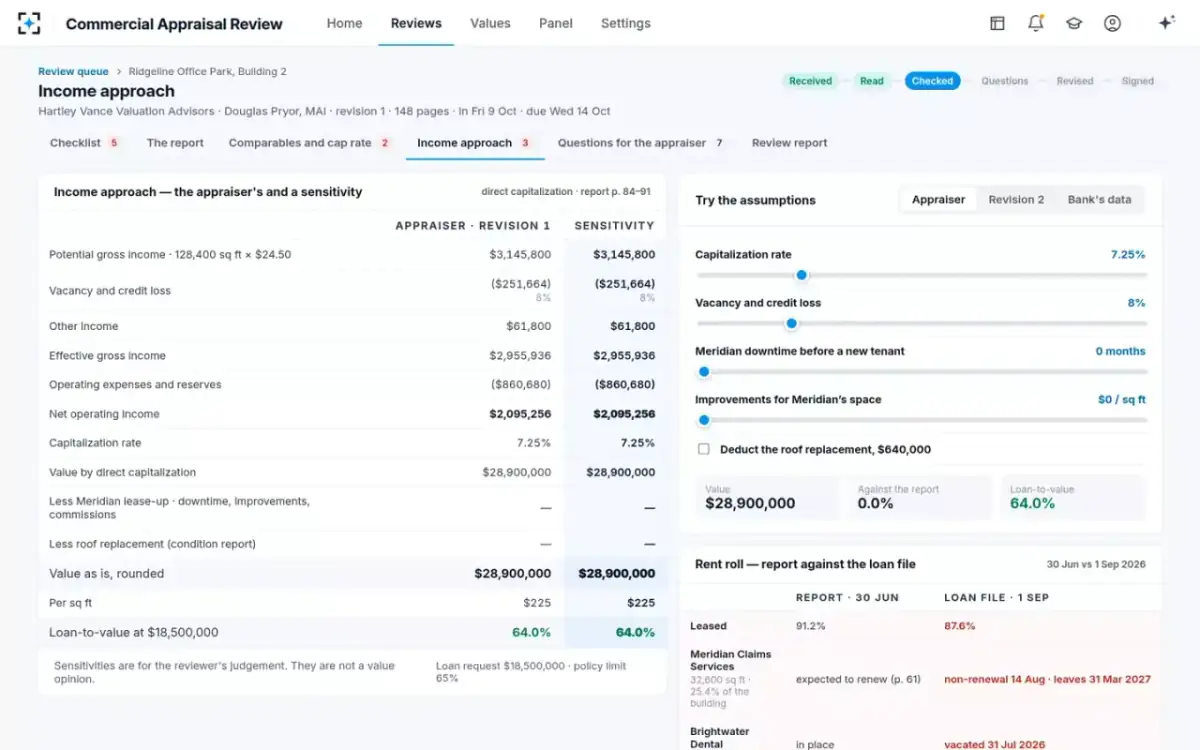
What is stabilized loan to value, and why does it flatter?
Stabilized loan-to-value divides the loan by the as-stabilized value instead of the as-is value. Because the stabilized value is higher whenever the property has lease-up ahead of it, the ratio is lower, and a loan that breaches policy on today's value can appear to fit on tomorrow's. The sample makes the point in three numbers.
The same $18.5 million request, measured against three values
On revision 2's as-is value, the request is 76.8% loan-to-value, 11.8 points over the bank's 65% office limit, and the loan at the limit is $15,665,000. On the as-stabilized value it would be 70.6%, still over the limit but less obviously. On revision 1, which assumed the tenant would stay, it was 64.0%, inside the limit. A credit officer shown only the stabilized ratio sees a modest exception; shown the as-is ratio, a loan $2,835,000 larger than policy allows.
When lending on "as stabilized" becomes a misuse
Lending on an as-stabilized value becomes a misuse when it funds today, against an existing building, money that only tomorrow's leasing would justify. Four patterns recur. A refinance sized to the stabilized value, so that the loan depends on leasing the bank has not underwritten. A construction loan whose advances run ahead of the work because the ceiling was set on a prospective value. An as-stabilized value reported without the as-is value at all, so the reader cannot see the gap. And a stabilization date so far out, or an occupancy so far above the market's, that the "reasonable period of time" in the definition has stopped being reasonable.
The OCC's review worksheet tests the first and third directly. It asks whether "the 'as-is' market value [is] reported" (item 9) and whether "assumptions and limiting conditions [are] consistent with the bank's intended collateral position in the transaction" (item 13) (OCC CRE booklet, Appendix E). A stabilized value used to support today's advance fails item 13 whatever the arithmetic says. The full worksheet, item by item, has its own guide.
When the engagement letter asks for it and the report omits it
The opposite failure is also common: the bank asks for an as-stabilized value and does not get one. In the sample, the engagement letter of 4 September 2026 asks for "the as-is and the as-stabilized market value"; revision 1 provides only the as-is value. That is a material finding, not a formality, because without the stabilized value and its date the reviewer cannot see how much of the as-is value depends on leasing, and credit cannot see the exit.
A missing prospective value, raised as a question the appraiser can answer
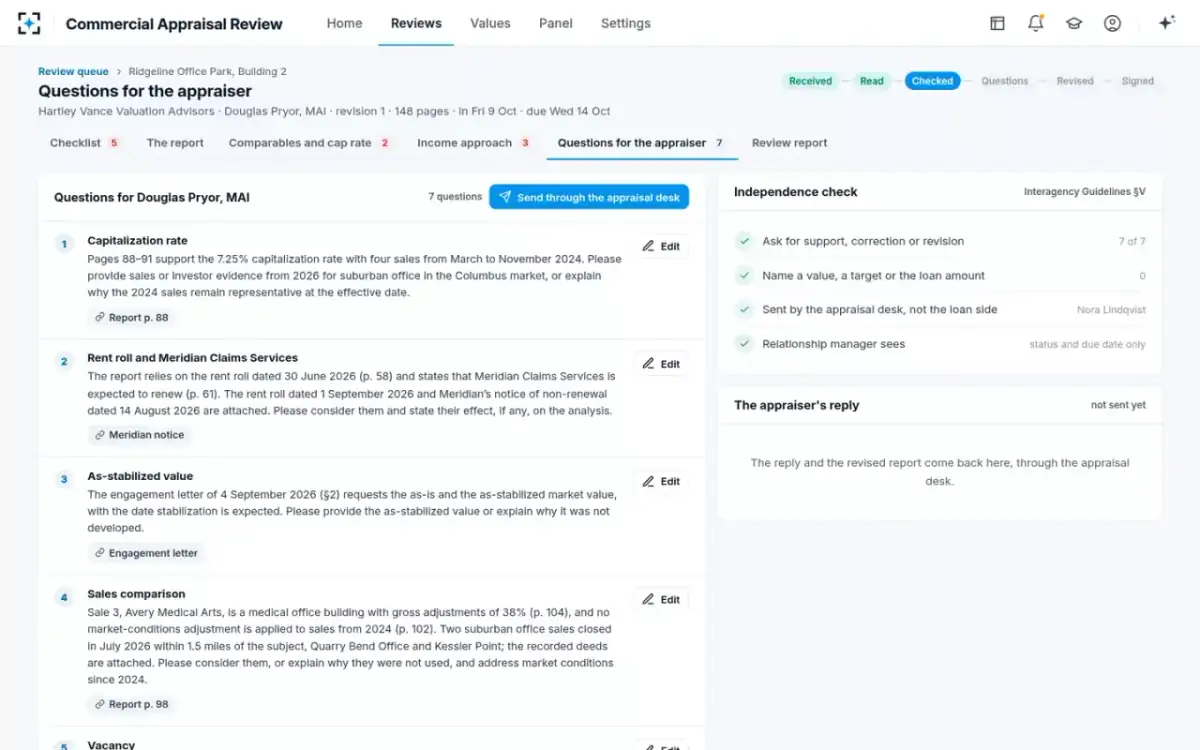
The question is drafted in the only form the independence rules allow: it points to the engagement letter and asks the appraiser to provide the value or explain the omission. It does not suggest a figure. Revision 2 supplies $26,200,000 as stabilized, with April 2028 as the projected date, and the review can then test the 19-month lease-up behind it.
Reviewing a prospective value: what to test
Questions a reviewer should answer before relying on an as-stabilized value
- Is the as-is value reported beside it?
The regulation requires market value in the actual condition; without it the gap is invisible.
- Is the stabilization date stated, with the market conditions it assumes?
The Guidelines require a point of reference to the conditions and time frame used.
- Is stabilized occupancy a market occupancy?
Compare it with the report's own submarket vacancy and the bank's data; in the sample the report applied 8% vacancy while its market section showed 19.6%.
- Are the lease-up months supported by absorption evidence?
Recent leasing velocity in the submarket, not the owner's plan.
- Are rent loss, commissions, tenant improvements and profit deducted?
Appendix C lists them for partially leased buildings.
- Does the rent roll in the report match the newest one in the loan file?
A stale rent roll can hide the vacancy the stabilized value assumes away.
- Which value does the credit memo use for loan-to-value?
For an existing building, the as-is value; a stabilized ratio should be labelled as such.
Prospective values come back into play after closing. The 2023 workout statement tells banks to consider, before deciding whether to obtain a new valuation, "Variances between actual conditions and original appraisal assumptions" and "Loss of a significant lease or a take-out commitment" (88 FR 43115). A stabilization date that passes without stabilization is exactly such a variance. To see the as-is and as-stabilized values reviewed on the sample appraisal, start from Commercial Appraisal Review.
Questions people ask
What is as completed value?
The prospective market value "as completed" is the property's market value as of the time development or renovation is expected to be finished. It is used to set the ceiling for construction and renovation loans, with advances limited to costs actually incurred. It usually sits between the as-is value and the as-stabilized value.
What is stabilized occupancy?
For an income property, it is the occupancy the property is expected to reach after being offered for lease for a reasonable period on terms comparable to similar properties, as the Interagency Guidelines define it. It is a market occupancy, not the owner's target, so it should be tested against the submarket's vacancy.
Is an as-stabilized value a market value?
Yes, but at a future date: a prospective market value whose effective date falls after the date of the report. It must be based on current and reasonably expected market conditions and clearly identified, so that no reader mistakes it for the value today.
Can a bank use the as-stabilized value for loan-to-value?
A bank should use the value that corresponds to what it is funding. For an existing building refinanced today, that is the as-is value. Phased construction loans may be limited by the value of the final phase funded, but disbursements should not exceed actual costs. A stabilized ratio can be shown for information, labelled.
Why is the as-is value lower than the as-stabilized value?
Because a buyer today would have to pay for the lease-up: lost rent while space is vacant, leasing commissions, tenant improvements and a return for taking the risk. Federal rules require the appraisal to deduct these for partially leased buildings and non-market leases.