Commercial appraisal AI, in a bank, is best used on the review side of the appraisal, not the valuation side: reading a long report, checking it against the standards and the bank's own evidence, and drafting the questions a reviewer sends back to the appraiser. That is where the rules leave room. No federal rule sets quality-control standards for automated tools used to review commercial appraisals, and the Interagency Appraisal and Evaluation Guidelines are explicit that a model's output, "by itself or signed by an appraiser, is not an appraisal". So the value stays with a certified appraiser and the conclusion stays with a human reviewer, and the work in between, which is most of the hours, is where agents fit. Botminds' Commercial Appraisal Review puts six agents there: they read, cite, compare and draft; the review appraiser decides and signs.
The examples below come from a fictional bank running the solution on a fictional appraisal. The rules are quoted from the regulators' own texts.
Commercial appraisal AI in Commercial Appraisal Review: six agents, two people, one signature
Agent
Report readerReads the whole report and extracts every approach, value, comparable, assumption and certification, each with its page.
Never: Summarises a value without its page.
Agent
Standards checkerAnswers the bank's review checklist: USPAP Standards 1 and 2, the regulation's minimum standards, the engagement letter and bank policy.
Never: Marks an item met without a page, or decides the review conclusion.
Agent
Comparables and cap-rate checkerSets the appraiser's sales and cap-rate evidence beside the bank's own closings and reviewed appraisals.
Never: Substitutes comparables in the appraiser's report.
Agent
Income and rent roll checkerRecomputes the income approach and ties rent, vacancy and expenses to the rent roll and leases in the loan file.
Never: States a value opinion; it shows sensitivities only.
Agent
Appraiser questions drafterDrafts questions asking for support, correction or consideration of information, and screens each for anything naming a value or loan amount.
Never: Writes to the appraiser directly.
A person decides
Appraisal deskSends the questions to the appraiser and receives the revision; the loan side never touches the exchange.
Agent
Review report drafterDrafts the Standard 3 review report and the note to credit, and compares each revision with the last.
Never: Signs, or changes a conclusion the reviewer chose.
A person decides
Review appraiserWeighs the findings, edits the questions, accepts or rejects the report and signs the review.
Can AI review a commercial appraisal?
AI can do most of the work of a commercial appraisal review, but not the review's conclusion. The Guidelines expect a bank's review to establish "whether the valuation methods, assumptions, and data sources are appropriate and well-supported" before the credit decision, and to be performed by people who are independent, qualified and competent for the property type. They allow automated tools for pre-funding review in one place only: residential, lower-risk mortgages, "with prior approval from its primary Federal regulator". The commercial paragraph contains no such allowance; it asks instead for more comprehensive review of complex, large and out-of-market credits.
The practical reading is that commercial review remains a person's review, and AI prepares it. Nothing in the Guidelines stops a reviewer from working from a checklist an agent answered, a comparison an agent assembled or a question an agent drafted, provided the reviewer checks it and owns the result. That is also how the OCC describes current practice across banking: "Banks are taking a measured approach to the adoption of generative AI (genAI) and agentic AI, with usage generally limited to specific use cases with guardrails and human-in-the-loop accountability to manage risk" (OCC Semiannual Risk Perspective, Spring 2026).
The line in the rules: question the appraisal, never the value
The line AI must not cross in appraisal review is the one people must not cross either: nobody on the bank's side may tell the appraiser what the value should be. The Guidelines' list of actions that compromise independence starts with "Communicating a predetermined, expected, or qualifying estimate of value, or a loan amount or target loan-to-value ratio to an appraiser or person performing an evaluation" and goes on to minimum value requirements, compensation tied to the loan closing, and threats to future work (Interagency Guidelines §V).
The same section says what a bank may ask. It may request that the appraiser "Consider additional information about the subject property or about comparable properties", "Provide additional supporting information about the basis for a valuation", and "Correct factual errors in an appraisal". Those three verbs, consider, support and correct, are the whole vocabulary of a lawful question. They are also a precise specification for an AI drafter: every question it writes should be one of the three, and none should contain a number that reads as a target.
What a bank may ask an appraiser, and what it may not, side by side
Permitted: the bank may ask the appraiser to: Consider additional information about the subject property or comparable properties, such as a newer rent roll or a closer sale.
Prohibited: the bank may not: Communicate a predetermined, expected or qualifying estimate of value.
Permitted: the bank may ask the appraiser to: Provide additional supporting information about the basis for a valuation, such as evidence for a cap rate.
Prohibited: the bank may not: Communicate a loan amount or a target loan-to-value ratio.
Permitted: the bank may ask the appraiser to: Correct factual errors in an appraisal, such as a wrong square footage or a misread lease.
Prohibited: the bank may not: Specify a minimum value needed to approve the loan or to order the valuation.
Permitted: the bank may ask the appraiser to: Report suspected USPAP non-compliance to the state regulator; the agencies do not treat that as coercion.
Prohibited: the bank may not: Condition pay on the loan closing, or imply future work depends on the value reported.
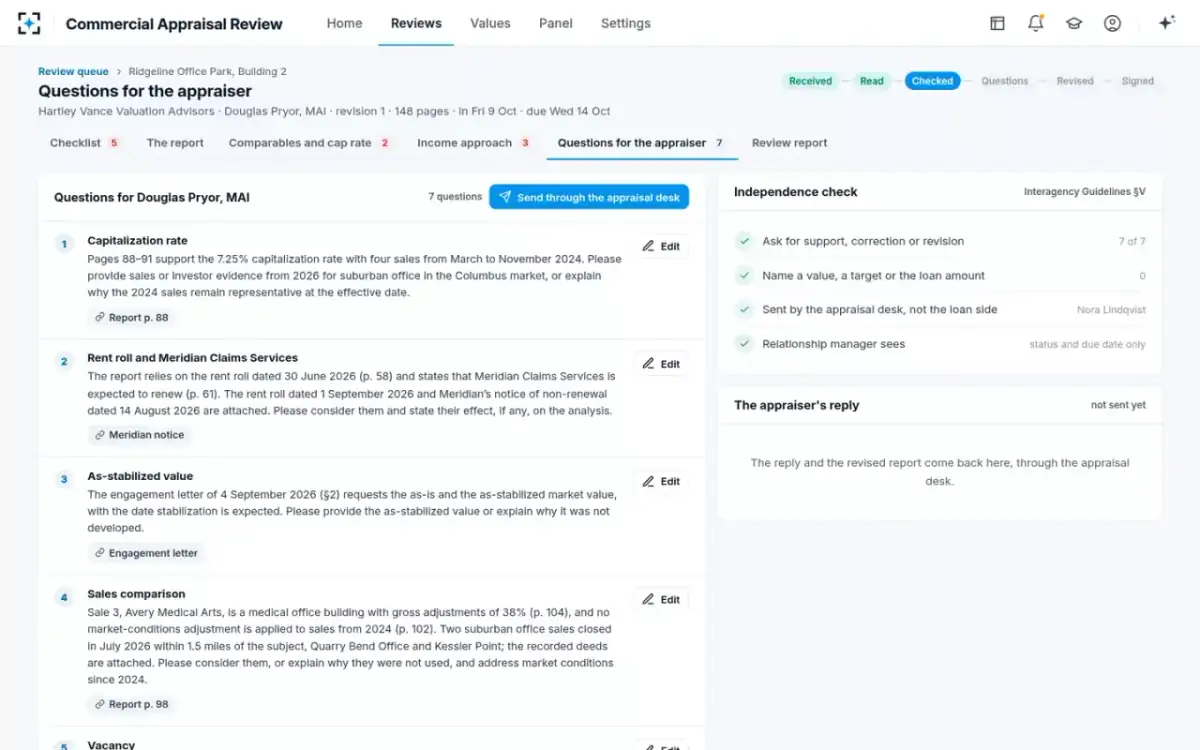
In the sample, the questions drafter writes seven questions for the appraiser of a 128,400 sq ft suburban office building. The first reads, in part: "Pages 88–91 support the 7.25% capitalization rate with four sales from March to November 2024. Please provide sales or investor evidence from 2026 for suburban office in the Columbus market, or explain why the 2024 sales remain representative at the effective date." It names a rate the appraiser already used and asks for support. It does not mention the bank's own median of 8.1%, which would read as a target.
Seven questions, an independence check, and a desk that sends them
Does the 2024 AVM rule apply to commercial property or to appraisal review?
No, on both counts. The 2024 quality-control rule for automated valuation models, effective October 1, 2025, covers models used "to determine the collateral worth of a mortgage secured by a consumer's principal dwelling", and defines a dwelling as a structure of one to four units (12 CFR 34 subpart I). Commercial property is outside it.
Review is outside it too, even for homes. The agencies were asked to cover AVMs used to check completed appraisals and declined: "the agencies are adopting the proposal to exclude reviews of completed determinations from the scope of the rule", noting that the appraisal review "serves as a separate and independent quality control function" (89 FR 64538, August 2024). The result is a gap rather than a permission. A bank using AI in commercial appraisal review has no prescribed control standard to meet, which means it has to write its own and be able to explain it to an examiner.
Which federal text governs AI in commercial appraisal review, and which does not
| Text | What it covers | What it means for AI in commercial review |
|---|---|---|
| AVM quality-control rule (2024) | Models valuing a consumer's principal dwelling, 1–4 units, in credit decisions and securitization | Does not apply: commercial property and review uses are both outside its scope. |
| Interagency Appraisal and Evaluation Guidelines (2010) | Appraisal and evaluation programs, independence, review, AVMs in evaluations | Applies to the review itself: depth, independence, deficiency resolution, documentation. A model output is not an appraisal. |
| Model risk guidance, OCC 2026-13 / SR 26-2 (2026) | Statistical, economic or financial models used by banks | Generative and agentic AI are expressly outside its scope; spreadsheet-style arithmetic is not a model. |
| Third-party guidance (2023) | Any vendor relationship | Applies: using a vendor's tool does not move the bank's responsibility for the review. |
| 12 CFR 34 subpart C | When appraisals are required, minimum standards, appraiser independence | Applies: every appraisal must be reviewed for USPAP compliance, whoever or whatever prepares the review. |
Is an AVM an appraisal for commercial real estate?
No. "Under the Agencies' appraisal regulations, the result of an Automated Valuation Model (AVM), by itself or signed by an appraiser, is not an appraisal, because a state certified or licensed appraiser must perform an appraisal in conformance with USPAP and the Agencies' minimum appraisal standards" (Interagency Guidelines §VIII). Above the $500,000 commercial threshold, a certified appraiser's appraisal is required, and no model output can stand in for it.
Below the threshold, a model can contribute to an evaluation, under conditions: the bank "may not rely solely on the results of an AVM to develop an evaluation" unless the result addresses the property's actual condition and meets the Guidelines' standards, and it must validate the model independently. Commercial AVMs are also weaker than residential ones because commercial sales are fewer and less alike. This is why the useful role for AI in commercial work is review support rather than valuation: the appraiser has already produced the value; the question is whether the report supports it.
The research supports the same division of labour. A peer-reviewed study of 7,133 institutional properties found that machine learning could explain part of the gap between appraisals and later sale prices, cutting the average absolute error from 11.12% to 9.25%. That is a tool for testing appraisals, not for replacing them, and how accurate commercial appraisals are in the first place sets the baseline any review method is measured against.
Where AI helps in commercial appraisal review
AI helps most where the evidence that tests an appraisal sits outside the report. A human reviewer reads the report well; what a reviewer working eight reports cannot do is pull, for every one of them, the bank's own recent closings, the reviewed appraisals from the last two years, the newest rent roll and every tenant letter in the loan file. Agents can, because that is retrieval and arithmetic, not judgement.
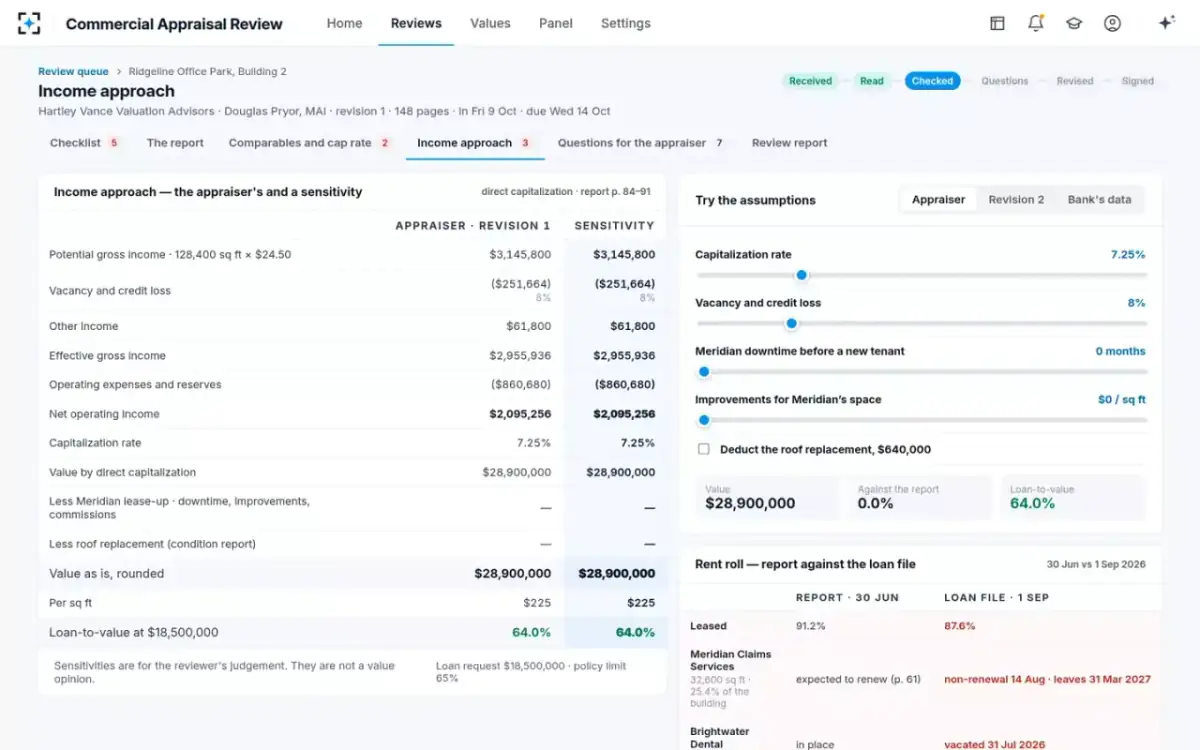
In the sample, the gap between the report and the bank's evidence is the whole story. The report supports 7.25% with 2024 sales; the bank's eight 2026 suburban office data points run 7.6% to 8.9%, median 8.1%, 85 basis points away against a tolerance of 50 that the bank set. The report uses a 30 June rent roll at 91.2% leased; the loan file holds a 1 September rent roll at 87.6% and a non-renewal notice from the largest tenant. The report's sales grid skips two July 2026 sales within a mile and a half. None of that is in the 148 pages.
A sensitivity for the reviewer, labelled as not a value opinion
Can AI change an appraised value? Why sensitivities are not a value opinion
No, and a well-built review tool should make that structurally impossible rather than a matter of discipline. In the solution, the agents never edit the appraiser's grid or income approach; they show what the indication would be under different inputs, on a separate surface, labelled as a sensitivity. In the sample, with the two skipped sales in and the medical office sale out, the sales comparison indicates about $26.2 million against the report's $29.5 million. That figure goes nowhere near the appraiser. It tells the reviewer how much the question matters.
The distinction is not cosmetic. If the reviewer wants a different value to support the credit decision, the Guidelines' route is a USPAP-compliant review by a qualified appraiser that produces a second opinion of market value, or a second appraisal. A sensitivity computed by software is neither. When the appraiser in the sample sends revision 2 at $24,100,000 as is, it is the appraiser's revised opinion, reached on evidence the questions surfaced, and the reviewer accepts it as credible and signs. Credit then sizes the loan on it.
Governing commercial appraisal AI when the model rules stop short
Because no rule prescribes controls for AI in commercial review, the bank has to set its own and be able to evidence them. The 2026 model risk guidance is explicit that "Generative AI and agentic AI models are novel and rapidly evolving. As such, they are not within the scope of this guidance" (OCC Bulletin 2026-13). The third-party guidance still applies, and is just as explicit that "the use of third parties does not diminish or remove banking organizations' responsibilities" (88 FR 37920).
Questions the chief appraiser and the second line should put to any commercial appraisal AI
- Does every answer cite the page or document it rests on?
A checklist answer without a page is an assertion. In the solution, an item cannot be marked met without one.
- Can the tool form, suggest or display a value as its own?
It should not. Sensitivities should be labelled and kept apart from the appraiser's report.
- Is every question to the appraiser screened for values, targets and loan amounts?
The Guidelines' prohibited list is short enough to test mechanically, and the count should be zero.
- Who sends the questions?
The appraisal desk, never the loan side and never the tool. Relationship managers should see status, not content.
- Who signs, and what does the signature mean?
A named reviewer, under USPAP Standard 3, with the conclusion stated beside the signature.
- Can you measure it on files you already reviewed?
Run it on closed reviews and compare its findings with what your reviewers found. Agreement on known files is the evidence an examiner will ask for.
- What data does it read, and is it the bank's own?
Closings, reviewed appraisals and loan files should stay within the bank's control and its third-party oversight.
The last question is the one that settles most debates. A reviewer who has watched the agents find, on a file the reviewer signed last spring, the same stale rent roll the reviewer found, trusts the next draft for a reason. How a review team builds that trust in four weeks is set out in the training guide.
What commercial appraisal AI will not fix
AI will not make an appraiser's judgement for them, and it will not make a weak review policy strong. If the bank has no written criteria for when a review becomes technical, an agent that flags 85 basis points of cap-rate gap has nowhere to send the flag. If the bank's own data is thin, say a handful of closings a year in a property type, the comparison against the bank's book is thin too, and the reviewer should know it. And if the review culture treats the appraiser as an adversary, a tool that drafts sharper questions will make the relationship worse, not better.
The Bureau of Labor Statistics expects appraiser productivity to rise "with greater use of mobile technology and automated valuation models" (BLS Occupational Outlook Handbook). For a bank, the productivity worth having is on the other side of the report: a review appraiser who spends the day on the three findings that matter rather than on finding them. To see the agents and the line they keep on the example bank's files, start from Commercial Appraisal Review.
Questions people ask
Is AI appraisal review allowed by regulators?
No federal rule prohibits using AI to prepare a commercial appraisal review, and none sets control standards for it: the 2024 AVM rule covers only consumer dwellings and excludes review uses. The Guidelines still require a review that is independent, risk-based and documented, so a human reviewer must own the conclusion and the bank must govern the tool as a third-party and operational risk.
Who signs an AI-assisted appraisal review?
The review appraiser does. In Commercial Appraisal Review the reviewer signs with a password and the meaning of the signature, reviewed under USPAP Standard 3, with the conclusion stated beside it. The review report drafter never signs and cannot change a conclusion the reviewer chose.
How does AI protect appraiser independence?
By screening every drafted question against the Guidelines' prohibited communications, a value, a target loan-to-value or a loan amount, and by routing questions only through the appraisal desk. In the sample, seven questions were drafted and none named a value; relationship managers saw only status and due date.
What can AI do in commercial real estate appraisal?
For lenders, the safest and most useful uses are on review: extracting a report's approaches and assumptions with page citations, answering a review checklist, testing comparables and cap rates against the bank's own deals, tying the income approach to the loan file, and drafting questions and review reports. Producing the value itself remains the appraiser's job above the threshold.
Can AI replace a commercial review appraiser?
Not under the current rules. A commercial review must be performed by people independent of loan production and competent for the property type, and only a qualified appraiser can develop a second opinion of value. AI can take most of the reading and evidence-gathering, which shifts the reviewer's day toward judgement.