Commercial appraisal review training has three layers. The first is the credential: most banks want commercial reviewers to hold a state certified general license, which under the Appraiser Qualifications Board's criteria takes 300 hours of core courses, a bachelor's degree and 3,000 hours of experience over at least 18 months, half of it non-residential. The second is review itself, which the credential barely touches: of those 300 hours, the only required course on the standards is the 15-hour National USPAP Course, and no core course is devoted to appraisal review, so reviewers learn Standard 3, the Interagency Appraisal and Evaluation Guidelines and the bank's own policy on the job. The third layer is new: learning to work from a review an agent has prepared, which is where Botminds' Commercial Appraisal Review comes in. Reviewers do not learn to trust agents from a manual; they learn by watching the agents find, on files they have already signed, what they found themselves.
The adoption plan below follows a fictional bank's review team. Credential figures come from the Oklahoma Real Estate Appraiser Board's published copy of the national criteria; state boards publish the version in force for their appraisers.
Four weeks from first setting to signed live reviews
- Wk 1 · set the ruleschecklist, tolerances
- Wk 2 · replayfiles they signed
- Wk 3 · side by sidelive reports
- Wk 4 · liveagents first
- Policyconcurrence rule
- Scoreagreement, closed files
- Disagreementsreview each one
- Sampleand sign off
What training do commercial appraisal reviewers need?
A commercial reviewer needs the appraisal competence to judge another appraiser's analysis, knowledge of the review standards and federal rules, and fluency in the bank's own policy and data. The Guidelines set the bar in terms of outcomes rather than courses: reviewers "should possess the requisite education, expertise, and competence to perform the review commensurate with the complexity of the transaction, type of real property, and market" and should be "capable of assessing whether the appraisal or evaluation contains sufficient information and analysis to support the institution's decision to engage in the transaction" (Interagency Guidelines §XV.A).
Examiners turn that into a question for the bank: "Does the bank have procedures to evaluate and address the independence, education, training qualifications, and role of reviewers?" (OCC, Commercial Real Estate Lending, ICQ 30). The answer a bank needs is a written qualification standard for reviewers, by property type and review depth, and evidence of how each reviewer meets it.
What qualifications should a bank's commercial appraisal reviewer hold?
The certified general credential is the national standard for appraising commercial property of any value, and the usual standard banks set for commercial reviewers. Under the criteria as Oklahoma's board publishes them, it requires 300 hours of core curriculum courses, a bachelor's degree or higher from an accredited college or university, and 3,000 hours of experience "no fewer than 18 months, including a minimum 1,500 hours non-residential" (Appraiser Qualification Criteria, Oklahoma Real Estate Appraiser Board).
The appraiser credential ladder, and what each step allows
| Credential | Qualifying education | Experience | Scope of practice |
|---|---|---|---|
| Trainee | 75 hours | None | Properties within the supervising appraiser's scope |
| State licensed | 150 hours | 1,000 hours, at least 6 months | Non-complex 1–4 units under $1 million; complex 1–4 units under $400,000 |
| Certified residential | 200 hours plus a degree or equivalent | 1,500 hours, at least 12 months | 1–4 residential units of any value or complexity |
| Certified general | 300 hours of core courses plus a bachelor's degree | 3,000 hours, at least 18 months, 1,500 non-residential | All types of real property at any transaction value |
The pool is small. The Appraisal Subcommittee counted 40,583 certified general credentials at the end of 2025, against 89,618 credentials of all kinds, and states reported 755 disciplinary actions against appraisers during the year (ASC, 2025 Annual Report). A bank that wants a commercial reviewer is usually hiring an experienced commercial appraiser and teaching them the bank's side of the work.
Is there a course on appraisal review in the credential?
Not in the core. The certified general curriculum spends its 300 hours on appraising: market analysis and highest and best use, the sales comparison approach, site valuation and cost, report writing, and 60 hours on the income approach. Standards appear as the 15-hour National USPAP Course. Appraisal review fits only in the 30 hours of subject-matter electives, if the candidate chooses it.
The 300 hours of a certified general credential: 60 on income, none required on review
Continuing education keeps the standards current: each USPAP edition comes with a 7-hour update course that state boards require within their renewal cycles. Oklahoma's board, for the 2024 edition that took effect on January 1, 2024, required every appraiser to "complete the 2024 7-Hour USPAP update course no later than December 31, 2024" (Oklahoma Real Estate Appraiser Board, 2024 USPAP). None of this teaches a reviewer the bank's policy, its data or how to read an agent's work. That falls to the bank.
The training a bank owes its own reviewers
The bank-specific layer is the one examiners probe, because it is where reviews fail. When the OCC examined Vineyard Bank in 2006, its corrective actions included: "Ensure that the appraisal ordering and review processes are clearly independent and that appraisal reviews provide more qualitative analysis." A later examination required the bank to "Clearly justify in appraisal review reports the use of escrows and document discussions with appraisers when appraisal values are adjusted." Vineyard failed in 2009; the FDIC estimated the loss to the Deposit Insurance Fund at $597 million (Treasury OIG, OIG-10-044).
Ensure that the appraisal ordering and review processes are clearly independent and that appraisal reviews provide more qualitative analysis.
OCC corrective action, quoted in Treasury OIG Material Loss Review of Vineyard Bank
What a bank's own commercial review training should cover
- The bank's review policy and depth criteria
When a review becomes technical, who concurs, and what the reviewer must document at each tier.
- Independence in practice
Who may contact the appraiser, through which desk, and the prohibited communications, a value, a target loan-to-value or a loan amount.
- The bank's checklist, item by item
What each item tests and the evidence that answers it, so two reviewers answer it the same way.
- The bank's own data
Where the closings, reviewed appraisals and market survey are, and how to compare a report's cap rate and comparables with them.
- The loan file
Rent rolls, leases, tenant notices and condition reports, and how to tie them to the income approach.
- Writing questions and conclusions
Questions that ask for support, correction or consideration; conclusions an examiner can follow a year later.
- Reading an agent's draft
How to check a cited page, when to drop a finding, and what the reviewer can never hand off.
How do you get reviewers to trust automation?
Reviewers trust automation when they can check it against answers they already know. A demonstration on someone else's appraisal proves little; an agent that finds, on a file the reviewer signed last spring, the same stale rent roll the reviewer found, and a cap-rate gap the reviewer missed, proves a great deal. That is why the second week of the plan is a replay of closed files, and why the chief appraiser scores it.
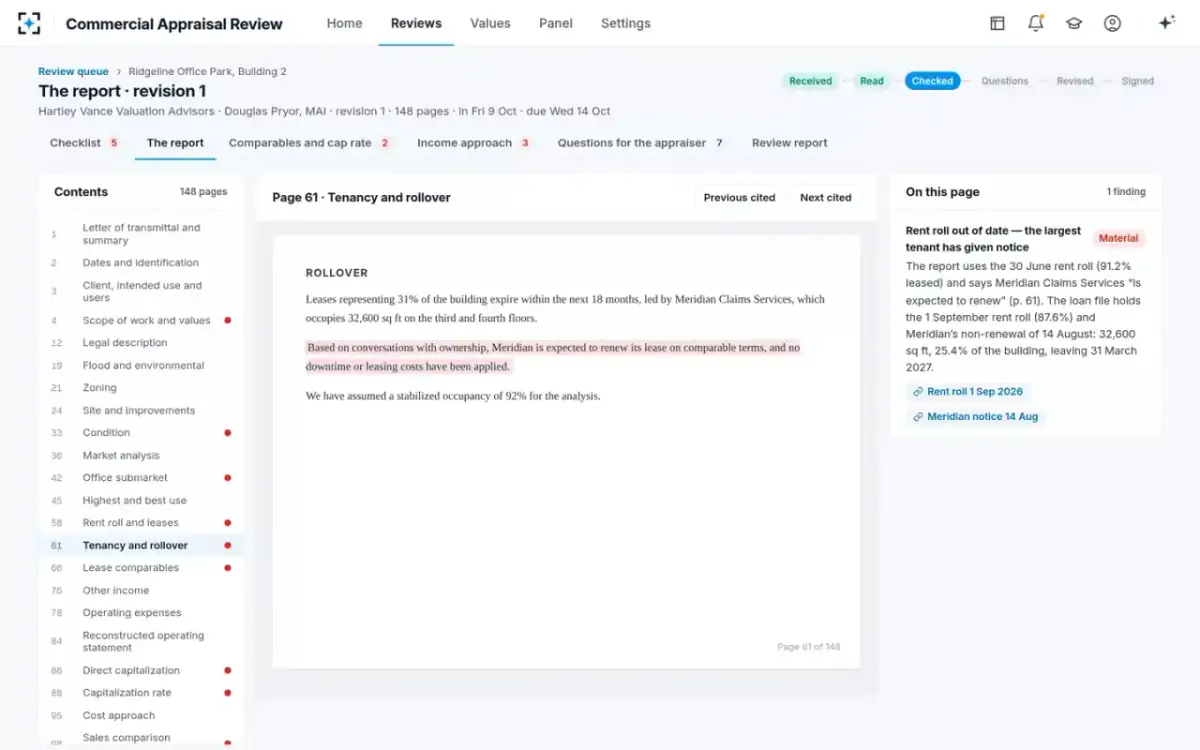
Every finding the agents produce opens on the page it came from. That is the single most important design choice for trust, because it turns each finding into something a reviewer can verify in seconds rather than take on faith. In the sample, the material finding on the rent roll opens on page 61 of a 148-page report, with the sentence highlighted: the appraiser expects the largest tenant "to renew its lease on comparable terms". Beside it sit the loan file's 1 September rent roll and the tenant's non-renewal notice of 14 August.
Trust is built one cited page at a time
A four-week plan to adopt Commercial Appraisal Review
Week one is settings. The chief appraiser and the reviewers load the bank's checklist and policy version, set the gross adjustment guideline, the cap-rate tolerance from the bank's median, the maximum rent roll age and the concurrence rule, and connect the bank's closings, reviewed appraisals and market survey. In the example bank those are a 25% gross adjustment guideline, a 50 basis point cap-rate tolerance, a 90-day rent roll and concurrence when a value moves more than 10%.
Week two is the replay. Each reviewer runs 10 to 15 commercial reviews they completed in the last year through the agents and compares the findings with their own, item by item. The chief appraiser scores three numbers: findings both found, findings only the reviewer found, and findings only the agents found. The second number is the one that matters for trust; the third is the one that matters for value.
Week three runs live reports side by side: the reviewer reviews as usual, then opens the agents' review and reconciles. Week four reverses the order: the reviewer starts from the agents' review, and the chief appraiser samples finished reviews and reviews every disagreement. By the end, the bank has its own evidence of agreement on known files, which is what it will need for its third-party oversight and for the examiner.
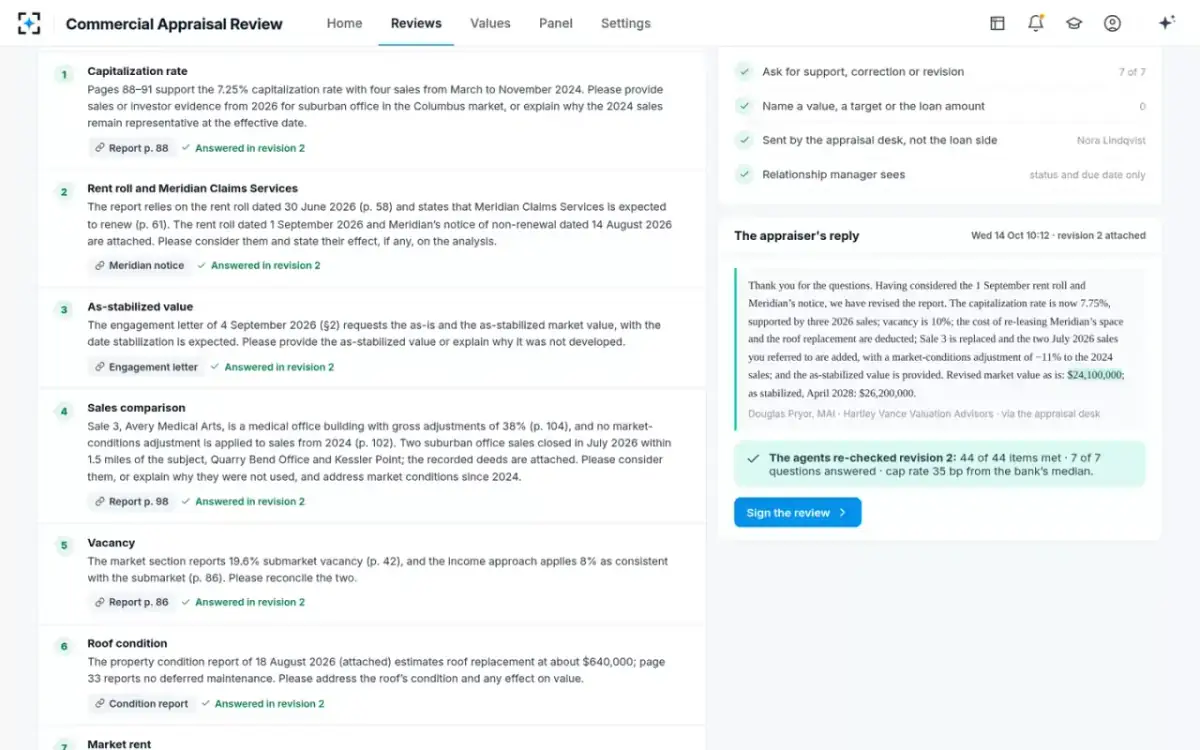
The revision check reviewers learn to rely on last
What reviewers should never delegate
Some parts of a review belong to the reviewer under the rules, and training should name them so nobody drifts. The conclusion, accepted, accepted with adjustments or not accepted, and the signature under USPAP Standard 3 are the reviewer's. So is the judgement of which findings are material, since a 38% gross adjustment on one comparable may or may not matter depending on what else supports the value. So is any second opinion of value, which only a qualified, licensed or certified appraiser may develop, inside a review that meets USPAP Standard 3 and with the workfile that requires; HUD applies the same rule to its own review appraisers (HUD MAP Guide §7.18.8).
The rest can be delegated with checking: reading, extraction, the checklist's first pass, comparisons with the bank's data, the arithmetic of the income approach, and first drafts of questions and the review report. The checklist that the first pass answers is built on the OCC's own worksheet, which is also a good training text in its own right.
Measuring trust: agreement on closed files, then sampling
Trust in a review tool should be measured, not declared. The bank's evidence is the replay scores from week two, the disagreement log from weeks three and four, and an ongoing sample: the chief appraiser re-reviews a set number of agent-assisted reviews each quarter, the same quality-control habit examiners expect for outsourced reviews. The Guidelines already ask the bank to "Establish procedures to test the quality of the appraisal and evaluation review process" (Interagency Guidelines §XVII); an agent-assisted review is tested the same way.
The measure that matters most is not speed. It is how often a reviewer, working from the agents' draft, catches a material deficiency they would otherwise have missed, and how often the agents raise a finding the reviewer rightly drops. Both should be visible in the file. Botminds runs the replay on a sample of the bank's own past appraisals and closings before go-live; to see the reviews it produces on sample data, start from Commercial Appraisal Review.
Questions people ask
How often is the USPAP update course required?
State boards require appraisers to complete the 7-hour National USPAP Update Course within their continuing-education cycles, tied to each USPAP edition. Oklahoma, for example, required all appraisers to complete the 2024 update course by December 31, 2024, after the 2024 edition took effect on January 1, 2024.
Do commercial review appraisers need a certified general license?
Banks usually require it for commercial reviewers, and it is needed to develop a second opinion of commercial value. The rules themselves require reviewers to be qualified, competent for the property type and independent of the transaction; a compliance review alone need not be performed by an appraiser.
How long does it take to adopt AI appraisal review?
Our plan takes four weeks: one to set the checklist and tolerances, one to replay closed files, one side by side on live reports and one live with sampling. The replay week is the one that cannot be skipped, because it gives reviewers and the bank evidence on files with known answers.
What should a bank's appraisal review policy say about training?
It should set qualification criteria for reviewers by property type and review depth, as the Guidelines require, and say how the bank confirms each reviewer meets them. If reviewers work from agent-prepared drafts, it should also say how drafts are checked and how agreement is sampled.
What is the difference between appraiser training and review training?
Appraiser training teaches how to develop a value: the approaches, market analysis and report writing. Review training teaches how to judge someone else's: the review standards, deficiency resolution without influencing the appraiser, the bank's policy and the evidence in its own files. The credential covers the first far more than the second.