A commercial appraisal review checklist should test four things: that the appraisal was properly engaged and the appraiser independent and qualified; that the report contains what the federal rules and USPAP require; that its approaches, comparables and income analysis are supported by market evidence; and that the value is the right kind of value for the credit decision. The best free model is the one examiners themselves use. Appendix E of the OCC's "Commercial Real Estate Lending" booklet is a 25-item CRE Appraisal Review Worksheet that "includes 12 CFR 34 requirements, USPAP requirements, and sound appraisal practices" (OCC, Comptroller's Handbook, Appendix E). This guide turns that worksheet into a working method, item by item, with the evidence each item needs and the point at which a checklist review should become a technical one. Botminds' Commercial Appraisal Review uses a bank's own version of such a checklist, 44 items in the example bank's case, and answers each item with the page of the report or loan file that supports the answer.
The OCC's CRE Appraisal Review Worksheet, in five groups
- Engagement and certifications (items 1–6)
Engaged directly by the bank, or properly accepted from another institution; no interest in the property; competency disclosed; state certified or licensed; reviewed for USPAP compliance.
- Report content (items 7–13)
Report type; legal description; the "as is" market value; an accurate property description; current agreements of sale and three years of sales history; assumptions consistent with the bank's collateral position.
- Approaches and market (items 14–18)
Applicable approaches used and omissions explained; current market conditions; exposure time; comparables truly comparable with adjustments supported; assumptions supportable with market data.
- Income and deductions (items 19–22)
Operating history analysed; cap and discount rates; tenant strength, rollover and renewal; re-leasing costs; vacancy and absorption; deductions for partially leased buildings and non-market leases; future supply and demand.
- The value conclusion (items 23–25)
Going-concern value allocated between real estate, personal property and intangibles; units of comparison consistent; cap rate reasonable for class, type and market; market value as defined in 12 CFR 34.42.
What is on a commercial appraisal review checklist?
A commercial appraisal review checklist has the OCC worksheet's 25 items at its core, plus the bank's own requirements: its engagement letter, its appraisal policy and the property types it lends on. The Guidelines do not prescribe a checklist; they require a review that establishes compliance and reasonableness, at a depth that follows risk, with documentation that shows how deficiencies were resolved. The 2018 interagency FAQs warn that the Guidelines themselves are not "a checklist or a 'one size fits all' approach" (Interagency FAQs, A4), which is why a bank builds its own on the regulator's skeleton.
Most bank checklists that pass examination share three traits. Every item has a defined answer set, typically meets, does not meet, not applicable or question. Every answer cites where in the report it was verified. And the checklist separates compliance items, which are binary, from reasonableness items, which need evidence from outside the report. The example bank's checklist has 44 items: USPAP Standards 1 and 2, the regulation's minimum standards, the engagement letter and bank policy.
Engagement and certifications: items 1 to 6
The first six items confirm the appraisal is one the bank may rely on at all. Item 1 asks whether the appraiser was "engaged directly by the bank" (12 CFR 34.45(b)(1)); item 2 covers appraisals prepared for another institution; item 3, freedom from "direct or indirect interest in the property or transaction"; item 4, the competency disclosure USPAP requires; item 5, a state certified or licensed appraiser; item 6, whether "the bank review[ed] the appraisal for compliance with USPAP" (12 CFR 34.44(c)).
The evidence for these sits in three places: the engagement letter, the appraiser's certification page and the state registry. The engagement letter answers items 1 and 2 by showing who the client is; the certification answers 3 and 4; the credential, checked against the Appraisal Subcommittee's national registry, answers 5. An appraisal accepted from another lender needs its own test, set out in the guide to using another bank's appraisal.
Report content and approaches: items 7 to 18
Items 7 to 18 test whether the report has what it must have and whether its method fits the property. The worksheet asks whether the "as-is" market value is reported (item 9), whether the property description is accurate down to square footage and condition (item 10), whether the appraiser analysed "any current agreement of sale, option, or listing" and "sales of the property occurring during the previous three years" (items 11 and 12), and whether the assumptions and limiting conditions fit the collateral position the bank intends to take (item 13).
Item 14 asks whether the appraisal "use[d] applicable value approaches, explain[ed] omitted approaches, use[d] appropriate techniques, and include[d] a reasonable rationale for the reconciliation." Items 15 and 16 cover current market conditions and exposure time, and item 18 asks whether "the assumptions [are] logical and supportable with market data." Most of these can be answered from the report, but item 18 cannot: it needs market data from outside the report. So does the item that matters most in commercial work, item 17.
Are the comparables truly comparable? Item 17
Item 17 is the heart of a sales comparison review: "If the sales comparison approach is the primary approach to value, are the comparables truly comparable with respect to property characteristics and location, and does the appraiser clearly discuss and support the adjustments?" It is also the item whose failure regulators have documented most bluntly. Treasury's inspector general found that at Omni National Bank, loan officers had direct contact with appraisers, and "the properties used as comparables were from distant locations or were more valuable than the property being appraised." Omni failed in 2009 at an estimated cost to the Deposit Insurance Fund of $288.2 million (Treasury OIG, OIG-10-017).
In other words, the comparable properties were not comparable.
Treasury Office of Inspector General, Material Loss Review of Omni National Bank (2009)
Answering item 17 properly takes four tests. Property type: is each sale the same use as the subject? Location: how far away, and in the same submarket? Time: how old is the sale, and is there a market-conditions adjustment? Size of adjustment: what are the gross adjustments, and does the bank's policy set a guideline? Then the test the worksheet implies but does not state: are there closer, newer sales the appraiser did not use?
Item 17 answered against the bank's own sales, not only the report's
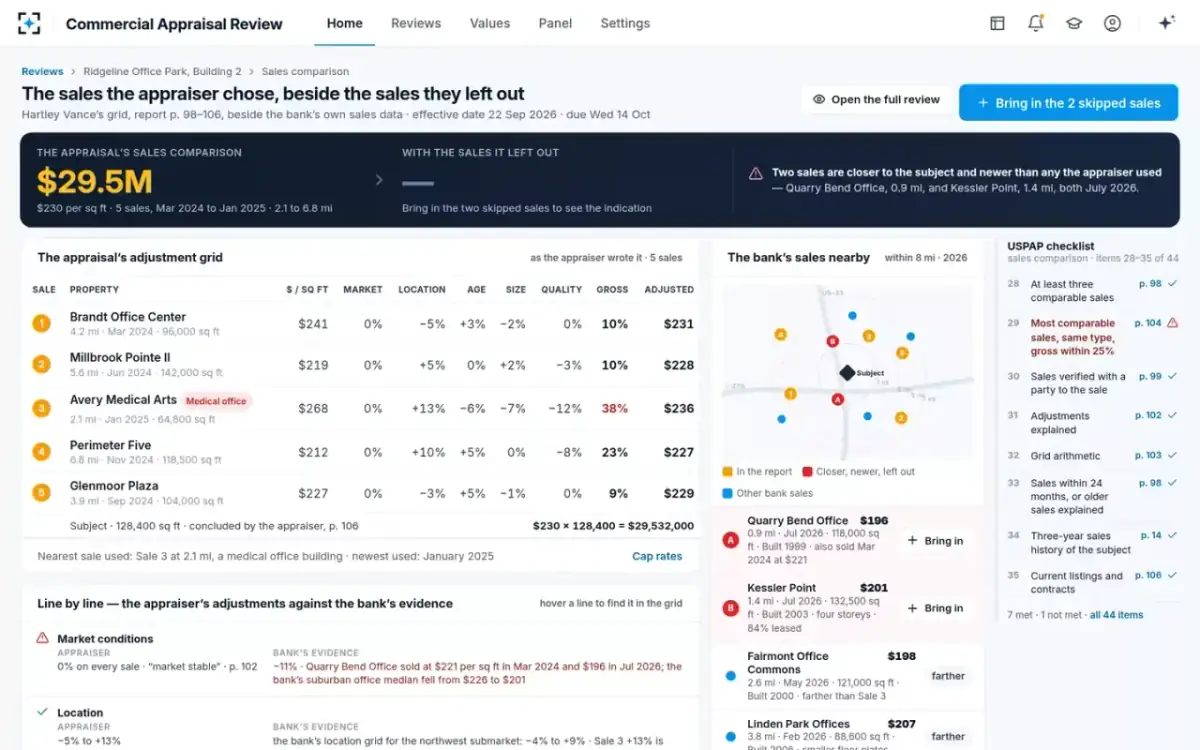
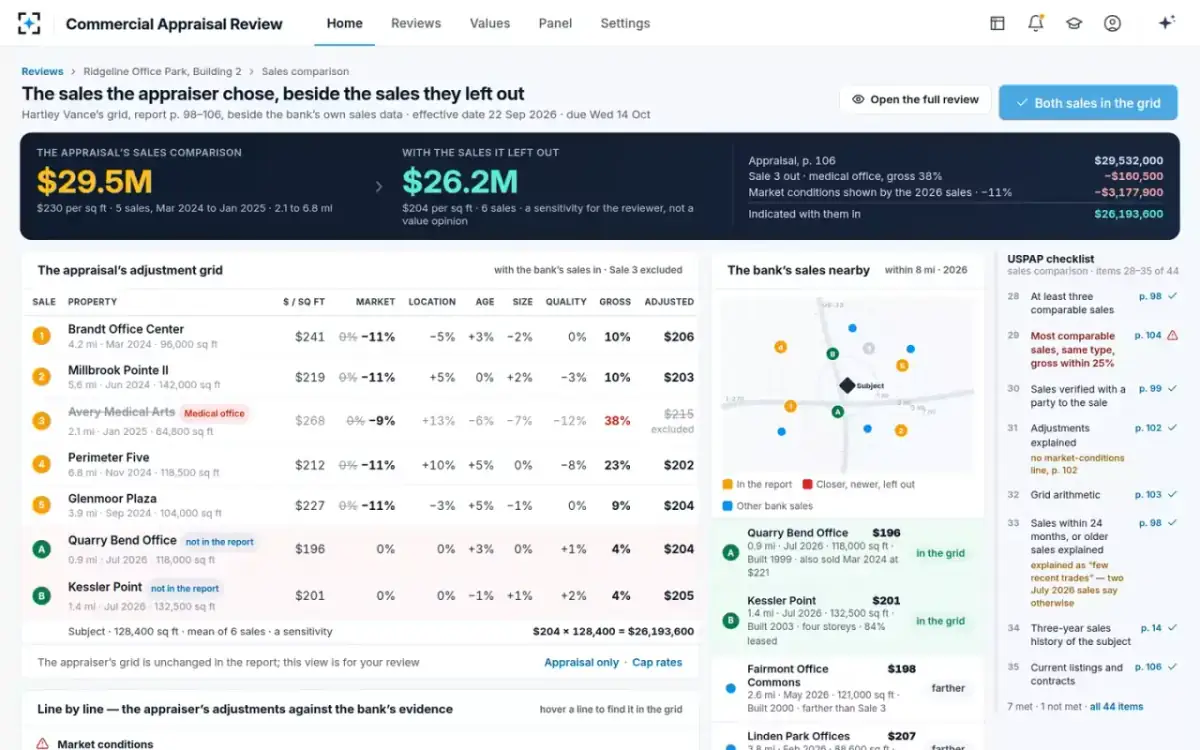
In the sample, the appraiser's grid concludes $230 per square foot on five sales from March 2024 to January 2025, applies no market-conditions adjustment, and includes a medical office building with gross adjustments of 38% against the bank's 25% guideline. The bank's own data holds two suburban office sales from July 2026 within a mile and a half, one of which also sold in March 2024 at $221 per square foot and in July 2026 at $196, a decline of about 11% in the same building. Item 17 is not met, and the question to the appraiser asks them to "consider them, or explain why they were not used, and address market conditions since 2024."
How do you review the income approach in an appraisal? Items 19 to 22
The income approach is reviewed by tying each line to evidence: rents to the rent roll and leases, vacancy to the market section and the bank's data, expenses to operating history, and the cap rate to current sales. Item 19 lists what a supportable income analysis includes: current revenues, expenses and vacancies; "appropriate analysis of discount and capitalization rates"; "an analysis of the strength of the tenants, tenant rollover risk, anticipated rents, and probability of lease renewals"; lease terms against budgets; re-leasing costs; vacancy and absorption; concessions; management; and new supply.
Turning the worksheet's income items into tests with evidence
| Worksheet item | What it tests | Evidence that answers it | When to escalate |
|---|---|---|---|
| 19a Current revenues, expenses, vacancies | The income starts from actual performance | Trailing operating statement and rent roll in the loan file | Rent roll older than the bank's limit at the effective date |
| 19b Discount and cap rates | The rate fits the class, type and market now | The report's cap-rate sales against the bank's own recent closings and reviewed appraisals | Gap from the bank's median wider than its tolerance |
| 19c Tenant strength, rollover, renewals | Lease risk is priced, not assumed away | Leases, tenant notices, estoppels, the rollover schedule | A major tenant's notice the report does not reflect |
| 19e, 20 Re-leasing costs; deductions for partial leasing | Downtime, commissions and improvements are deducted | Market leasing terms; the report's own lease comparables | Value assumes stabilized occupancy without deductions |
| 21 Departures from past performance | Big changes from history are explained | Three years of statements against the pro forma | Projected income well above history with no explanation |
| 22d Replacements and improvements | Capital needs are anticipated | Property condition report | Condition report and appraisal disagree on a major item |
Item 20 carries a regulation behind it. Under 12 CFR 34.44(d), every appraisal for a federally related transaction must take deductions and discounts for partially leased buildings and leases below market, among other cases. In the sample, the report assumes the largest tenant renews with "no downtime or leasing costs" while the loan file holds that tenant's notice that it is leaving 32,600 square feet, a quarter of the building. Item 19c and item 20 both fail on one page.
The value conclusion: items 23 to 25
The last three items test the number itself. Item 23 applies to properties valued as an operating business, such as hotels: the appraisal must allocate total value among "(1) the market value of the CRE, (2) the personal property value, and (3) the value of intangibles", because only the first can support a real estate loan. Item 24 asks whether "the determinants of the value conclusion [are] reasonable", including whether units of comparison match the comparables and whether "the capitalization or discount rate [is] supportable, and does it appear reasonable in terms of the class, property type, and market conditions". Item 25 asks whether market value follows the regulation's definition in 12 CFR 34.42.
Item 24b is where a checklist meets the bank's own book. The sample report's 7.25% cap rate is supported by four 2024 sales. The bank's eight 2026 suburban office data points in the same market run from 7.6% to 8.9%, median 8.1%, which is 85 basis points away. Whether 85 basis points is unreasonable is a judgement, and the example bank writes its threshold into policy, a 50 basis point tolerance, so that two reviewers make it the same way.
When does a checklist review become a technical review?
A checklist review becomes a technical review when the risk of the credit or the findings of the checklist call for it. The Guidelines name the first trigger: "Transactions involving complex properties or high-risk commercial loans should be reviewed more comprehensively to assess the technical quality of the appraiser's analysis", and they expect a bank to "establish criteria for when to expand the depth of the review" (Interagency Guidelines §XV.B). The second trigger is the checklist itself: a failed reasonableness item is a reason to look deeper.
What a checklist answer establishes, and what a technical review adds
Checklist answer: Five sales are presented, adjustments are explained, gross adjustments are listed.
Technical review: Each adjustment is tested against paired sales or market evidence; closer, newer sales are sought; the indication is recomputed as a sensitivity.
Checklist answer: A rate is stated and supported by cited sales.
Technical review: The rate is compared with current sales and the bank's own closings; the effect of the gap on value is measured.
Checklist answer: Rent roll, vacancy and expenses are analysed.
Technical review: Each line is tied to the newest rent roll, leases and tenant notices; rollover and re-leasing costs are rebuilt.
Checklist answer: The report meets or does not meet the standard.
Technical review: The reviewer forms a view on whether the value is credible and, if qualified and needed, a second opinion of value.
In practice, a bank's written triggers usually combine the two: any commercial credit above a dollar line, any property type on a complexity list, any out-of-market property, and any material finding on items 17, 19 or 24. The example bank adds one more: concurrence by the chief appraiser when the value moves more than 10% between revisions.
Commercial appraisal review form: what to document
The review form, or review report, is what an examiner reads, and the Guidelines say what it must show. A bank's documentation standard should address "the level of documentation needed for the review, given the type, risk and complexity of the transaction," should "describe the resolution of any appraisal or evaluation deficiencies," and "should provide an audit trail that documents the resolution of noted deficiencies or details the reasons for relying on a second opinion of market value" (Interagency Guidelines §XV.D).
In practice that means the form carries: the report and revision reviewed, with dates; the scope of the review and its depth; each checklist answer with its citation; each finding, the question asked, the appraiser's response and whether it resolved the finding; the conclusion; and the reviewer's signature. In the sample, the checklist's first pass returns 37 items met, 5 not met and 2 questions; revision 2 returns all 44 met, with each of the seven questions marked answered, and the reviewer signs. What a review appraiser does with that file, and where the rest of the day goes, is the subject of its own guide.
With the skipped sales in: a sensitivity the reviewer uses, not a value
A checklist built this way is also the bank's answer to the examiner's file review, which asks whether appraisals "meet USPAP" and weighs the "reasonableness and documentation of assumptions used to derive the collateral value". To see the 44-item version answered with pages on the example bank's appraisal, start from Commercial Appraisal Review.
Questions people ask
What is the OCC appraisal review worksheet?
It is Appendix E of the OCC's Comptroller's Handbook booklet "Commercial Real Estate Lending" (Version 2.0, March 2022): a 25-item CRE Appraisal Review Worksheet that examiners may use when reviewing commercial appraisals. It combines 12 CFR 34 requirements, USPAP requirements and sound appraisal practices, and it is free to download.
What should you look for in a commercial appraisal?
Start with engagement and independence, then whether the comparables are truly comparable and the adjustments supported, whether the cap rate fits current evidence, whether the income ties to the newest rent roll and leases, and whether deductions for vacancy, rollover and capital needs are taken. Finish with whether the value is the right kind, as is or prospective, for the credit decision.
Is there a standard commercial appraisal review form?
No federal form is required. The Guidelines require documentation standards that document the review, the deficiencies and their resolution, with an audit trail. Many banks build their form on the OCC worksheet and add their own policy items; the format is the bank's choice.
How many items should a commercial review checklist have?
Enough to cover the OCC worksheet's 25 items and the bank's own policy, engagement letter and property types. The example bank in this guide uses 44. More items are not better unless each has a defined answer and a cited source; an item that is ticked without evidence adds nothing.
Does a commercial evaluation need the same checklist?
No. An evaluation need not follow USPAP, so USPAP items do not apply, but it must still be reviewed before the credit decision and contain the content the Guidelines set out, including the property's actual condition and the sources used. Many banks keep a shorter evaluation checklist; the example bank's has 18 items.