Commercial real estate appraisals are accurate to within roughly 11 to 13% of the later sale price on average, and the error is not random. The best-known study, by Susanne Cannon and Rebel Cole, compared appraisals of institutional properties in the NCREIF index with the prices they sold for two quarters later, across 1984 to 2010, and found that "on average, appraisals are more than 12% above, or below, subsequent sales prices" (Cannon & Cole, MPRA paper 32589). A 2023 study of 7,133 properties sold between 1997 and 2021 put the mean absolute error at 11.1% (Deppner et al., Journal of Real Estate Finance and Economics). Both found the errors systematic: appraisals lag the market, falling below prices in rising markets and staying above them in falling ones. For a bank's appraisal review, that baseline is the point. A report can satisfy every standard and still carry a value that moves 12% when the property trades, which is why Botminds' Commercial Appraisal Review tests each report against the bank's own recent closings and cap rates rather than only against its own internal logic.
Mean absolute appraisal error by property type, 1997–2021: apartments best, industrial worst
Two caveats run through everything below. The samples are institutional properties held by pension and investment funds, appraised for portfolio reporting, not bank collateral appraised for a loan. And the measure compares an appraisal with a sale that came later, so some of the gap is the market moving, not the appraiser erring. Both studies adjust for that, and both still find double-digit average errors.
How accurate are commercial real estate appraisals, measured against later sales?
Measured property by property, about one appraisal in two misses the later sale price by more than 8%, and the average miss is 11 to 13%. Cannon and Cole report a median absolute difference of 8.1% and a mean of 12.5%, after adjusting for capital gains between the appraisal and the sale. The skew matters: most appraisals are reasonably close, and a minority are far off, which pulls the mean up.
The error was not steady over time. "The absolute difference peaks during the 2004 – 2006 period, when it is consistently in excess of 16%," Cannon and Cole write, and the median itself reached double digits in the 2004–2006 boom and in 2008–2009. The worst year for appraisals in their data was 2009, when appraisals by outside appraisers missed by 20.6% on average. Appraisals are least reliable exactly when a lender most needs them to be right: at turning points.
Three numbers that set the baseline for any appraisal review
12%+
average absolute gap between appraisal and later sale price, NCREIF 1984–2010
4–5%
average error even across a whole portfolio, because misses lean the same way at once
>50%
of the variation in signed appraisal error explained by market variables: the error is systematic
Why appraisal errors don't average out across a loan book
Errors would cancel across a portfolio if they were random. They are not. "Even in a portfolio context, allowing for offsetting positive and negative differences, appraisals are off by an average of 4% – 5 % of value," Cannon and Cole found, "because the under- and over-valuations are highly correlated across properties at the same points in time. In other words, errors don't 'average out.'"
For a bank, the portfolio view is the one that matters to capital and to the board. A loan book whose collateral values were all set by appraisals in the same twelve months carries the same lean in every value. When the market turns, the loan-to-value ratios on the whole book are understated together, and the concentration report, the stress test and the allowance all inherit the bias. One appraisal's error is a review problem; a whole vintage's error is a portfolio problem, and it starts as many review problems nobody caught.
Do commercial appraisals lag the market?
Yes, consistently. Cannon and Cole conclude that "appraisals appear to lag the true sales prices, falling below in hot markets and remaining above in cold markets. The largest deviations are observed during the two peaks and two valleys of the past two cycles." Their year-by-year results for appraisals by outside firms make the lag visible: too low at the top, too high at the bottom.
Sales beat outside appraisals by 16% at the 2006 peak and fell 20% short in 2008
The mechanism is in the inputs. An income approach relies on the property's income and a cap rate; a sales comparison relies on past sales. Cannon and Cole spell out the consequence: "if cap rates are changing rapidly, then an appraiser relying upon stale cap rates would be expected to undervalue a property in a rising market and overvalue a property in a falling market," and the same holds for an appraiser relying on existing rent rolls when rents are moving. In their models, the change in cap rates alone explained more than 12% of the variation in absolute appraisal error.
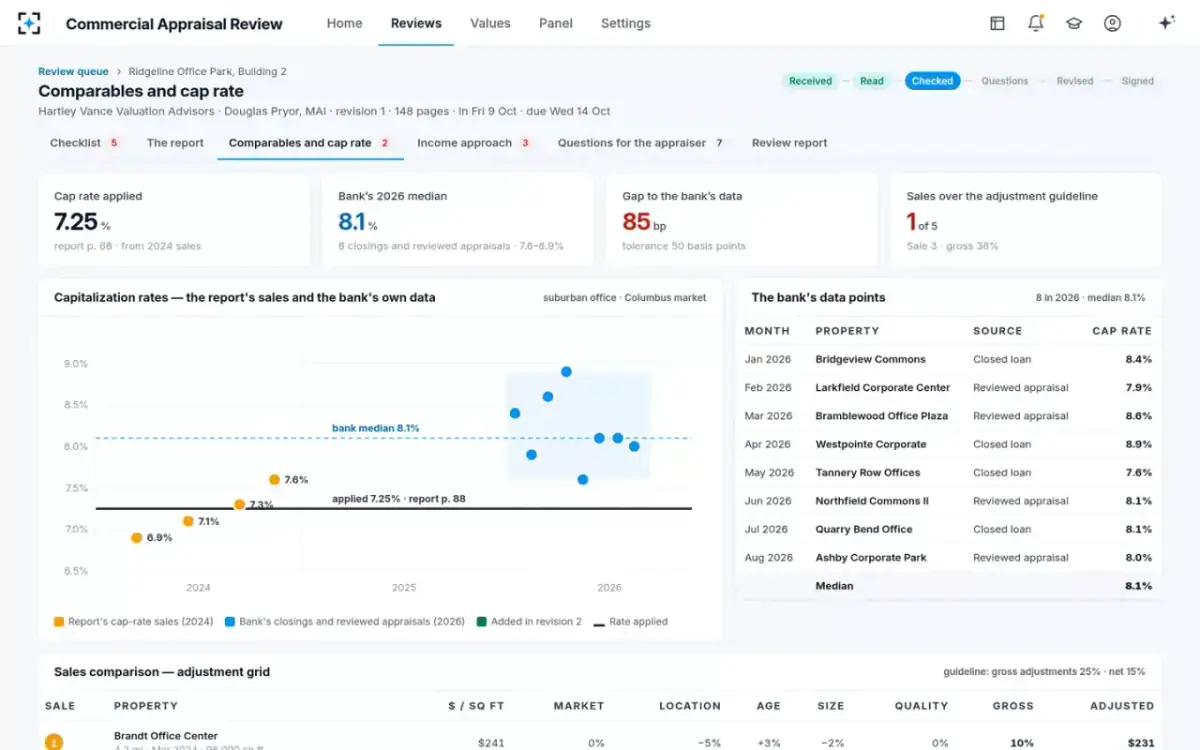
That is the example bank's problem in miniature. The fictional appraisal of Ridgeline Office Park, effective September 2026, supports a 7.25% cap rate with four sales from 2024, at 6.9 to 7.6%. The bank's own eight suburban office closings and reviewed appraisals in the same market in 2026 run 7.6 to 8.9%, median 8.1%. A cap rate drawn from a rising market, applied in a softer one, is exactly the stale input the research describes.
The lag, on one report: 2024 cap-rate sales against the bank's 2026 data
Which commercial property types are hardest to appraise?
In both studies, apartments are the most accurately appraised and office or industrial the least. Cannon and Cole found the average absolute error "greatest for Office properties at 13.5% and smallest for Apartment properties at 11.0%". Deppner and colleagues, on the later period, found apartments at 8.6% and industrial at 12.5%, with office at 11.7% and retail at 11.5%.
The ranking follows the evidence available to the appraiser. Apartments trade often, units are alike, and rents are short and visible. Office and industrial buildings are fewer, more different from each other and leased on long, negotiated terms, so comparables need larger adjustments and the income approach leans harder on assumptions about rollover and re-leasing. The OCC's own review worksheet asks whether the report includes "an analysis of the strength of the tenants, tenant rollover risk, anticipated rents, and probability of lease renewals" (OCC CRE booklet, Appendix E, item 19c), the item where office appraisals most often go wrong.
Is appraisal error random or systematic?
Largely systematic, which is the most useful finding for anyone who reviews appraisals. Cannon and Cole could "explain more than half of the variation in the signed percentage difference in sales price and appraised value" with a handful of market variables, and concluded that "appraisal errors are not due solely to property-specific heterogeneity." Deppner and colleagues went further with 50 property, location and market covariates and found that the deviations "exhibit structured variation that boosting trees can capture and further explain".
Most of the explainable error is about place and building, not time
Explained appraisal error, 1997–2021
- Time lag between appraisal and sale · about one-fourth · 25%
- Spatial and structural features of the property · the rest · 75%
Systematic error is testable error. If appraisals in a given submarket, property type and vintage tend to lean one way, then a reviewer with the right comparison set can see the lean before the loan closes. That comparison set is not a national index. It is the closest evidence to the subject, ideally sales and cap rates the bank itself has seen and underwritten in the same market in the last year.
Can machine learning improve commercial appraisals?
It can reduce the error, by a meaningful but bounded amount. In Deppner and colleagues' tests, gradient-boosted trees trained on the residuals cut the mean absolute error from 11.12% to 9.25% across all property types, with the largest relative gain for apartments and the smallest for office.
Mean absolute appraisal error before and after a machine-learning correction, by property type
| Property type | Appraisal error | After boosting-tree correction | Reduction |
|---|---|---|---|
| Apartment | 8.62% | 6.82% | 1.80 points (20.9%) |
| Industrial | 12.50% | 10.02% | 2.48 points (19.9%) |
| Retail | 11.52% | 9.89% | 1.63 points |
| Office | 11.71% | 10.27% | 1.44 points (12.3%) |
| All types | 11.12% | 9.25% | 1.87 points |
Read the table the right way round. Even after the correction, office appraisals still missed by more than 10% on average. Machine learning shrinks the systematic part of the error; it does not remove the uncertainty of valuing a building that may trade once a decade. That is a strong argument for using models to test appraisals and a weak one for using them to replace appraisals, and it is also roughly where the rules sit: commercial appraisal AI belongs on the review side, asking for support, with the value left to the appraiser.
What the 12% baseline means for commercial appraisal review
A review that only checks whether a report is complete and internally consistent cannot catch most of the error the research describes, because systematic error lives in inputs that look reasonable on their own terms. A 7.25% cap rate supported by four real sales is internally consistent. It is only wrong against newer evidence. The OCC's examination procedures make the same demand of examiners, who are told to weigh the "reasonableness and documentation of assumptions used to derive the collateral value" and "whether new appraisals or evaluations were obtained when conditions warranted".
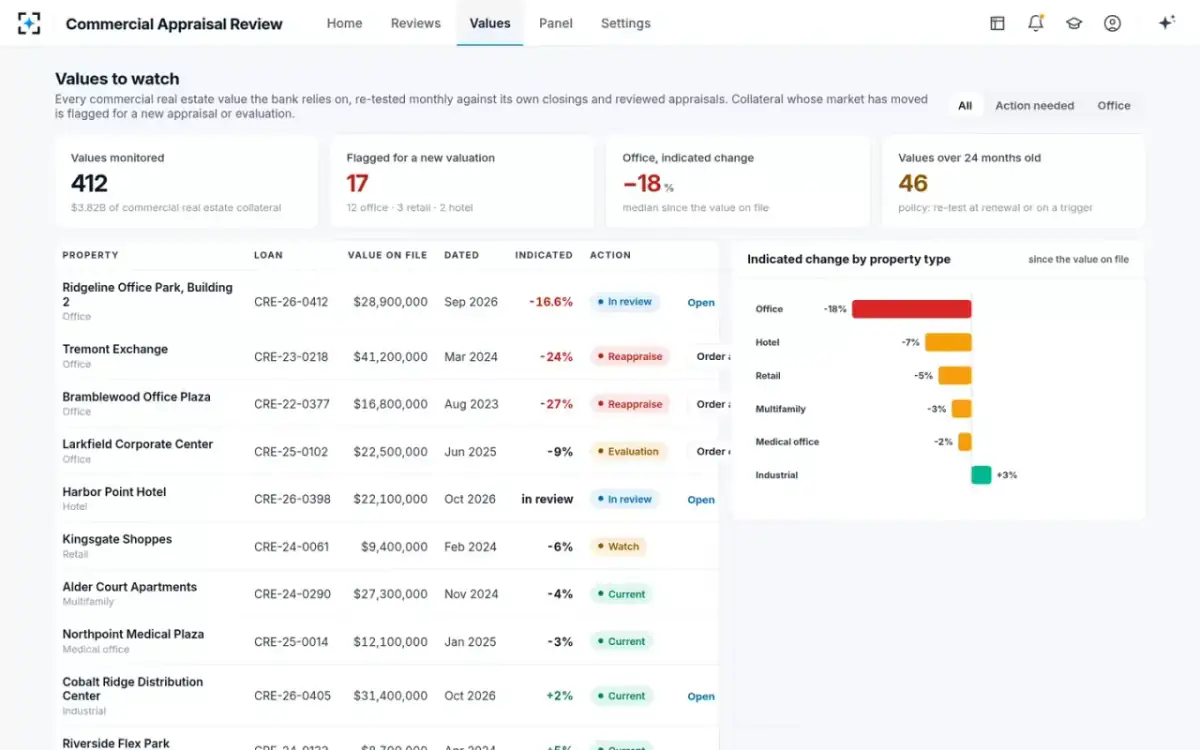
Three review habits follow. Test the cap rate and the comparables against the newest evidence in the bank's possession, not only against what the appraiser cited. Tie the income approach to the newest rent roll and lease file the bank holds, because a stale rent roll is the income-side version of a stale cap rate. And watch values already on the books, because the lag that makes a new appraisal too high in a falling market makes last year's appraisal higher still. The 2023 workout statement lists "Variances between actual conditions and original appraisal assumptions" among the triggers for a new valuation (88 FR 43115).
Every value on the books, re-tested against the bank's own closings
How a bank can measure its own appraisals against later sales
A bank does not need an index to know how its own appraisals perform; it needs to match its appraisals with what the collateral later sold, refinanced or was revalued for. Every payoff from a sale, every reappraisal at renewal or in a workout, and every foreclosure sale is a data point. Banks rarely assemble them, because the appraisal, the later event and the review sit in different files.
The Guidelines already ask for the raw material. They expect a bank to "monitor and evaluate the competency and ongoing performance of appraisers" using its review findings, and to watch "Fluctuations in discount or direct capitalization rates" as an indicator of changing market conditions (Interagency Guidelines §§XV and XVII). A simple version: for each property type, compare each appraisal's cap rate with the median of the bank's own closings in the following year, and each value with any later sale. If the bank's office appraisals have run high by a consistent margin, the review policy's tolerance should reflect it. The sample's Ridgeline review ended with the appraiser's own revision at $24.1 million, 16.6% below the first report, a move the bank's data predicted and the report alone did not. To see that comparison on the example bank's files, start from Commercial Appraisal Review.
Questions people ask
How far off are appraisals from sale prices?
On institutional commercial property, the average absolute gap between an appraisal and the sale price two quarters later is 11 to 13%, with a median near 8%. In boom and bust years the average gap rose above 16%, and in 2009 outside appraisals missed by 20.6% on average.
What is appraisal smoothing?
Appraisal smoothing is the tendency of appraised values to move more slowly than market prices, because appraisers anchor on past sales, past cap rates and prior values. The result is the lag Cannon and Cole measured: values too low in rising markets and too high in falling ones, and indexes built on appraisals that understate volatility.
Are outside appraisals more accurate than internal ones?
Not in the NCREIF data. Cannon and Cole found mean absolute errors of 11.7% for external appraisals and 10.8% for internal ones, and concluded that external appraisals are no more accurate than internal ones. The finding is about portfolio valuations; bank collateral appraisals must be performed by independent, state-certified or licensed appraisers regardless.
Why is office harder to appraise than apartments?
Office buildings trade less often, differ more from each other and depend on long leases whose renewal is uncertain, so comparables need larger adjustments and the income approach rests on rollover assumptions. Both major studies found office or industrial errors above apartment errors by two to four points.
Does a more accurate appraisal review need a model?
Not necessarily. The research shows the error is systematic and tied to stale cap rates, stale rents and location; a reviewer who compares each report with the bank's newest closings and the newest rent roll addresses the same drivers. Models help most by assembling that comparison for every report, not by producing a value.