Commercial appraisal review companies are third-party firms, usually staffed by certified general appraisers, that review commercial appraisals for lenders under the lender's review policy, at a fee per report. They give a bank capacity and property-type expertise it may not have in-house, and the Interagency Appraisal and Evaluation Guidelines expressly allow them: a bank "may find it appropriate to employ additional personnel or engage a third party to perform the reviews." What they do not take is the responsibility. The bank "remains responsible for the quality and adequacy of the review process," examiners ask whether outsourced reviews are quality-controlled, and an outside firm rarely sees the bank's own closings, rent rolls and tenant files. The choice for a chief appraiser is therefore between three models, outsourced review, staff review and agent-assisted review, and the honest comparison is on independence, depth, access to the bank's evidence and the cost of oversight, not only on the fee. Botminds' Commercial Appraisal Review is the third model: software agents that read the report and gather the evidence for whichever reviewer signs, staff or outsourced.
Worked examples use a fictional bank and its review of a fictional office appraisal. Where hours appear, they are Botminds' estimate, not a measurement or a published benchmark.
By our estimate, gathering and checking evidence is the biggest share of a commercial review
By hand · about 4 hours
- Read the report and answer the checklist · 1 h 15 · 31%
- Bank's sales and cap rates, the rent roll, the revision · 1 h 45 · 44%
- Write the questions and the review · 1 h · 25%
With agents · about 1 hour 45
- Check the agents' checklist · 30 min · 29%
- Check their evidence and the revision · 45 min · 43%
- Edit the questions and the review · 30 min · 28%
What do commercial appraisal review companies do?
A review company takes a report from the bank's appraisal desk, reviews it against the bank's checklist and policy, and returns a review report: compliant or not, credible or not, with the deficiencies listed. Depending on the engagement it may also correspond with the appraiser, re-check the revision, and, if its reviewer is qualified and the bank asks, develop a second opinion of value under USPAP Standard 3. Many also run appraisal management: selecting and engaging the appraiser on the bank's behalf.
Banks use them for three reasons. Capacity, when the queue outruns the staff. Expertise, for property types the bank rarely lends on, such as hotels, self-storage or special-purpose property. And independence by construction, for small banks where the people who could review also originate. The Guidelines anticipate all three: a bank "should assess the level of in-house expertise available to review appraisals for complex projects, high-risk transactions, and out-of-market properties" and may engage a third party where it falls short (Interagency Guidelines §XV.A).
Should banks outsource appraisal review? The responsibility never moves
A bank may outsource the work of review but not the accountability for it. The Guidelines are direct: "When using a third party, an institution remains responsible for the quality and adequacy of the review process, including the qualification standards for reviewers." The section on third-party arrangements adds that the decision to outsource "should not be unduly influenced by any short-term cost savings" and that the bank should weigh "the managerial expertise and associated costs for effectively monitoring the arrangement on an ongoing basis" (Interagency Guidelines §XVI).
The 2023 interagency guidance on third parties, still in force, generalises the point to every vendor: "the use of third parties does not diminish or remove banking organizations' responsibilities to ensure that activities are performed in a safe and sound manner and in compliance with applicable laws and regulations" (88 FR 37920). It applies equally to a review firm and to a software vendor, which is why the comparison below includes oversight as a cost on every model.
What examiners ask about outsourced appraisal reviews
The OCC's questionnaire gives the examiner's view in four bullet points. If any appraisal reviews are outsourced: "does bank policy state when such outsourcing is to occur? are procedures in place to test the quality of outsourced reviews? does the reviewer use bank-developed review documentation and specifications? does the bank have a quality control procedure in place for these reviews?" (OCC, Commercial Real Estate Lending, ICQ 33).
Each bullet is a cost a fee quote leaves out. A written outsourcing trigger means the chief appraiser maintains a policy. Testing quality means someone at the bank re-reviews a sample of the firm's reviews. Bank-developed documentation means the firm works to the bank's checklist, not its own. And quality control means a standing process, with findings, that an examiner can read. A bank that pays a firm and files its reviews without this has bought a document, not a control.
Commercial appraisal review companies, staff reviewers and agent-assisted review compared
| Question | Review company | Staff reviewer | Staff or firm reviewer with agents |
|---|---|---|---|
| Who signs the review? | The firm's reviewer; the bank accepts it | The bank's reviewer | Whichever reviewer the bank uses; agents never sign |
| Independence from loan production | Structural, if the bank engages the firm and the desk relays all contact | Depends on reporting lines; examiners test it | As for the reviewer; questions are screened for values and sent only by the desk |
| Access to the bank's own closings, rent rolls and tenant files | Usually only what the bank sends with the report | Full, if the reviewer has time to look | Full and automatic, for every report |
| Property-type expertise | Broad, especially for rare types | Limited to the team's experience | As for the reviewer; agents add the bank's history for that type |
| Capacity when the queue spikes | Elastic, at a per-report fee | Fixed; overtime or delay | Higher per reviewer, because reading and gathering move to agents |
| Oversight the bank must run | Outsourcing policy, sample re-reviews, quality control (OCC ICQ 33) | Internal quality control and loan review | Third-party oversight of the software, plus testing its findings on closed files |
| What examiners see in the file | The firm's report and the bank's QC evidence | The bank's review | The review with a page behind every checklist answer and every finding |
What does commercial appraisal review cost?
The fee is the visible part; the full cost of a review is reviewer time plus the bank's oversight plus the cost of what the review misses. No regulator publishes a fee or time standard for commercial reviews. The closest official benchmark is narrower: when the agencies raised the commercial threshold in 2018, the FDIC estimated that "an evaluation takes approximately 30 minutes less to review than an appraisal" and priced the time at a loaded $67.29 an hour for a loan officer, using BLS wage data grossed up for benefits (83 FR 15019). The method is sound even if the numbers are dated: hours times a loaded rate, measured on the bank's own work.
The full cost of one commercial appraisal review, as a sum the bank fills in
Reviewer time
hours per review × loaded hourly cost of the reviewer
Measure hours on your own last 20 commercial reviews, including the revision cycle.
Chief appraiser
Outside fees
reviews sent out × fee per review
Zero for staff review; for agents, the subscription spread over the reviews it supports.
Finance
Oversight
sample re-reviews × hours each × loaded cost + vendor management
OCC ICQ 33 for firms; testing on closed files for software.
Chief appraiser and third-party risk
What a miss costs
probability a material deficiency is missed × exposure added above policy LTV
In the sample, a missed revision would have left $2,835,000 above the 65% limit.
Chief credit officer
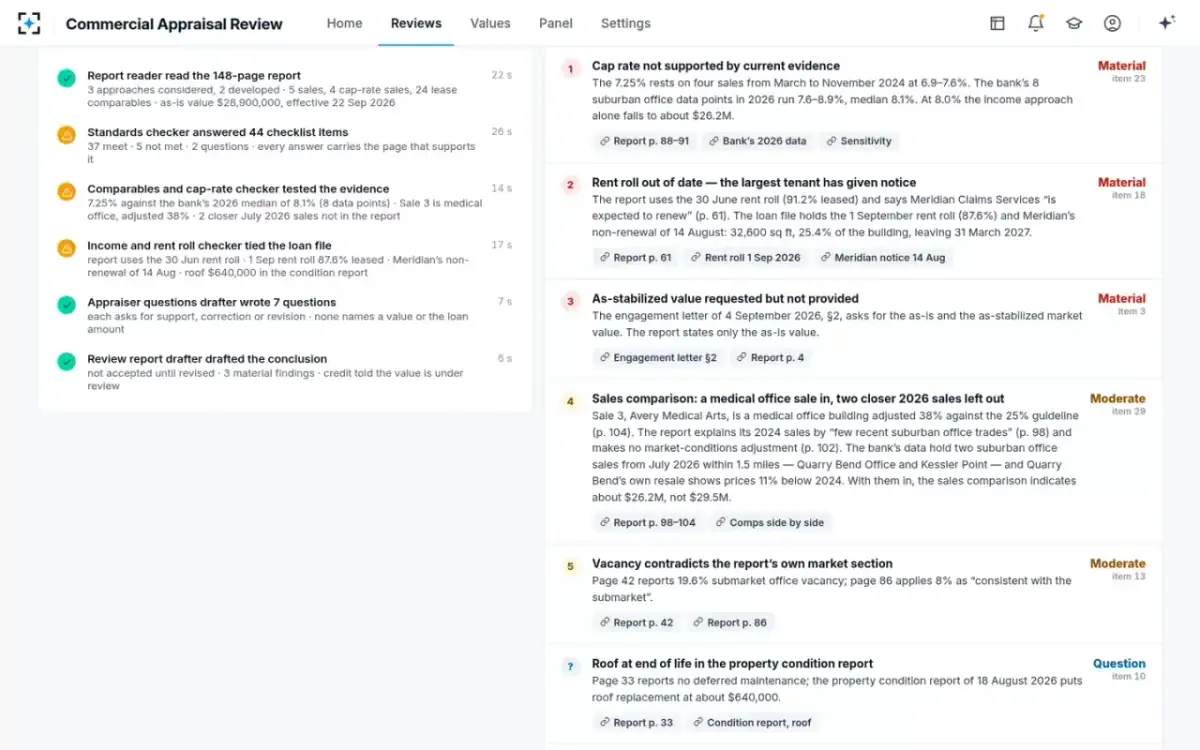
The fourth term is where models differ most. In the sample, a 148-page appraisal of an office building came in at $28,900,000, 64.0% loan-to-value on an $18,500,000 request. The three findings that moved it were all in the bank's files rather than the report: the bank's 2026 cap rates, a newer rent roll and a tenant's non-renewal notice. Revision 2 came back at $24,100,000, and the same request was 76.8% loan-to-value. A reviewer who never saw the bank's data would likely have accepted the first report.
The findings that moved the value came from the bank's own files
Staff review: independence and depth, at the cost of capacity
A staff reviewer's advantage is proximity. The reviewer can walk to the loan file, ask the portfolio manager about the tenant, and remember what the bank closed in the same submarket last quarter. The constraint is hours and headcount. The certified general pool that commercial reviewers come from held 40,583 credentials at the end of 2025 (Appraisal Subcommittee, 2025 Annual Report), and banks compete for it with appraisal firms and review companies.
Small banks face a second constraint, independence. The Guidelines allow a small institution with limited staff to have loan officers, other employees or directors review an appraisal if they are qualified, independent of the transaction and abstain from any vote on the loan, and the 2018 FAQs suggest that for complex or out-of-market property, "the financial institution may find it appropriate to evaluate alternatives, such as outsourcing of the review process" (Interagency FAQs, Q6). For those banks, a review company is often the only way to get independence and expertise at once.
Agent-assisted review: where it fits, and where it does not
Agents fit where the work is reading, retrieval and arithmetic: extracting a report's approaches and assumptions, answering a checklist with page citations, setting the appraiser's comparables beside the bank's own, recomputing the income approach against the newest rent roll, and drafting questions and the review report. They do not fit where the rules put a person: forming a value, deciding whether a deficiency is material, and signing. An agent-assisted review is still a staff review or a firm's review; it is a faster and better-evidenced one.
They also do not replace expertise the bank lacks. A bank with no hotel lending history gets little from comparing a hotel appraisal with its own book, because it has none. For that report, a specialist firm is the better answer, and the agents' value is in giving the firm the bank's loan file in an organised form. The agents and the outsourced reviewer are complements, not competitors. What the rules allow AI to do in appraisal review sets out the boundary in detail.
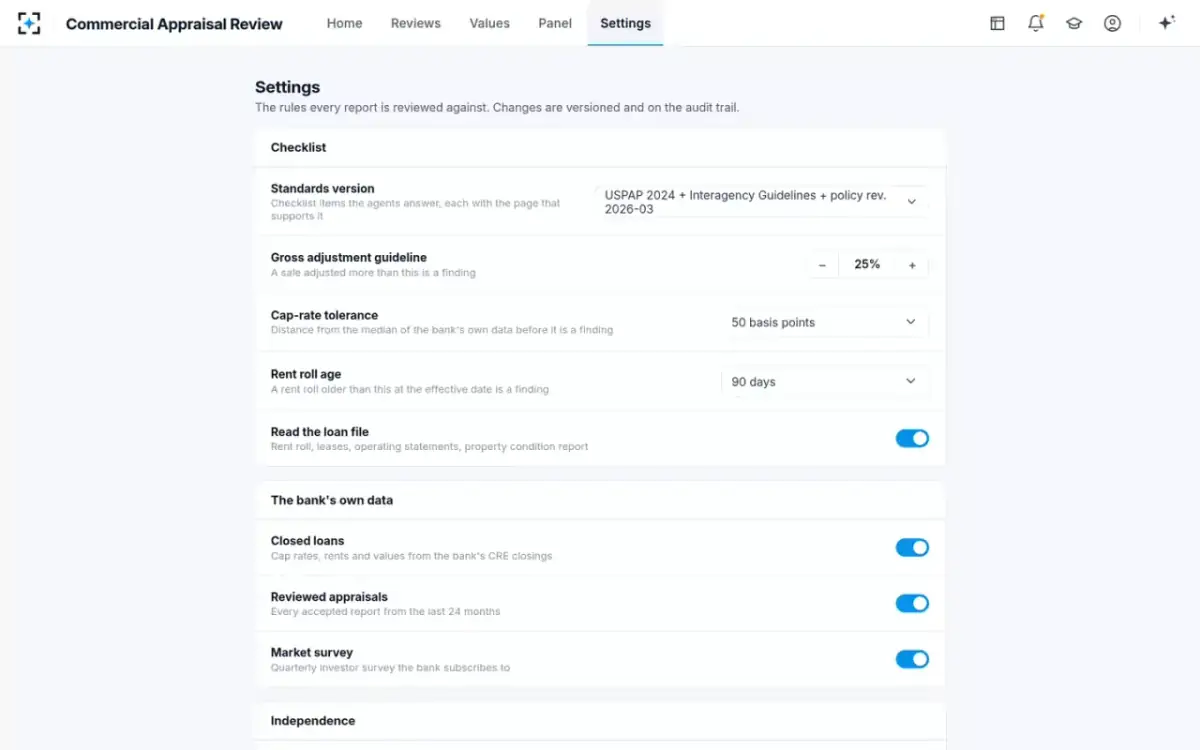
The review rules are the bank's, whoever performs the review
Questions to put to any commercial appraisal review company or vendor
The questions that separate review providers are the ones examiners will ask the bank later. Put them to firms and to software vendors alike, and ask for evidence rather than assurances.
Before you engage a review company or buy review software
- Will you review to our checklist and policy, or to yours?
OCC ICQ 33 asks whether the reviewer uses bank-developed documentation and specifications.
- Who are the reviewers, and what are their credentials by property type?
Certified general for commercial; ask for the reviewer assigned to hotels, healthcare or special-purpose property.
- How will you see our loan file and our own closings?
Without them, cap rates and rent rolls are tested only against the report itself.
- Who talks to the appraiser, and how is every exchange logged?
Only through the bank's appraisal function; no value, target or loan amount may ever be mentioned.
- How do we quality-control your reviews?
Sample size, re-review method, findings and how disagreements are resolved.
- Can you show results on reviews we already completed?
Run on 20 to 30 closed files and compare findings with what our reviewers found.
- What happens when you cannot resolve a deficiency with the appraiser?
Second appraisal or a Standard 3 review with a second opinion of value, before the credit decision.
The last two questions apply with special force to software. A vendor that cannot run on the bank's own closed files before contract cannot show the bank anything an examiner would accept. Botminds runs Commercial Appraisal Review on a sample of the bank's past commercial appraisals and closings first; to see what that looks like on sample data, start from Commercial Appraisal Review.
How to choose between the three on your own files
Choose with evidence from your own work. Pull 20 to 30 commercial reviews closed in the last year, with their revisions and any later sale, reappraisal or workout. For each, note what the review found, what it missed that later came to light, how long it took and what it cost. Then give the same reports to the firm you are considering, or run them through the software, and compare findings item by item.
Most banks will end up with a mix: staff reviewers for the core book, a firm for rare property types and volume spikes, and agents working for both. What should not vary across the mix is the checklist, the independence controls and the evidence standard, a page behind every answer, so that an examiner reading any review in the file sees the same control. What a review appraiser does all day is the place to start if the staff model is the one being sized.
Questions people ask
Who checks an outsourced appraisal reviewer?
The bank does. The Guidelines keep the bank responsible for the quality of outsourced reviews, and the OCC asks whether the bank has procedures to test their quality and a quality control process for them. In practice, that means a chief appraiser or senior reviewer re-reviewing a sample of the firm's work against the bank's own checklist.
What are appraisal review services for lenders?
They are third-party reviews of appraisals and evaluations performed for a lender under the lender's policy, from compliance checks to technical reviews and second opinions of value under USPAP Standard 3. Many providers also manage appraisal ordering. The lender remains responsible for the review program.
Is a staff review appraiser more independent than an outside firm?
Not necessarily. Independence depends on reporting lines and controls: a staff reviewer must be insulated from loan production and have no interest in the property or transaction. An outside firm is independent of loan production by structure, but only if the bank, not the borrower or the loan officer, engages it and relays all contact.
Can a small bank use loan officers to review appraisals?
Yes, with safeguards. The Guidelines and the 2018 FAQs allow a small institution to have a qualified loan officer, other employee or director review an appraisal if that person is independent of the transaction and abstains from any vote or approval on the loan. For complex or out-of-market property, outsourcing may be the better route.
Does review software replace a review company?
No. Software can take the reading, retrieval and drafting off any reviewer, staff or outsourced, but it does not sign and it does not bring expertise in property types the bank has never lent on. Banks that use a firm for rare property types can still give that firm an organised loan file and the bank's own data.