Yes, a bank can use another bank's appraisal, under conditions the federal appraisal rules set out. Under 12 CFR 34.45(b)(2), a regulated institution "may accept an appraisal that was prepared by an appraiser engaged directly by another financial services institution, if: (i) The appraiser has no direct or indirect interest, financial or otherwise, in the property or the transaction; and (ii) The regulated institution determines that the appraisal conforms to the requirements of this subpart and is otherwise acceptable" (12 CFR 34.45; FDIC and Federal Reserve rules match). The Interagency Appraisal and Evaluation Guidelines add that the receiving bank should review the appraisal to "at least the same level of review" it applies to its own, document that review, and confirm the other institution, not the borrower, ordered it. A borrower-ordered appraisal, a readdressed one and another bank's evaluation all fail the test. The review is the part banks under-do, because a transferred report arrives looking finished; Botminds' Commercial Appraisal Review runs it through the bank's own checklist and data exactly as it would a report the bank ordered.
The transfer test: five questions before relying on another lender's appraisal
- 1
Who engaged the appraiser?
A financial services institution engaged the appraiser directly, not the borrower. The original engagement letter, showing that institution as client, goes in the credit file.
12 CFR 34.45(b)(2); FAQ A20, A23
- 2
Was the appraiser free of any interest?
No direct, indirect or prospective interest, financial or otherwise, in the property or the transaction. An affiliate relationship with the ordering lender is not by itself a conflict.
34.45(b)(2)(i); FAQ A22
- 3
Is the report as the appraiser issued it?
Not readdressed or altered to conceal the original client or intended users. A readdressed report is misleading and does not conform to USPAP.
Guidelines §XV.B
- 4
Does it meet the rules, to your standard of review?
Reviewed to at least the same depth as appraisals the bank orders for similar property, and found to conform to subpart C and be otherwise acceptable.
34.45(b)(2)(ii); Guidelines §XV.B
- 5
Is it still valid for this transaction?
Effective date, market, cap rates, leases and the property's condition tested against the bank's validity criteria before the credit decision.
Guidelines §XIV; FAQ A8–A9
Can a bank use another bank's appraisal? The two conditions in the rule
The rule has two conditions and both must hold. The first is about the appraiser: no direct or indirect interest in the property or the transaction. The second is about the report and the bank's judgement of it: the receiving bank must itself determine that the appraisal conforms to the federal appraisal rules and "is otherwise acceptable". The exception exists because the general rule is strict: a fee appraiser "shall be engaged directly by the regulated institution or its agent" (12 CFR 34.45(b)(1)), and accepting another institution's appraisal is the only route around that requirement.
The Guidelines describe the exception in the same terms: "An institution or its agent must directly select and engage appraisers. The only exception to this requirement is that the Agencies' appraisal regulations allow an institution to use an appraisal prepared for another financial services institution provided certain conditions are met" (Guidelines §VI). The OCC's review worksheet tests it as item 2: "If the bank accepted an appraisal prepared for another institution, did the bank determine that the appraisal conformed to the requirements of 12 CFR 34 and was otherwise acceptable?" (OCC CRE booklet, Appendix E).
Can a bank use a borrower-ordered appraisal?
No. "An institution's use of a borrower-ordered or borrower-provided appraisal violates the Agencies' appraisal regulations" (Guidelines §VI). The 2018 FAQs repeat it for a developer who wants to order appraisals for a construction loan: "the financial institution may not accept a borrower-ordered appraisal and may not allow the borrower to select an appraiser from its approved appraiser list" (Interagency FAQs, A16).
What a borrower may do is tell the bank that an appraisal exists. The Guidelines allow it: "a borrower can inform an institution that a current appraisal exists, and the institution may request it directly from the other financial services institution." The FAQs close the loophole of routing: "A financial institution should not accept an appraisal from the borrower" (A20). The report must come from the institution that ordered it, which is also how the receiving bank gets the engagement letter it needs for test 1.
Transferred appraisals a bank may accept, and those it may not
May be accepted, after review: Another bank, credit union or other financial services institution, including a loan broker or an intermediate lender, that engaged the appraiser directly.
May not be accepted: The borrower, a developer or anyone else who is a party to the deal; a borrower choosing from the bank's approved list.
May be accepted, after review: Directly from the ordering institution, with its engagement letter.
May not be accepted: Handed over by the borrower, even if a bank ordered it originally.
May be accepted, after review: As issued to the original client, with that client named.
May not be accepted: Readdressed or altered to hide the original client or intended users.
May be accepted, after review: Independent of the property and transaction; an affiliate of the ordering lender is acceptable if otherwise independent.
May not be accepted: With a direct, indirect or prospective interest in the property or transaction.
May be accepted, after review: An appraisal.
May not be accepted: Another institution's evaluation, which the receiving bank generally should not rely on.
What is an appraisal transfer letter, and can an appraisal be readdressed to a new lender?
A transfer letter is a letter from the original lender releasing an appraisal it ordered to another lender, usually with the engagement letter attached. It is a sensible way to document test 1, because it shows who the client was and that the report came from that institution. What it cannot do is change the client. The Guidelines are blunt: "An institution must not accept an appraisal that has been readdressed or altered by the appraiser with the intent to conceal the original client. Altering an appraisal report in a manner that conceals the original client or intended users of the appraisal is misleading, does not conform to USPAP, and violates the Agencies' appraisal regulations" (Guidelines §XV.B).
If the receiving bank wants a report addressed to itself, the clean route is a new assignment: the bank engages the appraiser directly, under its own engagement letter, for a new appraisal. The appraiser may be the same one, and USPAP requires them to disclose prior services on the property within the three preceding years. The bank then owns the engagement and the scope of work, rather than inheriting both.
Loan brokers, syndications and participations
The exception covers more than banks. The FAQs allow a bank to accept an appraisal "prepared by an appraiser engaged by another financial services institution, including a loan broker", provided the appraiser is independent and the appraisal conforms, and warn that institutions "should review broker-ordered appraisals thoroughly" (A19). An intermediate lender, such as a warehouse lender's borrower, may also supply appraisals it ordered (A13).
Common transfer situations, and what the 2018 FAQs say
| Situation | Can the bank accept the appraisal? | What the bank must still do |
|---|---|---|
| Another lender declined the loan and releases its appraisal | Yes, if requested from that lender directly | Get the engagement letter; review to its own standard; confirm validity |
| A loan broker ordered the appraisal | Yes, if the appraiser is independent and the report conforms | Review thoroughly against its own policy |
| A syndicated loan where the lead lender ordered it | Yes; the lead usually engages and distributes | Each participant reviews and documents its reliance |
| The appraiser's firm is affiliated with the ordering lender | Yes, if the appraiser has no interest in the property or deal | Confirm independence and conformity |
| The borrower hands over a copy | No | Request it from the ordering institution instead |
| The report was readdressed to the new bank | No | Order a new appraisal under its own engagement letter |
Syndicated and participated loans are where the rule most often meets practice. The FAQs note that "In the case of a syndicated loan, a lead lender is usually responsible for engaging the appraiser and providing copies of the appraisal to the other participating financial institutions" (A21). Every participant is still relying on another institution's appraisal and owes its own review and its own documentation.
Can a bank use another bank's evaluation?
Generally not. The Guidelines say in a footnote that "An institution generally should not rely on an evaluation prepared by or for another financial services institution because it will not have sufficient information relative to the other institution's risk management practices for developing evaluations" (Guidelines §XV.B, footnote 45). An appraisal can be judged against USPAP and the federal minimum standards, which are the same for every lender; an evaluation is built to the ordering bank's own policy, method and data, which the receiving bank cannot see.
For a commercial loan at or below the $500,000 threshold, that means the receiving bank usually needs its own evaluation even when the borrower's previous lender has one. When an evaluation is enough is covered in the threshold guide.
How do you review a transferred appraisal?
At least as deeply as an appraisal the bank ordered itself, and with two extra steps. The Guidelines say a bank "should subject such appraisals to at least the same level of review that the institution performs on appraisals it obtains directly for similar properties and document its review in the credit file. The documentation of the review should support the institution's reliance on the appraisal." The extra steps are the origin checks, tests 1 to 3 in the transfer test, and validity, test 5, because a transferred report was written for someone else's transaction and date.
A transferred appraisal goes through the same review as any other
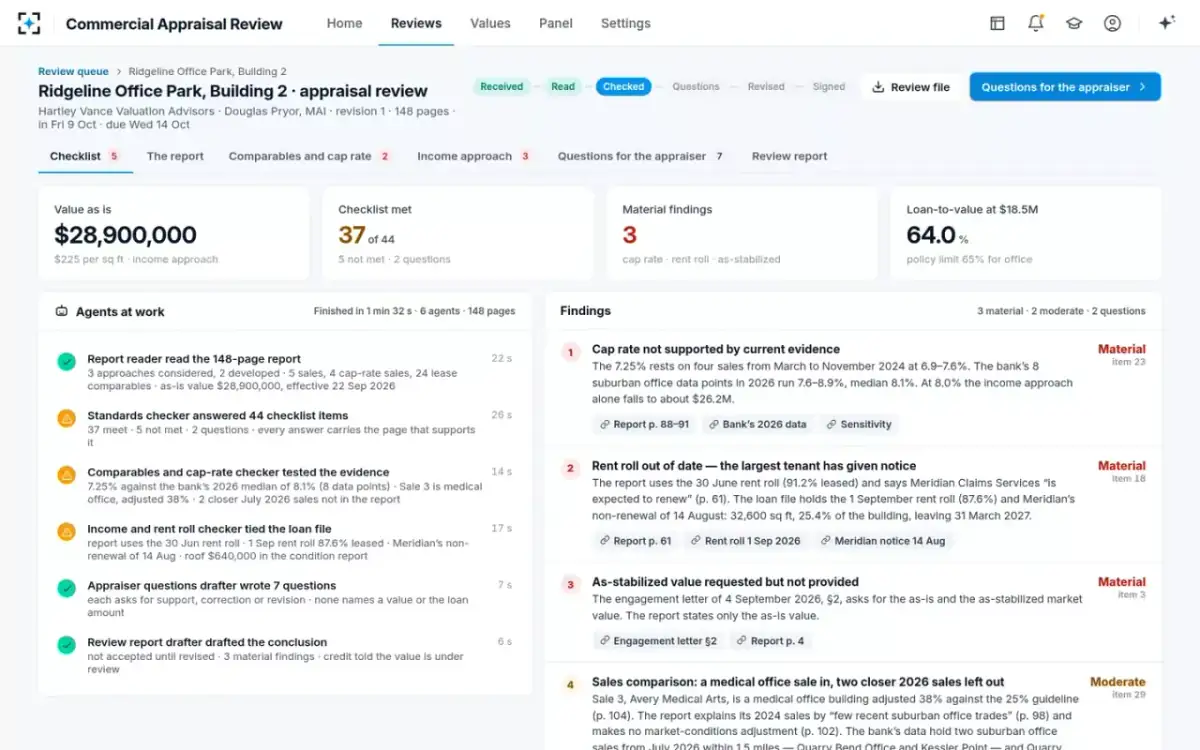
In practice, the review of a transferred commercial appraisal turns on the same evidence as any other: whether the comparables and cap rate still hold against the bank's own recent closings, whether the rent roll in the report matches the newest one in the loan file, and whether the value the report states is the kind of value the bank's credit decision needs. The other lender's acceptance of the report proves nothing about these; it may have been reviewed for a different loan amount, a different policy, or not at all. The questions the reviewer raises go back through the receiving bank's own appraisal function; whether the original appraiser will answer them depends on who the client is, which is one more reason some banks order a new appraisal instead.
Is a transferred appraisal still valid for the new loan?
Only if it passes the bank's own validity criteria. No regulation sets a shelf life for an appraisal; the FAQs say so directly, "there is no provision in the agencies' appraisal regulations specifying the useful life of an appraisal or evaluation" (A8). Instead, the Guidelines expect each bank to set criteria considering factors such as time passed, market volatility, financing conditions, competing supply, the property's condition, and changes in capitalization rates and lease terms.
A transferred report needs this test more than most, because the bank had no say in its timing. An appraisal effective a year ago in a market where office cap rates have risen by three-quarters of a point, or before the largest tenant served notice, may conform to every rule and still not support today's decision. The bank documents its validity conclusion in the credit file. The OCC's file-review procedures ask the same question of examiners: "whether new appraisals or evaluations were obtained when conditions warranted" (OCC CRE booklet, examination procedures).
What the credit file should hold for a transferred commercial appraisal
- The original engagement letter
Showing the financial services institution, not the borrower, as client (FAQ A23).
- How the report was received
Directly from the ordering institution, with a transfer or release letter if one was issued.
- The appraiser's independence confirmation
The USPAP certification, and any disclosure of prior services on the property.
- The bank's own review
To at least the depth the bank applies to similar property, with findings and how each was resolved.
- The validity conclusion
Why the value still supports this transaction at this date, against the bank's criteria.
- The decision to rely, or not
Made before the final credit decision, by the reviewer and, where policy requires, the chief appraiser.
Who talks to the appraiser about a transferred report?
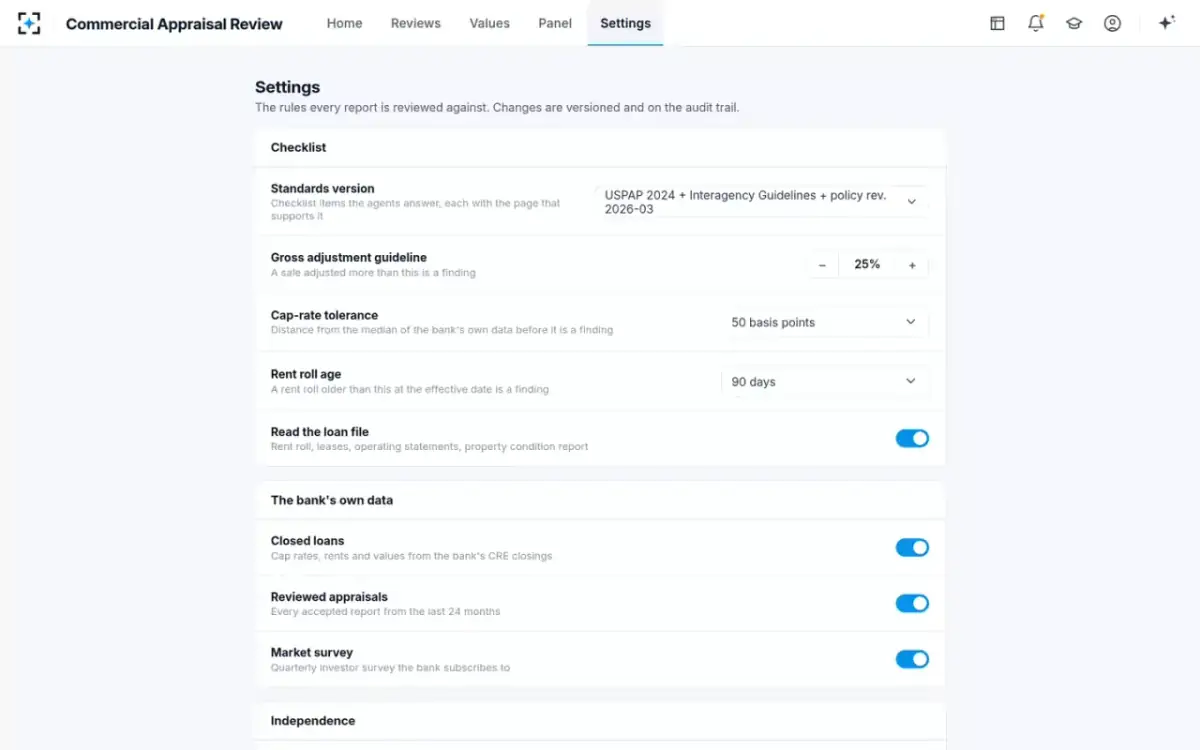
The receiving bank's appraisal function, under the same independence controls as for its own assignments. The independence rules do not relax because another lender ordered the report: questions still ask only for support, correction or consideration of information, never for a value, a target or a loan amount, and they still go through the people insulated from loan production. In the solution, questions go out through the appraisal desk, not the loan side, and every exchange is kept with the review.
Independence settings that apply whoever ordered the report
If the original appraiser declines to answer the receiving bank, because their client is the other institution, the bank has the same options it would have for any unresolved deficiency: a new appraisal, or a review under USPAP Standard 3 by a qualified appraiser that supports a second opinion of value, before the credit decision. What the review appraiser does with an unresolved finding is set out in its own guide. To see the review a transferred report would go through, on sample data, start from Commercial Appraisal Review.
Questions people ask
Do appraisals expire for commercial loans?
Not by regulation: the 2018 FAQs state that the appraisal rules contain no provision on the useful life of an appraisal or evaluation. Each bank must set written criteria for when an existing value remains valid, considering time, market volatility, financing, supply, condition and changes in cap rates and lease terms, and document its conclusion.
Can an appraisal be shared between two lenders?
Yes, if the ordering lender releases it directly to the other and the receiving lender reviews and accepts it under 12 CFR 34.45(b)(2). Whether the appraiser may deliver the report to a second lender depends on the original engagement letter; syndicated loans usually provide for the lead lender to distribute it.
How can a bank confirm appraiser independence on a transferred appraisal?
Through documentation, chiefly the original engagement letter showing the financial institution, not the borrower, ordered the appraisal, and the appraiser's certification of no interest in the property or transaction. The 2018 FAQs say the original lender's engagement letter should be included in the credit file.
Does the receiving bank need its own appraisal review?
Yes. The receiving bank must determine for itself that the appraisal conforms and is acceptable, and the Guidelines expect a review at least as deep as for appraisals it orders directly for similar property, documented in the credit file before the credit decision.
Can a credit union use a bank's appraisal?
Credit unions follow the NCUA's appraisal rule in 12 CFR 722, which also allows reliance on appraisals prepared for other financial services institutions under conditions. The NCUA joined the 2010 Guidelines but not the 2018 FAQs, so a credit union should check its own rule and examiner expectations.