A reasonable investigation under the FCRA is judged by where you looked, not by whether your own system agreed with itself. When a borrower disputes a tradeline, the lender that furnished it has to investigate the specific allegation, review everything the bureau sent with the dispute, report the result inside the clock, and correct the line at every bureau it reported to. None of that is satisfied by reading the record that produced the disputed line in the first place. That is the hard part: the proof that answers a dispute usually sits in origination, in servicing, in a payment history and in a call recording, four systems away from the collections screen an analyst is working in. Botminds' Collections Dispute Management closes that distance — specialist agents read each dispute, pause collection, pull the records that bear on the claim and draft a cited answer, and a named person decides and sends.
This guide is about the standard itself: what the regulation requires, what examiners and one federal appeals court have said about investigations that fell short, and what a closed dispute has to show a reviewer a year later. The worked examples come from a fictional sample lender, Ostrander Bank & Trust, as it runs through the solution; the people, agencies and accounts are invented. The law and the enforcement record are real and linked where they appear.
What is a reasonable investigation under the FCRA?
The duty has two doors. A dispute the borrower sends to a credit bureau reaches the lender as an indirect dispute, and the duty sits in FCRA §623(b): investigate, review all relevant information the bureau forwarded, report the result, and — if the information turns out to be incomplete or inaccurate — tell every nationwide bureau the lender furnished it to. A dispute the borrower sends to the lender's own dispute address is a direct dispute, and Regulation V sets it out in the plainest terms the rulebook has: the furnisher must "(1) Conduct a reasonable investigation with respect to the disputed information; (2) Review all relevant information provided by the consumer with the dispute notice; (3) Complete its investigation of the dispute and report the results of the investigation to the consumer before the expiration of the period under section 611(a)(1) of the FCRA" (12 CFR §1022.43(e)).
Neither the statute nor the regulation says what "reasonable" looks like in a file. The enforcement record does, and it is consistent: reasonableness is proportionate to the claim. A borrower who says the balance is $200 too high has made a claim a payment history can answer. A borrower who says the account is not hers at all has made a claim no balance field can answer, because the disputed question is identity, and identity lives in the signing record and the disbursement, not in the collections screen.
The four questions a reviewer asks of any closed dispute
1. What was claimed?
A file that answers itThe borrower’s own three sentences, kept apart: not mine, prove the $8,080.36, take it off my report.
A file that does not“Consumer disputes account information” — a category, not a claim, and nothing to answer.
2. Where did you look?
A file that answers itSix places named: the signed agreement, the signing record, the disbursement, 21 payments, two calls, the tradeline as furnished.
A file that does notOne place: the collections system that produced the disputed line in the first place.
3. What did the record say?
A file that answers itPage 8 of the agreement, signature at 19:42:07 ET on 14 March 2023, signature ID ES-23-0314-88172.
A file that does not“Account verified as accurate”, with nothing behind the sentence.
4. What did you report?
A file that answers itVerified, no change, with the reason sent to the borrower and the dispute flag cleared at the next update.
A file that does notA deletion, so the file goes quiet — and the question of accuracy is never answered.
Question two is the one that decides most files. A reviewer who can see six places searched, each with what it said, is reading an investigation. A reviewer who can see one place searched is reading a comparison — and a comparison of the disputed line with the system that produced it can only ever confirm what the lender already believed.
Is checking your own system a reasonable investigation?
Sometimes, and only when the claim is one your own system can settle. Where the claim turns on something your system cannot see, checking it is not an investigation at all. The CFPB's examiners put this in writing in December 2024, describing debt collectors that had automated the answer:
Examiners found that the furnishers failed to conduct reasonable investigations of certain indirect disputes in circumstances in which the furnishers utilized automated dispute response systems that reviewed only their own systems of record to assess the accuracy of the disputed information.
CFPB, Supervisory Highlights, Issue 37 (Winter 2024)
The same passage names what those systems never opened: the records of the creditors on whose behalf the debts were being collected — records the collectors could reach, and which bore directly on the disputes. The failure was not automation. The failure was the search radius. Examiners had already set the expectation earlier in the same report: conducting a reasonable investigation responsive to the specific allegations "often requires furnishers to at least review information relevant to the dispute in its own possession and, in some cases, may necessarily entail accessing or requesting third-party documents and other information relevant to the dispute to which the furnisher reasonably has access" (Supervisory Highlights, Issue 37).
Courts have reached the same place from the other direction. In Hinkle v. Midland Credit Management the Eleventh Circuit let a case go to a jury because a debt buyer had matched a disputed name against its own file and called it verified: "Midland did not attempt to consult account-level documentation to confirm that the 'Terri Hinkle' and 'Teri Hinkle' who incurred the debts in 2005-2006 were the same 'Teri Lynn Hinkle' it was dunning six years later. A reasonable jury could find that such a cursory investigation was unreasonable on the facts of this case" (827 F.3d 1295, 11th Cir. 2016). Two spellings of a name matched a third. The system said yes. The question the borrower asked was never touched.
Where the answer actually lives
Map the claim to the system that can settle it and the search radius stops being a judgement call. Six claims cover most of a consumer lender's dispute volume, and each has a home.
The borrower's claim, and the record that answers it
| What the borrower says | Where the answer is | What closes it | What will not close it |
|---|---|---|---|
| This is not my account | Origination: the signed agreement, the signing and identity record, the disbursement | A signature page with the date, time and signature identifier, the identity check behind it, and the account the money went into | A name and address match in the collections system |
| I never agreed to these fees | The agreement’s own terms, then the fee entries on the account | The clause that sets the fee, read against each fee charged and the date it was applied | A fee schedule that was current when the dispute arrived, not when the loan was written |
| I was never late — I paid that month | Payments: the posting date, the channel, and what the payment was applied to | The payment as received, as applied, and any later correction, with dates | The month’s reported status, which is the thing being disputed |
| The balance is wrong | Servicing: principal, interest, fees, and anything added after charge-off | A balance built from its parts, with the date each part was added | The balance field in the file you furnished |
| I asked them to stop calling my work | The collecting agency’s call log, and the request as it was recorded | The call log for the period, read against the date of the request | The lender’s own notes, if the agency placed the calls |
| I settled this account | The settlement letter, the payment that satisfied it, and what the agency reported back | The agreed terms, the payment, and the reporting that should have followed | Nothing, where the agency never reported the settlement back |
Two of these are worth dwelling on. The fee claim is the one most often answered from the wrong document: a lender that reads today's fee schedule rather than the clause in the agreement the borrower actually signed can confirm a fee the contract never allowed. And the call claim cannot be answered from the lender's own systems at all when an agency placed the calls, which is the precise situation examiners described — records the furnisher could reach, and did not.
Three lawful endings, and the one nobody uses
The statute gives an investigation three places to stop, not two. The furnisher may verify the information as accurate; it may find the information inaccurate or incomplete and correct or delete it; or it may determine that the information cannot be verified and tell the bureaus so (FCRA §623(b)(1)(E)). The third ending is the forgotten one. The Eleventh Circuit described when it is the honest answer: furnishers "can avail themselves of this option if they determine that the evidence necessary to verify disputed information either does not exist or is too burdensome to acquire", and the court added, in a footnote, that this is not a licence — by calling it a choice, "we do not mean to suggest that furnishers have complete discretion to cease investigation and report accounts as 'cannot be verified'" (Hinkle).
Verified, modified, cannot be verified: what each means and what it obliges
What it asserts: The lender looked at the records that bear on the claim, and they support the line exactly as furnished.
When it is the honest answer, and what must follow: Only when the records reached actually answer the borrower’s claim. The borrower is told the result, the reason, and that the lender’s file stays as it is.
What it asserts: The records contradict the line, in whole or in part.
When it is the honest answer, and what must follow: Correct it field by field, tell the borrower, and report the finding to every nationwide bureau the information was furnished to — not only the one that asked.
What it asserts: The evidence that would settle the claim does not exist, or cannot reasonably be got.
When it is the honest answer, and what must follow: When a portfolio arrived without account-level documents, or the original creditor cannot produce them. The information comes out of the file: unverifiable is not the same as unproven-but-kept.
Why does the third ending matter to a lender that originates its own loans? Because of what it prevents. A furnisher with no document to produce has two lawful choices and one unlawful habit: say it cannot be verified and stop reporting it, or do the work and verify it — never report "verified" because nothing in the file contradicts it. Silence in a record is not evidence. That is the distinction automated credit dispute verification gets wrong most often, and the one an examiner tests first.
Can a furnisher just delete the tradeline instead of investigating?
No — deleting is an outcome, not a substitute for the work that produces one. Examiners said so in April 2024, in terms a compliance manager can quote at a steering meeting: "in recent reviews of debt collection furnishers, examiners found that when the furnishers received a direct dispute they simply deleted the tradeline, rather than conducting an investigation" (Supervisory Highlights, Issue 32). The Bureau's position is that deleting in response to a direct dispute does not discharge the duty to investigate.
The reasoning is worth following, because deletion looks generous. It resolves the borrower's immediate complaint and closes the item inside the clock. What it does not do is find out whether the information was accurate — so the same error stays in the servicing system, is furnished again on the next account, and the cause is never fixed. The 2024 consent order against TD Bank describes the end state: having failed to investigate indirect disputes at all, the bank decided to rely on the bureaus to delete the disputed tradelines once the period had passed, and then "did not confirm with the CRAs that disputed tradelines had in fact been deleted, contact consumers to determine whether tradeline deletion was the result they sought, nor update its own system of record following its failure to investigate these disputes" (2024-CFPB-0009). Deletion as a policy left the borrowers unasked and the lender's own file wrong.
The documents the bureau should have sent you
Half of the "all relevant information" duty is not yours. When a borrower disputes through a bureau and attaches a death certificate, a settlement letter or a police report, those documents are part of the dispute, and the statute says where they have to go: the bureau's notice to the furnisher has to carry everything relevant the bureau received from the borrower about the dispute (15 U.S.C. §1681i(a)(2)(A)).
In practice much of it still arrives as a two-digit code and a sentence of consumer statement. That is a fact to build around, not a defence: a dispute that reaches you stripped of its attachments is a dispute you may have to ask about before you answer it, and the asking belongs in the file. Where the borrower wrote to you directly, there is no intermediary and no excuse — their letter, and whatever they enclosed, is the "all relevant information" the regulation names.
Six records, each opening at the passage that answers a claim
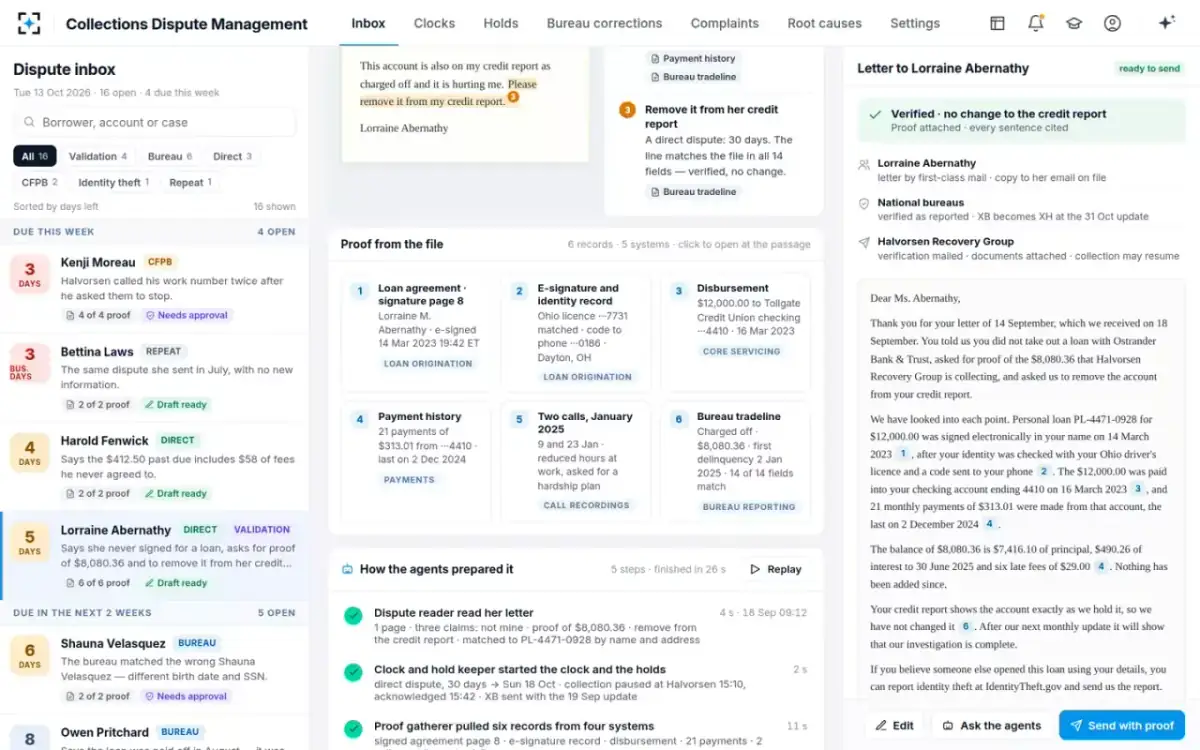
The dispute you may decline, and the letter that must follow
Regulation V lets a furnisher decline a direct dispute in a short, closed list of cases: where the dispute does not identify the account or the specific information disputed, where it arrives at an address the furnisher did not designate, where the furnisher reasonably believes it was submitted by or prepared on behalf of the borrower by "a credit repair organization, as defined in 15 U.S.C. 1679a(3)", and where it repeats, in substance, a dispute the borrower already submitted and that was already answered — with the important proviso that a repeat dispute is not substantially the same if it brings information the borrower had not previously provided (12 CFR §1022.43(b), (f)).
Declining is not free. On deciding that a dispute is frivolous or irrelevant, the furnisher "must notify the consumer of the determination not later than five business days after making the determination", and the notice has to give the reasons and identify what is needed to investigate. This is the duty that quietly produced a line in the 2024 consent order: from January 2017 through October 2020 the bank "failed to notify consumers who submitted Direct Disputes regarding their U.S. Bankcard accounts that Respondent had determined that their disputes were frivolous or irrelevant or to explain the reasons for that determination" (2024-CFPB-0009). A desk that declines without the letter has not saved the work; it has converted an investigation into a violation.
Examiners have also closed the obvious workaround. Furnishers that refused to investigate because a borrower had not satisfied the furnisher's own extra identity checks were told plainly that "Regulation V does not permit a furnisher to establish additional requirements beyond what the regulation requires in order to initiate a direct dispute investigation by the furnisher" (Supervisory Highlights, Issue 32). A dispute that meets the regulation's own list is a dispute you investigate, whatever your intake form says.
What the file has to show a year later
The duty to keep the evidence is written into the interagency guidelines a furnisher's policies must consider: "maintaining records for a reasonable period of time, not less than any applicable recordkeeping requirement, in order to substantiate the accuracy of any information about consumers it furnishes that is subject to a direct dispute" (Appendix E to Part 1022, III(c)). Substantiate is the operative word. Keeping a case note that says "verified" substantiates nothing; keeping the page you read does.
The file a reviewer asks for, a year after the dispute closed
- The claim in the borrower’s own words, split into the separate things they claimed
A dispute that says three things has three answers. Categories cannot be audited; sentences can.
- Every place searched, including the ones that produced nothing
A search that found no settlement letter is evidence. A search that was never run looks identical in a case note.
- Each record cited to a page, a line or a timestamp
Page 8 of the agreement, the signature at 19:42:07 ET, the payment posted on 18 September — not "the loan file".
- The comparison, field by field, between what was furnished and what the records show
Fourteen fields checked and fourteen agreeing is a finding. "Matches our records" is an assertion.
- The determination, the date, and the person who approved it
Verify, modify, delete or cannot be verified — with a name against any change to a credit file.
- What was sent, to whom, and when
The borrower’s letter, the response to the bureau, the correction to every bureau the account was reported to, and the dispute flag cleared at the next update.
The citation a reviewer follows: page 8, and the signature on it
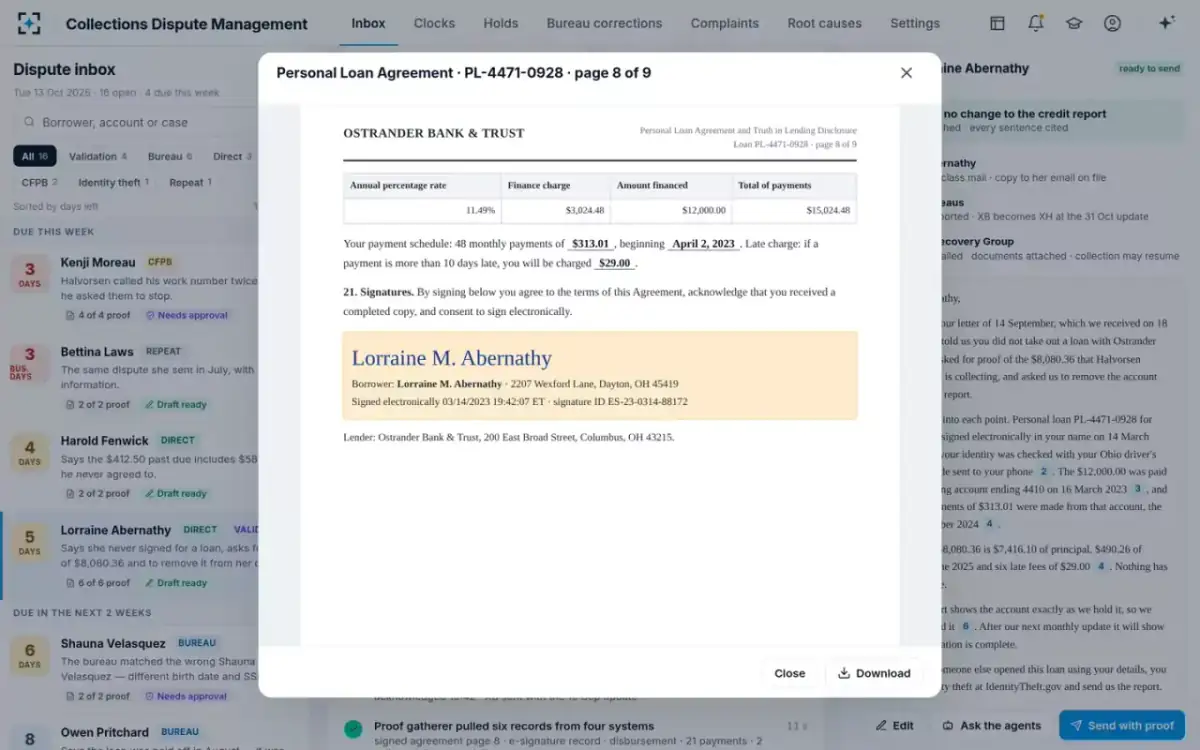
Re-testing an investigation you have already closed
Reasonableness is a property of a process, not of a single file, and the guidelines expect a furnisher to test its own: establish internal controls over accuracy and integrity "such as by implementing standard procedures and verifying random samples of information provided to consumer reporting agencies" (Appendix E, III(d)). A dispute desk can borrow the same method. Pull twenty closed disputes at random each month, put the four questions to each, and count the files that fail one.
Three patterns show up in that sample often enough to look for them on purpose. The first is the uniform outcome: a desk where almost every dispute closes verified is either serving unusually accurate data or not looking. At the fictional sample lender, 2,684 bureau and direct disputes closed in a quarter resolved as 1,903 verified, 591 modified and 190 deleted — 29% of disputes found something to change, which is the shape of a desk that is reading. The second is the single-source file: an investigation whose only citation is the system the disputed line came from. The third is the correction that went to one bureau, because the duty runs to every nationwide bureau the information was furnished to, and a fix at the bureau that asked leaves the other two wrong.
Where a sample shows the same cause repeatedly — phone payments keyed to a closed account, first-delinquency dates moved when a hardship plan started, fees added after charge-off and counted in the balance — the dispute desk has found a defect upstream, and what a mishandled dispute really costs is mostly the cost of not acting on that signal. To see the investigation, the citations and the approvals in one place, start from Collections Dispute Management.
Questions people ask
Does a furnisher have to contact the original creditor?
Not always, but it cannot refuse on principle. Examiners expect a furnisher to review the relevant information in its own possession and, in some cases, to access or request third-party documents it reasonably has access to. A collector whose client's systems are open to it and who forwards the dispute instead of reading them has not investigated — that was the exact finding in the CFPB's Winter 2024 Supervisory Highlights.
What does "cannot be verified" mean on a credit dispute?
It is the statute's third ending: the furnisher has concluded that the evidence needed to settle the claim does not exist or cannot reasonably be obtained, so the information comes out of the file rather than being reported as confirmed. The Eleventh Circuit was explicit that it is not a shortcut around investigating — the question becomes whether the furnisher reasonably determined that further work would be fruitless or unduly burdensome.
How long do you have to keep dispute investigation records?
The interagency guidelines say "a reasonable period of time, not less than any applicable recordkeeping requirement", to substantiate the accuracy of disputed information. There is no single number, so most lenders set the period against the seven-year reporting window and the limitation periods for FCRA claims, and keep the evidence, not just the case note, for as long as the tradeline can be read by anyone.
When can a furnisher refuse to investigate a dispute?
Regulation V lists the cases: the dispute does not identify the account or the information disputed, it went to an address the furnisher did not designate, the furnisher reasonably believes a credit repair organisation prepared or submitted it, or it is substantially the same as one already answered and brings no new information. In each case the borrower must be told within five business days, with the reasons and what is needed.
Is an investigation unreasonable just because software ran it?
No. The CFPB's findings turned on what the automated systems looked at, not on the fact of automation: systems that reviewed only their own records, and never the records of the creditors whose debts were being collected. Software that reads the dispute, gathers records from every system that bears on the claim and shows its citations is doing more of the work an examiner asks about, not less.
What records prove a furnisher investigated a dispute?
The claim as the borrower put it, every place searched with what each said, each record cited to a page or line, the field-by-field comparison with what was furnished, the determination with its date and approver, and what was sent to the borrower and to each bureau. A reviewer should be able to re-run the reasoning without asking anyone a question.