e-OSCAR dispute codes are routing labels. When a borrower disputes a tradeline with a credit bureau, the bureau turns the complaint into an automated consumer dispute verification — an ACDV — and tags it with a short numeric code standing for a category: not mine, never late, paid, wrong balance, and so on. The code tells a furnisher which kind of question has been asked. It does not tell it what the borrower said, what the borrower sent, or what is actually wrong, and the duty the FCRA imposes attaches to all of that rather than to the code. Botminds' Collections Dispute Management reads each ACDV with its code, its consumer statement and whatever came with it, checks the tradeline against the servicing file field by field, and proposes verify, modify or delete with the record behind every field — never the code against last month's answer.
This page explains the shape of the form and the duties attached to its parts. It deliberately does not publish a code table or say what any individual number means: the code lists are the format owner's, not a public standard, and a furnisher that works from a second-hand table is doing the one thing this page argues against. Where a specific code appears below it is only the code carried on one sample dispute in Collections Dispute Management's own demonstration data, on fictional people and accounts.
What governs an automated dispute, in numbers
5bus. days
for the bureau to notify the furnisher after receiving the dispute, with all relevant information it got from the borrower
FCRA §611(a)(2)(A)
30days
for the whole reinvestigation, counted from the bureau’s receipt — so the furnisher always has less
FCRA §611(a)(1)(A)
4 or 5codes
carried over 80% of disputes in the study that named the problem
NCLC, 2009 findings
3endings
a reinvestigation can have: verified, inaccurate or incomplete, or cannot be verified
Hinkle, 11th Cir. 2016
What do e-OSCAR dispute codes mean, and what they do not
A dispute code means that somebody at the bureau put the borrower's complaint into a bucket. That is a useful thing to know — it tells a furnisher whether to expect a question about identity, about timing or about an amount, and it lets a large desk route work to the right skill. It is not a statement of fact about the account, it is not the borrower's allegation, and it carries no evidence.
How much is lost in the bucketing has been documented. In its 2019 review of the dispute system, the National Consumer Law Center summarises what its earlier study of the same machinery found: credit bureaus "use the highly automated e-OSCAR system to convey disputes to furnishers, primarily using shorthand two- or three-digit codes, and at most only a line or two of text in a minority of instances", and "the credit bureaus use the same four or five codes over 80% of the time". A system in which four or five labels carry four fifths of everything is a system that cannot distinguish between the cases it is routing.
Furnishers conducted pro forma investigations, doing nothing more than check whether the information in the dispute transmittal form, called an Automated Consumer Dispute Verification (ACDV) form, matched the information in their own computer systems—the very systems that likely caused the error in the first place.
National Consumer Law Center, Automated Injustice Redux, summarising its 2009 findings
That last clause is the argument of this page in one line. An ACDV is a question about a system's output. Answering it by comparing the question with the same system's output tests nothing. The comparison has to be against the account behind the tradeline — the agreement, the payments as applied, the fees as charged, the calls — because that is where an error of the kind being disputed would have originated.
The anatomy of an ACDV, field by field
Strip the form to its regions and the duties sort themselves. Three regions identify and scope. Two carry the dispute. Two carry the answer. Only one of the seven is the code.
The seven regions of an automated dispute form, and what each one obliges you to do
Identification
What it carriesThe borrower’s name, addresses, date of birth and identifiers, plus the account number as the bureau holds it.
What it makes you doMatch the account. A mis-match here is itself a finding — it may be the whole dispute.
The disputed item
What it carriesWhich tradeline, and which fields on it the bureau is asking about: status, balance, amount past due, payment history, dates.
What it makes you doScope the check. The fields named are the minimum to examine, not the maximum.
The dispute code
What it carriesA short numeric code standing for a category of complaint, chosen by whoever processed the dispute at the bureau.
What it makes you doRoute the work. Nothing more: a category is not an allegation, and the code is not what the borrower wrote.
The consumer statement
What it carriesFree text, where any survives: the borrower’s own words, usually a line or two, sometimes nothing at all.
What it makes you doRead it first. This is the dispute, and it is the part a template answer never addresses.
Attachments, where they are passed on
What it carriesImages of what the borrower sent: a receipt, a statement, a police report, a letter.
What it makes you doReview them. This is the evidence the duty to review all relevant information is about.
The response block
What it carriesWhat the furnisher sends back: the outcome, the corrected field values, and the certification behind them.
What it makes you doAnswer field by field. Every value here is a new assertion about the borrower, made over again.
The due date
What it carriesThe date the bureau expects the answer by, set from its own receipt of the dispute rather than from yours.
What it makes you doWork to it. It is the only deadline on the form that is real.
Read in that order, the form answers a question most desks never ask out loud: which part of this is the dispute? The identification and the item are addressing. The code is routing. The due date is scheduling. The dispute itself is the consumer statement and whatever came with it — the two regions that are shortest, most often empty, and least often read.
What is the difference between a direct dispute and an indirect dispute?
An indirect dispute reaches a furnisher through a credit bureau, as an ACDV. A direct dispute arrives at the furnisher from the borrower, by post or through whatever channel the furnisher has published for them. They look similar on a desk and they are governed differently, which matters most at the two points where a furnisher might decline.
The two routes a credit-report dispute takes to a furnisher
Indirect — through a bureau, as an ACDV: Notice from the bureau under FCRA §611(a)(2). The bureau has five business days from its own receipt to send it, with all relevant information it received from the borrower.
Direct — to the furnisher, under Regulation V: A dispute notice from the borrower, sent to the address the furnisher set out on the credit report or published for direct disputes.
Indirect — through a bureau, as an ACDV: Nothing to the furnisher. The borrower dealt with the bureau; whatever reaches the furnisher is whatever the bureau passes on.
Direct — to the furnisher, under Regulation V: Enough to identify the account, the specific information disputed with the basis for it, and supporting documentation reasonably required to substantiate it.
Indirect — through a bureau, as an ACDV: Investigate, review all relevant information the bureau provided, report the results to the bureau, and where the information is incomplete or inaccurate, report that to every nationwide bureau it furnished to.
Direct — to the furnisher, under Regulation V: Conduct a reasonable investigation, review all relevant information the borrower provided, and report the results to the borrower inside the §611(a)(1) period.
Indirect — through a bureau, as an ACDV: Nothing on the face of §623(b). The duty follows the notice.
Direct — to the furnisher, under Regulation V: A defined list: identifying information, employers, inquiries, public records, fraud and active-duty alerts, information from another furnisher — and disputes the furnisher reasonably believes came from a credit repair organisation.
Indirect — through a bureau, as an ACDV: The bureau makes that determination on its side, and must tell the borrower within five business days of making it.
Direct — to the furnisher, under Regulation V: The furnisher may make it, but must then notify the borrower within five business days with the reasons and what is missing.
Indirect — through a bureau, as an ACDV: Back to the bureau that asked — and any correction to every nationwide bureau the item was furnished to.
Direct — to the furnisher, under Regulation V: To the borrower, and any correction promptly to every bureau that was given the inaccurate information.
The asymmetry in the fourth row is the one to remember. Regulation V gives a furnisher specific grounds to decline a direct dispute, including a reasonable belief that it came from a credit repair organisation. Nothing comparable appears in §623(b) for a dispute that arrives from a bureau. A desk that applies its direct-dispute filters to its ACDV queue is declining work it has no stated ground to decline. What a reasonable investigation has to cover takes the standard itself apart.
The code is a category; the duty attaches to the words
The statute is explicit about what travels with an indirect dispute. A bureau must notify the furnisher before the end of the five-business-day period, and "the notice shall include all relevant information regarding the dispute that the agency has received from the consumer or reseller". The furnisher's duties then attach to that notice: on receiving it, the furnisher must "conduct an investigation with respect to the disputed information", "review all relevant information provided by the consumer reporting agency", and report the results.
Neither sentence mentions a code. The object of both duties is the information — all of it. A furnisher that reads the code, queries its own system for the same fields and sends back "verified" has reviewed one of the regions of the form and ignored the two that carry the dispute. That is the pro forma investigation the quotation above describes, and it is not what the words require.
The Bureau made the same point in a 2022 circular, and withdrew that circular in May 2025 along with dozens of other guidance documents. Nothing in the statute moved with it. The duty to review all relevant information the bureau provided is written into §623(b)(1)(B) itself, and a dispute that meets the statute's requirements has to be investigated whether or not it arrives in the furnisher's preferred format.
Does a furnisher have to look at the documents a consumer attached?
Where the bureau passes them on, yes: they are part of the relevant information the statute requires the furnisher to review. The harder question is what happens when they do not arrive. The statute puts the first duty on the bureau: its notice to the furnisher must include all relevant information regarding the dispute that it received from the consumer, and a bureau that strips the attachments off has not sent everything it was given.
For a furnisher, that creates a practical obligation that is easy to describe and easy to skip. If the consumer statement refers to something the borrower sent — "I have the receipt", "as the letter shows", "see the court order" — and no image is attached, the dispute as received is incomplete, and answering it as though it were complete is answering a different dispute. The right move is to ask the bureau for what is missing and to record that you asked, so the file shows the gap rather than hiding it.
The same gap shows up from the borrower's side in the Bureau's complaint data. Among credit and consumer reporting complaints in 2025, the Bureau records that consumers described "a range of issues, such as problems receiving the results of a reinvestigation, problems about the time it took for a reinvestigation, and claims that CRAs merely accepted the word of furnishers without conducting a thorough review". Two sides of one system, each reporting that the other did not look.
Reading an ACDV against the file, not against last month's answer
Two shortcuts dominate the queue. The first is the system check: query the same servicing fields the tradeline was built from and report that they agree, which they will. The second is the history check: find the last dispute on this account, see what was sent then, and send it again.
The second is the more dangerous, because it looks like diligence. A repeat dispute often repeats because the first answer was wrong, and a second identical answer compounds the original error with a demonstrated refusal to look. It also discards the one thing the new dispute might have added: new information. Under Regulation V a direct dispute is not substantially the same as an earlier one if it includes required information not previously provided — and the same logic should govern how a desk treats a familiar-looking ACDV, whatever its code.
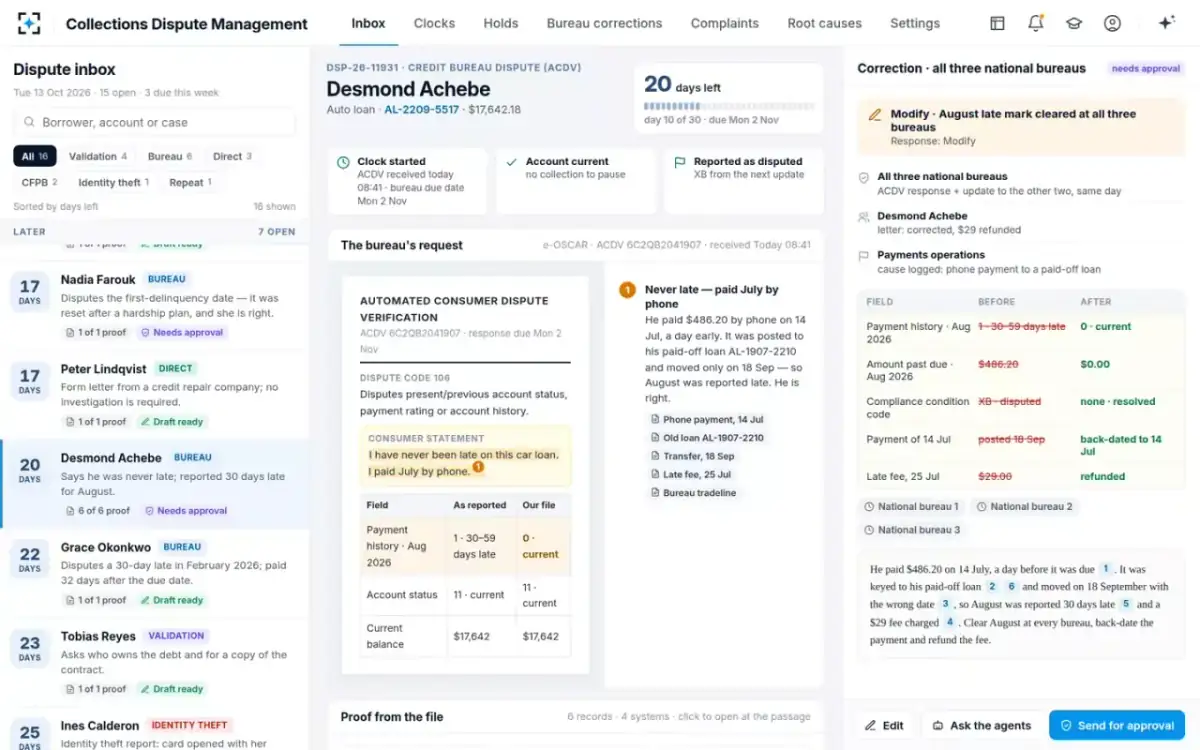
What replaces both shortcuts is a field-by-field comparison against the account itself. In the demonstration lender's sample file, an ACDV arrives carrying dispute code 106 and a consumer statement in the borrower's own words: he had never been late on his car loan, and he paid July by phone. The code would route it to a payment-history check. The statement names the month and the channel, which is what makes the error findable — the payment was made a day early and keyed to a loan the borrower had already paid off, and it moved to the right account two months later. By then August had been reported thirty days late and a fee charged. Nothing in the code could have produced that answer; the sentence beside it did.
The bureau's fields against the servicing file, line by line
Verified, modified, deleted — and cannot be verified
Most desks work with three outcomes. The Eleventh Circuit, reading the statute in a case about a debt buyer's investigation, found a fourth state hiding in plain sight: "Section 1681s-2(b) contemplates three potential ending points to reinvestigation: verification of accuracy, a determination of inaccuracy or incompleteness, or a determination that the information 'cannot be verified.'" The court also treated the standard as a variable one, turning on what kind of furnisher is answering and on how good its own documentation is.
Treating "cannot be verified" as a real outcome changes how a desk behaves when the records are thin. The honest answer to a dispute on an account whose file does not contain what would settle it is not "verified" — verification asserts that the furnisher checked and the information holds. Saying so is uncomfortable, because it leads to deletion. It is also the answer that is defensible a year later, and it is the one that stops the same account coming back every quarter.
Deletion is not quite final either. The statute allows information deleted after a dispute to be reinserted only where "the person who furnishes the information certifies that the information is complete and accurate". A furnisher that deletes to clear a queue and then re-furnishes the same item on the next monthly file has, in substance, certified something it declined to verify a month earlier.
What a careful answer puts back into the system
The response block is not a receipt. Every field value sent back is a fresh assertion about a borrower, and it goes out to be reported again. A careful answer therefore has three properties: it covers every field the file shows, not only the ones the code pointed at; each value traces to a record; and where anything changes, the change goes to every nationwide bureau the account was furnished to, not only to the one that asked. The statute puts that last duty in terms — where the investigation finds the information incomplete or inaccurate, the furnisher must "report those results to all other consumer reporting agencies to which the person furnished the information and that compile and maintain files on consumers on a nationwide basis".
One automated dispute, from the form to every bureau the account is reported to
Agent
Read the form, not the codeTakes the identification, the disputed item, the code, the consumer statement and any attachment, and records the due date the bureau set.
Never: Never answers from the code alone
Agent
Pull the account behind the tradelineGathers the agreement, the disbursement, the payments as applied, the fees, the calls and the prior placements, each cited to a page or a line.
Never: Never edits a record
Agent
Compare field by fieldChecks status, balance, amount past due, payment history, date of first delinquency and condition code against the file, and proposes verify, modify or delete.
Never: Never changes the credit file without approval
A person decides
Compliance approves the changeThe collections compliance manager reads the before-and-after table and approves, amends or rejects it. Identity-theft cases get a second reviewer from the fraud team.
A person decides
The answer goes out everywhereThe response returns to the bureau that asked, and an approved correction goes the same day to every nationwide bureau the account is reported to, with the borrower told and any wrong fee refunded.
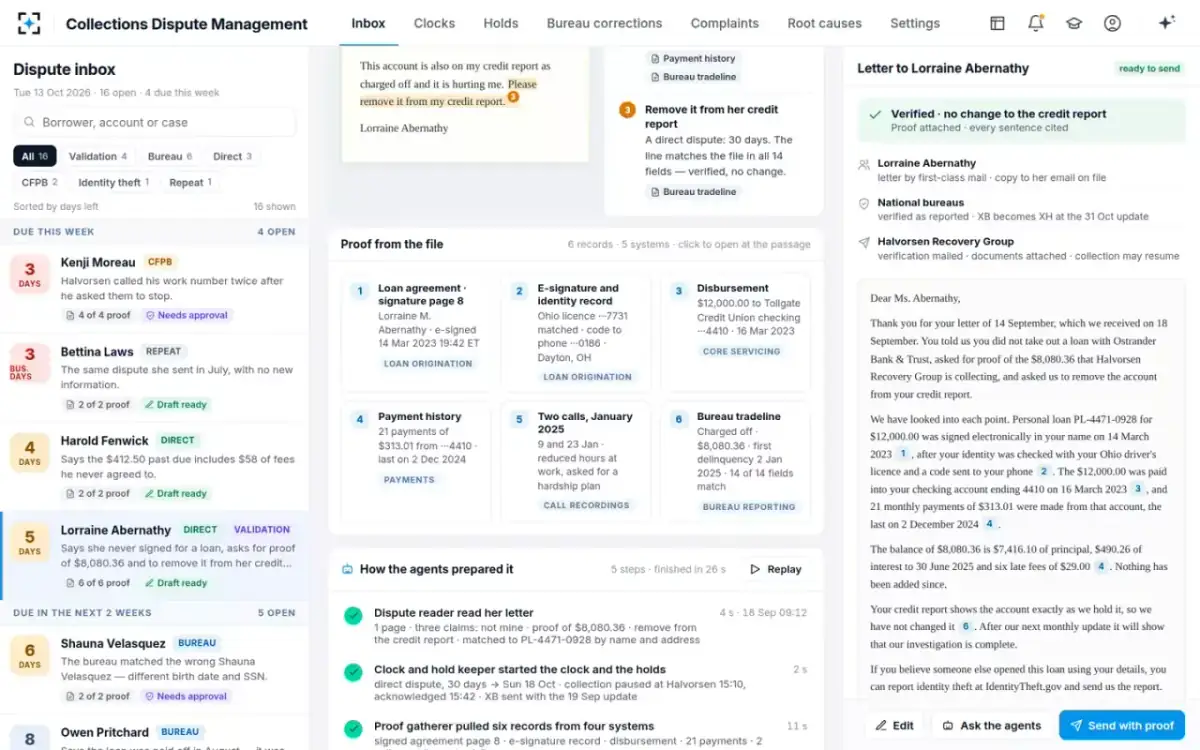
Every record the answer rests on, opened at the passage
None of this makes the code useless. It routes, and on a large desk routing is worth having. It simply is not the dispute, and the duty was never written against it. The single field that decides when a tradeline disappears shows what a field-by-field check is for, and how far automated verification may go on its own draws the line from the enforcement record. To see an automated dispute read, checked and answered end to end, start from Collections Dispute Management.
Questions people ask
What is an ACDV?
An automated consumer dispute verification: the electronic form a credit bureau sends a furnisher when a borrower disputes something the furnisher reported. It carries the borrower's identification, the tradeline and fields in question, a numeric dispute code, any consumer statement, sometimes images of what the borrower sent, a response block for the furnisher's answer, and the date the bureau expects that answer by.
Can a furnisher just verify the tradeline as reported?
Only if that is what a reasonable investigation found. "Verified" asserts that the furnisher checked the disputed information and it holds. Comparing the ACDV with the same servicing fields the tradeline was generated from is not a check — it is the pro forma investigation the National Consumer Law Center described, testing a system's output against itself. Where the records cannot settle the point, the statute allows a determination that the information cannot be verified, and that is the honest answer.
What does the consumer statement on an ACDV add?
Usually everything that makes the dispute findable. The code gives a category; the statement gives the month, the channel, the amount or the name that locates the error in the account. It is also short and often absent, which is why a desk that reads it first and treats a missing one as a reason to ask the bureau for more will resolve cases a code-driven queue never reaches.
How many days does a furnisher have to answer an ACDV?
Work to the due date printed on the form. The statutory period is 30 days — 45 where the borrower gives the bureau relevant information during it — but it runs from the bureau's receipt of the dispute, and the bureau has up to five business days to pass the dispute on and needs time at the end to act on the answer. The furnisher's working window is therefore always shorter than 30 days, and the only reliable figure is the one the bureau set.
Does a furnisher have to send a correction to every bureau?
Yes, where the investigation finds the information incomplete or inaccurate. The duty runs to all other nationwide consumer reporting agencies the furnisher supplied that information to, not only to the one that sent the dispute. A correction made at one bureau and not the others leaves the borrower with the same error on two of their three reports and the furnisher with a finding waiting to be made.
If the borrower disputes again, can the same answer be sent?
Not safely. A repeat dispute often repeats because the first answer was wrong, and sending it again adds a refusal to look to the original error. Under Regulation V a direct dispute is not substantially the same as an earlier one if it includes required information not previously supplied, and the same test is the right instinct for a familiar-looking automated dispute: read what is new before deciding it is old.