The FCRA dispute timeline a furnisher works to depends on the door the dispute came through. A dispute a borrower files with a credit bureau must be reinvestigated inside 30 days of the bureau's receipt, stretching to 45 if the borrower sends relevant information part-way through. A dispute written straight to the lender runs on that same statutory period. A written dispute inside a validation period carries no answering deadline at all — instead collection must stop, and stay stopped, until verification is sent. A complaint routed through the Consumer Financial Protection Bureau expects a company response in 15 calendar days. An identity-theft block runs in four business days. Botminds' Collections Dispute Management does the work behind those clocks: it reads each dispute on arrival, starts the count the rule actually sets, pauses collection at the agency holding the account, gathers the proof from the loan file and drafts a cited reply for a named person to send.
The reason a disputes desk misses dates is not that the rules are obscure. It is that the rules measure from different events — the bureau's receipt, the lender's receipt, the day a notice was put in the post, the day a complaint reached the portal — and three of the five counts are already running when the envelope lands on someone's desk. A pile worked in the order it arrived will therefore fail in a predictable way: the dispute that looks newest is often the one with the fewest days left.
Every figure describing a lender, a borrower or an account on this page is sample data from Collections Dispute Management's own demonstration lender, on fictional people and companies. The rules and the research figures come from the statute, the regulations and the regulator's own published reports, linked under each figure.
Five doors, five counts, and the event each one measures from
30days
to reinvestigate a dispute, from the day the credit bureau receives it
FCRA §611(a)(1)(A)
45days
if the borrower supplies relevant information inside the first 30
FCRA §611(a)(1)(B)
15days
for a company response to a complaint, counted in calendar days
CFPB complaint process
5bus. days
to tell a borrower a dispute was judged frivolous or irrelevant
Reg V §1022.43(f)(2)
4bus. days
for a bureau to block information an identity-theft report identifies
FCRA §605B(a)
How long does a furnisher have to resolve a credit dispute?
For the dispute type most borrowers mean — an item questioned with Equifax, Experian or TransUnion — the answer is 30 days from the bureau's receipt, or 45 where the borrower adds something relevant during the period. The statute is specific about both the duty and the start. A bureau must "conduct a reasonable reinvestigation to determine whether the disputed information is inaccurate … before the end of the 30-day period beginning on the date on which the agency receives the notice of the dispute from the consumer or reseller". The extension is narrower than it is usually described: the period "may be extended for not more than 15 additional days if the consumer reporting agency receives information from the consumer during that 30-day period that is relevant to the reinvestigation". Relevant information from the borrower buys the extra fortnight. A busy month at the bureau does not.
A lender reading that sentence should notice what it does not say. The 30 days belong to the bureau, and they start when the bureau receives the dispute — not when the bureau forwards it. By the time the request to verify a tradeline reaches the furnisher, several days of the 30 have already gone, which is why the due date a furnisher is given is almost never day 30 of its own calendar. Reading the dispute the bureau sends on is a separate skill, and the date on it is the first thing to check.
For a dispute written directly to the lender, Regulation V borrows the same period rather than inventing one. A furnisher must finish its investigation and report the results to the consumer before the §611(a)(1) period runs out. So a direct dispute is a 30-day job too, but the 30 days run from the lender's own receipt at the address it published for disputes — a different start, and usually a later one, than a dispute the same borrower sent to a bureau on the same morning.
Five doors, five clocks: which rule starts which count
The table below is the whole clock rulebook on one page. Read the third column first: the event that starts the count is where desks go wrong, far more often than the number of days.
Every door a dispute arrives through, and the count it starts
| The door | The rule | What starts the count | The deadline | What stops meanwhile |
|---|---|---|---|---|
| Debt validation request, in writing inside the validation period | FDCPA §809(b) · Reg F §1006.38(d)(2) | The written dispute reaching the collector inside the validation period | None for sending verification. The duty is to stop, not to answer by a date | All collection of the debt, or of the disputed part, until verification or a judgment is sent |
| Bureau dispute, passed to the lender to verify | FCRA §611(a)(1) and §611(a)(2) | The bureau receiving the dispute from the borrower — not the lender receiving it | 30 days, 45 with relevant new information from the borrower, measured on the bureau’s calendar | Nothing by force of this rule. The item is reported as disputed while it is open |
| Direct dispute, written to the lender at its published dispute address | Reg V §1022.43(c)–(e) | The lender receiving a notice that identifies the account, the information and the basis | The same §611(a)(1) period, counted from the lender’s receipt | Nothing by force of this rule, though a lender’s own policy often pauses collection |
| A complaint through the Consumer Financial Protection Bureau | The Bureau’s complaint process | The complaint reaching the company through the portal | 15 calendar days to respond; where it cannot be closed, an interim explanation and a final response inside 60 | Nothing automatically, but the complaint is routed to the firm named in it and answered in public view |
| An identity-theft block request to a bureau | FCRA §605B(a) | The bureau receiving proof of identity, an identity-theft report, the identification of the item and the borrower’s statement | 4 business days to block the item | Reporting of the blocked information, at that bureau |
Four of those five rows are owned by somebody else's receipt. Only the direct dispute is counted from an event the lender can see with its own eyes, and even that depends on the lender knowing which of its addresses is the published dispute address. A desk that measures every clock from the day a letter was opened has, in effect, given itself an extension that nobody granted.
When does the clock start on a debt validation request?
A validation request does not start an answering clock. It closes a door. Regulation F defines the window inside which a borrower's written dispute has that effect — the "validation period", which runs from the date the collector provides the validation information and ends 30 days after the borrower receives it or is assumed to have received it. The presumption is spelled out: a collector "may assume that a consumer receives the validation information on any date that is at least five days (excluding legal public holidays …, Saturdays, and Sundays) after the debt collector provides it".
That is two counts, not one. Put the validation notice in the post on a Monday and the borrower is assumed to have it the following Monday; the 30 days then run from there. The notice itself has to say which end date the collector will use, together with a statement that if the borrower disputes in writing on or before that date, "the debt collector must cease collection of the debt, or the disputed portion of the debt, until the debt collector sends the consumer either verification of the debt or a copy of a judgment". Publishing the end date is not a courtesy. It fixes the date a dispute has to beat, and a desk that cannot reproduce that arithmetic cannot tell a late dispute from a timely one.
What happens next is a stop, not a submission deadline. Nothing in the rule says verification must be sent inside 30 days, or inside any number of days. The pressure comes from the other side: every day without verification is another day the account cannot be collected. Many lenders therefore set an internal service level — in the demonstration lender's own settings it is 30 days from receipt — and treat it exactly as what it is, a promise to themselves, never a legal deadline. What the validation rules actually require you to send works through the package itself.
The 30 days that become 45 — and when they cannot
The 15-day extension is the most frequently misquoted number in this work. Three things about it are worth getting right. It is available to the consumer reporting agency, on a dispute the agency is reinvestigating. It is triggered only by information the agency receives from the consumer during the 30-day period, and only if that information is relevant to the reinvestigation. And it is a ceiling, not an entitlement: "not more than 15 additional days".
So a borrower who writes again on day 12 with a bank statement may have moved their own deadline out by a fortnight. A borrower who writes again on day 12 to complain about the wait has not. For the furnisher, the practical consequence is that a due date can move after the work has been scheduled, which is one of the few cases where a dispute's deadline gets later rather than nearer — and the only safe way to know is to read the date the bureau now shows rather than the date it showed last week.
Calendar days, business days and the five-day presumption
Three different units are in play, and mixing them is how a desk loses a day it did not know it had.
The FCRA's reinvestigation periods are plain days: 30, plus up to 15. The Bureau's complaint standard is explicitly calendar days — a response "within 15 calendar days of the complaint being received by the company", and where a complaint cannot be closed in that time, an interim explanation followed by a final response inside 60 calendar days. The notice duties are business days: four business days for a bureau to block information an identity-theft report identifies, and five business days for a furnisher to tell a borrower it has judged a direct dispute frivolous or irrelevant. And Regulation F's receipt presumption is business days by description rather than by name, since it excludes Saturdays, Sundays and the federal public holidays.
One worked case shows the size of the error. A validation notice provided on the Monday before a public-holiday Monday is assumed received on the Tuesday eight calendar days later — five days once the weekend and the holiday are left out — and the 30-day validation period shifts with it. A desk that computes the end date in calendar days will publish a date the regulation does not support, and will then have to defend it against a dispute that arrived in between.
Five disputes, one week in September, due dates a fortnight apart
- Company response, 15 calendar daysTue 29 Sep
- Proof in
- Block, 4 business days
- Bureau notifies
- The rest of the bureau’s 30 daysWed 14 Oct
- Post4 d
- The §611(a)(1) period, from the lender’s receiptSun 18 Oct
- Post4 d
- First 30 daysto 18 Oct
- Up to 15 more, relevant informationMon 2 Nov
The clock you cannot see: the bureau's own due date
The third lane above is the one that catches new analysts. A borrower disputes a tradeline with a bureau on the 14th. The bureau has five business days to pass the dispute on, and the statute requires it to pass on everything relevant it received from the borrower about the dispute. Suppose it uses four of those days. The lender now has 26 days of the bureau's 30, and the date the bureau expects an answer by will be earlier still, because the bureau needs time to process the reply, write to the borrower and send the corrected file onwards.
A furnisher that treats the arrival date of that request as day zero of its own 30-day period is, on this example, four days late before it starts, and a week late by the time the bureau's internal cut-off is counted. The clock that governs is not on the lender's letter. It is on the bureau's record, and it is visible only as the due date stamped on the request. The rule is simple and unforgiving: work the date you were given, never the date you received.
How long borrowers then wait for the whole cycle is measurable, at least for the part that passes through the Bureau's complaint process. In its December 2025 report on credit and consumer reporting complaints, the Bureau notes that nationwide agencies have 60 days to respond to a complaint, that one agency "has consistently taken nearly the full 60 days since early 2023", and that "in the most recent months, all three NCRAs have average response times that exceed 50 days". A borrower whose dispute becomes a complaint is therefore often two months further on, and the lender's own 15-day answer is only the first move in it.
What a missed deadline actually costs
Nothing happens on the morning after a missed date. That is the problem: the consequences arrive later, from three directions at once, and all three are more expensive than the work that was skipped.
The first is the borrower's next letter. A dispute answered without the record that settles it tends to come back, and the second round starts a new clock with less goodwill. The Bureau's 2025 complaint data shows where those letters go: consumers submitted more than 5.8 million credit or consumer reporting complaints in 2025, 88% of everything it received, and complaints about a company's reinvestigation into an existing issue were a common theme, with consumers describing how long reinvestigations took among them. The second is supervisory: a missed date is one of the few failures that leaves a clean, countable trail in a lender's own files, which makes it an easy finding to make and a hard one to argue with. The third is the collection itself — an account whose hold was never lifted because the response was never mailed is an account nobody is collecting on, quietly, for months.
Working the pile by deadline, not by arrival
Order matters more than speed. Take ten disputes received in one week at the demonstration lender and work them in the order they were opened; then work the same ten in the order they fall due. The work is identical. The outcome is not.
The same week of disputes, worked in arrival order and in deadline order
Arrival order: Fourth in the pile. Reached on day 11, answered on day 17 — two days late, in the one process where lateness is recorded against the firm.
Deadline order: First. The shortest clock in the week, and the only one with a published timeliness standard attached to it.
Arrival order: Fifth. Nobody realises the four-business-day count is already running at the bureau.
Deadline order: Second, and routed straight to the fraud reviewer rather than to the disputes pile at all.
Arrival order: Third. Treated as a 30-day job from the 17th, so answered on day 33 of the bureau’s count — three days past the bureau’s own date.
Deadline order: Third, worked to the date on the request rather than to the date it arrived.
Arrival order: Sixth, and comfortably inside its date by luck rather than by design.
Deadline order: Fifth. Two weeks of slack, so it waits behind the two short clocks.
Arrival order: Second, because the envelope looked urgent. Verification mailed day 21; the hold sat unlifted a further nine days.
Deadline order: Fourth. The hold goes on within the hour, and the only date that matters is the day the hold can lift.
Arrival order: First, because it is the loudest letter of the ten.
Deadline order: Sixth. Judged duplicative, with the five-business-day notice sent and the earlier response referred to.
Two of the ten went late in arrival order, and both were late for the same reason: their counts had started somewhere else. Deadline order fixes that without anyone working faster, which is why the first screen a disputes analyst sees in Collections Dispute Management is the pile sorted by days remaining rather than by date received.
Every open dispute, sorted by the days it has left
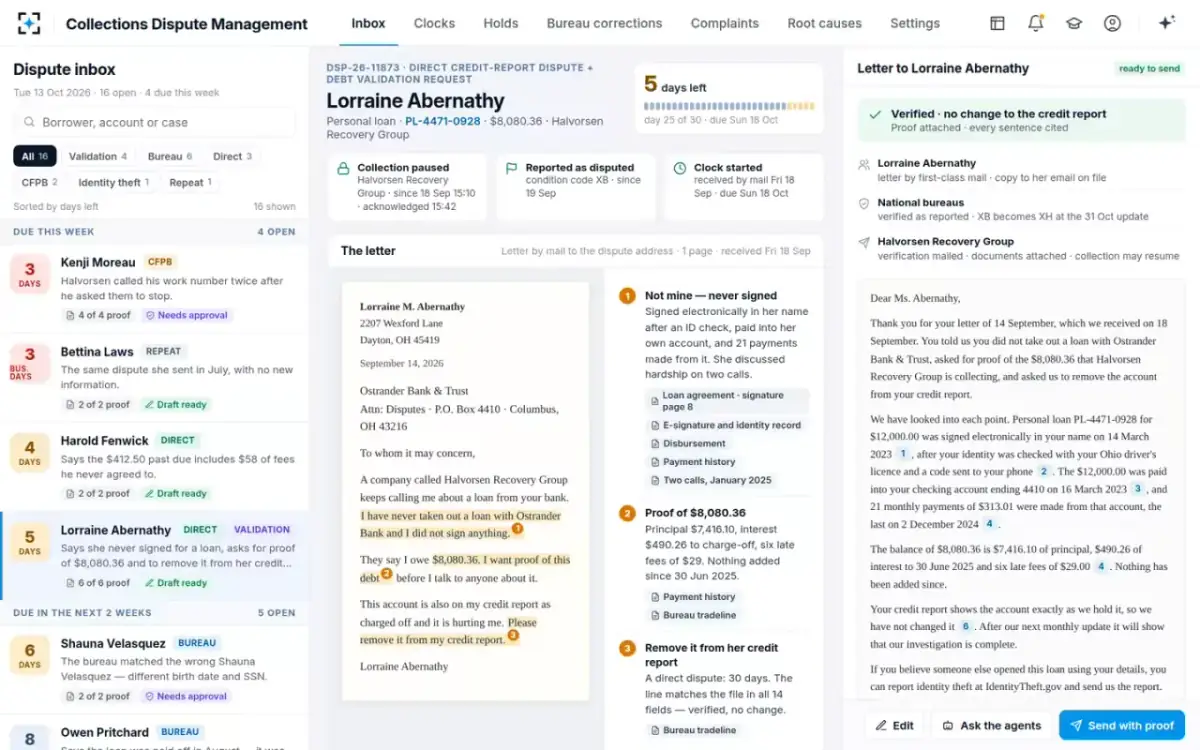
Six things to record in the hour a dispute arrives, so the clock cannot be argued about later
- The door, named
Validation request, bureau dispute, direct dispute, complaint or identity-theft block. Everything downstream follows from this one field, and a letter can be two doors at once.
- The date of receipt, and at which address
For a direct dispute, whether it reached the published dispute address matters as much as the date. For a validation dispute, whether it arrived inside the validation period decides whether collection must stop.
- The due date the counterparty gave you
A bureau request carries its own date. Record it as given and work to it; never recompute it from the day it arrived.
- The borrower’s claims, in their own words
Split the letter into separate claims and quote each one. A dispute answered claim by claim is far harder to re-open than one answered in general terms.
- The hold, and its acknowledgement
The hour collection was paused, the agency it went to, and the time that agency confirmed it. An unacknowledged pause is not a pause.
- Anything the borrower sent with it
Attachments can extend a bureau’s period by up to 15 days, and they are the information the investigation is required to review. Log them on arrival, not when someone gets to the file.
The month ahead, by due day and by door
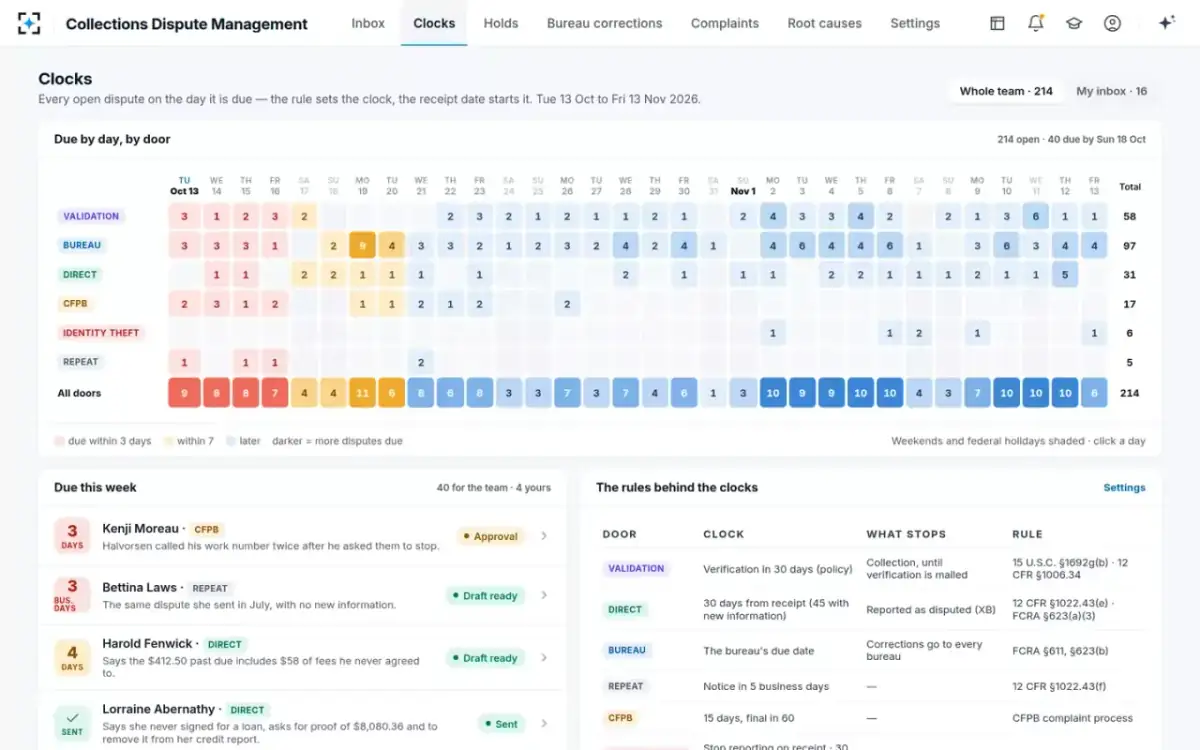
One last clock is worth naming because it is not a legal one. The demonstration lender warns at seven days and escalates to the collections compliance manager, and chases an agency that has not acknowledged a hold after four hours. Neither number comes from a statute; both exist because the legal clocks give no warning of their own. Who carries each of these clocks on a disputes desk is a question about seats, not software. To see the pile sorted by deadline, the holds and the letters together, start from Collections Dispute Management.
Questions people ask
How long does a furnisher have on a credit bureau dispute?
Thirty days from the day the bureau receives it, extended by up to 15 more days if the borrower supplies relevant information during that period. The bureau also has five business days from receipt to pass the dispute to the lender that furnished the item, so the lender's working time is always less than 30 days — which is why the answer is due on the date the bureau's request shows, not 30 days after it arrives.
Are credit dispute deadlines business days or calendar days?
Both, depending on the rule. The FCRA's 30-day and 15-day reinvestigation periods are plain days. The Bureau's complaint standard is calendar days: 15 for a response, 60 for a final response where the matter cannot be closed sooner. Notice duties are business days — four for a bureau to block information identified in an identity-theft report, five for a furnisher to tell a borrower a direct dispute was judged frivolous or irrelevant. Regulation F's receipt presumption also excludes weekends and federal public holidays.
What happens if a furnisher misses the 30-day deadline?
Nothing automatic, which is what makes it dangerous. The bureau may delete the disputed item from the file if the reinvestigation is not completed, the borrower keeps the right to sue over the failure, and the missed date is recorded in both the bureau's and the lender's own files — an unusually easy finding for an examiner to count. The borrower's practical remedy is usually the next letter rather than a lawsuit, and that letter arrives with the clock reset and the goodwill gone.
Can a collector keep collecting while a validation request is open?
No, where the dispute was written inside the validation period. Regulation F requires the collector to cease collection of the debt, or of the disputed portion, until it sends verification of the debt or a copy of a judgment — or, for a dispute it reasonably determines is duplicative, until it tells the borrower so and refers them to the earlier response. There is no deadline for sending verification; the suspension lasts until it goes out.
How long does a company have to respond to a complaint made to the Bureau?
The Bureau's own timeliness measure is a response within 15 calendar days of the complaint reaching the company. Where it cannot be closed in that window, the standard is an interim explanation to the borrower and to the Bureau, then a final response inside 60 calendar days. The Bureau received approximately 387,400 debt collection complaints in 2025 and sent about 79% of them to companies for review and response.
Does a single letter ever start more than one clock?
Often. A borrower who writes "this is not my debt, send me proof, and take it off my credit report" has made a validation dispute and a direct credit-reporting dispute in one envelope, and if they also send an identity-theft report a third duty begins. Each claim keeps its own rule and its own date, so the letter has to be split into claims before any clock can be set correctly.