FDCPA debt validation is two duties, not one. The first is a notice: a debt collector must give the borrower a defined set of facts about the debt at or shortly after first contact. The second is a switch: if the borrower disputes in writing inside the validation period, collection of the disputed debt must stop and stay stopped until verification, or a copy of a judgment, is sent. Neither duty is a document order. The law never names the signed contract, the chain of assignments or the payment history that validation letters routinely demand, and it sets no deadline at all for sending verification. Botminds' Collections Dispute Management reads each request on arrival, works out which of those two duties has been triggered, pauses collection at the agency holding the account, and drafts a cited verification from the lender's own loan file for a named analyst to send.
One boundary first, because almost every argument about validation turns on it. Section 1692g binds a "debt collector" as the FDCPA defines the term — broadly, a business whose principal purpose is collecting debts, or one that regularly collects debts owed to another — and the definition expressly leaves out a creditor’s own officers and employees while they collect its debts in its name. A bank collecting its own loans in its own name is usually outside it. Many such lenders nonetheless answer validation requests to the same standard by policy, which is a choice worth making deliberately rather than by accident.
Every borrower, lender, agency and account named below is sample data from Collections Dispute Management's own demonstration lender, on fictional people and companies. The rules come from the statute and from Regulation F, linked under each figure.
The validation information Regulation F requires about the debt, item by item
- The collector’s name, and the address where it takes disputes
Not any address. The one at which the collector accepts disputes and requests for original-creditor information — the address that decides whether a dispute counts as received.
- The borrower’s name and mailing address
Plain identification, and the first thing a borrower checks for a mis-match.
- The creditor the debt was owed to on the itemization date
For a debt related to a consumer financial product or service. Often the single fact a borrower is really asking for.
- The account number on the itemization date, whole or truncated
The number as it stood then, which may not be the number the collector uses now. Most often missed after an account has moved.
- The creditor the debt is owed to now
Separate from the one above, and different whenever the debt has been sold or placed.
- The itemization date itself
One of five defined reference dates, chosen by the collector. Everything in the next two items is measured from it.
- The amount of the debt on the itemization date
The anchor figure. Not the balance today.
- An itemization from that date to today
Interest, fees, payments and credits since the itemization date, so the borrower can see how the anchor figure became the current one. The other item most often missed.
- The current amount of the debt
The figure the borrower is being asked to pay, stated separately from the arithmetic that produced it.
What does a debt validation letter have to include?
Two sets of requirements run in parallel, and a notice has to satisfy both. The statute, §1692g(a), requires a written notice within five days of the initial communication — unless the information was in that communication or the debt has been paid — containing the amount of the debt, the name of the creditor it is owed to, and three statements: that the debt will be assumed valid unless disputed within thirty days of receipt, that a written dispute inside that window obliges the collector to obtain and mail verification or a copy of a judgment, and that a written request inside the same window obliges it to supply the name and address of the original creditor.
Regulation F then specifies the notice in much more detail, and the checklist above is its list of facts about the debt. The two items a template most often misses are the fourth and the eighth — the account number as it stood on the itemization date, and the itemization of interest, fees, payments and credits since that date. Both exist for the same reason: without them a borrower cannot connect the figure being demanded today to anything they recognise, which is exactly the condition that produces a validation request.
The regulation also requires the notice to carry the end date of the validation period and to tell the borrower, in terms, what a timely written dispute does. And it requires a segregated response block at the foot of the notice, with prompts in a set order, phrased as "I want to dispute the debt because I think:", "This is not my debt.", "The amount is wrong." and "Other (please describe on reverse or attach additional information)." A collector that uses the Bureau's Model Form B-1 has a safe harbour for the information and form requirements. One that does not has to show its own form carries the same content, laid out so none of it is overshadowed.
Validation is a trigger, not a document request
The most consequential misunderstanding in this work is that a validation request obliges the collector to produce a file of documents. It does not. The statute names what a dispute makes the collector do: obtain verification of the debt, or a copy of a judgment, and mail a copy to the borrower. It does not define verification, and it does not list what verification must contain.
the debt collector shall cease collection of the debt, or any disputed portion thereof, until the debt collector obtains verification of the debt or a copy of a judgment, or the name and address of the original creditor, and a copy of such verification or judgment, or name and address of the original creditor, is mailed to the consumer by the debt collector
15 U.S.C. §1692g(b)
Read the sentence for its verbs. Cease. Obtain. Mail. There is no date on any of them, and no inventory. What the rule actually imposes is a condition on collecting at all — which is a heavier duty than a deadline, because it has no end until the collector acts. A desk that treats validation as a thirty-day document assignment has misread the obligation in both directions at once: it invents a deadline the law does not set, and it under-reads the stop the law does set.
The misunderstanding is not confined to borrowers. The Bureau's 2025 complaint report describes the pattern in the complaints themselves: consumers increasingly complained about collections they did not recognise appearing on their reports, and "in many instances, consumers requested that collectors validate the debts and provide the original 'wet ink' contracts or other account documentation to substantiate the debt". The report notes that responses varied — some collectors closed the account and updated what they had reported, others supplied verification information such as the original creditor's name and account statements and said the borrower remained liable.
Does a debt collector have to send the original signed contract?
No. Neither §1692g nor Regulation F requires the original signed agreement, a wet-ink signature, a chain of assignment, a licence, or a notarised affidavit. A collector that sends the creditor's name, the amount and an account statement has, on the face of the statute, done what the words require.
That is the legal floor, and it is a poor place to build a desk. A verification that meets the floor and does not answer the borrower's actual question produces a second letter, then a credit-report dispute, then a complaint — three more clocks, each with more exposure than the one before. The demonstration lender's own approach is the opposite: when a borrower writes that she never signed for a loan, the response carries the signature page itself, the electronic signature record showing which identity document and which one-time code were checked, the disbursement into her own account and the payment history that followed. None of that is required. All of it ends the argument, which is the only outcome that is actually cheap.
There is one point where generosity has to stop. A verification package is assembled from the lender's records as they are; nothing in it is edited, and nothing is included that cannot be cited to a page or a line. A letter that paraphrases a record it does not attach invites the borrower to ask for the record — and now the second letter has arrived anyway.
The itemization date, and the five dates it can be
Regulation F does not ask a collector to reconstruct a debt from its origin. It asks for one anchor date and the arithmetic from there. The anchor is the itemization date: any of five reference dates on which the collector can establish what was owed. The choice is the collector's, and it changes what the anchor figure means.
The five itemization dates, and what each one makes the amount of the debt mean
| The reference date | What the regulation defines it as | What the amount on that date is | What proves it |
|---|---|---|---|
| Last statement date | The date of the last periodic statement, written account statement or invoice a creditor provided to the borrower | The balance the borrower last saw in writing. The easiest figure for a borrower to recognise, and the easiest to reconcile. | The statement itself, as sent |
| Charge-off date | The date the debt was charged off | The balance at charge-off, before any post-charge-off interest or fees. Common on placed and sold debt. | The servicing record of the charge-off, and the balance at that moment |
| Last payment date | The date the last payment was applied to the debt | The balance immediately after the last payment landed. Useful where payments and postings have been disputed. | The payment record, showing the date applied |
| Transaction date | The date of the transaction that gave rise to the debt | The original amount of the obligation. Natural for a single purchase or advance; awkward for a revolving account. | The agreement, invoice or transaction record |
| Judgment date | The date of a final court judgment that determines the amount owed | The amount the court fixed. Everything after it is post-judgment interest and costs. | The judgment, as entered |
Choosing well is a reconciliation decision, not a legal one. Pick the last statement date and the borrower is reading a figure they have seen before; pick the transaction date on a revolving account and the itemization that follows has to carry years of activity. Whichever is chosen, the same date must be used consistently across the notice, since four of the required items are defined by reference to it — the creditor it was owed to then, the account number then, the amount then, and everything since.
What must stop, and for how long
A timely written dispute does not pause a department. It pauses collection of the debt, or of the portion disputed, and it does so until one of two things has happened. Regulation F states the alternatives: the collector sends a copy of verification of the debt or of a judgment, or — for a dispute it reasonably determines is duplicative — it notifies the borrower in writing that the dispute is duplicative, gives a brief statement of the reasons, and refers them to its response to the earlier dispute.
One validation dispute, from the envelope to the day collection may resume
Agent
Read and splitIdentifies the door, matches the letter to the account by name and address, and separates it into the claims the borrower actually made, quoting each in their own words.
Never: Never decides the outcome
Agent
Clock and holdChecks the letter against the validation period published on the notice, and if it is timely and in writing, sends the pause to the agency collecting the account and records the acknowledgement.
Never: Never lifts a hold before the response is mailed
Agent
Gather the proofPulls the signature page, the electronic signature and identity record, the disbursement, the statements, the payments and the call recordings, each cited to a page or a line.
Never: Never edits a record
Agent
Draft the verificationAnswers each claim in the order the borrower raised it, in plain English, attaching the records that close it and offering the identity-theft route where the borrower says the debt is not theirs.
Never: Never sends
A person decides
A person sends, and the hold liftsThe disputes analyst reads the draft, edits it if it needs editing, and sends it with the documents attached. Only once it is mailed is the agency told collection may resume.
Two practical consequences follow. The hold must be keyed to the mailing, not to the completion of the work, because the statute's condition is that a copy "is mailed to the consumer". And the hold has to reach wherever the account is actually being collected. A lender that pauses its own activity while a placed agency keeps dialling has not stopped collection; it has stopped part of it. In the demonstration lender's settings the agency has four hours to acknowledge a pause, and every agency's call and letter log is read each morning so that a contact after a hold is found by the lender rather than by the borrower's lawyer.
In writing, inside the period, to the address you published
Three conditions have to be met before the stop is triggered, and each of them is a date or a fact a desk has to be able to prove a year later.
The three counts that decide whether a dispute is timely
5days
from the initial communication to send the written notice, unless the information was in that communication or the debt is paid
FDCPA §809(a)
5bus. days
the receipt presumption: the earliest date a collector may assume the notice arrived, excluding weekends and federal public holidays
Reg F §1006.34(b)(5)
30days
from that assumed receipt to the end of the validation period, the window a written dispute has to land inside
Reg F §1006.34(b)(5)
In writing is the first condition, and it is strict: an oral dispute does not trigger the cease-collection duty, even though a collector may well choose to act on one. Inside the period is the second, which is why the end date printed on the notice matters so much — it is the date the collector itself published, and it will be held to it. How each clock is counted, door by door works through the arithmetic in full.
The third condition is the address. Regulation F requires the notice to carry the address at which the collector accepts disputes, and a direct credit-reporting dispute under Regulation V has a parallel rule of its own. A letter sent to a payment lockbox is still a letter, and a desk that treats mail to the wrong address as a non-event is making a decision it will have to defend. The safer practice is to treat any writing that reads as a dispute as one, record where it arrived, and decide the legal question with that fact written down rather than inferred later.
The Bureau's examiners look at precisely this. Their debt collection procedures direct examiners to "assess the debt collector's policies and procedures for handling consumer FDCPA disputes and the steps the debt collector takes upon learning that a consumer disputes the debt" — learning, not receiving at a nominated address.
The duplicative dispute, and the answer that is not verification
Regulation F gives a collector one narrow way out of assembling verification a second time. A "duplicative dispute" is one submitted in writing within the validation period that "is substantially the same as a dispute previously submitted by the consumer in writing within the validation period for which the debt collector already has satisfied" the verification duty, and that "does not include new and material information to support the dispute". Where a collector reasonably determines that a dispute is duplicative, it may notify the borrower in writing, give a brief statement of its reasons, and refer them to the earlier response — instead of sending verification again.
Both halves of the definition have to hold. Substantially the same is the easier test. New and material information is the one that catches desks out: a second letter that reads like the first but encloses a bank statement, a police report or a death certificate is not duplicative, and treating it as such converts a routine matter into a failure to investigate. The decision is also a judgement about the borrower's evidence, which is why it is not a decision an automated reader should be allowed to make alone.
Where the borrower says the debt is not theirs because of identity theft, the duplicative route is almost never the right one. An identity-theft report starts separate duties, including a bureau's four-business-day block on the information the report identifies, and the response should offer that route plainly rather than bury it.
First-party creditors and the rule that does not reach them
A bank collecting its own loans in its own name is generally not a "debt collector" under the FDCPA, so §1692g's notice and cease-collection duties do not bind it as a matter of federal law. Three qualifications matter. The exclusion is for an officer or employee of a creditor collecting in the creditor's name; a creditor that collects its own debts under some other name that suggests a third party is involved is brought back inside the definition. State law may impose parallel duties where federal law does not. And a lender's own agencies are squarely inside the Act, so the same account can be covered when it is placed and not when it is held in-house.
That is why the demonstration lender treats the thirty-day verification turnaround in its own rules as a service level rather than a deadline, and says so in the setting itself. The useful question for a first-party servicer is not whether the rule reaches it, but whether it wants two standards of answer on one portfolio: one for accounts at an agency, another for the same borrower's account held in-house. Most do not, once they have seen the two letters side by side.
What a verification package should actually hold
Working back from the claims rather than forward from a template gives a short list that is both defensible and genuinely responsive. For "this is not my debt": the signed agreement with its signature page, the identity and electronic signature record, and the disbursement into an account the borrower controlled. For "the amount is wrong": the itemization from the chosen reference date, the payments as applied, and any fee the borrower is querying with the record that imposed it. For "I paid this": the payment record and, where a payment was misapplied, the correction itself.
Six records from one loan file, each opening at the passage it proves
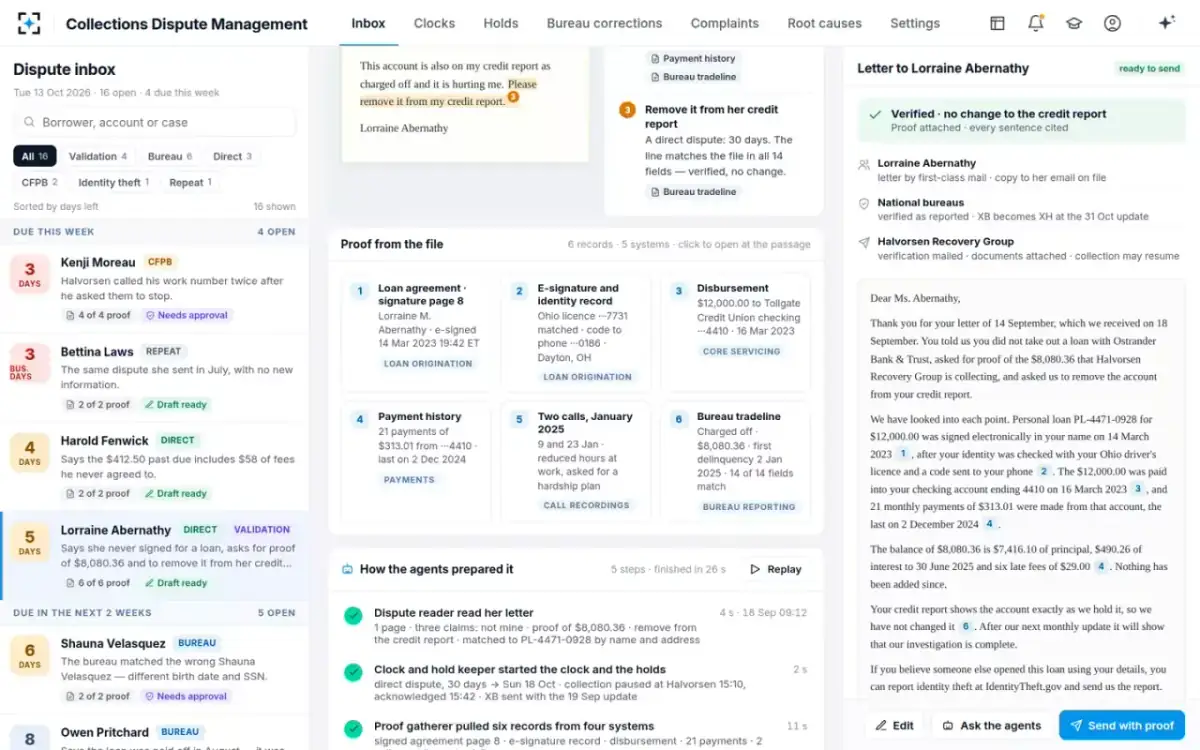
What that produces is a letter a borrower can check. The verified response in the sample file answers each of the borrower's three claims in her order, cites every sentence, attaches four documents and still sets out the identity-theft route — and it goes out on day 25 of a 30-day internal service level, with five days in hand.
Answered with the proof attached, and the hold lifted on mailing
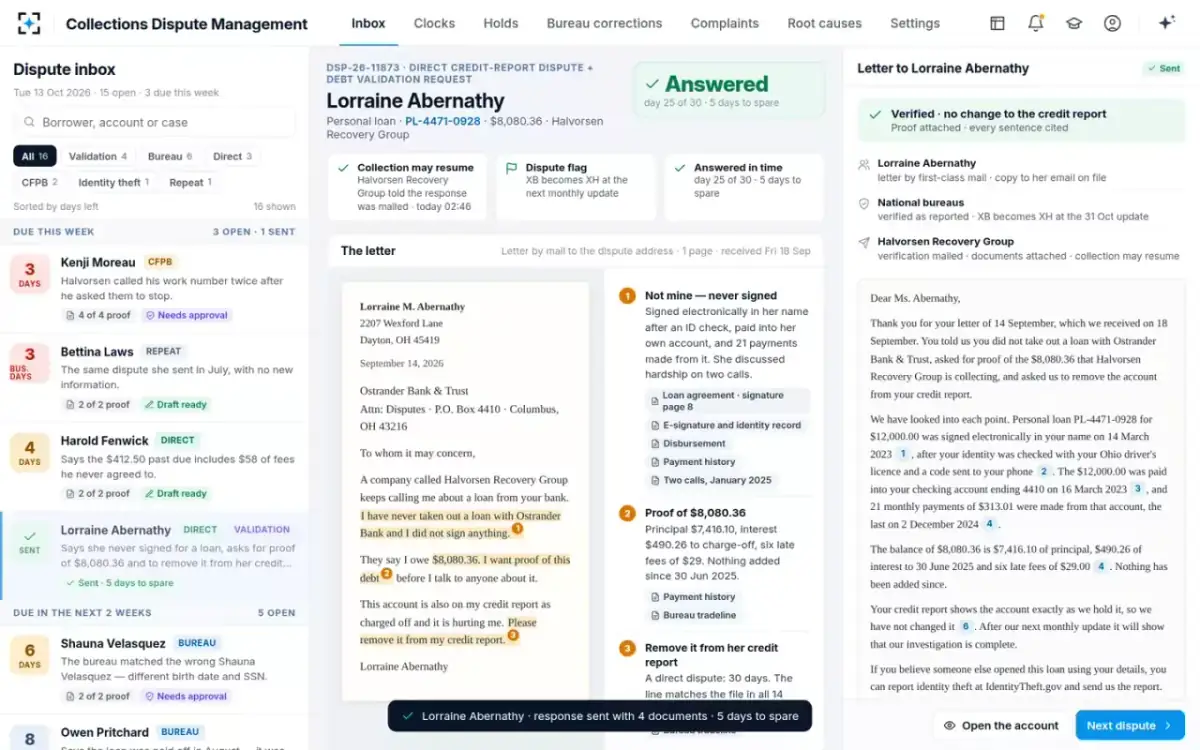
Where the records show the borrower is right, none of this applies and the work becomes a correction instead. What a reasonable investigation has to look like covers the credit-reporting side of the same letter, and what arrives when the borrower goes to a bureau instead is a different form with a different duty attached. To see the clocks, the holds and the drafted letters together, start from Collections Dispute Management.
Questions people ask
What happens if a debt collector does not validate the debt in 30 days?
Nothing happens on day 31, because there is no 30-day deadline for sending verification. The thirty days in §1692g are the borrower's window to dispute, not the collector's window to answer. What follows a timely written dispute is a suspension: collection of the disputed debt must stop and may not resume until verification or a copy of a judgment has been mailed. A collector that never sends verification has not missed a deadline — it has permanently disabled its own ability to collect that debt.
Does a debt validation request have to be in writing?
To trigger the cease-collection duty under §1692g(b), yes, and it must arrive inside the validation period. An oral dispute does not switch the duty on, though Regulation F requires a collector not to report a debt as undisputed when it knows it is disputed, and many collectors act on an oral dispute as a matter of policy. The practical rule for a desk is to record every dispute however it arrives, and decide the legal question from a written record of when and where it came in.
What is the itemization date on a collection notice?
It is the reference date the collector picks as the anchor for the amount of the debt. Regulation F allows five: the last statement date, the charge-off date, the last payment date, the transaction date or the judgment date. The notice must state which one it is, the amount of the debt on that date, and an itemization of interest, fees, payments and credits since then. It is the date that makes the current balance checkable.
Is a debt validation request the same as a credit report dispute?
No, though one letter frequently contains both. A validation request runs under the FDCPA and Regulation F, inside the validation period, and its effect is to stop collection. A credit-report dispute runs under the FCRA and Regulation V, has no window of that kind, and its effect is to start a reasonable investigation of what was furnished. The duties, the deadlines and the right answer differ, so a letter that does both has to be split into claims before either can be answered.
What is a duplicative dispute under Regulation F?
A written dispute inside the validation period that is substantially the same as an earlier written dispute the collector has already answered with verification, and that adds no new and material information. For one of those, the collector may notify the borrower in writing that the dispute is duplicative, state briefly why, and refer them to the earlier response instead of verifying again. A second letter that encloses new evidence is not duplicative, however familiar its wording.
Can a first-party lender ignore a validation request?
Usually the FDCPA does not reach it: the definition of a debt collector excludes an officer or employee of a creditor collecting in the creditor's own name. But a creditor collecting under another name that implies a third party is covered, state law may impose its own duties, and any agency the lender places the account with is covered outright. Most lenders therefore answer to the same standard everywhere, and record the turnaround as an internal service level rather than as a legal deadline.