Metro 2 reporting software assembles what a lender knows about an account into the industry's standard monthly reporting layout and delivers it to the credit bureaus. It is the right tool for that job and it is not a dispute tool: it sends the file, it does not answer the borrower who says the file is wrong. Those are two different duties written in two different parts of the same rulebook — furnish accurately, and investigate what is disputed — and buying software for the first while assuming it covers the second is the gap examiners keep finding. Botminds' Collections Dispute Management sits on the other side of that line. It does not produce the furnishing file and does not replace the engine that does; it reads the disputed tradeline, proves each disputed field against the account it came from, and drives the approved correction to every bureau the account is reported to.
This guide maps the two jobs: what a reporting engine discharges, what it cannot, which tradeline field is settled by which system, and what a furnisher's own written policies have to cover whichever tools it runs. The sample figures come from a fictional lender, Ostrander Bank & Trust, running through the solution. The rules and findings are the regulator's own, linked where they appear; the format's own manual is an industry publication and is not quoted here.
Two duties out of one data file: what the engine owns, what the dispute desk owns
The furnishing engine: "What does this account look like this month, in the layout every bureau reads?"
The dispute desk: "Is this field right for this borrower, and if not, what is, and who says so?"
The furnishing engine: The servicing system, in bulk, once a cycle.
The dispute desk: One borrower’s claim, and whichever systems can settle it — origination, servicing, payments, calls, agency logs.
The furnishing engine: Standard data reporting formats and standard procedures; information substantiated by the furnisher’s records when it is furnished (Appendix E I(b)(2), III(b)).
The dispute desk: Investigate, review all relevant information, report inside the clock, correct at every nationwide bureau (FCRA §623(b); 12 CFR §1022.43(e)).
The furnishing engine: Carries the dispute flag you tell it to set, and stops carrying it when you say so.
The dispute desk: Decides whether there is anything to flag, and what the line should say instead.
The furnishing engine: A clean file of wrong values: every field correctly formatted, some of them untrue.
The dispute desk: A defensible answer that arrives after the clock, or at one bureau instead of three.
The furnishing engine: A transmission record: what was sent, when, and whether it was accepted.
The dispute desk: An investigation: what was claimed, where you looked, what the records said, what you reported.
What does Metro 2 reporting software do, and what it does not
A furnishing engine does four things well. It maps a servicing system's fields to the standard reporting layout the bureaus consume. It assembles a cycle's worth of accounts into one file and transmits it to each bureau on a schedule. It validates the file against the layout's own rules, so malformed records are caught before a bureau rejects them. And it keeps the transmission record: what went, when, and what came back.
The regulation is explicit that using such a format is good practice rather than an end in itself. The interagency guidelines a furnisher's policies must consider recommend "using standard data reporting formats and standard procedures for compiling and furnishing data, where feasible, such as the electronic transmission of information about consumers to consumer reporting agencies" (Appendix E to Part 1022, III(b)). The same guidelines set the substantive test the format cannot meet on its own: information must have integrity, such that it "(i) Is substantiated by the furnisher's records at the time it is furnished; (ii) Is furnished in a form and manner that is designed to minimize the likelihood that the information may be incorrectly reflected in a consumer report" (Appendix E, I(b)(2)).
Read those two together and the division of labour is obvious. Clause (ii) is a format question, and an engine answers it. Clause (i) — substantiated by the records — is an evidence question, and no engine answers it, because the engine's input is the servicing system's values, not the documents behind them. A furnishing engine faithfully transmits whatever the servicing system believes, including the things it believes wrongly.
Two duties, one data file
The statute separates the duties cleanly. Section 623(a) governs what you furnish: accurately, with notice when a consumer disputes it, and with corrections when you learn it is wrong. Section 623(b) governs what you do when a bureau forwards a dispute: investigate, review the information the bureau sent, report the result, and — where the investigation finds the information incomplete or inaccurate — report that finding to every other nationwide consumer reporting agency the information was furnished to (15 U.S.C. §1681s-2).
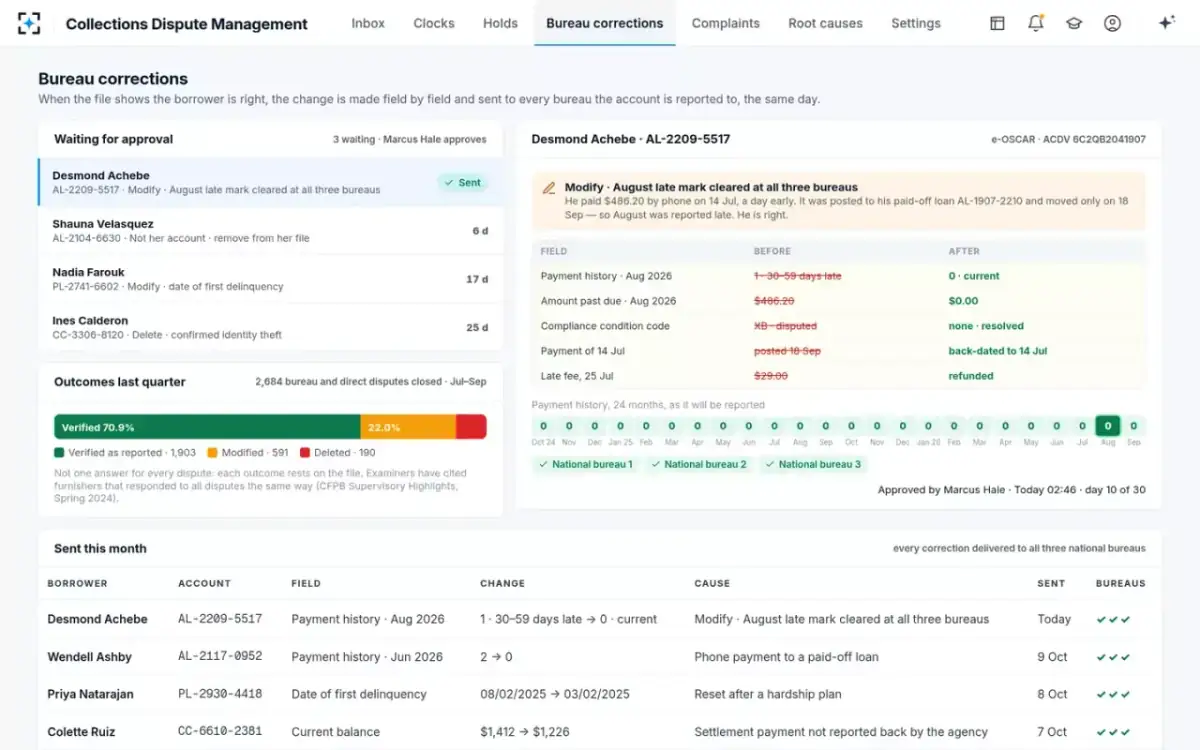
That last clause is the one that catches lenders who think of furnishing as a one-way pipe. A bureau dispute arrives from one bureau; the duty to fix runs to all of them. An engine configured to send the next cycle's file will eventually carry the corrected value to every bureau, which is not the same thing: the duty is to report the finding of the investigation, promptly, not to let the next monthly cycle wash over it. In the solution an approved correction goes to every bureau the account is reported to on the day it is approved, and each delivery is marked.
The stack on one page, and the duty that attaches at each edge
1
Servicing and collections
The account as it truly stands: principal, interest, fees, payments as applied, plans, charge-off, placement.
The duty hereNothing is furnished that this layer cannot substantiate.
2
The furnishing engine
A monthly file in the industry’s standard layout, assembled from servicing and sent to each bureau.
The duty hereStandard formats and standard procedures; a form and manner designed to minimise misreporting.
3
The bureaus
The tradeline as it now reads on three national files, plus whatever they matched it to.
The duty hereForward disputes to the furnisher with all relevant information.
4
The dispute desk
Each dispute, the records that bear on it, the comparison, the determination and what was sent.
The duty hereInvestigate, report inside the clock, and correct at every bureau the line went to.
5
The agencies
Placements, call and letter logs, settlements, payments taken on your behalf.
The duty hereStop collecting when told; report back what they did, so the file stays true.
Does Metro 2 software handle disputes?
It handles the signalling, not the investigation. A furnishing engine can carry a dispute indicator on a line, can carry the removal of that indicator, and can carry a changed value once someone decides what the value should be. What it cannot do is any of the four things the dispute duty actually consists of: deciding which records bear on the borrower's claim, retrieving them, comparing them with the disputed field, and producing an answer a person can sign.
Some engines bundle a dispute queue, and a queue is worth having — but a queue is a list of disputes with statuses, not an investigation. The test is the same one an examiner applies: open a closed dispute and ask where the lender looked. A queue can tell you who worked it and when it closed. It cannot tell you that page 8 of the agreement was read, or that the payment was traced to the account it was keyed to by mistake, because those records never passed through the furnishing layer.
The practical consequence shows up in staffing. Lenders that bought an engine and kept the dispute work in spreadsheets and email end up with two unconnected truths: a transmission record that says the file went, and a case list that says the dispute closed, with nothing in between that proves the second was earned. That is the arrangement choosing credit dispute management software is meant to replace, and it is the reason the two purchases should be considered together even though they are two purchases.
The dispute flag, and the rule behind it
The one place the two tools genuinely touch is the dispute indicator, and it is also the one most often got wrong. The statute is short and absolute: where the completeness or accuracy of furnished information "is disputed to such person by a consumer, the person may not furnish the information to any consumer reporting agency without notice that such information is disputed by the consumer" (15 U.S.C. §1681s-2(a)(3)). The duty begins when the dispute arrives, not when the investigation concludes.
Examiners found furnishers failing exactly here. In April 2024 they reported that furnishers "who received direct disputes from consumers were continuing to furnish the disputed information to CRCs without notifying the CRCs that the information was subject to dispute" (Supervisory Highlights, Issue 32). This is not a hard problem technically — the engine has a field for it. It is a hard problem organisationally, because the trigger lives at the dispute desk and the action lives in the furnishing cycle, and nothing connects them unless something is built to connect them. On the sample lender the flag is set with the update that follows receipt and cleared at the update after the response goes out, and both events are on the dispute's own record.
Regulation F adds a sibling rule for collectors with its own timing: a debt collector must not furnish information about a debt to a bureau before it "(i) Speaks to the consumer about the debt in person or by telephone; or (ii) Places a letter in the mail or sends an electronic message to the consumer about the debt and waits a reasonable period of time to receive a notice of undeliverability" (12 CFR §1006.30(a)(1)). An engine will furnish whatever it is given on the cycle it is told to. Whether the borrower has yet been contacted is a fact from the collections side of the house.
Reconciling the file you send against the file you hold
There is a timing trap in that division worth naming. A furnishing cycle is monthly, and a dispute clock is thirty days from receipt, so the two are almost the same length and not at all the same thing. A correction that waits for the next file is a correction that may land inside the clock by luck and outside it by a week's bad timing, and in the meantime the borrower has been told one thing and the bureaus another. Treat the investigation's result as its own delivery, sent when it is approved, and let the monthly file agree with it afterwards rather than being the means of making it true.
The useful discipline for a furnishing stack is reconciliation: compare the tradeline as it now reads at each bureau with the account as the servicing system holds it, field by field, and treat every difference as a defect with an owner. A dispute is one way to discover such a difference; it is the most expensive way, because the borrower found it first.
What reconciliation finds is rarely a formatting error. At the fictional sample lender, 781 of 2,684 disputes closed in a quarter ended in a correction, and the causes sat upstream in five different systems — not one of them in the furnishing engine.
What was actually wrong: the causes behind 781 corrections in one quarter
By cause, of 781 corrections (Jul–Sep)
- Settlements an agency did not report back · 23%
- Phone payments keyed to a closed loan · 22%
- First-delinquency date reset after a plan · 15%
- Fees after charge-off counted in the balance · 15%
- Mixed files at the bureau — not our borrower · 11%
- Confirmed identity theft · 7%
- Other causes · 7%
Each of those is a different kind of fix. A settlement an agency never reported back is a handoff problem; a phone payment keyed to a closed loan is a payment-posting control; a first-delinquency date that moved when a hardship plan started is a servicing rule, and the one examiners single out most often, because moving that date keeps an account on a credit report longer than the law allows — how one field goes bad follows it in detail. None of them is visible from the transmission record, and all of them are visible from a quarter's disputes read together.
A reconciliation does not have to be large to be useful. Pull fifty accounts a month across the products you report — a mix of current, delinquent, charged-off, settled and placed — and compare, field by field, what each bureau now shows against what servicing holds. Count the differences rather than explaining them, because the count is the control: a stack with no differences is probably not being sampled properly, and a stack whose differences cluster on one field has found its next fix. Then read the differences against the quarter's disputes. Where the same field appears in both, the borrowers are telling you what your own sample would have.
Which system proves which field, and who may change it
| Tradeline field | The system that proves it | Who may change what is reported | What has to happen everywhere |
|---|---|---|---|
| Account status and payment history | Payments: each payment as received, as applied, and any later re-application | The dispute desk, on compliance approval | The corrected month goes to every nationwide bureau the account was furnished to, the same day |
| Amount past due and current balance | Servicing: principal, interest and each fee with the date it was added | The dispute desk for a disputed period; servicing for the account itself | A balance corrected at one bureau and not the others is the finding, not the fix |
| Date of first delinquency | Servicing: the first missed payment that was never brought current | Collections systems, and only by correcting the underlying date | The date drives when the line must fall off — so every bureau must hold the same one |
| Compliance condition code (dispute flag) | The dispute desk: the day the dispute arrived and the day the response went | Set and cleared from the dispute, carried by the furnishing engine | Carried on every file while the dispute is open, at every bureau |
| Account ownership and identity | Origination: the signed agreement, the identity and signing record, the disbursement | Nobody, without the signing record — a mixed file is corrected, not argued | A deletion for a file that is not the borrower’s goes everywhere at once |
| Settled or paid status after a plan | The settlement letter, the payment that satisfied it, and the agency’s report back | The dispute desk, with the agency’s record attached | Reported consistently at all three, or the next dispute writes itself |
What should a furnisher's credit reporting policies cover?
Whatever tools you buy, the written policies are yours. Regulation V requires every furnisher to "establish and implement reasonable written policies and procedures regarding the accuracy and integrity of the information relating to consumers that it furnishes to a consumer reporting agency", appropriate to "the nature, size, complexity, and scope of each furnisher's activities" (12 CFR §1022.42(a)).
Examiners have twice found policies that existed only as somebody else's technical documentation. In the Winter 2024 report, in reviews of student loan furnishers, "examiners found that the furnishers relied solely on external procedures regarding the technical steps for creating and transmitting consumer reporting files, but maintained no internal policies or procedures with respect to complying with the applicable requirements of the FCRA and Regulation V" (Supervisory Highlights, Issue 37). The vendor's implementation guide is not your policy. The gap between them is where this finding lives.
The handoffs a furnishing stack has to write down, and who owns each
- What triggers the dispute flag, and what clears it
Which event sets it, which update carries it, and who may remove it. Owned by the dispute desk, executed by the furnishing engine.
- How an approved correction reaches every bureau
One approval, one dispatch, a delivery mark against each nationwide bureau — not a wait for the next cycle.
- Who may change a credit file, and on what evidence
A single route with a named approver and a field-by-field before-and-after. Two routes means two stories.
- What the engine must not furnish, and why
A debt not yet communicated to the borrower, an account under an identity theft block, a line the investigation found unverifiable.
- How bureau feedback comes back into servicing
Rejected records and matching problems are accuracy findings. Examiners have cited furnishers that never noticed their files were rejected.
- What is reconciled, how often, and against what
The tradeline as it reads at each bureau against the account as servicing holds it, on a sample, on a schedule.
- Which agency reports what back, and by when
Settlements, payments and contacts. A quarter of the sample lender’s corrections began as something an agency did and did not report.
- Who owns each recurring cause, and what the fix is
A cause without an owner is a dispute that will arrive again next quarter with a different borrower’s name on it.
Corrections waiting for approval, and every correction sent this month
Where the format's own manual stops
The industry's reporting manual is a layout and a set of code definitions, maintained by the trade body that publishes it. It tells you how to express a status, a condition code or a date in the file. It cannot tell you which status is true for an account, which is why a lender reading it for compliance guidance is reading the wrong document: the duties are in the statute, in Regulation V and in the interagency guidelines, and the format is how you express an answer you arrived at elsewhere.
This matters for a procurement question that comes up often: is a dispute answered correctly when the field is formatted correctly? No. A code that is valid in the layout can be wrong about the account, and a dispute response that reports a valid code for an untrue state is a violation expressed in perfect syntax. The reviewer's question is never whether the file parsed. It is where you looked before you filled the field — what a reasonable investigation requires sets out that standard.
Buying for the gap, not for the overlap
Most lenders of any size already furnish. The decision in front of them is not whether to replace the engine but whether anything in their stack discharges the dispute duty, and the honest way to find out is to open three closed disputes from last quarter and try to answer the reviewer's four questions from the systems they own. What was claimed, where did we look, what did the records say, what did we report.
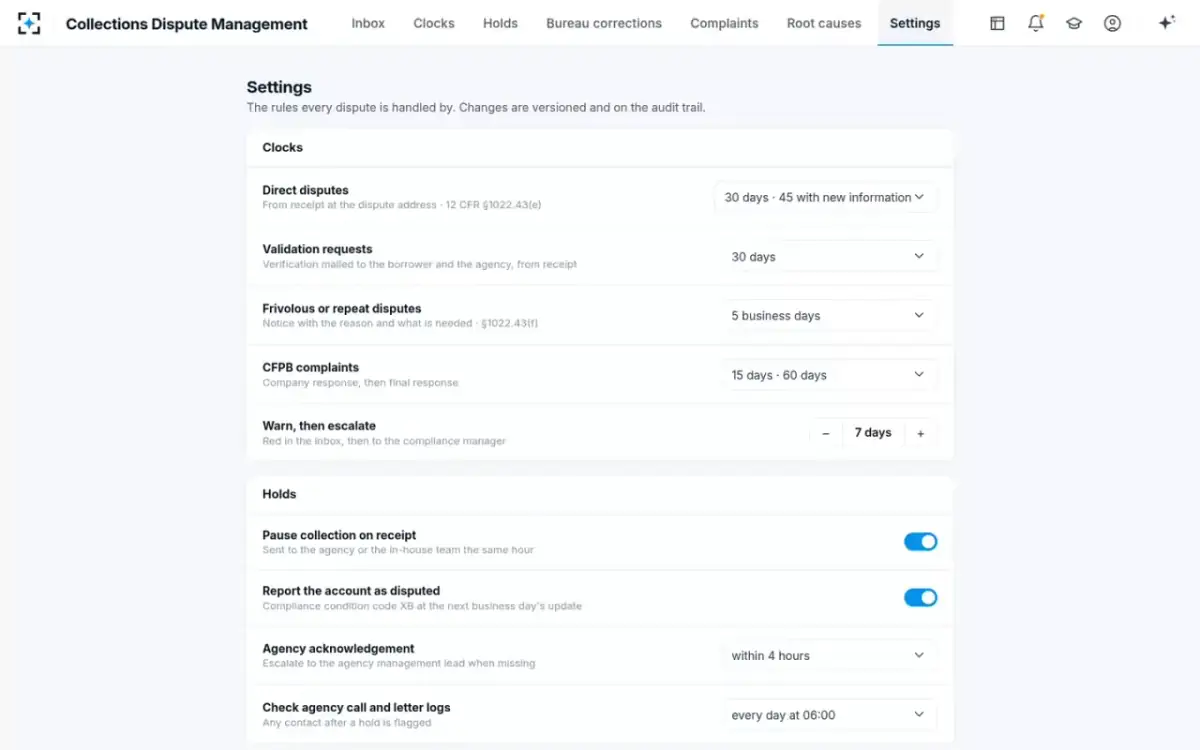
If those answers live in an inbox, a spreadsheet and somebody's memory, the gap is the investigation, not the transmission. Two settings decide whether a tool closes it: whether a response can cite the page it rests on, and whether an approved correction leaves for every bureau at once. Everything else — intake channels, clocks, holds, letter templates, reading level, escalation windows — should be configuration rather than a project, because a lender's dispute procedures are its own and they change.
Clocks, holds, approvals and letters as settings, not as a project
Questions people ask
Do you need Metro 2 software to furnish credit data?
You need to furnish in a form the bureaus accept, and in practice that is the industry's standard layout. Whether you reach it with dedicated software, a module of your servicing platform or a built file depends on volume and on how many products you report. The interagency guidelines recommend standard formats and standard procedures; they do not name a product, and nothing about the choice changes the dispute duties that follow.
What is a compliance condition code?
It is the field on a furnished line that carries conditions about the account's status, including the mark that says the borrower disputes the information. The statute requires that a disputed line not be furnished without notice of the dispute, so the mark goes on when the dispute arrives and comes off when the investigation has been reported — and both events should be recorded on the dispute, not only in the file that was sent.
How do you stop furnishing an account that is disputed?
For most disputes you do not stop furnishing; you keep furnishing with the dispute flag set, because the duty is notice rather than silence. Suppression is the exception, not the rule: an identity theft block has its own statutory route, and a line the investigation found unverifiable should come out rather than keep being reported. Deleting a tradeline in place of investigating it is the practice examiners criticised in April 2024.
Who checks that what we furnish matches the servicing file?
Somebody has to be named, and in most lenders nobody is. The guidelines expect internal controls over accuracy and integrity, including verifying samples of what is furnished. A practical division is: the furnishing team owns the file's form and transmission, the dispute desk owns any field a borrower has questioned, and a reconciliation on a sample of accounts each month belongs to whoever owns credit reporting policy.
Can you furnish a debt before contacting the borrower?
Not as a debt collector. Regulation F requires a collector to speak to the consumer about the debt, or send a letter or electronic message and wait a reasonable period for a notice of undeliverability, before furnishing information about it to a bureau. The rule binds the collector rather than the format, so a furnishing engine will send whatever it is given: the control has to sit where placements and letters are decided.
Does Collections Dispute Management replace our furnishing engine?
No. It does not assemble or transmit the monthly file. It reads the tradeline as furnished, proves each disputed field against the account, drafts the response, records the approval and drives the corrected fields to every bureau the account is reported to — then shows which upstream system produced the error, so the next cycle sends something truer.