Credit dispute management software is bought to do one thing and usually does another. The need is a dispute that arrives, is answered inside its clock with the proof that closes it, and leaves a file a reviewer can defend. What most of this market sells is an inbox: a case with a status, a queue with an owner, a report with a backlog. Both are called dispute management, and the difference between them is the investigation — the part that goes out to origination, servicing, payments and the agencies' own logs and comes back with the records that settle the borrower's claim. Botminds' Collections Dispute Management is built around that part, and this guide is written to be used against it as much as against anyone else: twelve questions, the evidence to ask for with each, and three jobs for which it is the wrong tool.
A note on the market before the questions. Search for this category and most of what comes back is credit repair software sold to consumers and to the organisations that dispute on their behalf — the opposite side of the same exchange. The lender-side buyer is unusually badly served, which is why so many dispute desks run on a shared mailbox, a spreadsheet and four system logins. The worked examples here come from a fictional sample lender, Ostrander Bank & Trust, running through the solution.
The shape of the problem a product has to fit
5doors
a dispute arrives through, each with its own clock and its own pause
6records
one answer was assembled from in the sample file, from origination to the tradeline as furnished
3bureaus
every approved correction has to reach, the same day, not one
8rules
clocks, holds, approvals and letters a lender should be able to set without a project
What should credit dispute management software do?
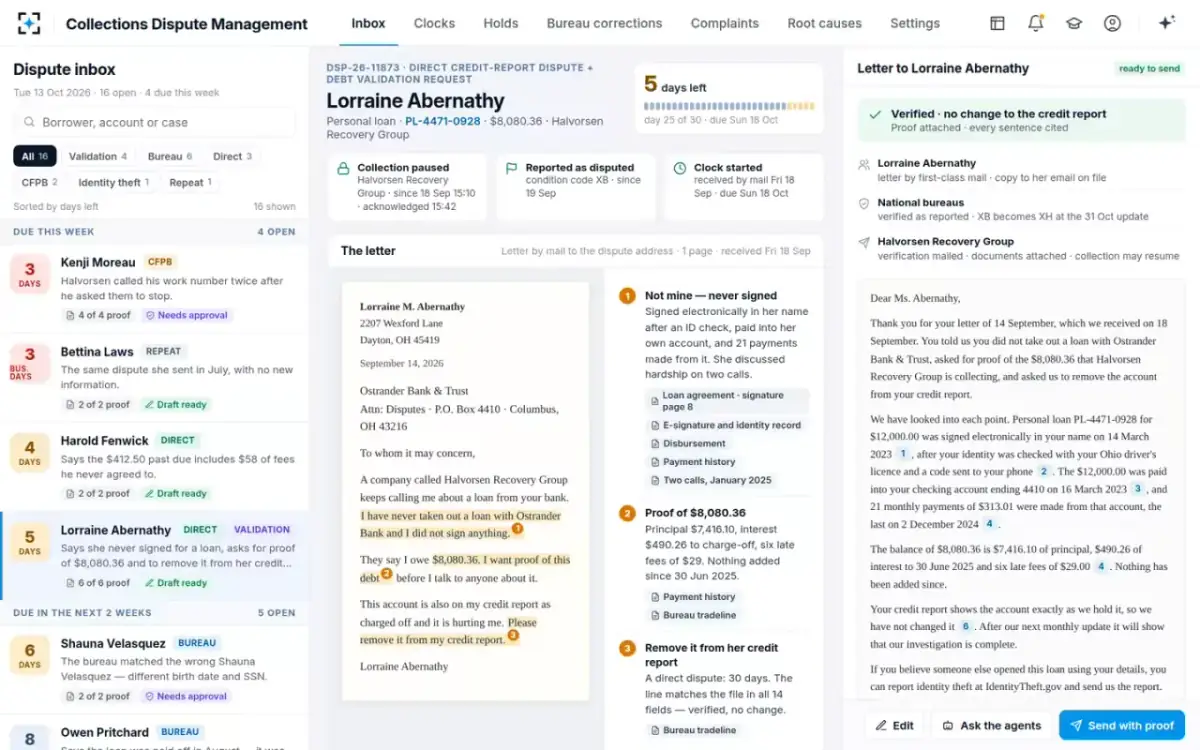
Nine things, in order, and the order is the argument. Accept a dispute from every door it can arrive through. Identify the borrower and the account, and split the text into the separate claims the borrower actually made. Start the right clock from the right date. Pause collection wherever the account sits, and record the acknowledgement. Gather the records that bear on each claim, from every system that could hold them, cited to a page or a line. Compare the furnished line against those records, field by field. Draft a response that answers each claim in the order it was raised, with a citation behind every sentence. Route a change to a credit file to a named approver, then deliver the approved change to every bureau the account is reported to. And cluster the closed disputes by cause, so the defects that generate them get owners.
Examiners describe the same work from the outside, and a buyer can use their language as a specification. The CFPB's debt collection examination procedures direct examiners to "identify all channels and physical locations the entity provides for receipt of customer disputes, complaints, and inquiries" and to "determine whether the furnisher conducts reasonable investigations of direct disputes from consumers where required, including a review of all relevant information provided by the consumer" (CFPB, Examination Procedures: Debt Collection, March 2022). Channels and investigations — intake and evidence. A product that is excellent at the first and silent on the second covers half the examination.
A case tracker, and a dispute that arrives answered
What a tracker gives you: A case created from an email or an upload, with a type and an owner.
What answering the dispute requires: The borrower’s own words split into separate claims, matched to the account by name, address and account number.
What a tracker gives you: A due date typed in, or a default of 30 days for everything.
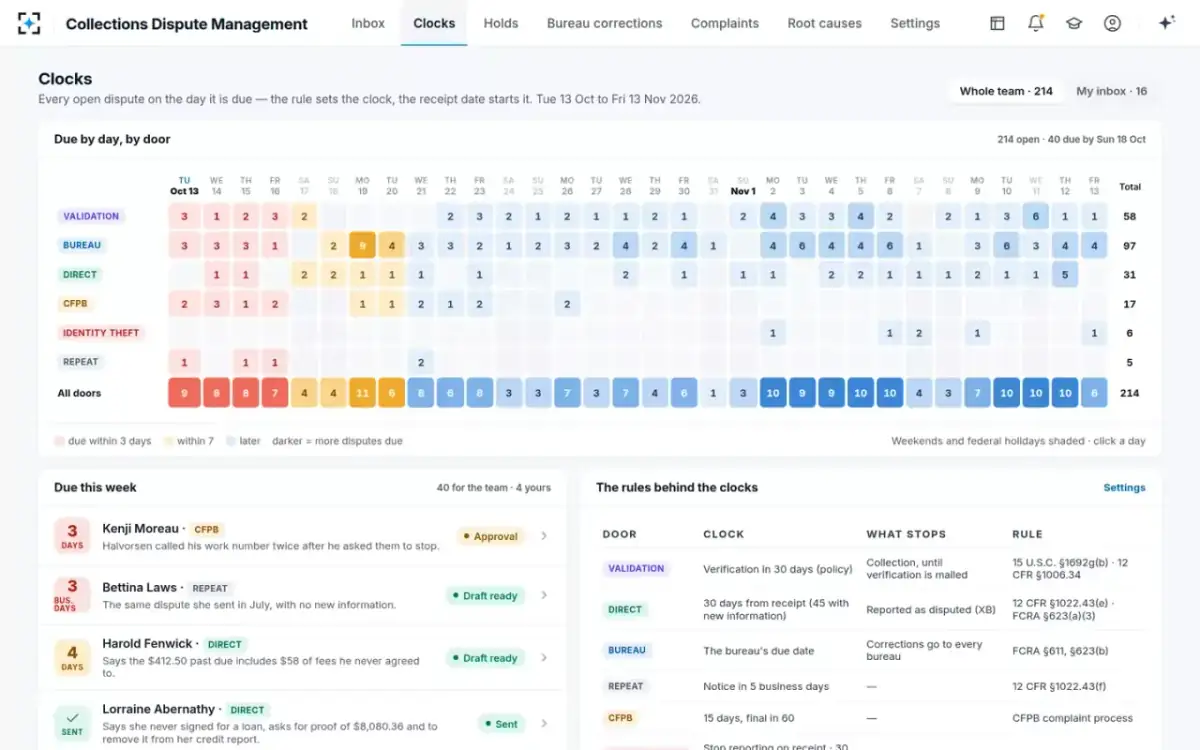
What answering the dispute requires: The clock the rule gives this door, from the receipt date, with the rule cited and the escalation set.
What a tracker gives you: A note that says collection should stop.
What answering the dispute requires: A pause sent to whoever is collecting, an acknowledgement recorded, a missing one chased, and the agency’s own logs read daily.
What a tracker gives you: An attachments tab, filled in by whoever remembered.
What answering the dispute requires: Records pulled from every system that bears on the claim, each opening at the page or line that answers it.
What a tracker gives you: Nothing: the analyst compares in their head or in a spreadsheet.
What answering the dispute requires: The furnished fields against the account, field by field, with both columns shown and the differences marked.
What a tracker gives you: A template with merge fields.
What answering the dispute requires: An answer to each claim in the order raised, every sentence citing the record it rests on, with the records attached.
What a tracker gives you: A status change by whoever has the role.
What answering the dispute requires: A field-by-field before-and-after, approved by a named person, with the time it was approved.
What a tracker gives you: A task to update the bureau that asked.
What answering the dispute requires: One dispatch to every nationwide bureau the account is reported to, with a delivery mark against each.
What a tracker gives you: A backlog report and an average handling time.
What answering the dispute requires: The causes behind the quarter’s corrections, each with an owner and a fix, so next quarter has fewer.
The five doors it has to accept
A dispute is not one thing, and a product that models it as one will be wrong about the clock on four of the five. A validation request under the debt collection rules stops collection on the disputed debt until verification is mailed. A direct dispute to the lender's own designated address carries the Regulation V investigation duty and the five-business-day notice if it is declined. A bureau dispute arrives as a structured message with a due date the bureau sets. A complaint arrives through a regulator's portal with a fifteen-day response and a sixty-day final. An identity theft claim carries its own blocking route and, in most lenders, a second reviewer.
Repeat disputes cut across all five. A borrower who writes again with nothing new may be answered with a notice rather than a fresh investigation — but only if the product can tell "the same dispute again" from "the same dispute plus the document you asked for", because the second is a new dispute with a full clock. That single distinction is worth asking a vendor to demonstrate; it is where a tracker quietly becomes a liability.
The examination procedures also tell you to look past the obvious channels: assess "the effectiveness of other means available for disputes, inquiries, or complaints, including written submissions and any online portal" (Examination Procedures: Debt Collection). In practice the awkward door is the agency's: a dispute raised with a collection agency by phone, logged in the agency's system, and never seen by the lender whose name is on the credit report.
One inbox, sorted by the days each dispute has left
Does a dispute management system replace our CRM?
No, and a buyer who expects it to will be unhappy twice. A customer relationship or case system holds the conversation with the borrower and the work queue around it; a dispute system holds the investigation and its evidence. They overlap at exactly one point — the fact that a dispute exists — and the clean division is to let the case system own the contact history and the dispute system own the claim, the records, the comparison, the determination and the delivery.
The same question is usually asked about three other systems. A furnishing engine is not replaced either: it sends the monthly file, while the dispute desk proves and corrects individual fields — where each tool's duty ends maps that boundary. A complaint management platform may already hold the regulator's portal work; the question is whether it can reach the agency's call log, because most complaints in this business are answered from someone else's records. And a document store is not an investigation: holding the agreement is not the same as citing page 8 of it.
Twelve questions that separate a tracker from an answer
Ask these in a demonstration, in this order, on the vendor's own sample data. Each has an artefact behind it that takes a minute to show, and a reaction that tells you more than the artefact.
Twelve questions, and the evidence to ask for with each
- Show me the same dispute arriving by letter, by bureau message and by complaint portal
Three doors, three clocks, one account. A product with one intake path has modelled the easy case.
- Which clock did it start, and where did that rule come from?
The rule should be named on the dispute, not buried in a configuration screen nobody can read.
- What happened in the first hour, before a person opened it?
Collection paused at whoever is collecting, acknowledgement recorded, the account marked as disputed at the next update.
- How many systems did the answer reach, and can you show me the records?
Count them. One is the finding examiners wrote up; four or five is an investigation.
- Click a citation in the draft response
It should open the document at the passage. If it opens a system, or a folder, the citation is decoration.
- Show the field-by-field comparison on a dispute where the borrower was right
Both columns, every field, and the differences marked. "Our system agrees" is not a comparison.
- Who approved the change to the credit file, and when?
A name and a timestamp against a before-and-after table. A role with a toggle is not an approval.
- How many bureaus received the correction, and how do you know?
A delivery mark against each nationwide bureau. Waiting for the next monthly file is not reporting the result of an investigation.
- Show me a repeat dispute that brought new information
It must be treated as a new dispute with a full clock, not closed as a duplicate. This is the question most products fail.
- Open a dispute closed a year ago and tell me the rules in force that day
Versioned clocks, holds and approvers. Without them, last year’s file cannot be explained to anyone.
- What are the causes behind last quarter’s corrections, and who owns each?
A product that cannot answer this is a response generator; the only permanent saving is in not generating the dispute.
- Which of these are settings, and which are a project?
Clocks, holds, approvers, escalation windows, letter templates and reading level should all be settings, versioned and on an audit trail.
What to ask about the investigation, not the inbox
Three of those twelve carry most of the weight, and they are all about evidence. The first is reach: how many systems an answer touches. The CFPB's December 2024 examiner findings describe furnishers whose automated systems reviewed only their own records and therefore failed the reasonable investigation duty (Supervisory Highlights, Issue 37), and reach is the one property of a dispute product that cannot be retrofitted with a template.
The second is attachment. The CFPB's review of how companies answer complaints notes that "companies sometimes refer to documents in their responses, but do not attach the corresponding documents as expected" (Consumer Response Annual Report, 2025). Referring to a document you do not attach is the written form of asking to be believed. A product should attach the records that close the dispute by default and make leaving them out the deliberate act.
The third is sameness. In its December 2025 report on credit reporting complaints, the Bureau "identified responses that are identical, or nearly identical to the response provided to another consumer" (Annual report of credit and consumer reporting complaints). The finding is about the credit bureaus rather than furnishers, and it is the clearest published description of the failure mode a template-first product encourages: an answer that is fluent, timely, compliant in form, and not about this borrower. The same report notes that of the three nationwide agencies, only one documented furnisher error reports during the period it analysed — a reminder that measurement of error is itself uneven in this market.
Where one answer came from: six records, system by system
Build or buy a dispute management system?
Build what only you can know; buy what every furnisher needs. The parts worth building are the connections into your own systems and the quirks of your own procedures — which is exactly what a bought product should expose as configuration rather than require as development. The parts not worth building are the ones that look simple and are not: the clock arithmetic across five doors with business days and holidays, the hold lifecycle with acknowledgements and chasing, the field-by-field comparison, the simultaneous delivery to three bureaus, and the versioning that lets you explain a dispute closed two years ago.
There is a third option that deserves naming because it is what most lenders are actually running: a mailbox, a spreadsheet and four logins. It works at low volume with a good analyst and fails invisibly — not with a backlog, but with answers that went out on time and cited nothing. If you are choosing between building and buying, first measure what you have: take twenty closed disputes and count how many systems each answer reached. That number decides the business case more honestly than any vendor's slide.
Whatever you choose, the written policies stay yours. Regulation V requires a furnisher to establish and implement reasonable written policies and procedures on the accuracy and integrity of what it furnishes, appropriate to its size and complexity (12 CFR §1022.42(a)), and examiners have found furnishers that relied on a vendor's technical documentation and had no policies of their own. A product is an implementation of your policy, never a substitute for having one.
What you bring to a pilot on your own closed disputes
The only demonstration worth much is on disputes you have already answered, because you know what the right answer was. A pilot on closed disputes compares the product's work with your analyst's on cases where the outcome is settled, which tests the investigation rather than the interface.
A pilot on your own closed disputes, in four columns
What you bring
Fifty to a hundred closed disputes across every door, with the responses you sent; read access to origination, servicing, payments, call recordings and the agencies’ logs; your dispute procedures and letter templates; the clocks and approvers you actually use.
What is measured
For each dispute: how many systems the answer reached, how many records were cited to a page or line, whether the comparison found what your analyst found, and how many days were left on the clock when a response was ready.
What good looks like
Every claim in the borrower’s letter answered separately; a citation behind each sentence that opens at the passage; the same outcome as your analyst on the disputes they got right, and a defensible disagreement on the ones they did not.
What it cannot tell you
Whether the outcome was legally right — only your own review says that. Nor how the product behaves on volume, on a bad data day, or in a month when two bureaus change a layout.
Two cautions about reading the result. A product that agrees with your analyst on every case has told you nothing about the cases that matter; look hardest at the disagreements, and at whether the product's disagreement is supported by a record you had not reached. And resist measuring the pilot in minutes saved. The honest measures are reach, citation and clock headroom — how many systems, how many cited records, and how many days were left when a response was ready.
Going live without breaking the clocks
A dispute desk cannot pause while a system is installed; the clocks keep running on everything already open. Three decisions make a cutover uneventful. Decide where the open ones live: usually, finish them where they are and start the new intake on a date, rather than migrating half-answered investigations. Decide the first door: bureau disputes are the most structured and the easiest to prove against, direct disputes carry the heaviest duty, and complaints are the most visible — most lenders start with the structured one and add the heaviest second. And decide the approvals before the first correction, not after: who approves a modify, who approves a delete, and who is the second reviewer on an identity theft case.
Then check the clocks on day one, not in the first report. Every door's rule, the date each clock runs from, the escalation window, and who gets the escalation — these are the settings most likely to be wrong on arrival and the ones whose errors are invisible until a response is late.
Every open dispute on the day it is due, by door
The three jobs this is the wrong tool for
Being honest about the edges is cheaper than a failed implementation. Collections Dispute Management does not produce the furnishing file: if your problem is that the monthly file is late, malformed or rejected, that is a furnishing engine's job and this will not help. It does not place, recall or manage accounts with collection agencies: it sends holds, reads the agencies' logs and flags contacts after a hold, but the placement strategy and the commercial relationship stay where they are. And it does not decide outcomes: the agents read, clock, pause, gather, compare and draft, and a named person concludes and sends — a division examined in what automated credit dispute verification may decide.
Two more boundaries worth stating. This is a lender-side product: it answers disputes, it does not raise them, so it is not a credit repair tool and will not be useful to anyone looking for one. And it is not a substitute for fixing the upstream systems that generate disputes; it finds and names those causes, and somebody in payments, servicing or agency management still has to close them. For how the clocks differ by door, see every clock, by the door, and to see the whole desk, start from Collections Dispute Management.
Questions people ask
What features matter in dispute management software?
Five, in this order: intake from every door with the right clock on each, an automatic collection hold with the agency's acknowledgement recorded, record-gathering across every system that could answer the claim with each record cited to a page or line, a field-by-field comparison against the furnished line, and one approved correction delivered to every nationwide bureau the account is reported to. Queues, dashboards and templates are useful and are not what separates products.
How does dispute software connect to e-OSCAR?
Through the same structured exchange your furnishing arrangements already use: disputes arrive as messages with a dispute code, a consumer statement and the fields in question, and responses go back the same way. The connection is rarely the hard part. The hard part is what happens between arrival and response — whether the fields were proved against the account, and whether anything that was corrected also reached the other bureaus.
What do you need to bring to a dispute software pilot?
Fifty to a hundred closed disputes across every door with the responses you sent, read access to the systems that hold the proof — origination, servicing, payments, call recordings and the agencies' logs — and your own procedures: the clocks, the approvers, the letter templates. The point of using closed disputes is that you already know the answer, so the pilot tests the investigation rather than the interface.
How long does it take to put dispute software live?
The honest answer depends almost entirely on access to the systems that hold the proof, not on the product. A desk that already has read access to origination, servicing, payments and its agencies' logs can start with one door and add the others; a desk that has to request each connection will spend most of the elapsed time waiting for them. Start with the most structured door, get the clocks and approvals right on day one, and add the heaviest duty second.
Does a dispute management system replace our complaint platform?
Only if your complaint platform cannot reach the records that answer a complaint. Most complaints in collections are answered from somebody else's material — an agency's call log, a payment as it was applied, a balance built from its parts — so the question to ask is not which system owns the portal but which can produce the evidence inside fifteen days with the documents attached.
What should worry me in a vendor demonstration?
A single intake path; a citation that opens a system rather than a page; a correction that goes to the bureau that asked; a repeat dispute closed as a duplicate without checking for new information; and any answer that treats the clock as a field somebody types. Each of those is a published examiner finding waiting to happen, and each is visible in five minutes if you ask.