Under a lender's FCRA dispute procedures, a credit dispute analyst reads what a borrower has written about their own credit file, works out which rule it falls under and when the answer is due, finds the records in the lender's systems that settle it, decides whether what was reported is right, and writes the reply. Most of the day is the finding. The deciding takes minutes, the writing takes longer than it should, and the clock that governs the whole thing usually started somewhere the analyst cannot see. Botminds' Collections Dispute Management takes the mechanical half — the reading, the clocking, the pausing of collection, the gathering of proof and the first draft — and leaves the judgement and the signature where they belong, which changes what the seat is for rather than how fast it runs.
It is also not one seat. A dispute that ends in a change to somebody's credit file passes through four, and the reason the analyst who sends is never the one who approves a credit-file change is that the file belongs to the borrower, not to the lender. This page describes all four: what each decides, what each may never decide, and the clock each one carries.
The four people named below are fictional characters in Collections Dispute Management's own demonstration data, and the minute figures are the demonstration lender's own estimates, marked as such. The wage and complaint figures are published and linked under the figures that use them.
Most of an analyst's minutes on a dispute go to finding the records
45–90min
of analyst time on one dispute worked by hand, start to finish
the demonstration lender’s own estimate
30of 70
minutes of a worked example spent pulling records out of four systems
estimate, one direct dispute
What does a credit dispute analyst do all day?
Six things, in roughly this order, repeated. Open what arrived. Work out which door it came through — a validation request, a bureau dispute, a direct dispute, a complaint, an identity-theft claim — because the door decides the rule and the rule decides the date. Pause collection where the rule requires it, and make sure the agency holding the account knows. Find the records that answer the specific claim the borrower made. Compare what was reported with what the records show, field by field. Write the reply, in language the borrower can check, and send it.
Two of those six are judgement and four are retrieval. That ratio is the whole story of the seat. An analyst who has spent thirty minutes in four systems before forming a view arrives at the judgement tired and late, and the part that was supposed to be the job — deciding whether the lender got it right — is done in the last ten minutes of an hour.
The volume behind the seat is not in doubt. The Bureau's 2025 complaint figures show where the national pressure sits: consumers submitted more than 5.8 million credit or consumer reporting complaints in 2025, 88% of everything the Bureau received, and the Bureau took in about 387,400 debt collection complaints the same year. Those are only the matters that escalated as far as the regulator; every one of them had a dispute behind it first.
Complaints the Bureau received in 2025, by product
Of everything consumers complained about
- Credit or consumer reporting · 88%
- Debt collection · 6%
- Cards, deposit accounts and money transfers · 5%
- Everything else · 1%
This desk sits under the largest complaint category in the country, which is why its procedures get read by examiners more often than most. The Bureau's own debt collection procedures tell examiners to "evaluate the comprehensiveness of systems, procedures, and/or flowcharts for capturing, logging, tracking, handling, and reporting disputes and/or complaints and their resolutions". Capturing and tracking come first in that list for a reason: a desk that cannot show what arrived and when has nothing to show at all.
Four seats around one dispute
The four roles below are how the demonstration lender divides the work. The names are fictional; the division is not unusual, and the reason for each boundary is written into the procedure rather than left to seniority.
Who carries one dispute, and what each seat decides
Today
Works the mailroom pile in arrival order and pulls every record by hand. "The answer is always in our systems. Finding it is the job."
With agents
Opens each dispute with the proof already gathered, the borrower’s claims answered in the margin and a cited draft ready; reads, edits where it needs editing, and sends.
Still theirs: Decides whether the reply is right, and signs it. May not approve a change to a credit file.
Today
Finds out later that a fix went to one bureau and not the others. "If we change a credit file, I want to see why, field by field."
With agents
Approves every modify and delete from a before-and-after table, and the same update goes to every bureau the account is reported to.
Still theirs: Approves every credit-file change and every company response to a complaint. Did not draft what they approve.
Today
"Fifteen days is short when the agency has the call recordings."
With agents
Starts from a company response drafted into the portal’s fields, with the agency’s call log, the payment and the balance already cited.
Still theirs: Owns the complaint record and the 15-day clock; the response still goes to the compliance manager before it is submitted.
Today
"I need to know the minute an agency touches an account it was told to pause."
With agents
Sees every paused account by agency, with its acknowledgement and any contact since — read from the agency’s own call log each morning.
Still theirs: Owns the agencies’ conduct and the escalation when a hold is breached. Does not answer the dispute itself.
The separation in the second row is the load-bearing one. A correction to a credit report is an assertion about a person that will be read by lenders, landlords and employers for years, and the analyst who concluded that the lender was wrong is the worst-placed person to review that conclusion. Splitting the draft from the approval is not bureaucracy; it is the only control that catches a sincere mistake.
Who approves a credit report correction at a bank?
In most banks, somebody in compliance or credit-risk governance rather than in the operations team that drafted it, and the approval is recorded against the specific field changes rather than against the case. In the demonstration lender it is the collections compliance manager, and the rule is absolute in both directions: every modify, every delete and every company response to a complaint goes to them, and identity-theft cases get a second reviewer from the fraud team on top.
Regulation V explains why the approval has to be attached to the field values rather than to the outcome. A furnisher's duty after a direct dispute is to investigate the disputed information reasonably, review all relevant information the borrower provided, report the results in time, and where the investigation finds the reported information inaccurate, promptly notify each bureau that was given it and supply the correction needed to make it accurate. The deliverable is corrected values, so the approval has to be of values.
Six lines worth writing into the procedure, and the reason for each
- Nothing leaves without a named person
Reading, gathering and drafting can be done for the analyst. Sending cannot: somebody signs, and the record shows who.
- Whoever approves a credit-file change did not draft it
A correction is an assertion about a person. The control that catches an honest error is a second pair of eyes on the field values, before they go.
- A correction goes to every bureau the account is reported to
Fixing one bureau leaves the same error standing on the borrower’s other two reports, and leaves the lender furnishing information it has already determined to be wrong.
- A hold does not lift before the response is mailed
The rule that stops collection is satisfied by sending, not by finishing. Tie the hold to the mailing and the question never arises.
- Every sentence in a reply points at a record
A letter that paraphrases a document it does not attach invites the borrower to ask for the document — which is the second dispute, arriving early.
- A root cause is a process, never a person
Quarterly cause analysis only works if naming a cause is safe. The moment it names people, the causes stop being reported.
How many disputes can an analyst handle a day?
There is no published benchmark, and any number offered without a definition of the work is worthless: a desk answering bureau disputes on a single product is doing something quite different from one answering mixed mail that includes identity-theft claims and complaints. What can be said honestly is arithmetic. If a direct dispute worked entirely by hand takes somewhere between 45 and 90 minutes — the demonstration lender's own estimate — then a six-hour working day of nothing else is five to eight of them, and a desk carrying a mixed queue will manage fewer.
That estimate is also where the leverage is, because most of it is not analysis.
Where seventy minutes go on one direct dispute, and what each step becomes
Note which bar shrinks least. Writing goes from fifteen minutes to about eight, and it should: the draft still has to be read, judged and often changed, and that is the part of the hour that is actually the job. The thirty-minute bar is the one that disappears, and it is the one that contains no judgement at all.
A desk that wants a real capacity figure can derive one from its own files in an afternoon, and it is worth doing before anyone promises a service level. Take a month of closed disputes and split them by door, because a bureau dispute on a single product and a mixed first-party letter containing an identity-theft claim are not the same unit of work. Count the elapsed days from receipt to reply, not the minutes somebody logged. Then count the proportion that came back — a second letter, an escalation, a complaint — because a dispute answered in twenty minutes and reopened six weeks later cost more than one answered in ninety and closed. Capacity measured without the reopen rate flatters the fastest desk and rewards the thinnest answers.
The hour that is not analysis
What makes the gathering expensive is that the records sit in different places and each one has to be found, opened and read to the relevant page. On a single "this is not my debt" letter in the demonstration lender's sample file, the proof is six records: the loan agreement and its signature page, the electronic signature and identity record, the disbursement, the payment history, two call recordings, and the bureau tradeline itself. Four systems, six artefacts, one claim.
The analyst's actual skill shows up after that, in three judgements a retrieval step cannot make. Whether the records answer the claim the borrower made, rather than a nearby claim that is easier to answer. Whether what was reported matches the file in every field, including the ones nobody disputed. And whether, when the file shows the borrower is right, the reply says so plainly instead of hedging.
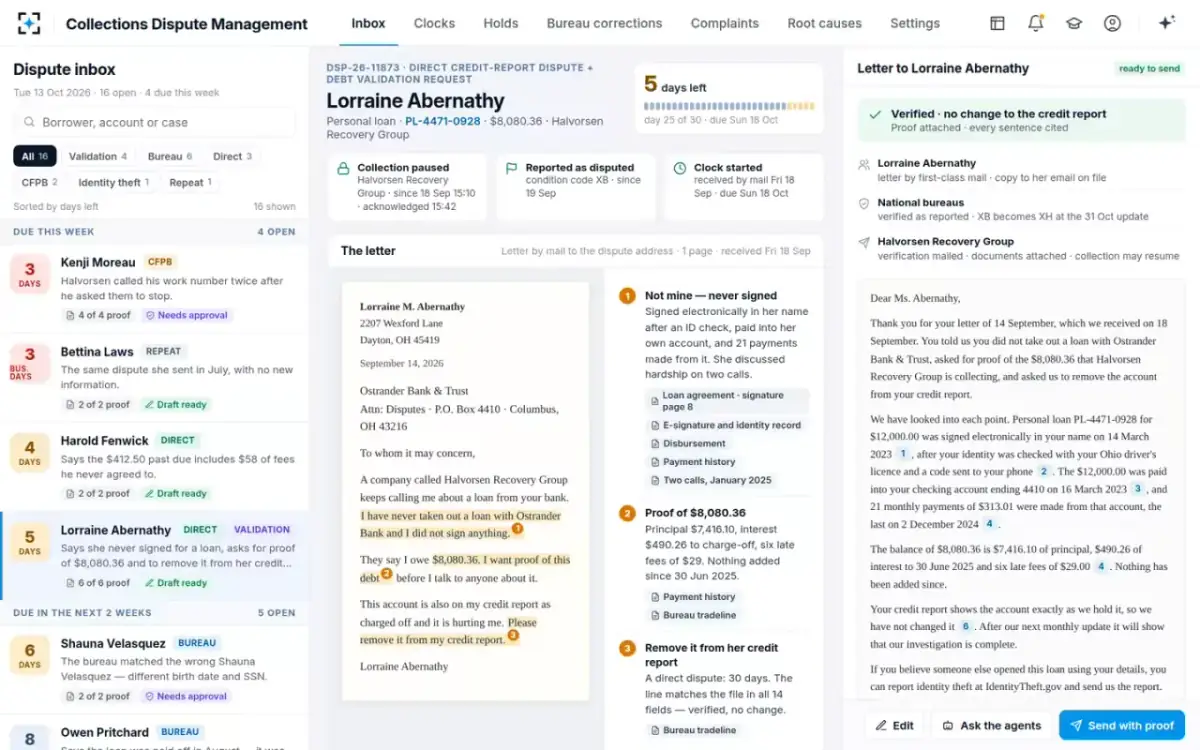
The pile, sorted by the days each dispute has left
The complaints specialist and the fifteen-day clock
Complaints are a different seat because the audience is different. A dispute is answered to a borrower; a company response to a complaint is answered to a borrower and to a regulator at once, in a portal that records whether it was timely. The Bureau's own measure is a response within 15 calendar days of the company receiving the complaint, with an interim explanation and a final response inside 60 calendar days where it cannot be closed sooner.
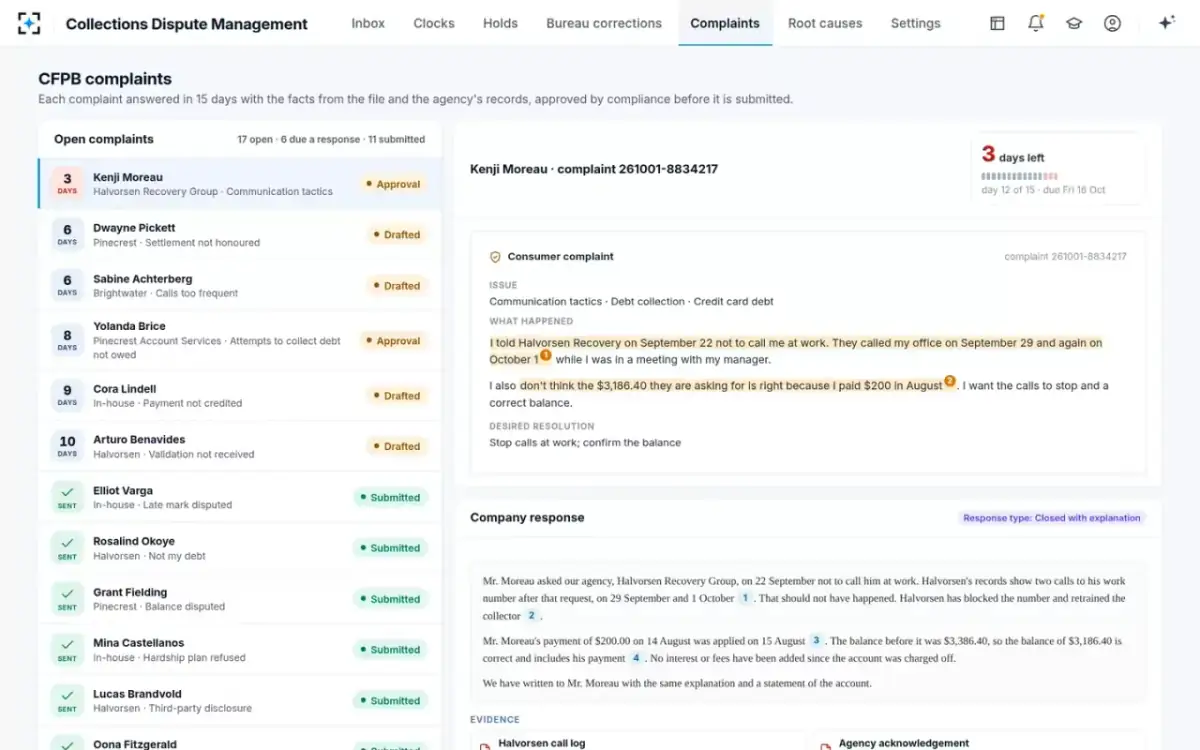
Fifteen days is ample unless the evidence is somewhere else, which on a collections complaint it usually is. In the demonstration lender's sample book a borrower complains that an agency called his work number after he asked them to stop, and that his balance is wrong. Both halves of the answer live outside the lender: the calls are in the agency's own call log, and the balance turns on a payment applied weeks earlier. The drafted company response admits the two calls from the agency's log, shows the payment applied and the balance as correct, and goes to the compliance manager before it is submitted.
Each complaint on its own fifteen-day clock, with the answer drafted from the records
The agency lead, and the contact nobody saw
The fourth seat exists because a lender's duty does not stop at the lender's own staff. The Interagency Guidelines list, among the policies a furnisher should maintain, "providing for appropriate and effective oversight of relevant service providers whose activities may affect the accuracy or integrity of information about consumers furnished to consumer reporting agencies". An agency that keeps collecting on a paused account, or that reports a settlement back late or not at all, is affecting accuracy at the lender's expense.
Effective oversight here is mostly a reading habit with teeth, and it is specific enough to write down. Read the agency's call log and letter log rather than its monthly summary, because a summary is the agency's account of itself. Read them on a fixed schedule, daily rather than monthly, since the value of finding a contact after a hold decays quickly — a breach found the next morning is a conversation, and one found at the quarterly review is a complaint with a paper trail. Reconcile what the agency reports back about settlements and payments against what the servicing system shows, because an unreported settlement becomes a credit-reporting error with the lender's name on it. And keep the escalation path short: the lead needs to be able to stop placements at one agency without convening anybody.
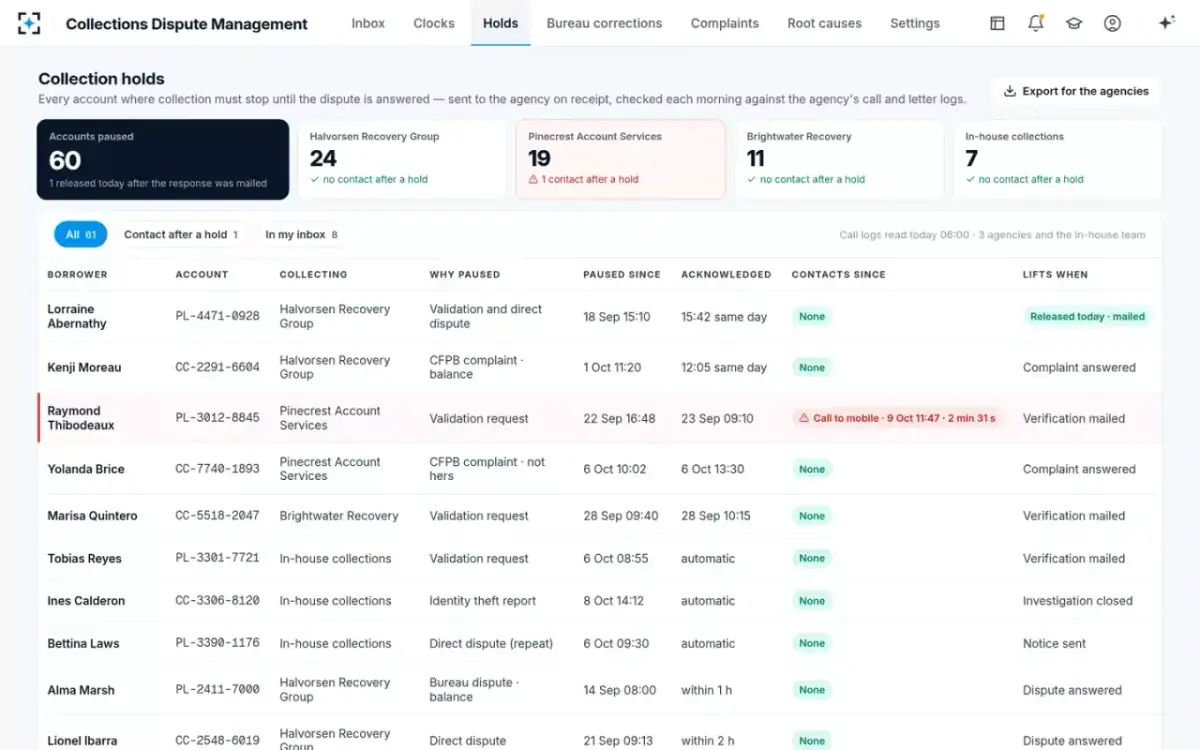
What the seat does is read the agencies' own records rather than their assurances. In the demonstration lender, every agency's call and letter log is read at six each morning; a pause has to be acknowledged within four hours or it is escalated. In the sample book that routine turns up one contact: an agency called a borrower's mobile seventeen days after collection on his account had been paused. Nobody at the agency flagged it. It was found by reading the log.
Every paused account, by agency, with its acknowledgement and anything since
What the desk looks like when reading and gathering are done first
Three things change, and only one of them is speed.
The first is the order of the pile. A queue sorted by the day each dispute arrived is a queue that will miss dates, because three of the five clocks start before the envelope is opened. Each door's clock, and what starts it sets out why. A queue sorted by days remaining fixes that without anyone working faster.
The second is what the analyst reads first. With the claims split out in the borrower's own words and the records already gathered and cited, the first thing on the screen is the question rather than the search. The judgement happens at the start of the hour instead of at the end of it.
The third is what the seat becomes. Taking retrieval off a desk does not make an analyst a reviewer of machine output; the draft is a draft, and it is changed often. It makes the analyst the person who decides whether the lender got it right — which is what the job description always said, and what the thirty minutes in four systems never left room for. Where automated verification has to stop draws that boundary from the enforcement record, and what to ask before buying anything for this desk turns it into questions. To see the four seats working one dispute, start from Collections Dispute Management.
Questions people ask
What does a disputes analyst own in the dispute procedure?
Read incoming disputes and identify the rule and the deadline each falls under; pause collection where the rule requires it and confirm the agency has done so; gather the records that answer the specific claim; compare what was reported with what the records show, field by field; and write and send a reply the borrower can check. The analyst sends verified responses. A change to a credit file goes to a separate approver.
What skills does a credit dispute desk need?
Close reading, because the dispute is in the borrower's sentences rather than in the category it was filed under. Fluency in the lender's own systems, since the evidence is scattered across origination, servicing, payments, calls and the furnishing file. Enough knowledge of the FCRA, Regulation V and Regulation F to know which clock is running and what may be declined. And plain writing: a reply that cannot be understood produces a second dispute.
Should disputes sit in compliance or in operations?
The usual answer is both, split along the approval line: the drafting and sending sit in operations, and the approval of any change to a credit file sits with compliance. What matters more than the reporting line is that the two are different people and that the approval attaches to the field values, since that is what will be examined.
What does a dispute analyst do when the borrower is right?
Say so, in the reply, and set out exactly what will change. In practice that means writing the corrected field values before and after, sending them to an approver, and then making the same change at every bureau the account is reported to on the same day — with the borrower told and any fee charged in error refunded. Half a correction, made at one bureau, is the failure this step exists to prevent.
How is the work different on an account placed with an agency?
The records and the risk both move outside the building. The pause has to reach the agency and be acknowledged, the evidence for a complaint about conduct is in the agency's own call and letter log, and a settlement the agency does not report back becomes a credit-reporting error the lender owns. That is why a fourth seat watches agency conduct: the furnisher's accuracy duties follow the account wherever it is being worked.