Automated credit dispute verification is software answering a credit-report dispute: reading the dispute as it arrives, finding the account, pulling the records that bear on the claim, comparing the tradeline with the file and producing a response. The question every head of collections eventually has to answer is not whether to automate it but how far automation may go before a person has to decide — and that line is already drawn, in a consent order and in two sets of examiner findings. It is drawn in an unexpected place: not at reading or gathering, which examiners would like more of, but at concluding from too little, and at changing a credit file without a name against the change. Botminds' Collections Dispute Management is built to that line — six specialist agents read, clock, pause, gather and draft, and they never send, never change a credit file without approval and never lift a collection hold before the response is mailed.
What follows is the line as the published record draws it, then the test to put to any product that claims to automate this work, including ours. The worked figures come from the solution's own demonstration run on a fictional sample lender; they are labelled where they appear and they are not a customer's measured result.
What the absence of investigation cost one bank
22,000+
indirect disputes where no investigation at all was performed
7months
with direct dispute investigations not conducted, after resources moved elsewhere
$20M
civil money penalty, with $7.76 million set aside for redress
2017–2021
the period the Bureau examined for both dispute duties
What is automated credit dispute verification?
The phrase gets used for two different things, and a buyer should separate them before the first demonstration. The first is the exchange itself: disputes travel between the credit bureaus and lenders as structured messages — an automated consumer dispute verification form carrying a two-digit dispute code, a short consumer statement and the fields in question — and the lender replies in the same structure. That rail is automated by design and has been for years.
The second is the answer. Software that automates verification reads the dispute, resolves it to an account, decides which records could settle each claim, retrieves them, compares the furnished line against them field by field, and drafts the reply the rail will carry. The first is plumbing; the second is the investigation the FCRA requires, and the enforcement record is entirely about the second. A product that automates the message and leaves the investigation to whoever is logged in has automated the wrong half.
The difference shows up most sharply on the disputes where identity is the question. A borrower who says the account is not hers may be describing a mixed file — two people with similar names and a shared address history, or a bureau that matched the right name to the wrong birth date and social security number. No comparison of the furnished line against the lender's own file can resolve that, because both files agree with each other and neither is about the right person. The answer lives in the signing record, the identity check behind it and the account the money was paid into, and a dispute process that cannot reach those three has no way to tell a mixed file from a liar.
There is a third thing the phrase hides: deciding. Someone has to conclude that the line is right, or wrong, or unverifiable — and when it is wrong, to authorise a change to a person's credit file. That is a decision with a consequence for the borrower, and it is the part of this work that the published record keeps putting back into human hands.
Is an automated dispute response a reasonable investigation?
It can be, and the deciding factor is where the software looked. The CFPB's examiners described the failure mode in December 2024, in findings about debt collectors that had automated their replies, and the detail that mattered was not the automation but the blind spot:
In each instance, the furnishers' automated systems did not consider any records of the furnishers' clients—i.e., the entities, such as creditors, on behalf of which the furnishers were collecting debts—relevant to the dispute.
CFPB, Supervisory Highlights, Issue 37 (Winter 2024)
Read that as a design specification. The systems were fast, consistent and entirely inside their own four walls. They confirmed disputed information against the record that had produced it, which is a tautology dressed as a verification. Nothing in the finding suggests the examiners wanted a human to do the comparing instead; what they wanted was for the comparison to reach the records that could answer the borrower's claim. An automated process with a wide search radius is closer to the standard than a manual one with a narrow radius — a point developed in what a reasonable investigation requires under the FCRA.
The statute sets the floor plainly: on notice of a dispute from a bureau, the furnisher must review all of the relevant information the bureau provided with it (15 U.S.C. §1681s-2(b)(1)(B)). Relevant information arrives as a code, a sentence, and sometimes an image. A process that parses the first and ignores the second two has not reviewed it.
The sentence that draws the line
The clearest statement of what automation may not do is a sentence about what some collectors did instead of investigating. Examiners found furnishers whose agents had access to their clients' systems and did not open them: "Rather than reviewing their clients' records to which they had access to assess the accuracy of the disputed information, the furnishers' agents forwarded the disputes to the clients for investigation and, when the clients failed to respond, instructed CRCs to delete the related consumer tradelines" (Supervisory Highlights, Issue 37).
Three decisions are buried in that sentence, and automation can legitimately take only one of them. Deciding which records bear on the claim: automatable, and done better by software that knows every system the answer could be in. Deciding whether what the records show confirms, contradicts or fails to settle the claim: a judgement with a borrower on the other end of it. Deciding to remove a tradeline because nobody answered an email: not a decision anyone should be making, by hand or otherwise.
One dispute, step by step: what software may do, and what a person must
Software may: Read the letter, email, bureau message or complaint; find the account; split the text into the separate claims, in the borrower’s own words.
A person must: Nothing, until the match is doubtful — a mixed file or a near-identical name goes to a person before anything else happens.
Software may: Start the right clock from the rule and the receipt date, and show the days left.
A person must: Set the rules the clocks come from, and own the escalation when one is about to run out.
Software may: Pause collection on receipt, send the pause to the agency, record the acknowledgement, chase a missing one.
A person must: Release the hold — and only once the response has gone.
Software may: Pull the agreement, the signing record, the disbursement, payments, calls, agency logs and the tradeline as furnished, each cited to a page or line.
A person must: Nothing. This is the step examiners want more of, not less.
Software may: Compare the furnished fields with the file, field by field, and show both columns.
A person must: Read the comparison where it disagrees, and decide what the disagreement means.
Software may: Propose an outcome with the records behind it.
A person must: Conclude. Verified, inaccurate or incomplete, or cannot be verified — with a name and a date.
Software may: Lay out the change field by field, before and after, and prepare it for every bureau at once.
A person must: Approve it. A change to a person’s credit file is signed, not inferred.
Software may: Draft the borrower’s letter, the bureau response and the complaint response, every sentence cited.
A person must: Send. Nothing leaves without the person whose name is on it.
What software may read, gather, compare and draft
The work automation does well in a dispute is the work that is mechanical and currently slow: reading a one-page letter and finding the account it is about, working out which clock applies, pausing collection at the agency, and retrieving six records from four systems. On the fictional sample lender, those steps run as five in sequence and finish in under half a minute.
Twenty-six seconds, step by step, in Collections Dispute Management
Notice what the fast part is not. It is not the answer. At the end of those 26 seconds the file holds a dispute split into three claims, six records open at the passages that bear on them, a field-by-field comparison and a draft — and no decision. The analyst arrives at a desk where the reading and the fetching are finished and the judgement is untouched, which is the opposite of the arrangement examiners criticised.
The drafting deserves its own caution. A drafted response is a convenience that becomes a liability the moment it stops being read, because a fluent letter is a persuasive thing to sign. Two habits keep it honest: every sentence carries the citation it rests on, so a reader can check a claim in one click; and the draft answers the borrower's claims in the order the borrower raised them, rather than in the order the lender finds convenient.
What a person must decide, and sign
Four statutory duties attach to a dispute, and each leaves a different kind of evidence. Automation can carry all four as far as the point of judgement, and no further.
The four duties on a disputed line, and who discharges each in Collections Dispute Management
Investigate the disputed information
Who does whatSoftware gathers; a person is accountable for the conclusion
What it leaves behindEvery system searched and what each returned, including the searches that found nothing
Review all relevant information the bureau sent
Who does whatSoftware reads the code, the consumer statement and any attachment
What it leaves behindThe borrower’s words, kept separate from the lender’s paraphrase of them
Report the result inside the clock
Who does whatA named person sends; software proposes and times
What it leaves behindThe response, the day it went, and the days left on the clock when it did
Correct at every bureau the line was furnished to
Who does whatA named approver, then one dispatch to all of them
What it leaves behindThe field-by-field change, the approver, and a delivery mark against each bureau
The fourth row is where lenders most often fall short, and it is also the one automation improves most. When a borrower is right, the duty runs to every nationwide bureau the information was furnished to — not only the bureau that forwarded the dispute. Done by hand, that is three separate updates with three chances to forget one. Done once, from an approved change, it is a single dispatch and three delivery marks.
Can automation close a dispute without a person?
Technically, yes; defensibly, no — and the distinction is the whole argument. Nothing in the FCRA says a human must read a dispute. What the statute says is that the furnisher must investigate, report accurately, and correct everywhere. The reason a person belongs at the end of the chain is evidentiary: an outcome with a name and a time against it can be explained two years later, and an outcome that appeared because a rule fired cannot be explained at all once the rule has changed.
The 2024 consent order shows the shape of the failure when nobody is accountable for the conclusion. Even where investigations were performed and returned inside 30 days, the order finds, "Respondent's representatives did not review all relevant information provided by the CRA or did not accurately report the results of the investigation to the CRA" (2024-CFPB-0009). Automation makes that failure cheaper to commit at scale and harder to see, unless each conclusion carries the name of someone who could have refused it.
One approval, three nationwide bureaus the same day
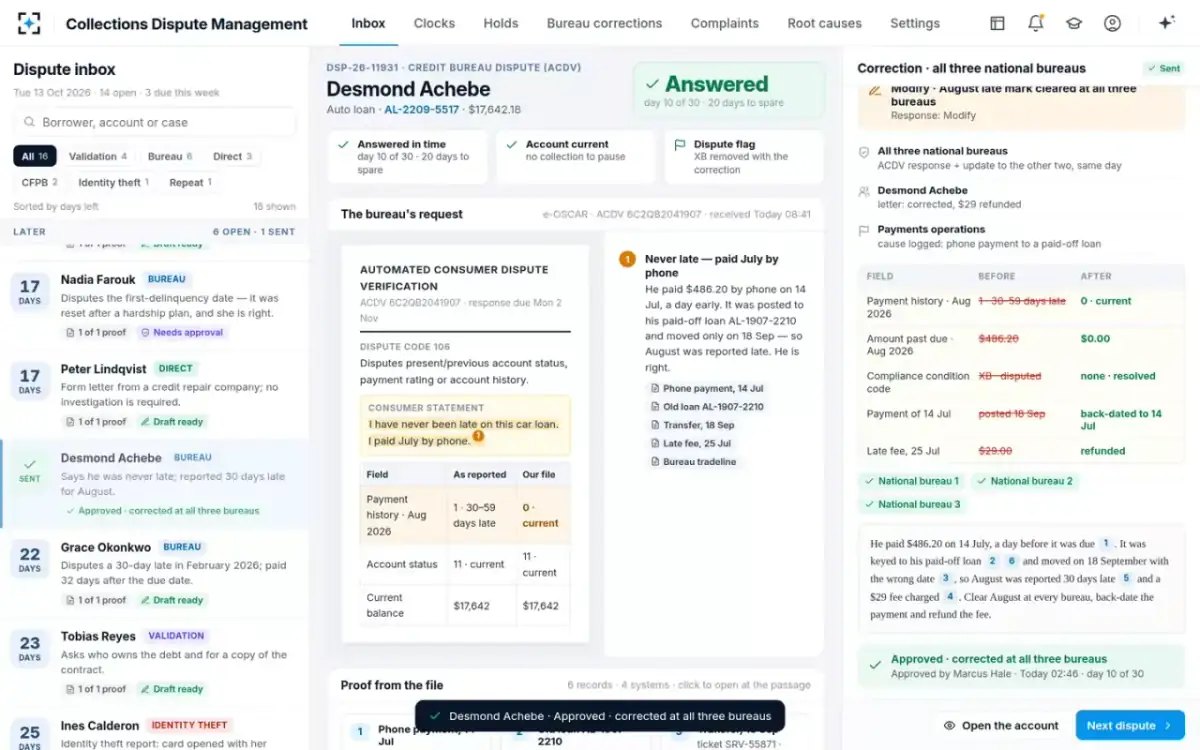
The hold automation may set and may not lift
A collection hold is the one place in this work where automation is strictly better than a person, because the duty is immediate and the failure is invisible. When a validation request arrives, collection on the disputed debt stops until the verification is mailed; when a dispute is in flight, the account is reported as disputed. Both are mechanical, both must happen the hour the dispute lands, and neither is interesting enough to be reliable when it depends on someone remembering.
There is a second mechanical duty beside it, and it is the one most often missed. While a dispute is open, the line must go out marked as disputed, which means the compliance condition code has to be set at the next reporting update and cleared when the dispute closes — on the sample lender's file the flag is set with the update that follows receipt and changes at the month-end update after the response goes. Furnishing a disputed line without that mark is the finding examiners described in April 2024, when they found furnishers that received direct disputes and kept furnishing the disputed information without telling the bureaus it was disputed. It is a one-character omission and a clean violation, which is exactly the kind of work to take away from people.
Lifting the hold is a different act. It asserts that the response has gone, and a hold lifted a day early is a collection call the lender cannot defend. In the solution the release is bound to the mailing, not to the outcome: the hold ends when the response is sent, whatever the response says. The other half is watching the agencies, because a pause sent is not a pause honoured — the agencies' own call and letter logs are read every morning, and a contact after a hold is escalated rather than filed.
Sixty paused accounts, and the one contact that should not have happened
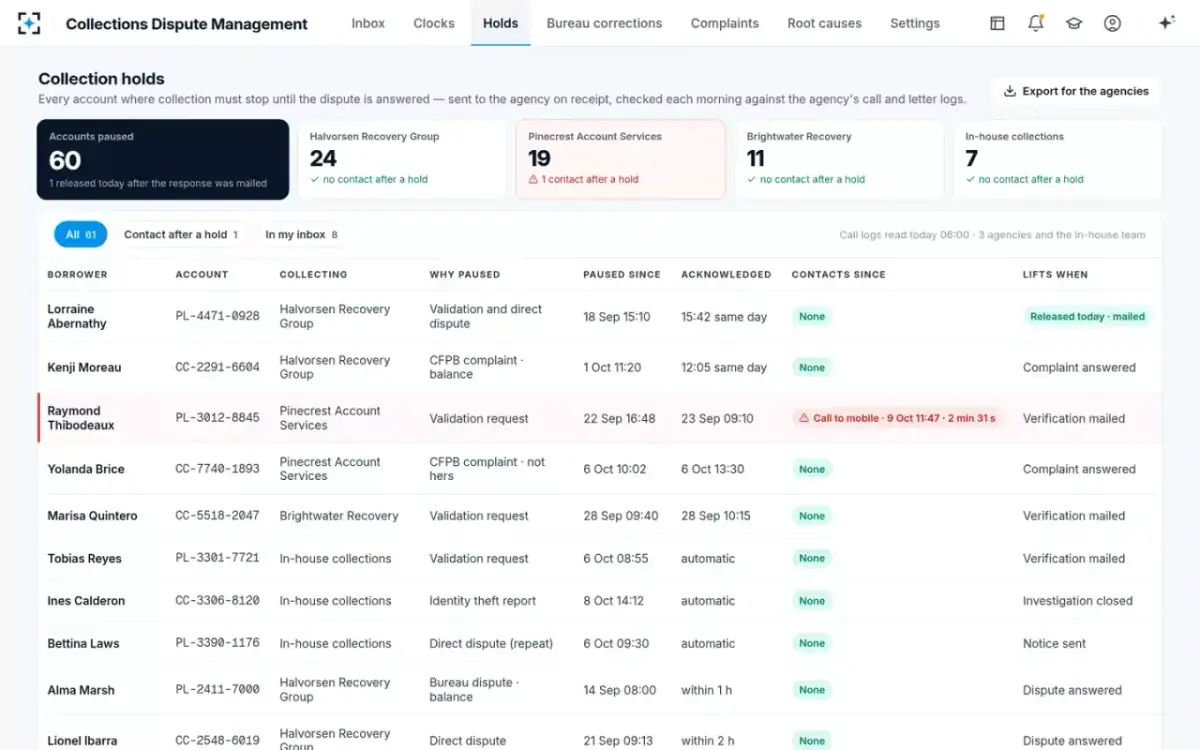
Auditing the machine: the trail a reviewer walks
An automated dispute process has to be auditable in two directions: one dispute at a time, and in bulk. The interagency guidelines point at the second: internal controls over accuracy and integrity, including standard procedures and checks on random samples of what was furnished (Appendix E to Part 1022, III(d)). Sampling is how you test a process that answers thousands of disputes the same way; reading one file is how you test whether it answered that one correctly.
Four things make a file walkable. Every sentence of the response points to the document and page it rests on. Every record is cited to a page, a line or a timestamp, and opens there. The rules in force when the dispute was worked are recoverable, with their version, because a clock or an approval threshold that has changed since cannot be used to explain what happened. And the sequence is dated: who read, who gathered, who drafted, who approved, who sent, with times.
In bulk, the number to watch is the spread of outcomes. A process whose answers cluster on one outcome is either serving unusually clean data or not looking: the courts have made the same point from the other side, where a furnisher that matched its own records and reported "verified" was sent to a jury (Hinkle v. Midland Credit Management, 11th Cir. 2016). Outcome mix, citation count per response, and the share of disputes answered without opening any record outside the collections system are three measures worth putting on a monthly report.
What to ask a vendor about automated dispute handling
Nine questions separate a product built to this line from one built for a demonstration. Ask for evidence rather than a claim: in each case there is an artefact the vendor can show you from their own sample data in five minutes, and a reaction that should end the conversation.
Nine questions for anyone selling automated dispute verification
- Which systems does an answer reach, beyond the one the disputed line came from?
Ask to see a dispute answered from origination, servicing, payments and a call log. "We integrate with your core" is a roadmap, not an answer.
- Show me a response where every sentence cites the record it rests on
Then click one citation. If it opens the system rather than the page, the citation is decorative.
- What happens when the record that would settle the claim does not exist?
The honest answers are: ask the borrower, ask the client, or report that it cannot be verified. "It verifies against our data" is the finding examiners wrote up.
- Who can change a credit file, and what does the approval look like?
You want a field-by-field before-and-after, a named approver and a timestamp. A role with a toggle is not an approval.
- When a correction is approved, how many bureaus get it, and how do I know?
A delivery mark against each nationwide bureau the account is reported to. One bureau corrected is a finding waiting to happen.
- What does it do the hour a dispute arrives?
Pause collection at whoever is collecting, record the acknowledgement, and report the account as disputed at the next update — before anyone reads anything.
- How does it know an agency called an account that was on hold?
By reading the agency’s own call and letter logs on a schedule. Trusting the agency’s own exception report finds nothing.
- Can I see the rules that were in force on a dispute closed last year?
Versioned clocks, holds and approval rules. If the current settings are the only settings, last year’s file cannot be explained.
- What is the outcome mix across a quarter, by cause?
A product that cannot tell you why disputes happen is a response generator, not a dispute process.
One more, for the room rather than the vendor: what will your own people do with the time? The answer that holds up is the one in the examiner findings — more places looked at per dispute, and a person reading the disagreements. The answer that does not is more disputes closed per analyst per day. For how the seats change, what a credit dispute analyst does all day walks the desk, and what to ask before you buy dispute software covers the rest of the selection.
Questions people ask
Can software investigate a credit dispute?
Software can perform most of the investigation: read the dispute, find the account, decide which records could settle each claim, retrieve them and compare them with what was furnished. What it should not do is conclude from records that cannot answer the claim, or change a credit file without a named approval. The CFPB's 2024 findings criticised automated systems for their search radius, not for being automated.
What did the CFPB say about automated dispute systems?
In Supervisory Highlights Issue 37 (Winter 2024) examiners found that furnishers using automated dispute response systems that reviewed only their own systems of record failed to conduct reasonable investigations, and that in each instance those systems did not consider any records of the clients whose debts were being collected. The same report says a reasonable investigation often requires reviewing relevant information in the furnisher's possession and, in some cases, requesting third-party documents it reasonably has access to.
Who has to approve a credit report correction?
The law names no job title; it requires the correction to be made and reported to every nationwide bureau the information was furnished to. In practice a lender names an approver because a change to a credit file is a consequential act that has to be explainable later. In Collections Dispute Management every modify, every delete and every complaint response goes to the collections compliance manager, and identity theft cases get a second reviewer from the fraud team.
Can automation close a dispute without a person?
It can be configured to, and the risk is evidentiary rather than technical. An outcome nobody signed is an outcome nobody can explain when the rules have since changed, and it removes the one control that catches a confidently wrong answer. The defensible pattern is automation up to the point of judgement, with a person concluding and sending.
Does automation make a dispute response faster or better?
Both, if the time it frees goes into looking in more places rather than closing more cases. On the sample lender the reading, clocking, pausing and gathering take 26 seconds against most of an hour by hand — but the measure that matters to an examiner is how many systems the answer touched and whether every sentence cites a record.
What should a vendor be able to show in a first demonstration?
A dispute answered from at least three systems, a response whose citations open at the page, a field-by-field correction with a named approver, a delivery mark against each bureau, and the rules that were in force when an older dispute was closed. All five are five-minute asks, and a product that cannot show them is tracking disputes rather than answering them.