When a borrower says the date of first delinquency is wrong, they are disputing the only field on a tradeline that decides when the tradeline stops existing. Everything else on a charged-off account — the balance, the status, the payment history — describes the debt. This one sets its expiry: the seven-year period that removes a collection or charge-off from a credit report is measured from it, and a date set a year too late keeps the item on the report for a year longer than the law allows. It is also the field least likely to have been set by a person. Botminds' Collections Dispute Management checks it on every dispute, against the payment history in the servicing file rather than against last month's furnishing file, and proposes a correction that goes to every bureau the account is reported to.
The fictional lender, borrowers and accounts described below are sample data from Collections Dispute Management's own demonstration data. The dates worked through in the figures are arithmetic from the statute, not from any real account.
From a missed payment to the month the tradeline must go
The missed due date
15 April · payment not made
The event the whole chain hangs on. It is in the servicing record, with the amount due and the amount received.
Servicing
Thirty days
15 May · the delinquency commences
The examiner’s own description of the correct setting for the furnishers it reviewed: 30 days after the missed payment due date, not the start of the next statement cycle.
Credit reporting
A hundred and eighty days
11 November · the seven-year period begins
FCRA §605(c)(1) starts the seven years on the expiry of the 180-day period that begins on the commencement of the delinquency.
The statute
Seven years
11 November, seven years later · the item must go
FCRA §605(a)(4) bars reporting a collection or charge-off that antedates the report by more than seven years. Seven years and nearly seven months after the missed payment.
The bureau
What happens when the date of first delinquency is wrong
Three things, in rising order of cost. The first is arithmetic: the item leaves the report on the wrong date. A date set too late keeps a charge-off visible past its seven years, which is reporting the law does not permit; a date set too early removes it before the period is up, which is inaccurate in the other direction and costs the lender information it was entitled to report.
The second is that the error is invisible in the usual checks. A tradeline with a wrong date of first delinquency looks entirely normal: the balance reconciles, the status matches, the payment history matches. Nothing in a routine comparison between the furnishing file and the servicing system will show it, because both hold the same wrong value. It surfaces only when somebody recomputes the date from the payments themselves, or when the borrower notices that an old account is still there.
The third is that it is almost never a single account. The field is set by a batch job against a rule, and a rule that is wrong is wrong everywhere it applies. The Bureau's examiners describe exactly that pattern — furnishers continuing to report dates of first delinquency inaccurately for months after determining they were doing so because of system coding issues, then conducting lookbacks to identify and remediate the accounts affected. One borrower's dispute about one date is usually a sample.
How do you calculate the date of first delinquency?
From the account's own payment history: find the payment that was missed and never made good, and take the point at which the account became delinquent and stayed delinquent through to the collection activity or charge-off that is being reported. The statute does not spell out a formula, but it is precise about which delinquency counts and how the date is expressed.
A person who furnishes information to a consumer reporting agency regarding a delinquent account being placed for collection, charged to profit or loss, or subjected to any similar action shall, not later than 90 days after furnishing the information, notify the agency of the date of delinquency on the account, which shall be the month and year of the commencement of the delinquency on the account that immediately preceded the action.
15 U.S.C. §1681s-2(a)(5)(A)
Three words in that sentence do most of the work. Commencement: the date is the beginning of the delinquency, not the date of charge-off, not the date of placement, not the date the account was last paid. Immediately preceded: where an account has gone delinquent, been brought current and gone delinquent again, the relevant run is the one that ran straight into the charge-off. And month and year: the reported field is a month, which means a dispute about a day is really a dispute about which month the delinquency commenced in — and makes an error of two weeks either invisible or a whole month, depending on where in the month the due date falls.
The second half of the arithmetic is in §605. The seven-year window is not measured from the date of first delinquency itself: the period "shall begin … upon the expiration of the 180-day period beginning on the date of the commencement of the delinquency which immediately preceded the collection activity, charge to profit and loss, or similar action". The reportable life of a charged-off account is therefore 180 days plus seven years from the commencement of the delinquency, which on the dates in the figure above is seven years and nearly seven months after the payment was missed.
The 90-day duty, and the month and year it names
The duty in §623(a)(5)(A) is to notify the bureau of the date of delinquency within 90 days of furnishing the information about the delinquent account. It is easy to satisfy and easy to miss, because it is a second step after the step everybody remembers — reporting the charge-off itself. The consequence of missing it is a tradeline the bureau cannot age: it knows the account was charged off, and it does not know when the seven years begin.
That failure is enforceable on its own. The Bureau's 2024 consent order against a national bank found that for at least 13,000 retail card accounts the bank failed to furnish the date of first delinquency where it was required to do so, and that this violated §623(a)(5)(A). The same order recorded that "between 2017 and 2021, at least 2,348 Direct Disputes were not timely investigated" — a reminder that the field and the dispute process usually fail at the same institution, because both are downstream of the same unattended system.
Two coding errors an examiner has already named
The Bureau's Spring 2024 supervisory report is unusually specific about how this field goes wrong, which makes it a good place for a credit reporting lead to start a self-review. Two findings are worth quoting as written.
The first is a rule error in the batch. Examiners found that "coding errors resulted in furnishers inaccurately reporting dates of first delinquency as the first day of the statement cycle following the consumer's missed payment, rather than 30 days after the missed payment due date". The gap is days rather than months, but because the field is reported as a month and a year, a shift of a fortnight moves the reported month whenever the due date falls in the second half of it — and it does so for every account the rule touches.
The second is a rule error about bankruptcy. Where accounts should have been reported as current with dates of first delinquency reflecting the bankruptcy filing dates, examiners found furnishers had not updated them: "by failing to update the dates of first delinquency for the accounts in bankruptcy when they determined the accounts were in bankruptcy, the furnishers failed to promptly update or correct information they had determined to be incomplete or inaccurate". The failure here is not the original setting but the refusal to revisit it after the facts changed.
The same review named a third pattern, which is the subject of the next section: furnishers reporting dates of first delinquency as more recent than they should have been, including by changing the date for accounts that remained delinquent month after month.
What is re-aging a debt, and why it is the same bug twice?
Re-aging is moving the date of first delinquency forward, so that an old debt looks newer than it is and stays on the credit report longer than it should. It is what the third finding above describes, and it has two quite different causes that produce an identical outcome.
The first cause is a batch that treats every month of delinquency as a fresh one. An account that goes unpaid month after month is, on the system's reading, newly delinquent each month, and the date creeps forward with the calendar. Nobody decided to do it. The second cause is an event that resets a status field the date is derived from: a transfer between systems, a settlement posting, a placement with an agency, a hardship arrangement. In both cases the date of first delinquency is being computed from the account's current state rather than from its history, and that is the bug — the field is historical, and a field that is derived from the present cannot hold the past.
The same account on the report, with the date set once and with the date moved each month
- Missed payment to the seven-year clock starting
- Seven years on the report84 months
- The date creeps forward with the calendar14 months
- Then the same seven months
- Seven years on the report84 months
Fourteen months is not a rounding error on a credit file. It is the difference between a mortgage application that sees a charge-off and one that does not. And because the second lane's arithmetic is internally consistent — 180 days plus seven years, correctly applied to the wrong start — every check that verifies the calculation will pass.
Hardship plans, settlements and the date that must not move
Four everyday servicing events put pressure on this field, and each one has a right answer that is easier to state than to implement.
What the furnishing batch does, and what the account file says, in the four cases that break the date
What a batch derived from current status tends to do: Treats each month’s delinquency as a new one and moves the date forward with the calendar.
What the account file supports: One unbroken run of delinquency ran into the charge-off. Its commencement is the date, and it does not move because time passed.
What a batch derived from current status tends to do: Resets the delinquency status when the plan starts, and derives a new date from the reset.
What the account file supports: A plan changes how the account is reported going forward. It does not undo the delinquency that preceded it, and the date of first delinquency stays where it was unless the account is genuinely brought current.
What a batch derived from current status tends to do: Treats the payment as activity and re-derives the date from it.
What the account file supports: A payment after charge-off changes the balance and the status. The commencement of the delinquency that preceded the charge-off is a fact about the past and is unaffected.
What a batch derived from current status tends to do: Carries over what the new system can map, and defaults the date to the transfer or placement date where the field does not map.
What the account file supports: The date travels with the account. The guidelines require transfers to be handled so that re-aging and duplicative reporting do not occur, which means the field has to be mapped deliberately, not defaulted.
The bankruptcy case is the exception that proves the rule, and it runs the other way. There the Bureau's examiners found furnishers at fault for not moving the date — because once an account is determined to be in bankruptcy and should be reported as current with a date reflecting the filing, leaving the old date in place is a failure to correct information the furnisher knows to be inaccurate. The principle is consistent: the date follows the account's documented history, and it changes when and only when that history changes.
When the account is sold: who owns the date
A sold debt is where this field is most often lost, because the party reporting it is furthest from the records that set it. The Interagency Guidelines address the risk directly, listing among a furnisher's policies the handling of information "following mergers, portfolio acquisitions or sales, or other acquisitions or transfers of accounts or other obligations in a manner that prevents re-aging of information, duplicative reporting, or other problems that may similarly affect the accuracy or integrity of the information furnished".
Courts have read the practical consequence into the investigation standard. In a case about a debt buyer that held almost no account-level documentation, the Eleventh Circuit held that "whether a furnisher's investigation is reasonable will depend in part on the status of the furnisher — as an original creditor, a collection agency collecting on behalf of the original creditor, a debt buyer, or a down-the-line buyer — and on the quality of documentation available to the furnisher". A buyer that cannot prove the date from documents is not excused from the duty; it is in a worse position, because what it can defend is limited to what it holds.
For a lender selling debt, the lesson runs in the other direction. The date of first delinquency and the records that establish it are part of what is being sold, and a sale file that omits them produces a tradeline somebody else will have to defend with nothing. For a lender buying, it is a diligence item with a seven-year tail.
Proving the date from the account, not from the last file
The only defensible way to answer a dispute about this field is to recompute it. Take the payment history as applied, find the due dates and the payments against them, identify the unbroken run of delinquency that preceded the charge-off, and show the month that run commenced with the payment record that proves it. That is a different exercise from reading the field out of the furnishing file, and it is the one that catches a rule error — because a rule error reproduces itself identically in every file it has ever written.
The account from origination to dispute, with every payment
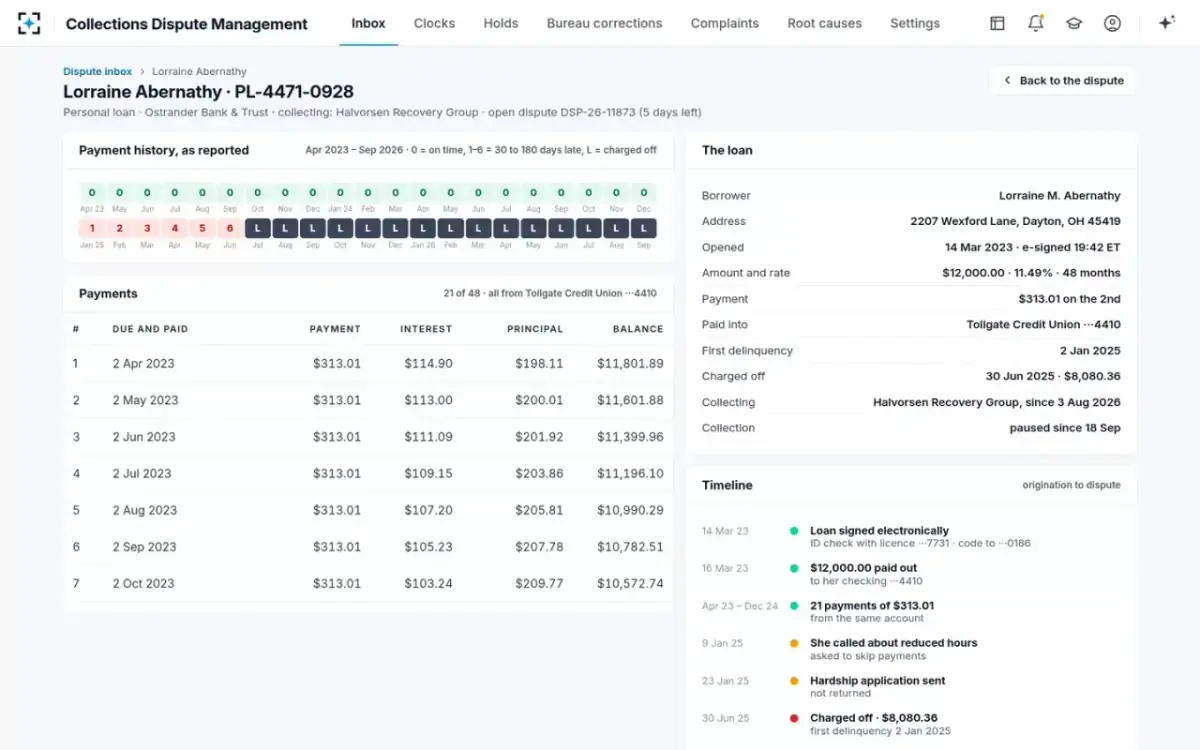
In the demonstration lender's sample book the check runs on every dispute, not only on those that name a date. The reporting checker compares the tradeline with the servicing file field by field — status, balance, amount past due, payment history, date of first delinquency and condition code — and proposes verify, modify or delete on the whole set. A borrower who disputes a late mark and is right about that will often have a second error nobody asked about, and the field-by-field pass is what finds it. Why the dispute code is the wrong thing to answer makes the same argument from the other end.
Fixing it at every bureau, on one approval
A correction to a credit file is an assertion about a person, so in the demonstration lender it goes to a named approver — the collections compliance manager — as a before-and-after table rather than as a ticket. What is approved is the set of field changes, and what then happens is the part furnishers most often truncate: §623(b)(1)(D) requires a furnisher that finds the information incomplete or inaccurate to report that result to every nationwide consumer reporting agency it furnished the information to, not only to the one that raised the dispute.
One approved correction, field by field, and the record behind each value
| The field | As reported | As corrected | What proves it |
|---|---|---|---|
| Payment history, August | 30 days late | Current | The payment record: $486.20 received by telephone on 14 July, a day before the due date |
| Where the payment went | Applied to a loan closed in 2019 | Applied to the open loan, back-dated to 14 July | The posting record showing the misdirected payment and the date it was moved |
| Amount past due | $486.20 | $0.00 | The balance after the payment is applied where it belongs |
| Late fee | $29 charged | Refunded | The fee record, and the reversal |
| Condition code | Account in dispute | Removed | The dispute, closed as a correction |
| Date of first delinquency | Not reported — the account is not delinquent | Unchanged | The payment history, which shows no unbroken delinquency to report |
Approved once, delivered to all three nationwide bureaus the same day
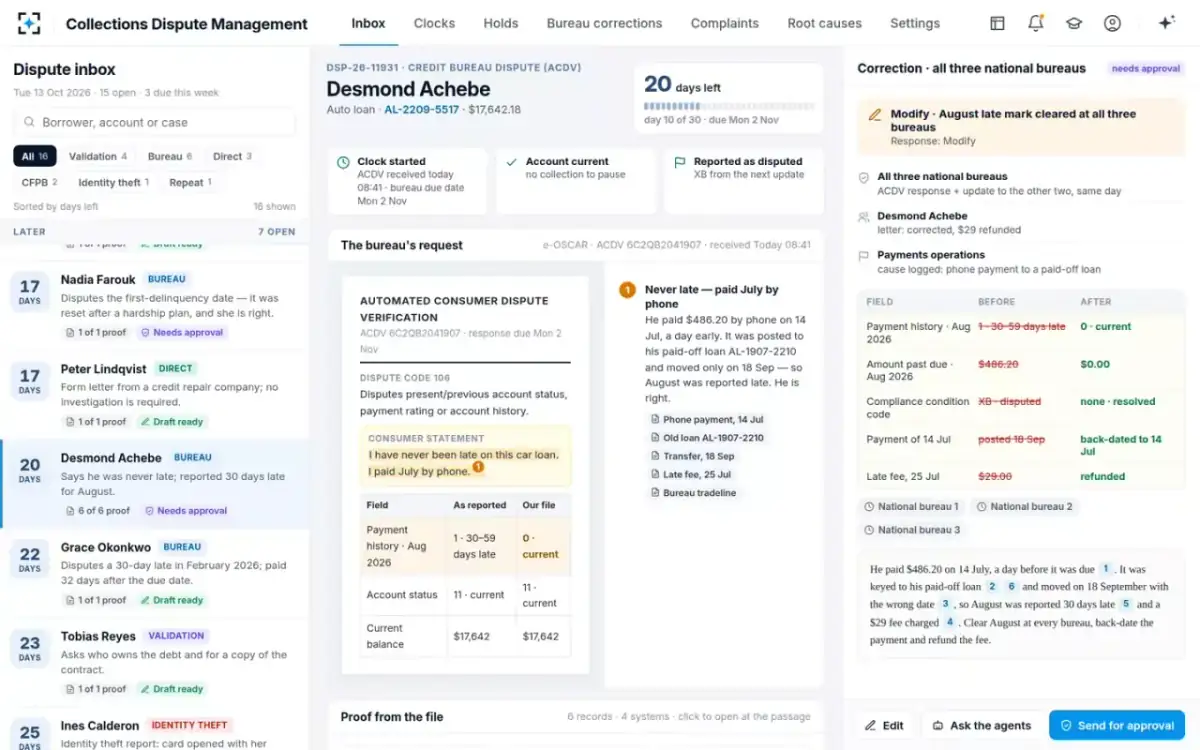
That last rule is where a date correction most often half-fails. A borrower who disputes with one bureau gets the fix at that bureau; the other two keep the old date, and the item ages out of one report two years before the others. What a reasonable investigation has to establish covers the standard the recomputation has to meet, and what reporting software fixes and what it does not is the question a credit reporting lead asks next. To see the field check, the approval and the delivery together, start from Collections Dispute Management.
Questions people ask
What is the date of first delinquency?
The month and year the delinquency commenced on the run of non-payment that immediately preceded the account being placed for collection, charged off or similarly treated. It is reported by the furnisher to the bureau, within 90 days of furnishing the information about the delinquent account, and it is the field the seven-year reporting period is calculated from.
How long does a charge-off stay on a credit report?
Seven years, counted from the expiry of the 180-day period that begins on the commencement of the delinquency immediately preceding the charge-off. In practice that is about seven years and six months after the account first went delinquent — not seven years from the charge-off, and not seven years from the last payment.
Does a payment plan reset the date of first delinquency?
No, unless the account is genuinely brought current. A hardship arrangement or forbearance changes how the account is reported going forward; it does not undo the delinquency that preceded it. A furnishing rule that derives the date from the account's current status will move it anyway, which is one of the ways re-aging happens without anyone deciding to do it.
Who sets the date of first delinquency when a debt is sold?
It travels with the account: the delinquency it records happened once, with the original creditor, and a sale does not reset it. The Interagency Guidelines require furnishers to handle portfolio sales and transfers so that re-aging and duplicative reporting do not occur, which means the field has to be mapped deliberately rather than defaulted to a transfer or placement date. A buyer that cannot prove the date from documents is in a weaker position when the item is disputed, not a stronger one.
How do you fix a wrong date of first delinquency?
Recompute it from the payment history as applied, show the month the unbroken delinquency commenced, and correct the field at every nationwide bureau the account was furnished to — not only at the bureau that raised the dispute. Then look for the rule that produced it: a date set by a batch is set the same way on every account the rule touches, which is why the Bureau's examiners have required lookbacks rather than single-account fixes.
Can I tell the date is wrong without the lender's records?
Sometimes. If the same account shows different dates of first delinquency at different bureaus, at least one is wrong. If the date is later than the charge-off date, or later than the last payment on an account that never recovered, it cannot be the commencement of the delinquency that preceded the charge-off. And if the date moves between two reports pulled months apart while the account's status has not changed, it has been re-aged.