First party collections laws are the rules that reach a lender collecting its own loans, and the reason the subject is confusing is that the most famous rule does not. The Fair Debt Collection Practices Act exempts an officer or employee of a creditor collecting in the creditor's name, so Regulation F's seven-calls-in-seven-days presumption is not, by its own terms, binding on a bank's collections floor. That exemption is narrower and lonelier than it sounds: about half the states reach original creditors, Massachusetts caps a creditor at two calls in seven days, New York City's rule reached original creditors on 1 September 2026, and the prohibition on unfair, deceptive and abusive acts applies to every supervised entity whatever the FDCPA says. Botminds' Collections Contact Strategy treats the federal presumption as one rule among several, switched on or off by the compliance team that owns it, with every block naming the rule it came from.
The bank, the branches and the accounts in the examples are fictional sample data for one early-stage collections team. Statutes, regulations and the court opinion are linked where they appear. Nothing here is legal advice; which laws reach your floor is a question for your own counsel, and the point of the page is to show how short the federal answer is.
Who binds whom: the matrix Collections Contact Strategy configures per lender
Regulation F · 12 CFR 1006
Your collectorsNo
Reminder lineNo
Branch officersNo
Placement agenciesYes
It implements the FDCPA, which exempts an employee of a creditor collecting in the creditor’s name.
Unfair, deceptive or abusive acts and practices
Your collectorsYes
Reminder lineYes
Branch officersYes
Placement agenciesYes
It applies to every supervised entity, whatever the FDCPA says about who is a debt collector.
Massachusetts 940 CMR 7.04(1)(f)
Your collectorsYes
Reminder lineYes
Branch officersYes
Placement agenciesSeparately
The First Circuit read it as the reason "creditors may call him twice every seven days, but no more".
New York City 6 RCNY § 5-77, from 1 Sep 2026
Your collectorsYes
Reminder lineYes
Branch officersYes
Placement agenciesYes
The city declined to exclude original creditors, once debt collection procedures have begun.
Washington RCW 19.16.250
Your collectorsBy policy
Reminder lineBy policy
Branch officersBy policy
Placement agenciesYes
The statute binds a licensee — a collection agency. A lender is reached where it adopts it or where another provision says so.
Does the FDCPA apply to first party collections?
Generally, no. The statute's definition of "debt collector" is written around someone collecting for another, and it then exempts the creditor's own staff outright. A first-party collections operation — the lender's own collectors, calling in the lender's name, about the lender's own loans — sits outside it, and therefore outside Regulation F, which implements it.
Three qualifications are worth naming before anyone relaxes. A creditor that uses a name other than its own, in a way that suggests a third party is collecting, loses the exemption by the statute's own words. A debt bought after default is not the buyer's originated debt, so a purchaser is not a first party. And an affiliate collecting for the lender is exempt only on terms: the statute's exclusion for a related company applies where it collects only for affiliates and collection is not its principal business.
The exemption, in the statute's own words
"The term 'debt collector' means any person who uses any instrumentality of interstate commerce or the mails in any business the principal purpose of which is the collection of any debts, or who regularly collects or attempts to collect, directly or indirectly, debts owed or due or asserted to be owed or due another. … The term does not include— (A) any officer or employee of a creditor while, in the name of the creditor, collecting debts for such creditor" (15 U.S.C. § 1692a(6)). A later exclusion covers a person collecting a debt "to the extent such activity … concerns a debt which was originated by such person".
Read closely, the exemption has three conditions, not one: an officer or employee, in the name of the creditor, collecting for that creditor. A vendor running a lender's early-stage calls under its own name meets none of them. A branch officer calling a past-due borrower meets all three. The same bank can therefore be exempt on one call and not on the next, which is an argument for holding one standard across the floor rather than two.
Do Regulation F call limits apply to a bank collecting its own loans?
Not by force of the regulation. The Bureau was asked to extend it and said no, in terms that are worth quoting because they also say what the decision did not decide: "The Bureau declines to expand the rule to apply to first-party debt collectors who are not FDCPA debt collectors, as requested by some commenters. The proposal was intended to implement provisions of the FDCPA, and the Bureau did not solicit feedback on whether or how such provisions should apply to first-party debt collectors. This rule also is not intended to address whether activities performed by entities that are not subject to the FDCPA may violate other laws, including the prohibitions against unfair, deceptive, or abusive practices in Dodd-Frank Act section 1031" (85 FR 76734, 30 November 2020).
That is a jurisdictional answer, not a safe harbour. The sentence most lenders should take from it is the last one: the rule is "not intended to address whether" the same conduct breaks another law. A creditor outside Regulation F is not a creditor outside the law of harassment; it is a creditor without the regulation's rebuttable presumption to stand on. Where an FDCPA collector that stays under seven calls gets a presumption of compliance, a creditor that makes the eighth call has no equivalent shelter and no equivalent number — only the general standard, applied after the fact.
The law that does not stop there: UDAAP reaches every supervised entity
The examination manual draws the line in one sentence: "the FDCPA (and its implementing Regulation F) only applies if the entity is a 'debt collector' under the FDCPA, while the prohibition on unfair, deceptive, or abusive acts and practices applies to all supervised entities" (CFPB, Debt Collection Examination Procedures, March 2022). The communications module of that manual is written to be used against either kind of entity.
What that means on a floor is that the evidence an examiner asks for is the same whoever you are. Call volumes per account, what was said and when, what the borrower asked for, whether the request was honoured, and whether the policies and training match what the files show. A first-party operation that cannot produce those is not protected by its exemption; it is simply being examined under a standard with no bright line in it. The procedures themselves are the subject of what the examination asks you to prove about your calls.
Massachusetts: two calls in seven days, and the creditor is in scope
Massachusetts is the clearest counter-example, and a federal appeals court stated the rule in a sentence any compliance officer can use. In a 2024 opinion on whether excessive calls are a cognizable injury under the state's consumer protection act, the First Circuit wrote of the plaintiff's privacy interest and then drew the line.
But the regulation against excessive debt collection calls balances any diminished privacy interest against Nightingale's right to be free from creditor harassment. That is why creditors may call him twice every seven days, but no more.
U.S. Court of Appeals for the First Circuit, Nightingale v. National Grid USA Service Co., No. 23-1476 (9 July 2024)
Two of the opinion's other findings matter more than the number. The violation, the court held, "did not occur when Nightingale received the excessive calls. It occurred when Defendants initiated them" — so the count is of attempts made, not of calls answered. And on the state high court's reading, a collector "initiates" a communication "every time it attempts to contact a debtor's telephone to convey information". A Massachusetts limit built on connected calls is built on the wrong number. The case itself was brought against a utility and the two collectors it hired, which is the ordinary shape of the problem: the creditor's own limit and the agency's are both in play.
New York City from 1 September 2026: original creditors included
New York City went the other way from the Bureau, deliberately and on the record. Industry commenters asked to be excluded, and the Department of Consumer and Worker Protection refused: "the Department declines to exclude original creditors collecting on their own debts from the definition of 'debt collector.' Although federal and state regulations exclude these parties, they have long been covered by the Department's rules" (6 RCNY § 5-77, Notice of Adoption, effective 1 September 2026).
The rule does set a boundary, and it is a useful one for a lender to understand: an original creditor falls inside the definition once debt collection procedures have begun, not for its day-to-day servicing. So the question for a bank is not whether the city's rules reach it, but which of its contacts count as collection — a line that has to be drawn in the account's own history rather than in a policy document. Beyond the hours, the city counts communications of every kind rather than telephone calls, which is a different arithmetic from the federal one and reason enough to hold the stricter of the two.
Two rulemakings, two answers on the original creditor
- Proposed to final ruleMay 2019 – 30 Nov 2020
- A year to the effective dateto 30 Nov 2021
- Proposed to Notice of Adoptionfrom Apr 2025 to adoption
- Implementation windowto 1 Sep 2026
Washington, and the difference between a licensee and a lender
Washington's collection agency statute is often listed alongside Massachusetts as a state that limits calls, and it does: a communication with the debtor or spouse "more than three times in a single week", or at the place of employment "more than one time in a single week", is presumed to have been made for the purposes of harassment, as is one at the residence outside 7:30 a.m. to 9 p.m. (RCW 19.16.250(13)).
The distinction to hold onto is in the first four words of the section: the duties fall on a licensee, which is to say a licensed collection agency. A bank collecting its own loans is reached by that statute where another provision says so, or where it adopts the limit as policy — not automatically. This is the general shape of state collection law, and it is why a national first-party book cannot be run from a single federal number. The hours side of the same statute is worked through in FDCPA call time restrictions.
Which states regulate original creditors? About half do not
The best published count comes from a Federal Reserve Bank of Philadelphia working paper on the economics of debt collection: "the FDCPA explicitly excludes original creditors from its definition of debt collectors. Among state laws, approximately half (26) do not apply to the original creditors" (Fedaseyeu and Hunt, FRB Philadelphia Working Paper 18-04, revised October 2018 — a working paper, not peer reviewed).
Turn that around and it is the number that matters to a lending book: roughly half of the states do reach original creditors in some way, and they are not the same half for every kind of conduct. For a lender operating in thirty states, a policy of "the FDCPA does not apply to us" is wrong in about half the book and untestable in the rest, because nobody on the floor can tell which borrower sits where. The same paper notes that first-party collectors are "generally less constrained by regulation than are third-party collectors" — less constrained, not unconstrained, and the authors are describing a cost advantage rather than a compliance position.
Your agencies' calls are your problem, in two ways
The first way is arithmetic. A placement agency carries its own count under Regulation F, and your branch and reminder-line calls do not appear in it. But a borrower, a complaint and a regulator all see one lender. If the agency called four times this week and your branch called three, nobody inside your walls knows that unless the agency's file is read into the same count — which is exactly the gap that produced 41 calls over a limit in one three-month look-back at the sample bank, every one after a branch or agency call the spreadsheet could not see.
The second way is supervisory. A bank is answerable for the conduct of the third parties that act for it, and the practices an agency uses on your accounts are practices performed on your borrowers. The working paper above argues that by hiring third-party collectors, creditors can avoid competing on collection practices, and finds that third-party collectors use harsher practices than original creditors do — an argument, in the end, for holding an agency to your standard rather than to its own.
The contact policy as settings a compliance team owns, in Collections Contact Strategy
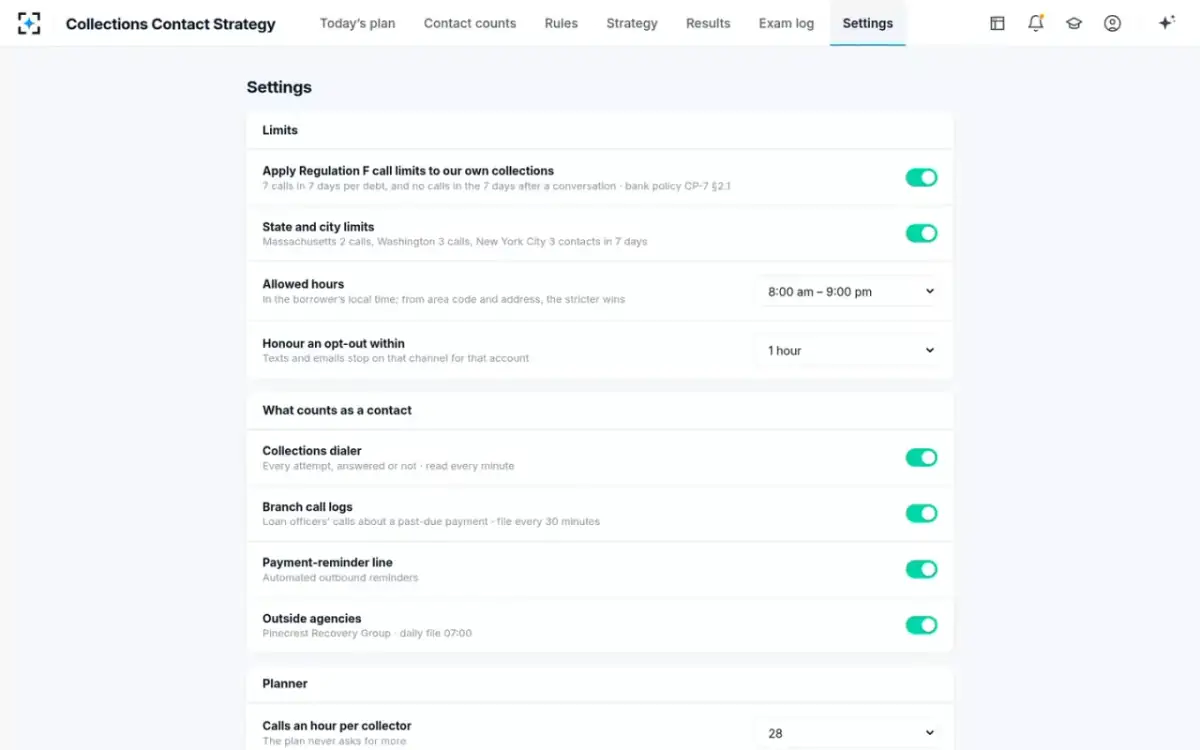
A policy a lender can hold, and how to write it down
One workable first-party policy adopts the federal presumption as a floor and then tightens it where a state or a city is stricter. The reasons for it are practical rather than legal. One number is teachable; two are not. The accounts move between the lender's floor and its agencies, so a single standard keeps the history comparable. And the figure a complaint or an examination will be measured against is the total a borrower experienced, which is the one the lender can control only if it counts it.
Adopting the federal presumption as policy, against leaving it to the states
Adopt it: the lender holds its own floor to 7 calls in 7 days: One rule, plus the states that are stricter. A collector never has to know which exemption applies to them.
Do not: rely on the FDCPA exemption, state by state: A different rule in roughly half the states, applied by whoever happens to know.
Adopt it: the lender holds its own floor to 7 calls in 7 days: A documented, consistent limit is evidence of a control, not of liability.
Do not: rely on the FDCPA exemption, state by state: Volume is judged after the fact against no number at all.
Adopt it: the lender holds its own floor to 7 calls in 7 days: Still stricter, and still have to be configured on top.
Do not: rely on the FDCPA exemption, state by state: Still stricter, and more likely to be missed.
Adopt it: the lender holds its own floor to 7 calls in 7 days: Hold them to the same number, and read their files into the count.
Do not: rely on the FDCPA exemption, state by state: Two standards, two counts, one borrower.
Adopt it: the lender holds its own floor to 7 calls in 7 days: A few calls a week per account you were entitled to make, spent elsewhere.
Do not: rely on the FDCPA exemption, state by state: Calls you were entitled to make, and a complaint file that has to be explained one account at a time.
Six questions to settle before your own collectors dial
- Whose limits are we holding ourselves to, and who decided?
Write the decision down with a date and an owner. A limit adopted by habit cannot be explained to an examiner or changed safely.
- Which states and cities reach us, and on which accounts?
The answer turns on the borrower’s location and on whether collection procedures have begun, not on where the bank is chartered.
- Do branch and reminder-line calls count toward our number?
If the limit is per debt, they do. Decide it explicitly, because the systems that log them are usually not the dialer.
- Who owns the agency file, and how often does it land?
A count that updates weekly cannot stop the call that happens on Tuesday. The sample bank reads branch and agency files as they arrive and re-plans the affected accounts.
- Who may change a rule, and who may not?
Rule changes belong to the compliance analyst who signs for them; a team lead moving a contact into a forbidden hour should be refused, with the rule named.
- Where is the decision, and every block, written down?
One log of contacts, blocks and the rule behind each, kept as it happens — the artefact that turns a policy into a demonstrable control.
Federal, state, city and the bank's own rules, each with its citation
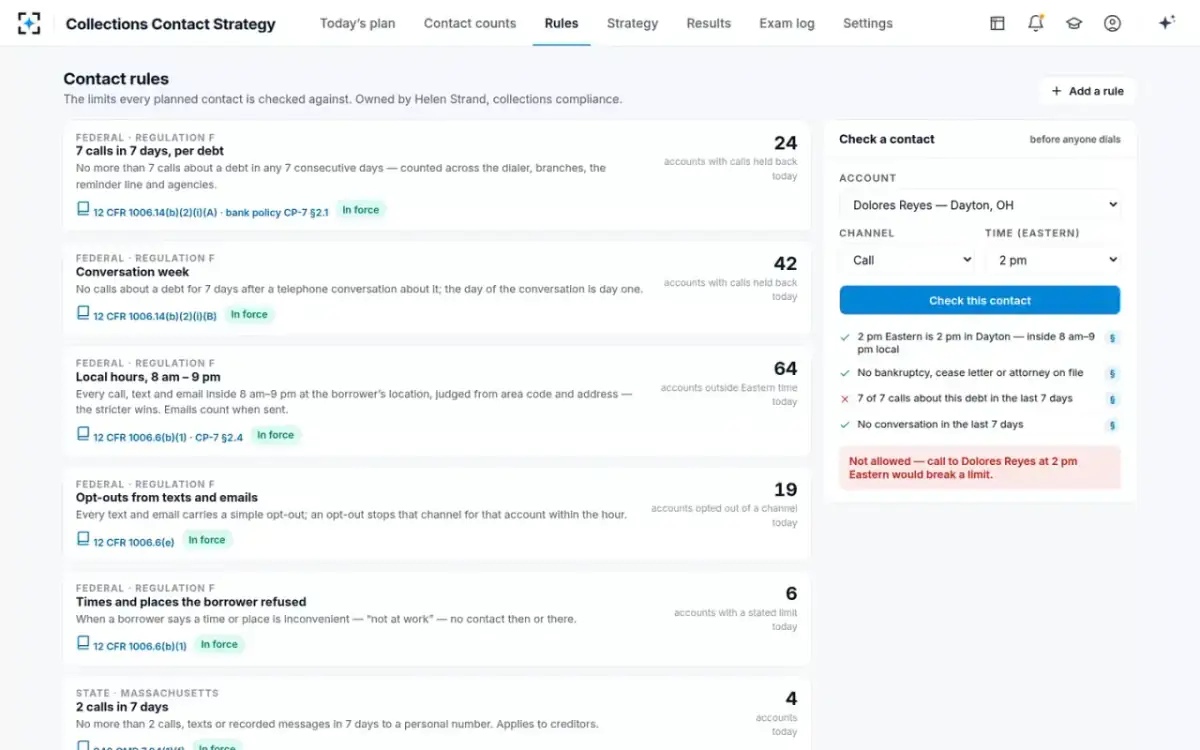
One last point about writing it down. A first-party limit adopted as policy is only worth what its evidence is worth: the log of what was attempted, what was blocked and which rule blocked it, kept as it happens rather than reconstructed when a complaint arrives. That is also the thing a lender gets for free once the count exists — and the count is the subject of the 7-in-7 rule and what the seven calls count. To see the rule layers, the blocks and the log on your own accounts, start from Collections Contact Strategy.
Questions people ask
What is the difference between first party and third party collections?
First party means the creditor collecting its own debts in its own name — its collectors, its branches, its reminder line. Third party means a separate firm collecting for the creditor, or a debt buyer collecting a purchased account in its own name. The distinction decides who is a "debt collector" under the FDCPA, and therefore whether Regulation F applies by force of law or only by policy.
Can a creditor be examined for call frequency without the FDCPA?
Yes. The prohibition on unfair, deceptive or abusive acts and practices applies to all supervised entities, and the examination manual's communications module is built to be used against entities that are not FDCPA debt collectors. What changes without the FDCPA is not whether frequency is examined but whether there is a number the entity can point to.
Who is liable when an outside agency breaks a contact rule?
The agency is liable in its own right as an FDCPA debt collector. That does not end the lender's exposure: the agency acts on the lender's accounts, and a bank is expected to oversee the third parties that work for it. In practice the protection is contractual and operational — one standard, and the agency's contact file read into the lender's own count.
Should a lender hold itself to the 7-in-7 rule?
There is a good case for it, and the reasons are mostly operational: one rule is teachable, it travels with an account between the floor and an agency, and it gives a documented limit where the general standard gives none. It is a choice rather than an obligation, and it should be recorded as a choice, with a date and an owner.
Does a debt buyer count as a first party?
No. The statute's exclusion covers a person collecting a debt that the person originated; a purchased account was originated by someone else. A buyer collecting a defaulted account it bought is generally an FDCPA debt collector, with Regulation F applying in full.
Does the FDCPA apply if we use a trading name for collections?
It can. The definition expressly includes a creditor who, collecting its own debts, "uses any name other than his own which would indicate that a third person is collecting". A house brand that reads as an outside agency can move a first-party operation inside the Act, which is one reason to keep the collections letterhead the bank's own.