AI debt collection software is a broad label for three very different products: software that talks to borrowers, software that decides who is contacted and when, and software that reads and reconciles the contact history behind both. Only the second and third can be judged on evidence a buyer can check, and only the second and third are what Botminds' Collections Contact Strategy is. Its agents count every call, text, email and letter per debt across every team and agency, test each hour and channel against the rules, score when a borrower is likely to answer, build the day's plan and propose tested changes to it — and none of them contacts anybody. Collectors place every call, and every collection email waits for the account's collector to approve it. That division is the thing to examine in any product in this market, because it decides what you are buying and what you are still answerable for.
The accounts, people and figures from the solution on this page are fictional sample data from it as it runs. The regulatory material is linked where it appears.
What AI debt collection software does, honestly
Strip the category down and there are four jobs software is actually doing on a collections floor. It reconciles contact history from systems that do not agree — the dialer, branch call logs, the texting and email platforms, the letters vendor, the placement agencies — into one count per debt. It applies a rulebook to that count, including federal, state and city limits, opt-outs, stated inconvenient times and the lender's own policy. It estimates, from each account's own history, when and on which channel a borrower is likely to answer or pay. And it turns the first three into an ordered list of work for each collector, re-ordered when something changes.
Everything else in the category is either a different product — a voice system that holds conversations — or a report. The reconciliation job is the one that pays, and it is also the one buyers under-rate, because it looks like plumbing. It is not: on the sample floor, the eighth call was never a collector ignoring a rule. It happened because a branch loan officer called at 11:31 and the spreadsheet that holds the count had no way to know.
Six jobs an agent can hold on a collections floor
Specialist agents are easier to govern than one general assistant, for a plain reason: each has a job narrow enough that the thing it may never do can be written in a line, and a buyer can ask to see that line enforced. Six jobs cover the work here.
Six agents, and the one thing each may never do
Agent
Contact counterReads every call, text, email and letter from the dialer, branches, the reminder line, the letters vendor and outside agencies, and keeps the live count per debt.
Never: guesses. A record it cannot match to a debt goes to a person
Agent
Rules checkerTests every hour and channel of every account against the limits, opt-outs, stated inconvenient times and the local calling window.
Never: switches a rule off or overrides a block; the stricter reading wins
Agent
Reach scorerEstimates how likely a borrower is to answer, and to promise to pay, by hour and channel, from that account’s own history.
Never: uses protected characteristics
Agent
Contact plannerBuilds each collector’s day inside their capacity, skips accounts likely to pay without contact, and re-plans when a count changes.
Never: plans a forbidden hour or channel, and never contacts anyone
Agent
Strategy analystDesigns tests with a random control group and reads them on promises, contacts per promise, complaints and opt-outs.
Never: decides. It proposes, and reports the bad numbers as well as the good
Agent
Exam log keeperWrites every contact, block, count change and opt-out with its rule, its source record and who acted, and builds the monthly pack.
Never: edits an entry once written
Read that list for what is missing. Nothing on it talks to a borrower, agrees a payment arrangement, or decides that an account should be placed with an agency or charged off. Those are the decisions with consequences for a person's money and credit, and they stay with named people — which is also why the floor's governance names an owner for rules and a different owner for strategy.
Can an AI agent call a borrower?
Technically yes, and in this product no. The technology to place an outbound call and hold a conversation exists and is sold; the question is whether you want it in collections, where the call is a regulated communication and every sentence in it is evidence. Three considerations usually settle it for a bank. The conduct standards apply to what is said and when, and they are judged after the fact from recordings and notes. A borrower can make a request mid-call — that this is an inconvenient time, that they want no further contact on this medium — and the response to that request is exactly the kind of thing examiners have already written findings about. And the complaint that follows a bad automated call is about the lender's name, not the vendor's.
There is also a quieter reason. A system that both plans the contact and makes it has no natural point at which a person sees the decision. The product described here plans the contact, shows the collector why the hour was chosen and what is forbidden, and then stops. The collector dials; the team lead can move a planned contact, and a move into a forbidden hour is refused with the rule. The human step is not ceremonial — it is the only point at which somebody who knows the account can say "not this one, not today".
Two products sold under one label, and what each one risks
Software that talks to borrowers: Places calls or holds chat conversations, collects commitments, answers questions about the debt.
Software that prepares a collector's day: Counts contacts, applies limits, scores the hour, orders the work, proposes tested changes.
Software that talks to borrowers: In what it said, when it said it, and how it responded to a request made mid-conversation.
Software that prepares a collector's day: In whether the count is complete and the rulebook current. Both are checkable against records.
Software that talks to borrowers: A transcript and a recording, after the fact, for a sample of calls.
Software that prepares a collector's day: For every contact: why it was allowed, which rule applied, which source record set the count.
Software that talks to borrowers: It answers something. The question is what.
Software that prepares a collector's day: It refuses the cell and names the rule; the account goes to a person with the reason attached.
Software that talks to borrowers: A system, until it escalates.
Software that prepares a collector's day: The collector who owns the account, on every contact.
Software that talks to borrowers: A count that is wrong, because it is a participant in the count rather than its arithmetic.
Software that prepares a collector's day: A borrower who will not engage. It can only spend a fixed allowance better.
What should AI never decide in collections? Four things, and how a product enforces them
Four decisions should not leave a person's hands, and a buyer should ask to see each one blocked rather than discouraged. The software should never place a contact: calls are dialled by a collector, and messages wait for approval. It should never make or accept a promise to pay, because a payment arrangement is a commitment by both sides and often a change to the account's status. It should never override a block: a rule that an agent can relax is not a rule. And it should never decide a protected matter — whether to place with an agency, to charge off, to report to a credit bureau, or to treat a borrower differently on anything resembling a protected characteristic.
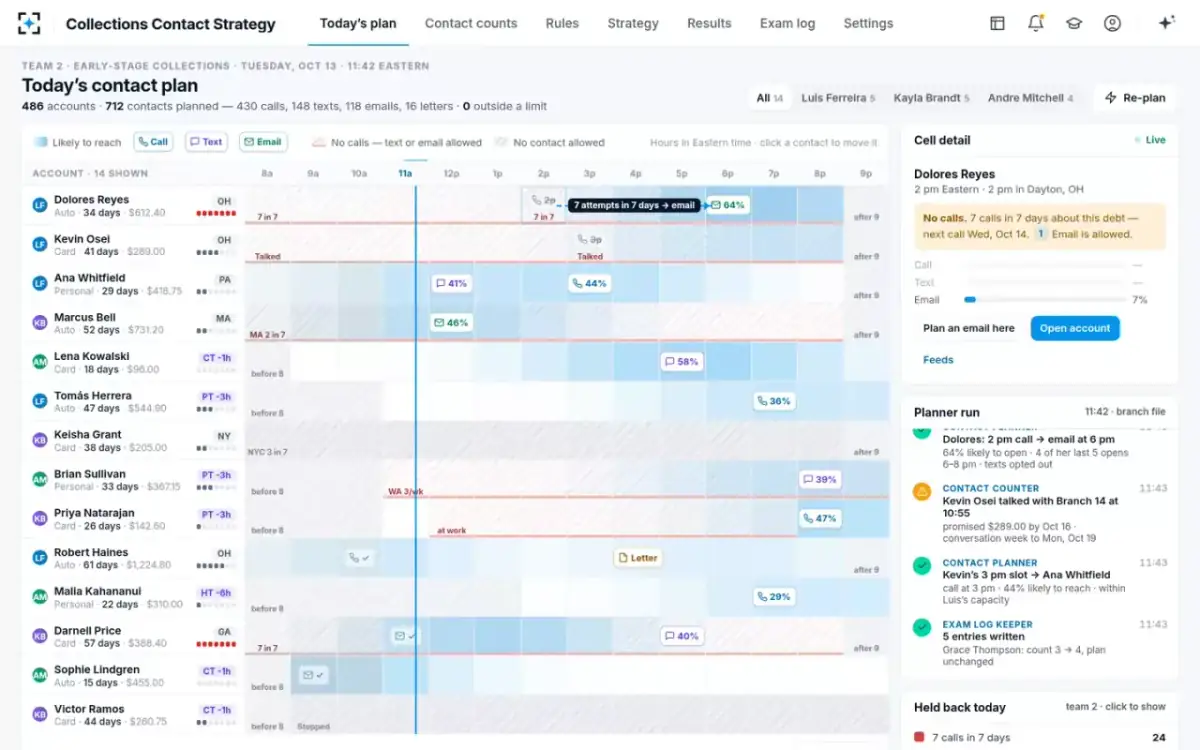
The useful follow-up question in a demonstration is "show me the refusal". Ask for an account at its limit, then ask the planner to schedule a call. A product that enforces its limits will decline and name the rule and the date the call becomes allowed; a product that enforces them by configuration will show you a setting. The difference is not pedantic. A limit that is a setting is a limit that someone can change under pressure at month end, and the only record of the change will be in the settings history that nobody reads.
Who may do what: eight jobs, four seats
| Job | Agents | Collector / team lead | Compliance analyst |
|---|---|---|---|
| Count contacts per debt | Does it, from every source, and shows the records behind each count | Reads it; raises a record that looks wrong | Reads it; defines what counts as a contact |
| Check an hour or channel against the rules | Does it, for every account, every hour, every channel | Reads the reason a cell is closed | Owns the rulebook; adds, edits and retires rules |
| Score the likelihood of reaching a borrower | Does it, from the account’s own history, never from protected characteristics | Sees the records behind a score | Reviews how the score is built and monitored |
| Plan the day | Does it, inside capacity and never in a forbidden cell | Moves a planned contact; a forbidden hour refuses the move | Sets capacity and the skip threshold |
| Propose a strategy change | Designs and reads the test; proposes only | The strategy manager approves, declines or extends | Confirms no rule was changed by the test |
| Place a call or send an email | Never | Does it: collectors dial, and approve each email | Audits that it happened as planned |
| Agree a promise to pay | Never | Does it, on the call | Nothing |
| Override a block | Never | Cannot | Can change the rule, with the change recorded and attributed |
Read-only on the systems that hold the truth
A detail worth more than it sounds: the counting agent reads contact systems and never writes to them. It does not place, change or delete a contact in the dialer, the texting platform or an agency file. That matters for three reasons. It makes the count auditable against the source, because the source is untouched. It removes a whole category of incident in which a reconciliation job corrupts the system of record for the thing it is reconciling. And it means the examiner's independent recount — from your dialer export, your branch logs, the agency's own files — should match the product's count, which is the only test of the count that matters.
The counterpart rule is what happens when a record cannot be matched to a debt. An agency file with a phone number and no account number, a branch note without a loan reference: these are common, and the tempting behaviour is to guess with a fuzzy match on the number. Guessing is how a count silently becomes wrong in both directions — an attributed call that was not about this debt inflates it, a missed one leaves room for the eighth call. The rule here is that unmatched records go to a person. The cost is a small queue; the benefit is that a count is either evidenced or absent, never invented.
Is a reach score a model? What the supervisory definition says
Three different things in this product sit in three different places against the supervisory definition. The call count is arithmetic. The rulebook is a deterministic set of rules. The reach score is an estimate produced by a method, and that is the piece a model-risk function will want to look at.
The revised guidance the Federal Reserve issued on 17 April 2026, replacing the old model risk letter, defines a model as a complex quantitative method that applies statistical, economic or financial theory to turn input data into quantitative estimates — and expressly leaves out simple spreadsheet arithmetic and deterministic, rule-based software with no such theory behind it (SR 26-2).
Note what that definition does not do: it does not turn on whether the software is described as artificial intelligence. A rule engine marketed as AI is still a deterministic rule-based process; a scoring method presented as a simple heuristic may still be a quantitative estimate. The honest answer a vendor can give is a description of each component and what it does, leaving the classification to the bank's own policy — and a vendor who answers the question with "it is not a model" has told you about their sales training rather than their software.
The same guidance is also realistic about what validating such a thing looks like. It accepts that assessing theoretical construction matters for some models while other assessments — interpretability measures, or benchmarking against other models — are more practical for others (SR 26-2, model validation).
For a reach score the practical assessments are the ones a buyer can ask for directly. Can it show the records behind a score for one named account? Can the score be benchmarked against the dumbest sensible alternative — call everyone at the hour they last answered — so that you know what the method is adding? And is its performance read again on a schedule, against what actually happened? That last one is the question that champion challenger testing exists to answer on a collections floor.
Every block cites its rule: what an auditable decision looks like
The phrase to insist on is not "explainable AI". It is "name the rule and the record". When this software closes a cell, it says which rule closed it — the seven-calls presumption in 12 CFR 1006.14(b)(2), a state limit such as Massachusetts' two calls in seven days, a city limit, or the bank's own policy — and which source record triggered it, down to the branch call at 11:31 and the date the next call becomes allowed. That is a decision a collector can act on, a team lead can argue with and an examiner can test, because every element of it is checkable somewhere else.
The clearest example is the medium a borrower has closed. Under the rule, a debt collector must not communicate or attempt to communicate with a person through a medium if that person has asked them not to use it (12 CFR 1006.14(h)), and the telephone rules say a revocation made by an automated opt-out mechanism, by replying with words such as "stop" to a text, or through a designated website or number, is a reasonable means per se to revoke consent (47 CFR 64.1200(a)(10)). So when a borrower replied STOP to a text in August, the correct behaviour four months later is that no text is planned for that account, the consent panel shows the opt-out and its source, and the plan quietly moves to a channel that is still open.
A refusal that names its rule, its record and its date
Where agents get it wrong, and what happens to the account then
Any honest account of this category has to include the failures, because they are predictable and a buyer should ask how each is handled. The count can be incomplete: an agency file arrives late or empty, and for a day the count is lower than the truth. The matching can fail: a branch note has no account reference. The score can be wrong: a borrower changes job and stops answering at the hour that always worked. The rulebook can be stale: a city adopts a stricter limit and nobody has added it.
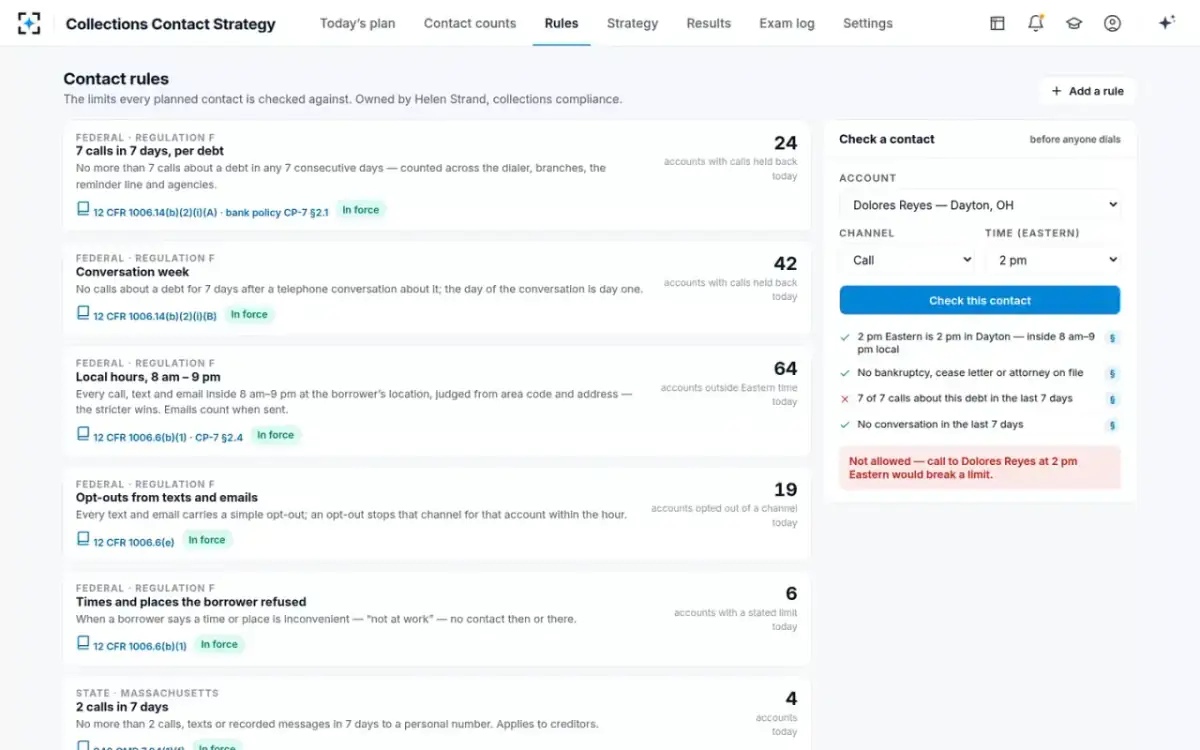
What distinguishes a product is not whether these happen but what the account does when they do. A late feed should make the affected accounts conservative rather than optimistic — plan fewer contacts, not more — because the failure mode you cannot afford is the one that produces an extra call. An unmatched record should produce a queue item with the record attached. A stale rulebook is the one failure software cannot detect for you, which is why the rules are a surface a compliance team edits directly, with each change attributed, rather than a configuration file a vendor maintains.
What the examiners have already found about collection conduct
Buying decisions in this market are usually framed around efficiency, and the findings are mostly about something else: what happened when a borrower said something. In Supervisory Highlights issue 34, the Bureau's examiners described collectors who kept going after a consumer said it was a bad moment.
Examiners identified multiple instances where consumers told debt collectors' agents that it was an inconvenient time to talk, either because they were at work or driving, but the agents continued the conversation.
CFPB, Supervisory Highlights, issue 34, summer 2024
Nothing in that finding is about call volume, and no limit in a rulebook would have prevented it. What software can do is make sure the statement survives the call: the collector's note that this was a bad time becomes a limit on the account, visible to whatever plans the next contact, rather than a sentence in a note field. The Bureau's own examination procedures ask examiners to consider notes made during or after calls alongside recordings, and to review a sample of records — so the note is evidence either way. The only choice is whether it is also an instruction, a point developed in what an examiner asks for.
Twelve questions to ask an AI collections vendor
The questions below are written so that a vague answer is visible as a vague answer. Several of them have a right answer that sounds unimpressive, which is the point: in this market the impressive answer is usually the one that moves work away from a person who ought to be doing it.
Twelve buying questions, and the answer that should worry you
- Which systems does it count contacts from, out of the box?
Worrying: "any system, via integration". Ask specifically about branch call logs and agency files — the two that break counts.
- What happens to a record it cannot match to a debt?
Worrying: a confidence score. The safe answer is that it goes to a person and is never guessed.
- Can an agent place a call or send a message?
Worrying: "it can, if you enable it". Ask whether it is a limit or a setting.
- Show me a block. Which rule, which record, which date?
Worrying: a generic "blocked by policy". The rule, the triggering record and the release date should all be on the screen.
- Can anyone override a block, and who?
Worrying: a supervisor override. Changing the rule should be the only route, and it should be attributed.
- Is the contact history written to, or only read?
Worrying: write access to the dialer. Read-only is what makes your count checkable against the source.
- How is the local calling window determined?
Worrying: the area code alone. Ask what happens when the area code and the address disagree.
- Who edits the rulebook, and how long does a new city rule take?
Worrying: a vendor change request. Your compliance team should be able to add a limit without a project.
- What does the score use, and what is it forbidden to use?
Worrying: an unanswered question about protected characteristics, or a refusal to show the records behind one score.
- How is a strategy change proved before it goes to the book?
Worrying: a case study. Ask for the control group, the period and the guardrail numbers.
- Can an entry in the log be edited after the fact?
Worrying: "corrections are supported". Append-only, with corrections written as new entries, is the answer that survives an exam.
- What does it do when a feed is late or empty?
Worrying: carries on. It should make the affected accounts more conservative, not less.
The rules as a surface a compliance team owns
The last thing to say about AI in collections is the least exciting. None of this prevents a violation: a person still places the call, and a person can still say the wrong thing on it. What software can do is make sure the forbidden contact is never on the list, that the reason is on the screen when a person asks, and that the answer still exists a year later. If that sounds like a smaller claim than the category usually makes, it is — and it is the one you can check. Start from Collections Contact Strategy, or compare the ways a bank can run the same work in four ways to run the contact plan.
Questions people ask
Is an AI collections agent allowed to negotiate?
Nothing stops software proposing an arrangement, but a promise to pay is a commitment with consequences for the account, and in this product it stays with the collector on the call. The reason is practical as much as legal: a negotiation is where a borrower explains a hardship, a dispute or a change of circumstances, and those statements should change what happens to the account rather than be captured as a payment date.
How do you stop an agent from calling outside the rules?
By making the forbidden contact unplannable rather than discouraged. Every hour and channel of every account is tested against the rulebook before the day is built, a forbidden cell cannot hold a contact, and a team lead moving a planned contact into one is refused with the rule. Ask a vendor to demonstrate the refusal on an account at its limit; a product that shows you a setting instead has answered a different question.
How do you audit an AI agent's decision?
By asking what it would take to disagree with it. A decision you can audit names the rule it rests on, the source record that triggered it and the date it changes, and is written once to a log that cannot be edited afterwards. With those three, a contact placed in March can be explained in November by somebody who was not there; without them, an audit is an interview.
Does AI raise or lower compliance risk in collections?
It moves it. A floor that counts contacts by hand carries the risk that the count is wrong; a floor that automates the count carries the risk that a feed fails silently or a rulebook goes stale. The second set is smaller and much easier to monitor, but only if the software fails conservatively — fewer contacts when data is missing — and only if the rules are owned by your compliance team rather than by a vendor's change queue.
What should AI collections software never be allowed to do?
Place a contact, agree a promise to pay, override a block, or decide a matter with consequences for a person's credit or treatment — placement with an agency, charge-off, bureau reporting, or anything touching a protected characteristic. Those four lines are worth writing into a contract as limits rather than settings, so that relaxing one is a change of agreement and not a change of configuration.
What questions should you ask an AI collections vendor?
Start with four. Which systems do you count contacts from today, named? What happens to a record you cannot match to a debt? Show me one block with its rule, its triggering record and its release date. And who can edit the rulebook, with what record of the change? The answers to those four separate products that reconcile a real floor's contact history from products that assume one clean source of calls.