Collections automation is usually sold as doing more contacting with fewer people, and that is the wrong end of the problem. The work on a past-due floor that is slow, error-prone and genuinely mechanical is not the dialling — it is knowing how many times each debt has already been contacted, by whom, through which channel, and what the rules allow next. Automate that first and everything after it gets easier; automate the dialling first and you have built a faster way to make the same mistake. Botminds' Collections Contact Strategy is built in that order: count every contact per debt from every team and agency, check each hour and channel against the rules that bind you, plan each collector's day inside them, and prove any change to the plan against a held-back control group. People still place every call. This guide is about the order of the work, the five things a business has to supply, and what makes a programme slower than it needed to be.
Figures from the solution below are fictional sample data from it as it runs; the rules and supervisory material are linked where they appear.
What collections automation should mean
A useful definition: automation is the part of the work that can be done the same way every time, from records, with a result anyone can check. That test excludes the conversation with a borrower, which is judgement, and includes almost everything that happens before it. Reading six systems and producing one count per debt is the same work every day. Testing an hour against a rulebook is the same work. Ordering a collector's day by what the rules allow and where the borrower is likely to answer is the same work. Deciding whether to accept a hardship arrangement is not.
The reason the order matters is that these layers depend on one another in one direction only. A plan built on a wrong count is confidently wrong. A rule applied to a wrong count blocks the wrong accounts and clears the ones it should have stopped. A test that measures a strategy running on a wrong count measures noise. So the count is not phase one because it is easy — it is phase one because every later phase inherits its errors.
The order the layers have to be built in, and roughly where the effort goes
- Count: one number per debt, from every sourcethe foundation
- Check: the rulebookthe limits
- Plan: the daythe ordering
- Test: a control groupthe proof
What should you automate first in collections? The count, not the call
Automate the count first, because it is the only layer whose output can be checked against something outside the software, and because it is the layer whose failure is invisible. A wrong plan is argued about by a team lead within a day. A wrong count sits quietly under everything until an examiner recounts it.
"The count" means a single number per debt, not per phone number and not per borrower, covering every call, text, email and letter about that debt from every team that makes contact. It means knowing the date of the last telephone conversation, not just the last attempt. It means holding the opt-outs and the stated inconvenient times as part of the same picture. And it means being able to show, for every number, the records that produced it — which is the property that makes the first check of the system possible: pick the twenty accounts with the most contacts and recount them by hand.
Start the first phase here and it pays before anything else is built. A floor whose count is right can keep dialling exactly as it does today and will already stop the contact that would have been one too many, because the count is what the limit is applied to. That is also what makes a staged programme defensible: there is a working, useful thing at the end of the first phase rather than a half-built platform.
Automating the dialler against automating the count
Automating the dialling: More attempts per collector hour, and the same list order as yesterday.
Automating the count: The same number of attempts, with the ones that were never allowed removed.
Automating the dialling: Idle time between calls.
Automating the count: A number that was wrong by mid-morning because somebody else called.
Automating the dialling: Spends the week’s allowance faster, on the same accounts, earlier in the cycle.
Automating the count: Nothing, but it exposes how many contacts the floor could not see.
Automating the dialling: Attempt volume up; promises per hundred contacts roughly where it was.
Automating the count: The allowance lands on accounts that need it, and a change to the order can be proved.
Automating the dialling: More calls, explained the same way they were before.
Automating the count: Every contact and every block with its rule and its source record.
Automating the dialling: The dialer, and borrowers answering.
Automating the count: Feeds from every team that contacts a borrower, including the ones outside collections.
Then the check: a rulebook that can hold a new city rule
The second layer is the rulebook, and the test of a rulebook is not whether it holds today's rules but whether it can hold tomorrow's without a project. Rules change on someone else's schedule. New York City's amended debt collector rules carry their own effective date — "This rule takes effect September 1, 2026" — and they do not look like the federal rule they sit beside.
Excessive frequency means any communication or attempted communication … made by the debt collector to a consumer by any medium of communication, in connection with the collection of debt within a seven-consecutive-calendar-day period, either 1) more than three times in total during such period or 2) any time after the consumer responded to a prior communication within such period.
New York City Department of Consumer and Worker Protection, Rules Relating to Debt Collectors
Read that against the federal presumption and three structural differences appear at once. The city rule counts any medium, not only telephone calls, so texts and emails consume the same allowance. The limit is three in seven rather than seven in seven. And the second prong is triggered by the consumer responding to a communication, not by a telephone conversation. A rulebook built on the assumption that limits count calls cannot express that rule at all; it has to be rewritten, which is how a city's deadline becomes a lender's release schedule.
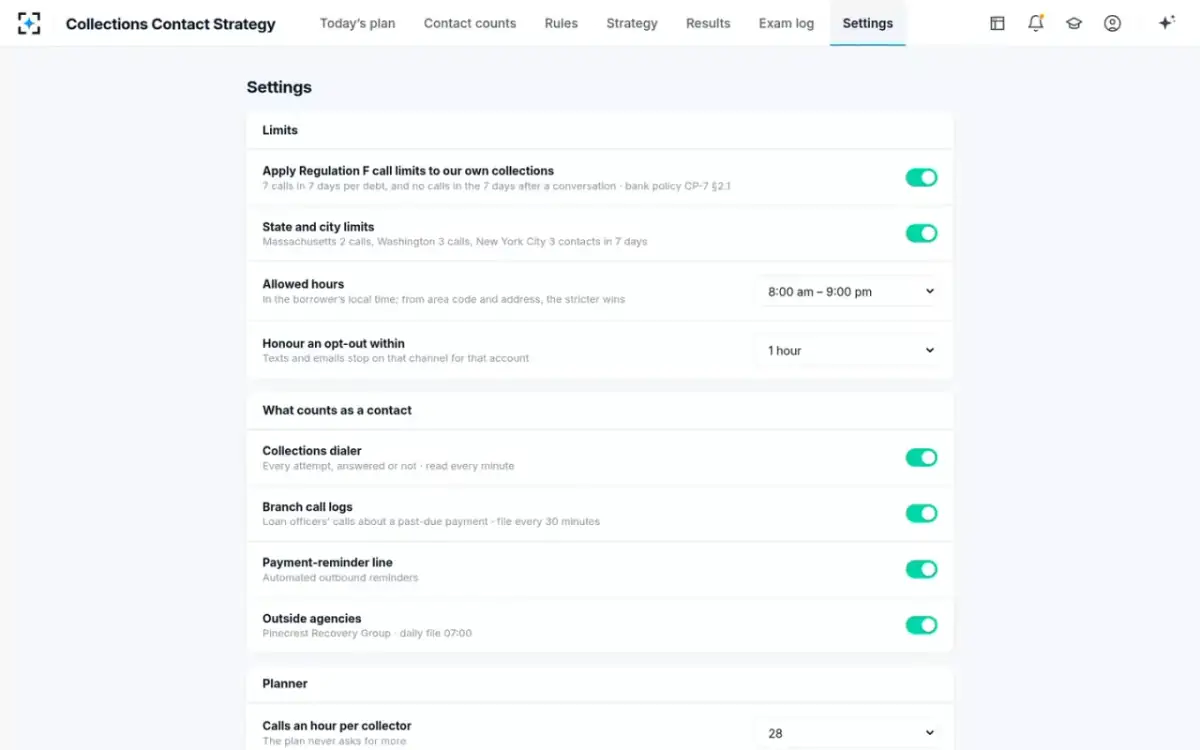
So the requirement for the second phase is a rulebook whose shape is general — a limit has a medium set, a window, a count, a trigger and a jurisdiction — and whose contents are owned by your compliance team. The practical acceptance test is to add one new limit in the room and watch who has to be involved. If the answer includes a vendor, the rulebook is a configuration file rather than a rulebook, and the next city will cost the same as this one. The fuller comparison of these limits is in which call limits bind your own team.
The contact policy as settings a compliance team changes
Then the plan: hours, channels and the accounts you leave alone
With a count and a rulebook, planning becomes an ordering problem rather than a judgement. For each account the rules close some cells of the week outright; of the cells that remain, some hours and channels are far more likely to reach the borrower than others, and each collector can only work so many. The third layer fills the collector's day from the top of that list, and re-fills it when something changes.
The decision inside this layer that buyers under-estimate is the one about accounts to leave alone. A share of early-stage accounts will cure without being contacted at all, and contacting them spends allowance, goodwill and collector time on an outcome that was going to happen anyway. Setting a threshold — leave alone the accounts above a stated likelihood of paying on their own, give them one reminder — is a policy choice with a number attached, which is the kind of choice that belongs in settings next to the limits rather than inside a scoring method nobody can see.
The other property to insist on is re-planning. A plan built at eight in the morning is a statement about a world that changes by eleven: a branch officer calls, an agency file lands, a borrower promises to pay. Each of those changes the count on a few accounts, and the right response is to withdraw the contacts that are no longer allowed and give the freed capacity to the next best account. A plan that is rebuilt only overnight is a list, and a list goes stale in exactly the direction that produces an extra contact.
Then the test: nothing changes without a control group
The fourth layer is the discipline that keeps the first three honest after go-live. Once a plan is built automatically, changing it is cheap, and cheap changes accumulate: a channel order here, a capacity change there, a new threshold. Without a held-back control group each of those is an opinion, and six months later nobody can say which of them helped. With one, a change is a question with a date on it — the design, the four numbers and the stopping rules are set out in champion challenger testing.
It is worth building the testing layer before the first big strategy argument rather than after it, for a political reason as much as a methodological one. A control group introduced because a change went badly looks like blame. A control group that has been running since go-live is simply how the floor works.
What data do you need to automate a contact strategy? The five things you bring
Software supplies the arithmetic. The business supplies five things, and the programme moves at the speed of the slowest of them.
The five inputs, and the question that decides whether yours is ready
- Your contact policy, written down
Not the regulation — your policy: which limits you hold yourself to, the hours you call, how fast an opt-out takes effect, who approves a message. The question: can somebody produce the current version today, with the date it last changed?
- The rules you apply, with their citations
Federal, the states your borrowers live in, any city rules, and your own stricter stops. The question: who owns this list, and when did they last check it against a regulator’s page rather than a summary?
- A sample of your real contact history
Enough weeks to contain the awkward cases, from every source rather than the clean two. The question: can you produce a week that includes branch calls and an agency file?
- The feeds, with an owner each
Dialer, branch call logs, the payment-reminder line, the text and email platforms, the letters vendor, each agency, and the account and payment records. The question: for each one, who sends it, how often, and what does it key on?
- Named decision owners
Who owns the rules, who approves a strategy change, who approves a message, who answers an examiner. The question: are these four different people, and do they know it?
The input that most often turns out to be missing is the second. A contact rulebook maintained as a summary — a slide, a wiki page, a memory — drifts, and the drift is only visible when somebody compares it line by line with the regulator's current page. Doing that comparison once, at the start, is a day's work, and any difference it finds is one the floor has been working to.
How do you automate collections without automating the calls?
By drawing the line at the contact itself and building everything on the inside of it. The agents count, check, score, plan and propose; a collector places every call, and every collection email waits for the account's collector to approve it before it is sent. A team lead can move a planned contact, and a move into an hour the rules forbid is refused with the rule rather than warned about. Nothing in the automation reaches a borrower.
That line is not only a conduct choice; it is what makes the rest of the automation inspectable. Because the software never acts on the outside world, everything it produces is a proposal that a person either took up or did not — and the difference between the two is itself recorded. The limits that make this real are set out in what the agents may and may not do; the short version is that a limit which can be switched on is not a limit.
One rule deserves its own mention here because automation makes it easy to break at scale. A borrower's revocation of consent has to be honoured, in any reasonable manner it is made, within a reasonable time not exceeding ten business days, and a caller may not designate an exclusive means of revoking (47 CFR 64.1200(a)(10)). An automated channel that accepts a reply only in one exact form, or that routes opt-outs to a queue worked weekly, converts a borrower's clear request into a compliance problem repeated across a book. The setting on the sample floor honours an opt-out within an hour, and the median in September was four minutes.
Feeds from outside the floor: branches, the reminder line, the letters vendor, the agencies
The six sources are what make the count hard, and each has its own failure. Branch call logs are made by people whose job is not collections, so the reference to the debt may be a customer number rather than an account number. The payment-reminder line is often a separate system with its own idea of what a contact is. The letters vendor reports in batches, sometimes days later. Agency files arrive daily and differ from one another in format, in time zone and in what they call an attempt. Text and email platforms hold the opt-outs, which matter more than the sends.
A readiness table: one row per feed, filled in before anything is built
| Feed | Who owns it | How often it lands | What it keys on | What is usually missing |
|---|---|---|---|---|
| Collections dialer | Collections operations | Continuously | Account number and attempt time | Whether an attempt connected, and whether a conversation took place |
| Branch call logs | Retail/branch network | Daily, sometimes manually | Customer number, often not the loan | A reference to the specific debt, and the reason for the call |
| Payment-reminder line | Servicing | Daily | Account number | Agreement on what counts as a contact versus an informational message |
| Text and email platforms | Marketing or servicing | Continuously | Phone number or email address | Opt-outs and replies, mapped back to the debt rather than the address |
| Letters vendor | Vendor | In batches | Account number and mail date | The date posted rather than the date produced |
| Outside agencies | Recovery / vendor management | Daily file per agency | Agency’s own reference plus account number | Time zone of the attempt, and a consistent definition of an attempt |
There is a governance point hiding in the last row. Agency contacts are made by a third party whose conduct you still answer for, and supervisory guidance treats ongoing monitoring as a standing obligation rather than an annual review.
The interagency guidance gives ongoing monitoring three jobs: confirming that a third party's controls hold up and that it can meet its contract, escalating significant problems such as repeat audit findings, compliance lapses or service interruptions, and responding to them once found (Interagency Guidance on Third-Party Relationships, June 2023).
A daily contact file is the cheapest form of that monitoring anyone has invented. It tells you, without asking, how often the agency contacted your borrowers, at what hours, and whether the pattern changed — and it keeps your own count whole at the same time.
What happens to a contact that cannot be matched to a debt
Some records will not match. A branch note with a customer number and three loans behind it; an agency row with a phone number and no account reference; a text reply from a number that belongs to two borrowers in the same household. The behaviour at this moment determines whether the count can be trusted, and there are only two honest options: attach the record to the right debt, or hand it to a person.
Guessing is the third option and it is the one to refuse. A fuzzy match on a telephone number is wrong in both directions — it attributes a contact about one debt to another, inflating one count while leaving room for an extra contact on the other — and it is wrong invisibly, because the guess looks exactly like a match. On this floor the rule is that unmatched records go to a person and are never guessed. The cost is a small queue each morning; the benefit is that every number in the count can be opened to the record that produced it.
A file from outside the floor, from arrival to a re-planned day
Agent
ReceivedThe daily file from an agency, a branch or the reminder line is read as it lands, without waiting for an overnight batch.
Never: writes back to the source system
Agent
MatchedEach row is matched to its debt by account number, then by phone number where the account reference is missing.
Never: guesses — an unmatched row stops here
A person decides
Resolved by handA collections analyst works the unmatched queue, with the raw record and the candidate accounts in front of them.
Never: closes a record without attaching it to a debt or marking it out of scope
Agent
CountedThe matched contact changes the debt’s count, and a conversation starts the window that follows one.
Never: changes a count without writing the entry that explains it
Agent
Re-checked and re-plannedAffected accounts are re-tested against the rules; contacts that are no longer allowed come off the plan and the freed capacity goes to the next best account.
Never: leaves a now-forbidden contact on a collector’s list
A person decides
WorkedThe collector sees a changed list with the reason attached, and places the contacts on it.
Never: moves a contact into an hour the rules forbid — the move is refused
How long does it take to automate collections, and what makes it slower
There is no honest universal answer, and a vendor who gives you a number before seeing your feeds is quoting a template. What can be said is which things move the date, and almost all of them are on the buyer's side of the table. The programme goes live once it has passed every quality check on your data and your rules; what decides when that happens is how quickly you can produce five things and settle four arguments.
Three things make it faster. A contact policy that already exists in one place. Feeds that key on an account number, because the matching rate decides the size of the manual queue. And a single named owner for the rulebook, because the alternative is a committee discovering that it disagrees about whether a limited-content message is a contact.
Four things make it slower, reliably. A feed owned by a department outside collections, which needs a sponsor rather than a specification — branch call logging is often this. A rulebook that has to be reconstructed from memory before it can be written down. Borrower addresses and phone numbers that disagree, since the local calling window depends on them. And an unsettled question about whose rules apply to your own collectors, which is a policy decision and not a configuration one.
One more slows the first weeks after go-live rather than the build: the discovery that the floor was making more contacts than it thought. A look-back over the previous quarter, once the count is complete, is standard and usually uncomfortable. It is also the point at which the programme pays for itself in argument, because the number is no longer contestable.
Keeping it honest after go-live: monitoring, oversight and the rule that changes
Three things have to keep happening or the automation decays. The feeds have to be watched for silence as well as for errors — a letters vendor that stops sending looks exactly like a quiet month, and the count silently drops. The rulebook has to be reviewed against the regulators' own pages on a schedule, because the rules move and nothing in your systems will tell you. And the strategy has to keep being tested, because a plan tuned to last year's book is not tuned to this one.
The records side is simpler but easy to neglect: the federal floor for keeping evidence of compliance runs for at least three years after the last collection activity on a debt, so the retention clock is tied to account behaviour rather than to the calendar — and the monthly routine that produces the evidence is described in what an examiner asks for.
Finally, remember the rules that are not about frequency at all, because automation makes them easy to forget. A debt collector must not communicate with a consumer at their place of employment where it knows or has reason to know that the employer prohibits such communication (12 CFR 1006.6(b)(3)), and a borrower's statement that a time or place is inconvenient closes it regardless of what the count says. These are limits that arrive through a collector's note rather than through a feed, which is why the note has to become a limit on the account rather than prose nobody reads again.
A file arrives, and the day changes around it
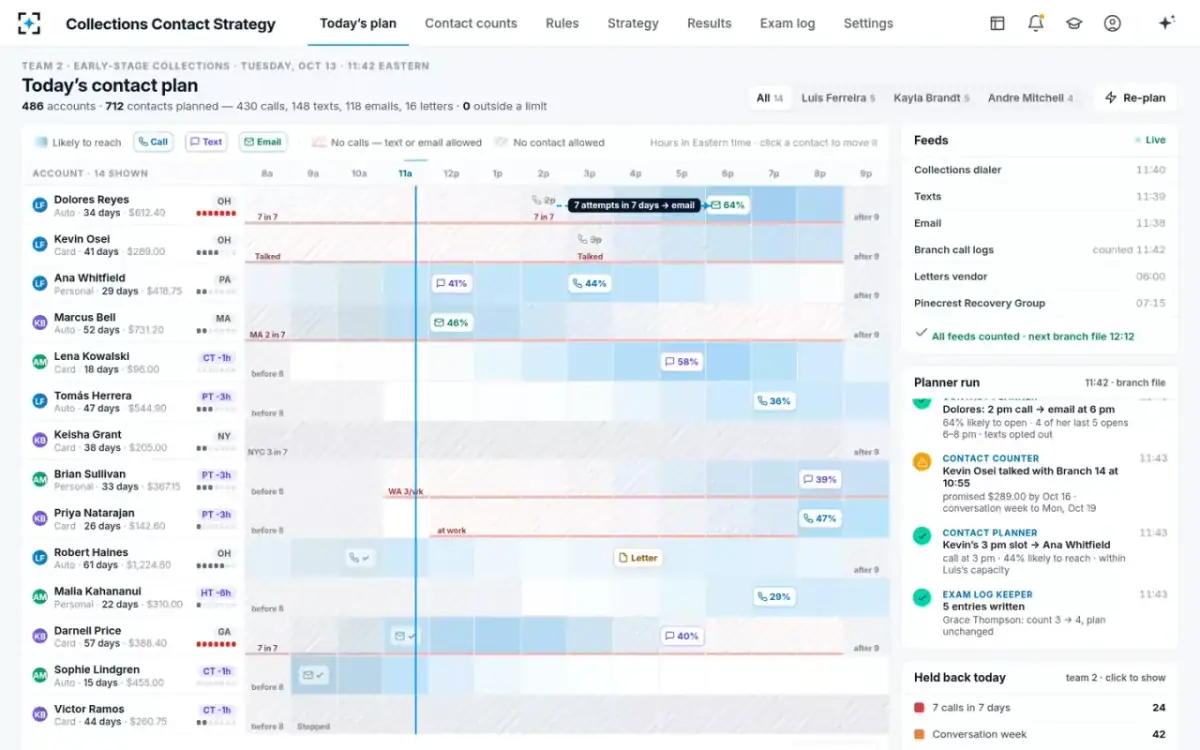
Automating a collections floor well is unglamorous. The order is count, check, plan, test; the inputs are a policy, a rulebook, a history, some feeds and four named owners; and the thing you are buying is the ability to answer a question about one contact on one day, a year later. To see those four layers on one book, start from Collections Contact Strategy, or compare it with the other ways to run the same work in four ways to run the contact plan.
Questions people ask
How do you load contact history from an outside agency?
As a daily file per agency, keyed on your account number wherever the agency holds it, with the attempt time, the medium, the outcome and the agency's own reference. The two fields most often missing are the time zone of the attempt and a consistent definition of an attempt, and both have to be settled in the agreement rather than in the mapping. The file is also the cheapest form of ongoing oversight of that agency you will ever get.
What do you do about contacts you cannot match to a debt?
Hand them to a person. A fuzzy match on a phone number is wrong in two directions at once — it credits a contact to the wrong debt and leaves room for an extra contact on the right one — and the guess is indistinguishable from a real match afterwards. A morning queue of unmatched records, each with the raw record and the candidate accounts beside it, is a small cost for a count every number in which can be opened to its source.
How do you keep a new state or city rule from breaking the plan?
By keeping limits in a general shape — a medium set, a window, a count, a trigger and a jurisdiction — rather than as code that assumes limits count telephone calls. New York City's rule counts communications through any medium, caps them at three in seven consecutive days and is also triggered by a consumer responding, none of which fits a call-only model. The acceptance test is to add a new limit in the room and see who has to be involved.
What does a collections automation pilot look like?
A week of your own contact history from every source, counted per debt, with the result checked by hand on the twenty accounts with the most contacts, plus a retrospective pass to see which contacts would have been over a limit. That is enough to prove or disprove the thing that matters and small enough to run without a programme. Pilots built on a vendor's sample data prove only that the sample works.
Who has to sign off before automation goes live?
Four seats, and they should be four different people: compliance for the rulebook and what counts as a contact, operations for capacity and the plan, the strategy owner for any change to the order of channels, and vendor management for the agency feeds. A programme where one person holds two of these is faster to start and much harder to answer questions about later.
How do you automate collections without automating the calls?
Draw the line at the contact. Software counts, checks, scores, plans and proposes; a collector places every call and approves every message, and a move into a forbidden hour is refused rather than warned about. Everything inside that line is checkable from records, and the division has the useful side effect that the software never has to be trusted with the one thing a borrower will remember.