The CFPB debt collection examination procedures are the Bureau's published field manual for a debt collection examination: a scoping section, a document request list and seven modules of specific steps an examiner works through, covering the entity's business model, communications, information sharing and consumer reporting, validation notices and disputes, payment processing, equal credit opportunity, and litigation practices. They matter to a collections floor because they are written as instructions to the examiner rather than as advice to you, so they say exactly what will be asked for and in what order. Botminds' Collections Contact Strategy is built on the other side of that request: every contact, block, count change and opt-out is written to an append-only log with the rule it rests on and the source record that triggered it, as the work happens, so the answer to "why was this person called on day eight" is produced by the floor's ordinary operation rather than reconstructed from a dialer export at the end of a quarter.
The month, the accounts and the people in the figures below are fictional sample data from the solution as it runs. The procedures, the findings and the complaint figures are the Bureau's own, and are linked where they appear.
What the CFPB debt collection examination procedures are, and what they cover
The document is a supervisory tool, published in March 2022 and used alongside the Bureau's general Supervision and Examination Manual. It opens with background on the market, then sets out the material examiners should obtain before the modules begin, then works through the modules themselves. Its scope is defined by law rather than by business model: the FDCPA and Regulation F reach entities that are debt collectors under the statute, while the prohibition on unfair, deceptive or abusive acts and practices reaches every supervised entity. A bank collecting its own loans is therefore outside large parts of the FDCPA analysis and squarely inside the rest, which is the distinction worked through in which call limits bind your own team.
Read it as an operations document and one feature dominates. Almost every step is a question about evidence — does the entity retain, does the entity monitor, review a sample, listen to a sample — and almost none is a question about intent. That shapes what a floor should build. A policy that says the right thing and a training deck that teaches it are necessary, and neither of them answers a step that begins "review a sample of records".
The request list, item by item
Before the modules, the procedures tell examiners what to obtain. The list is short, specific and almost entirely about artefacts a floor either has or does not.
Policies and procedures; Notes and disclosures; Telephone recordings; … Monitoring procedures; Compensation policies; Relevant computer program and system details; Consumer files, including original loan documents, and payment records systems; … Third-party contracts and oversight materials, including monitoring reports and findings; … Consumer complaints and disputes
CFPB, Debt Collection Examination Procedures, March 2022
Three items on that list are where most floors lose time. "Relevant computer program and system details" means the dialer, the texting platform, the email platform and whatever holds the counts — and an examiner who is told the count lives in a spreadsheet maintained by a team lead has learned something before opening it. "Third-party contracts and oversight materials, including monitoring reports and findings" means the placement agencies, and the monitoring you actually did of them, not the clause in the contract requiring them to comply. "Consumer complaints and disputes" includes complaints routed through the Bureau's own consumer response channel, which the examiner can see without asking you.
The examiners' request list, turned into a readiness list
- Policies and procedures
The contact policy as it stands today, with the date each limit, hour and approval rule last changed and who changed it.
- Telephone recordings
Retrievable by account and by date, not only by agent and shift. An examiner samples accounts, not agents.
- Monitoring procedures
How outgoing contact is monitored as well as incoming: the step asks for both, and inbound call quality scoring alone answers only part of it.
- Operating checklists and review documents
The month-end review, who performed it, what it found and what was done about the findings.
- Relevant computer program and system details
Every system that places or records a contact, including branch call logging and the payment-reminder line.
- Consumer files and payment records
The account as the collector saw it, including the contact history and the promises, not only the balance and the payments.
- Third-party contracts and oversight materials
Agency agreements plus the monitoring reports and findings. The second half is the half that is usually missing.
- Compensation policies
How collectors are paid, because incentives are read as a cause of conduct rather than as a human-resources matter.
- Consumer complaints and disputes
Your own log and the complaints submitted to the Bureau, reconciled, with what each one was about.
Module 2 of the debt collection exam procedures: how communications are tested
Module 2 covers communications in connection with debt collection, and it is the module a contact strategy lives or dies in. It addresses both the FDCPA and Regulation F requirements and the unfair, deceptive or abusive acts and practices standard, and it is explicit that the evidence is documents and recordings rather than assurances.
In assessing an entity's communications, examiners should consider documents and recordings, including hard copies or electronic copies of letters, voice recordings of telephone communications, and notes made during or after telephone calls or personal visits. Examiners should review a sample of records and listen to a sample of collection calls.
CFPB, Debt Collection Examination Procedures, Module 2
"Notes made during or after telephone calls" is the sentence to sit with. A collector's free-text note is evidence in this examination. A note reading "cust says bad time, will try later" is a record of a borrower stating that a time was inconvenient, and the next contact at that hour will be read against it. That is why a floor that captures stated inconvenient times as a structured limit, rather than as prose in a note field, is in a materially different position: the limit is then visible to whatever plans the next contact, instead of visible only to a person who reads the note.
The module also asks, separately from the conduct steps, for the policies and procedures by which you watch yourself: examiners are told to "review the entity's policies and procedures for monitoring both incoming and outgoing communications, attempts to communicate, and other outgoing messages". Attempts and messages are named alongside communications, so a monitoring programme built around answered calls only answers a third of the step.
What an examiner does with your call logs
The procedures do not ask you to produce a compliance conclusion. They ask for records, and then the examiner tests them, with a sample chosen to suit the scope: the document is explicit that transaction testing uses sampling procedures and may require a judgmental or a statistical sample. A judgmental sample is the one to plan for, because it is not random. It is chosen, and the obvious things to choose are the accounts with the most contacts, the accounts that complained, the accounts that asked you to stop, and the accounts where a count changed.
From there the work is arithmetic the examiner does, not arithmetic you present. Calls about one debt are counted within a rolling seven-day window; a telephone conversation is located and the following seven days are examined; the borrower's local time is established and contacts outside the window are listed. The only way to be comfortable in that exercise is to have done it first, with the same definition of a contact, across the same set of sources — including the branch, the reminder line, the letters vendor and the agencies, which is the gap the seven-calls count most often falls through.
One call, from the plan that proposed it to the answer an examiner gets
Agent
CountedEvery call, text, email and letter about the debt is read from each source and held as a live count per debt, with the record behind each one.
Never: guesses a record it cannot match to a debt — it goes to a person instead
Agent
CheckedEvery hour and channel of the account is tested against the federal, state, city and bank rules, and the local calling window.
Never: switches a rule off, or overrides a block
Agent
PlannedThe contact is placed in an hour the rules allow and the borrower is most likely to answer, inside the collector’s capacity.
Never: plans a contact in a forbidden hour or channel
A person decides
PlacedThe account’s collector makes the call, or approves the email before it is sent. The team lead may move a planned contact.
Never: moves a contact into an hour the rules forbid — the move is refused, with the rule
Agent
LoggedThe contact, its outcome and any count change are written once to an append-only log with the rule, the source record and who acted.
Never: edits an entry that has been written
Agent
AssembledAt month end the log becomes a pack: totals, exceptions, opt-out timing and a random sample of accounts with their full contact history.
Never: leaves an exception out of the pack
A person decides
Signed and explainedThe collections compliance analyst reviews the pack, signs it, and uses it to answer a question about one account on one day.
Never: signs a pack whose exceptions have no explanation
How do examiners test call frequency?
By counting, in the telephone call frequency step of Module 2, and by looking for the two conditions that defeat the presumption of compliance: more than seven calls to a person about a particular debt within a seven-day period, and a call placed within seven days after a telephone conversation with that person about that debt, in each case subject to the exclusions the rule lists. The examiner establishes those two facts from your records. Everything that makes the count hard on a real floor — a call from a branch officer, an agency's daily file, a conversation that happened on the reminder line — is your problem to have solved, not a reason the count is different.
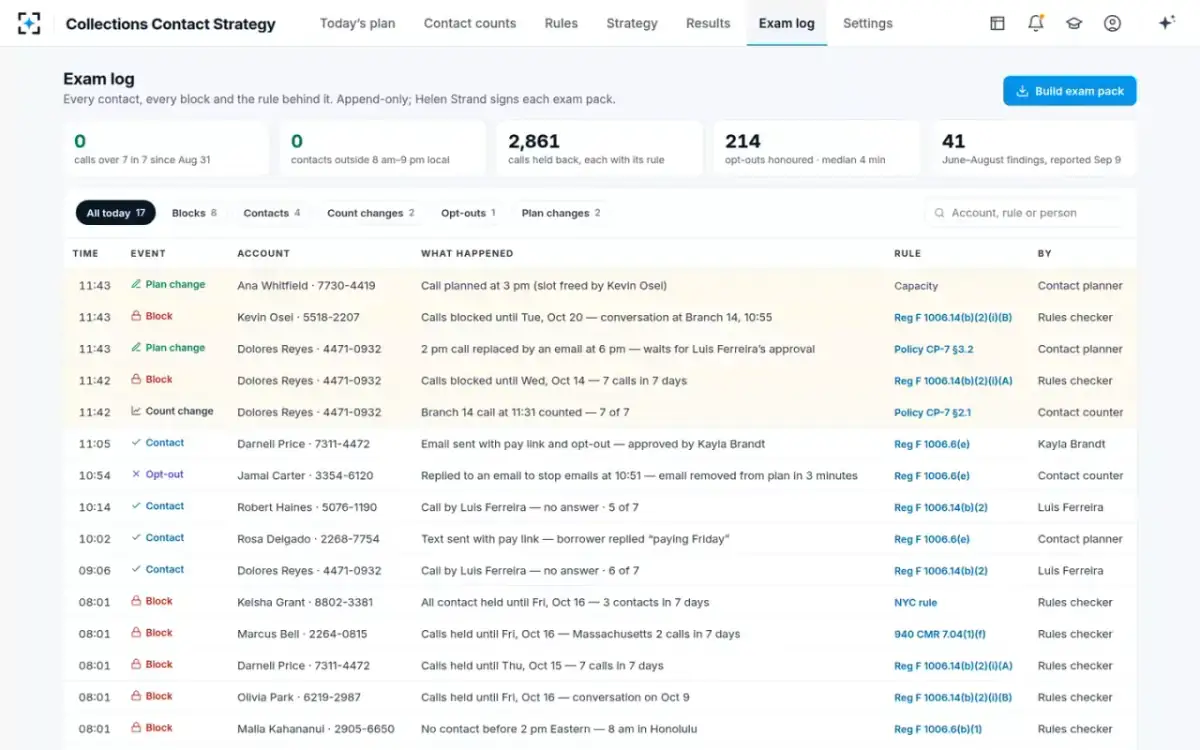
Two consequences follow for how a floor should keep its numbers. First, the count has to be per debt rather than per phone number or per person, because that is the unit the rule uses; a borrower with two past-due accounts has two counts. Second, the moment a count changes is itself a fact worth writing down. If a branch file arrives at 11:42 and moves an account from six calls to seven, the log should hold the arrival, the match, the new count and the contacts that were withdrawn from the plan as a result — because the question an examiner asks about that account is not "what was the count" but "what did you do when it changed".
One month of the log, in the numbers the pack opens with
38,412
entries written in September: every contact, block, count change and opt-out
demo · sample data
1,207calls
held back because a rule forbade them, each with the rule and the record that triggered it
demo · sample data
0contacts
outside 8 am to 9 pm in the borrower’s local time, and 0 calls over any limit
target
4min
median time to honour an opt-out, across 71 opt-outs in the month
demo · sample data
How long do you have to keep collection call records? Three years, and what you need not create
Three years after the last collection activity on the debt is the federal floor, and the procedures put it as a step for the examiner rather than as advice: determine whether the entity retains records that are evidence of compliance or noncompliance with the FDCPA and Regulation F until at least three years after the last collection activity on a debt. Two comments to the rule are cited alongside it, and both matter operationally.
For example, the entity should retain all telephone logs and copies of documents provided to consumers. (Comment 100(a)-1). b. There is no requirement to create additional records for the sole purpose of evidencing compliance. (Comment 100(a)-2).
CFPB, Debt Collection Examination Procedures, step 10
The first comment names telephone logs explicitly, which settles a question floors argue about: the log is a retained record, not working material. The second is the one that gets misread. It says you are not obliged to manufacture records whose only purpose is to evidence compliance — it does not say that records you do create are optional to keep, and it offers no comfort at all when the question is why a call was placed. In practice the records that answer an examiner are the ones the work produces anyway: the count, the rule that closed an hour, the source file that changed a number, the approval before an email went out.
The clock is also easy to misread. It runs from the last collection activity on the debt, not from the date of the record, so a file worked again in month twenty resets what the three years mean for everything already on it. That is one reason a floor often sets its own retention above the floor; on the sample book here the setting is seven years, which is the bank's choice and not the regulation's requirement.
The retention clock runs from the last collection activity, not from the call
- Debt worked
- Three years after the last collection activity36 months
- Debt worked
- Seven years of entries kept84 months
Why a finding can stand even when the count is inside the presumption
The seven-calls arithmetic is a presumption of compliance, not a safe harbour, and the Bureau has made findings against collectors whose call frequency was inside it. In Supervisory Highlights issue 34, examiners described consumers who had asked collectors to stop contacting them and were then called more than a hundred times; the frequency sat within the limits the rule sets, so the collectors were entitled to the presumption, and examiners found that the volume of calls after a specific request to stop overcame it (Supervisory Highlights, issue 34, summer 2024). The same issue records findings about communicating at times the collector knew to be inconvenient.
That is a design instruction for a contact log. If the only thing recorded about a contact is that it was allowed, the log cannot answer the question the finding turns on, which is what the borrower had already said. A log that holds the opt-out, the stated inconvenient time, the request to stop and the moment each was honoured — alongside the count — is a log that can show the presumption was never the whole of the floor's reasoning. The practical test is simple: pick an account that complained, and see whether the log explains the last five contacts without anyone having to remember them.
One month's exceptions, as the pack lists them
| What the pack lists | September | What an examiner does with it |
|---|---|---|
| Calls over any limit | 0 | Counts a sample independently from the underlying records, and asks what would have happened if one had occurred. |
| Calls held back by a rule | 1,207, each with its rule and the record that triggered it | Tests a handful against the rule cited, to see whether the block was right and whether the rule is stated correctly. |
| Contacts outside the local window | 0, across all time zones on the book | Checks how local time was determined, and what happens when the area code and the address disagree. |
| Opt-outs received and honoured | 71, median 4 minutes to take effect | Looks for contact on that medium after the request, and at how the request was captured. |
| Stated inconvenient times and places | Captured as a limit on the account, with the contact that stated it | Reads the collector note behind it, then looks for later contact at that time. |
| Accounts sampled at random | 60, with full contact history | Replaces your sample with its own, usually chosen rather than random. |
Complaints as a scoping tool, not an afterthought
Complaints appear twice in the procedures — in the material examiners obtain, and as a source of consumer complaints and disputes including those submitted to the Bureau's consumer response channel — and they are used to decide where to look. That makes the volume worth understanding. The Bureau's FDCPA annual report for 2025 records approximately 207,800 debt collection complaints in 2024, about seven percent of all complaints it received that year (CFPB, FDCPA annual report, November 2025). Debt collection is a large and well-populated complaint category, and a floor's own complaints are read against a national picture the examiner already has.
The useful discipline is to reconcile rather than to count. Your complaint log and the complaints routed through the Bureau should be the same population, and where they are not, the difference is itself a finding waiting to be made. Then categorise by what the complaint was about — frequency, time of day, channel, a request to stop that was not honoured — because those categories map onto the steps in Module 2, and a category that is growing tells you which step will be uncomfortable.
Building a monthly pack that answers the questions before they are asked
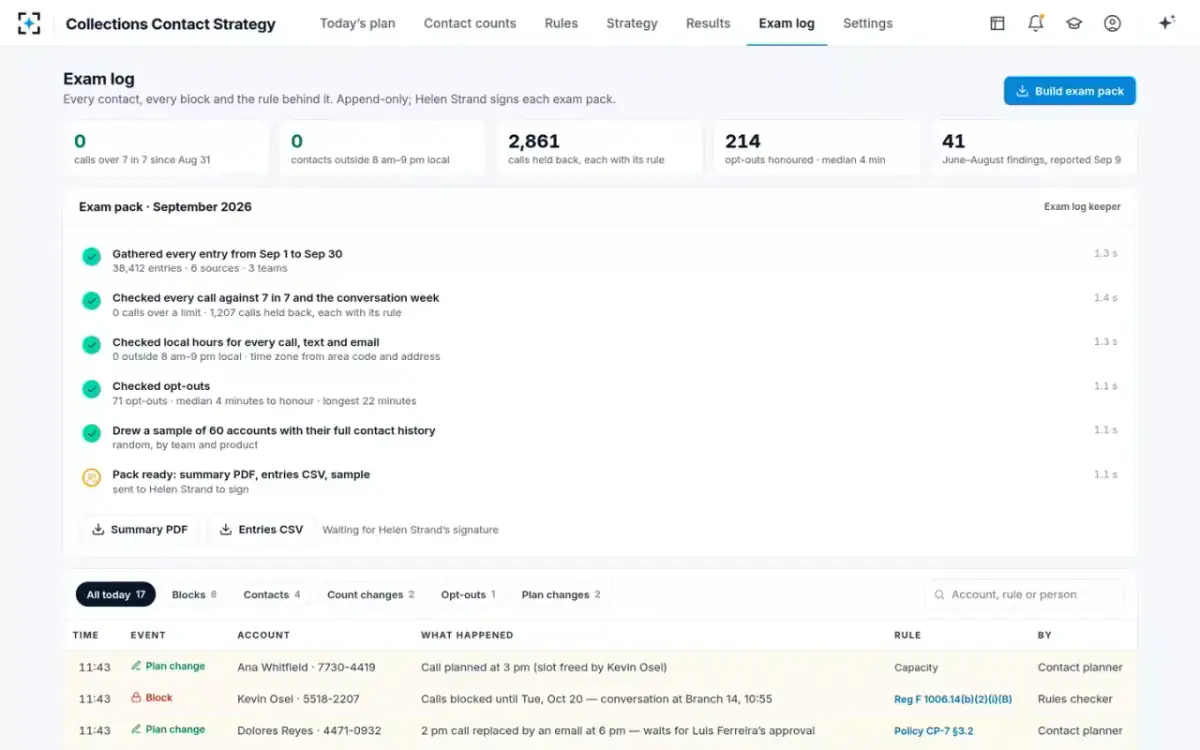
A pack assembled in the week before an examination is a reconstruction, and it reads like one. The alternative is a short monthly routine, produced from the log that the floor's ordinary work already writes: totals for the month, the exception lines above, the timing of every opt-out, and a random sample of accounts with their full contact history attached. On the sample book that is 38,412 entries for September, reduced to one page of totals and one list of exceptions, with the sixty sampled accounts behind it.
Building it monthly does two things an annual effort cannot. It finds the broken feed in the month it breaks — a letters vendor that stopped sending, an agency file that arrived empty for three days — rather than in the quarter an examiner notices the gap. And it produces a series: twelve months of the same lines, which is the only form in which "our contacts outside the window went from eleven to zero" can be said at all.
A month assembled from the log, waiting for a signature
The signature that makes the pack evidence
An unsigned pack is a report. A signed pack is a statement by a named person that these are the month's exceptions and that each has been looked at, and that is the difference between a document an examiner reads and a document an examiner tests. On this floor the collections compliance analyst signs every pack, and the governance rule behind it is that rule changes belong to her too: the same person who owns which limits apply owns the monthly statement that they were applied.
Two details make the signature mean something. The pack must be built from an append-only log, so that an entry written in September cannot be improved in October — the signature covers a month that can no longer be edited. And the exceptions must be explained in the pack rather than in a separate file, because the question "what happened on these 1,207 held-back calls" has to be answerable from the thing that was signed. The underlying entries stay available underneath it, which is what an auditable agent decision has to look like if it is to be worth anything in this room.
The log the pack is built from: every entry with its rule and its source
None of this makes an examination pleasant, and nothing a vendor builds can promise an outcome: the procedures put the examiner's own count, the examiner's own sample and the examiner's own reading of your notes at the centre of the exercise. What a floor can control is whether the answer exists before the question. To see the log, the monthly pack and the rules behind each block together, start from Collections Contact Strategy, or read how a change to the contact plan is proved in champion challenger testing.
Questions people ask
What does an examiner ask for in a debt collection exam?
The procedures list the material to obtain: policies and procedures, notes and disclosures, telephone recordings, operating checklists and review documents, monitoring procedures, compensation policies, system details, consumer files and payment records, third-party contracts and oversight materials, written correspondence, court documents, and consumer complaints and disputes. Two worth checking first are the oversight materials for placement agencies and the monitoring procedures for outgoing contact.
Do examiners listen to collection calls?
Yes. Module 2 tells examiners to consider documents and recordings — letters, voice recordings and the notes made during or after calls — and to review a sample of records and listen to a sample of collection calls. That makes retrieval by account and date a practical requirement: a recording archive searchable only by agent and shift cannot produce the calls on the accounts an examiner has chosen.
How long do you have to keep collection call records?
At least three years after the last collection activity on the debt, under 12 CFR 1006.100(a), and the procedures name telephone logs and copies of documents provided to consumers as examples of what to retain. The clock runs from the last activity on that debt, so re-working an old account extends it. A lender may set a longer period for its own reasons; that is a policy choice, not the rule.
What makes a call-frequency finding stick?
Evidence that the count was wrong, or evidence that something other than the count made the conduct harassing. Examiners have found harassment where call volume stayed inside the seven-in-seven presumption but followed a specific request to stop, because the presumption is rebuttable. A log that holds opt-outs, requests to stop and stated inconvenient times alongside the count is the only thing that answers the second kind of finding.
How do you evidence a blocked call?
By writing the block down at the moment it happens, with three things attached: the rule that forbade the contact, the source record that triggered it — the branch call at 11:31, the agency file at 06:00 — and the date the contact becomes allowed again. A block recorded only as an absence proves nothing; an examiner cannot distinguish a call you declined to place from a call nobody thought of.
Who should sign a collections compliance pack?
The named person who owns the contact rules, so that the same seat answers for what the limits are and for the statement that they were applied — on this floor, the collections compliance analyst. The signature is worth more when the pack is built from an append-only log, because the month it covers can no longer be edited after the fact.