The FDCPA call time restrictions bar a debt collector from communicating at "any unusual time or place or a time or place known or which should be known to be inconvenient to the consumer", and, absent knowledge to the contrary, treat the convenient hours as after 8 a.m. and before 9 p.m. local time at the consumer's location (15 U.S.C. § 1692c(a)(1)). Regulation F repeats the rule for calls, texts and emails alike. For the firm, the hard part is not the two numbers but the clock: a collections floor working a national book has as many calling windows as it has time zones, plus state and city rules that start later or run on a clock of their own, plus every hour a borrower has said is impossible. Botminds' Collections Contact Strategy computes each account's window from every location signal on file, closes the hours the rules close, and names the rule beside each closed hour, so the compliance team can show an examiner why a call did or did not happen.
This guide is written for the people who own that answer: the head of collections, the collections strategy manager, and the compliance analyst who signs the monthly testing. The worked examples use a fictional sample lender with 486 past-due accounts; the rules and quotations are real and linked where they appear.
What a call-time failure exposes a debt collector to
$1,000
statutory damages per individual action, before actual damages and fees
$500K
class-action cap, or 1% of net worth if that is lower
3hrs
of the federal window lost each day on one Eastern mobile number with a Pacific address
What do the FDCPA call time restrictions require of a collections operation?
They require that no communication or attempt reach a borrower at a time the collector knows or should know is inconvenient, with 8 a.m. to 9 p.m. local time as the default only when the collector knows nothing more. Regulation F carries the same rule at 12 CFR § 1006.6(b)(1)(i), extends it explicitly to electronic media, and adds an official interpretation that answers the operational questions the statute left open: whose location, what to do when the file disagrees with itself, and when an email counts as sent.
Three features of the rule shape every control built on it. It is written about inconvenience, not about a clock, so the 8-to-9 window is a presumption that knowledge displaces in either direction. It is written about the borrower's location, so the hour belongs to the account rather than to the shift. And it covers attempts, so an unanswered call at 7:40 a.m. local time is a violation even though nobody spoke.
Examiners test it in exactly those terms. The CFPB's examination procedures tell the examiner to determine whether the collector "communicates or attempts to communicate with any consumer at an unusual time or place or at a time or place that the debt collector knows or should know is inconvenient", and note that a collector knows or should know a time is inconvenient "if the facts and circumstances indicate that a time or place is inconvenient for the consumer even if the consumer does not specifically state" it (CFPB debt collection examination procedures). The test is about what the firm knew, which makes it a test of what the firm wrote down.
Do FDCPA call time restrictions bind a bank collecting its own loans?
Not directly: the FDCPA and Regulation F reach third-party debt collectors, and a creditor collecting its own debts in its own name is generally outside the statute's definition. That does not leave a bank's own floor free to call at 7 a.m. Three other sources reach it, and a lender that holds its own collectors to the federal window as policy avoids running two standards for in-house and agency calls that nobody can explain side by side.
First, Massachusetts writes its rule for creditors: 940 CMR 7.03 defines a creditor as "any person and his or her agents, servants, employees, or attorneys engaged in collecting a debt owed or alleged to be owed to him or her", and 7.04 then forbids calls outside normal waking hours. Second, New York City's amended rules, effective 1 September 2026, treat an original creditor as a debt collector once it has begun debt collection procedures. Third, unfair, deceptive or abusive practices are prohibited for every supervised lender regardless of the FDCPA, and an examiner who finds pre-dawn calls on a bank's own floor does not need the FDCPA to write it up. The full map of which rules reach an in-house team is in first party collections laws.
The agencies a lender places accounts with are bound directly, and their calls are still the lender's problem: a lender answers to its own regulator for how its vendors treat its customers. A contact plan that counts agency attempts and in-house attempts against one window per account is simpler to defend than two plans that each look compliant on their own.
Whose clock is it? Call time restrictions at book scale
The borrower's. The interpretation states that "an inconvenient time for communicating with a consumer is before 8:00 a.m. and after 9:00 p.m. local time at the consumer's location" (comment 6(b)(1)(i)-2), so a floor in Charlotte calling a borrower in Honolulu at 8:05 a.m. Eastern has dialled at 2:05 a.m. local time. Across the contiguous states the first lawful hour already moves by three hours; Alaska and Hawaii stretch it further.
The consequence for a collections operation is structural. A dialer campaign scheduled by the floor's own clock cannot be compliant for a national book without a per-account offset, and the offset itself changes twice a year for most accounts and never for Arizona's. Computing each day's window from that day's offsets, rather than storing one time zone per account at load time, removes a class of error that otherwise appears every March and November.
How many of 486 accounts are inside every applicable window, hour by hour
The chart is the capacity planner's argument as much as the compliance team's. The floor's first hour reaches fewer than half the book, and staffing that assumes a flat day overstaffs the morning and understaffs the afternoon. Which of the open hours are worth a scarce call is a separate question, taken up in right party contact rate.
How should a lender resolve conflicting location signals?
By calling only in the hours that are convenient everywhere the file says the borrower might be. The interpretation says a collector with "conflicting or ambiguous information regarding a consumer's location" complies if it communicates "at a time that would be convenient in all of the locations at which the debt collector's information indicates the consumer might be located". The safe window is the intersection of the candidate windows, not the union, and it can be short.
The CFPB works the most common case itself: a mobile number with an Eastern area code and a residential address in the Pacific zone. "The convenient times to communicate with the consumer are after 11:00 a.m. Eastern time (8:00 a.m. Pacific time) and before 9:00 p.m. Eastern time (6:00 p.m. Pacific time)." Ten hours instead of thirteen, every day, for every account that looks like that, and mobile numbers keep their area code across a move, so it is an ordinary pattern on any national book.
An Eastern mobile number on a Pacific address: two ways to build the window
One time zone stored per account: Whichever field loaded last — often the phone number, because the dialer owns it.
Every signal kept; the window is the overlap: Address of record, mailing address, each phone number's area code, and any location the borrower gave on a call, each kept with its source.
One time zone stored per account: 8:00 to 21:00 if the area code won; 11:00 to 24:00 if the address won.
Every signal kept; the window is the overlap: 11:00 to 21:00, the CFPB's own answer in comment 6(b)(1)(i)-2.
One time zone stored per account: Dialled, if the area code won: 6:30 a.m. at the borrower's home.
Every signal kept; the window is the overlap: Held. The cell says which location closed it.
One time zone stored per account: Sent, if the address won: 7 p.m. in Seattle.
Every signal kept; the window is the overlap: Held until the next morning's overlap opens.
One time zone stored per account: One zone, no reason, and a conflict nobody resolved.
Every signal kept; the window is the overlap: The conflict named on the account and resolved the way the interpretation prescribes.
Two design rules follow. Keep every location signal with its source instead of collapsing them at load time, because the rule asks what the information indicates, and a single field cannot indicate a conflict. And make the narrowing visible on the account, so a collector who sees a later first hour knows it is the rule at work and not a system fault to be overridden.
Call time restrictions by state: the overlays that change the window
State and city rules stack on top of the federal window, and the hours a firm may use on any account are the latest opening and the earliest closing among every rule that reaches it. The variations that matter to a national lender change one of three things: the hours, the clock, or who is bound.
Three overlays that change a lender's calling window
| Rule | Hours | Whose clock | Who it binds |
|---|---|---|---|
| Federal: 15 U.S.C. § 1692c(a)(1); 12 CFR § 1006.6(b)(1)(i) | After 8 a.m., before 9 p.m., absent knowledge to the contrary | Local time at the consumer's location; every candidate location if the file conflicts | Third-party debt collectors |
| Massachusetts: 940 CMR 7.04(1)(g) | Normal waking hours if known; otherwise 8 a.m. to 9 p.m. | Eastern time, written into the rule | Creditors collecting their own debts, and their agents |
| Washington: RCW 19.16.250(13)(c) | Calls at the residence between 9 p.m. and 7:30 a.m. presumed harassment | The landline area code's zone; for toll-free numbers, the last known residence; displaced by the licensee's reasonable belief | Licensed collection agencies |
| New York City: 6 RCNY § 5-77(b)(1)(i), from 1 September 2026 | After 8 a.m., before 9 p.m., absent knowledge to the contrary | Eastern Time, replacing "at the consumer's location" | Debt collectors, including original creditors once collection procedures begin |
Massachusetts deserves a second reading because it binds the creditor. The rule forbids "placing telephone calls at times known to be times other than the normal waking hours of a debtor, or if normal waking hours are not known, at any time other than between 8:00 A.M. and 9:00 P.M. eastern time" (940 CMR 7.04(1)(g)). The same section caps a creditor at two telephone communications per debt in each seven-day period to the debtor's residence or mobile number, which is why the sample lender's cell detail screen most often names Massachusetts when it closes an hour that the federal window would allow.
New York City changes the clock rather than the hours. Its amended rule replaces "at the consumer's location" with "Eastern Time" (6 RCNY § 5-77(b)(1)(i)). Local-hours logic is the federal answer; the city asks a different question, and a system that only knows local time cannot answer it. Washington, finally, is written as a harassment presumption with its own clock rule, and adds a frequency presumption of three communications a week with the debtor or spouse.
Emails and texts: the scheduler is the riskiest dialer
An email or text is timed at the moment the firm sends it. The interpretation is explicit: "an electronic communication occurs when the debt collector sends it, not, for example, when the consumer receives or views it." A reminder batch released at 6 a.m. Eastern is a 3 a.m. communication to every Pacific borrower in it, however quietly it sits in an inbox until breakfast.
Supervision has already found it. Examiners reported that "debt collectors sent payment reminder emails to the consumer before 8 a.m. in the consumer's time zone", alongside agents who "continued the conversations" after consumers said they were at work or driving (CFPB Supervisory Highlights, Issue 34, July 2024). The email finding is the one most collections technology invites: the marketing-grade platform that sends the reminders is configured by a different team from the one that configures the dialer, often on one clock for the whole book.
The control is to put every channel through the same window. In the sample lender's setup an email drafted at 10 p.m. Eastern for a Seattle borrower is queued, not sent, and the queue releases it when the account's own window opens; the time it left is kept beside the rule that held it, which is the evidence an examiner asks for when testing electronic communications.
What makes an hour inconvenient inside 8 to 9?
Anything the firm knows or should know, and the firm knows what any of its collectors heard. The interpretation's example is a borrower who says weekdays are fine "except from 3:00 p.m. to 5:00 p.m." and that no weekend time works; from then on the collector "knows or should know" both restrictions and is barred from those times "unless the consumer informs the debt collector that those times are no longer inconvenient". The borrower does not have to use the word inconvenient.
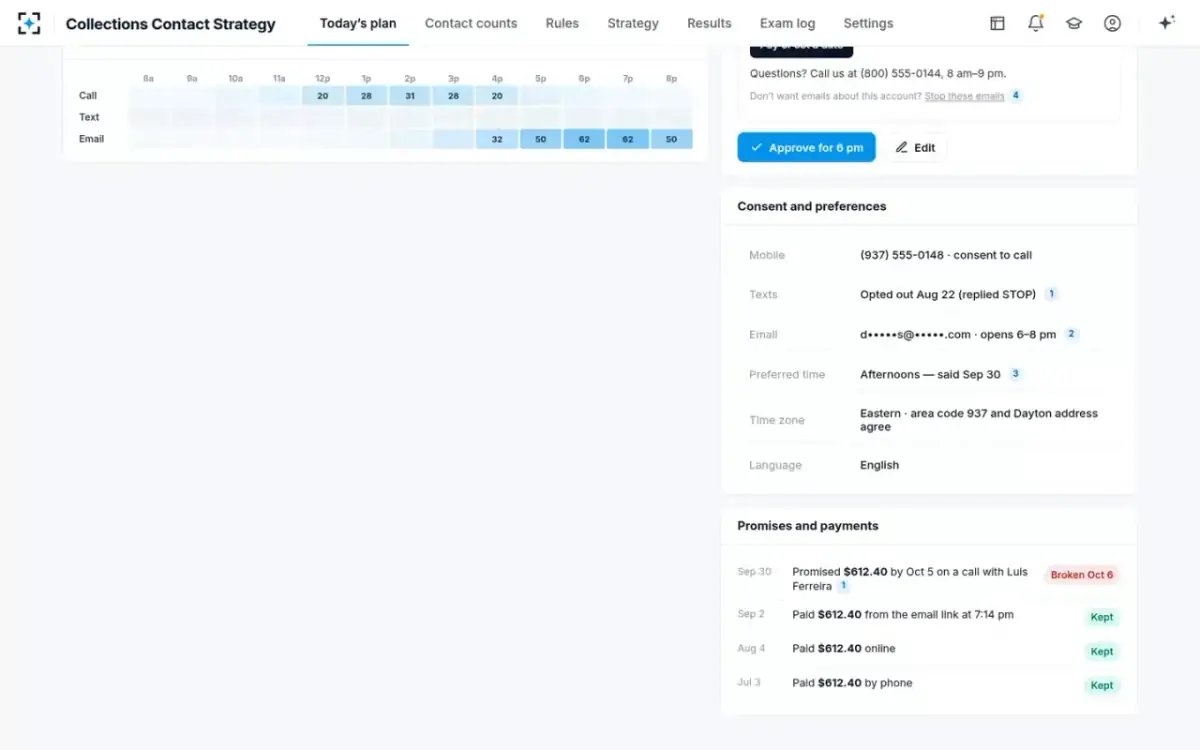
That turns a training point into a systems requirement. A refused time spoken on a recorded call binds every collector, every channel the restriction covers, every batch job and every agency working the account, from the moment it was said. Kept as a free-text note, it binds nobody in practice. Kept as a closed block on the account, tied to the call it came from, it can be enforced and shown.
Preferences and refused times, each tied to the call it came from
How a contact plan closes a forbidden hour before anyone dials
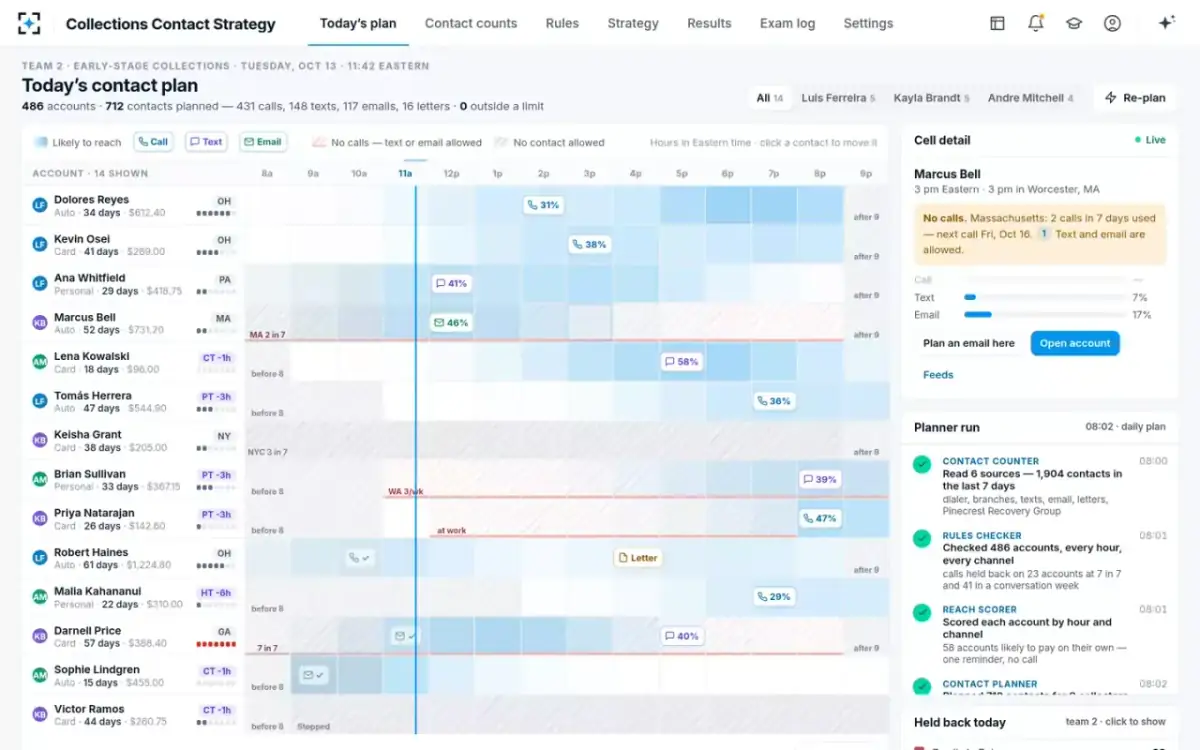
The useful control is an absence rather than a warning: the closed hour is never offered. The sample lender's morning plan is a grid of accounts against hours in the floor's time, shaded by how likely each borrower is to answer, with the early columns grey for the western rows because their windows have not opened. A team lead cannot drag a call into a grey cell; opening the cell gives the rule that closed it and the channels still open.
Why this hour is closed in Collections Contact Strategy, and what is still allowed
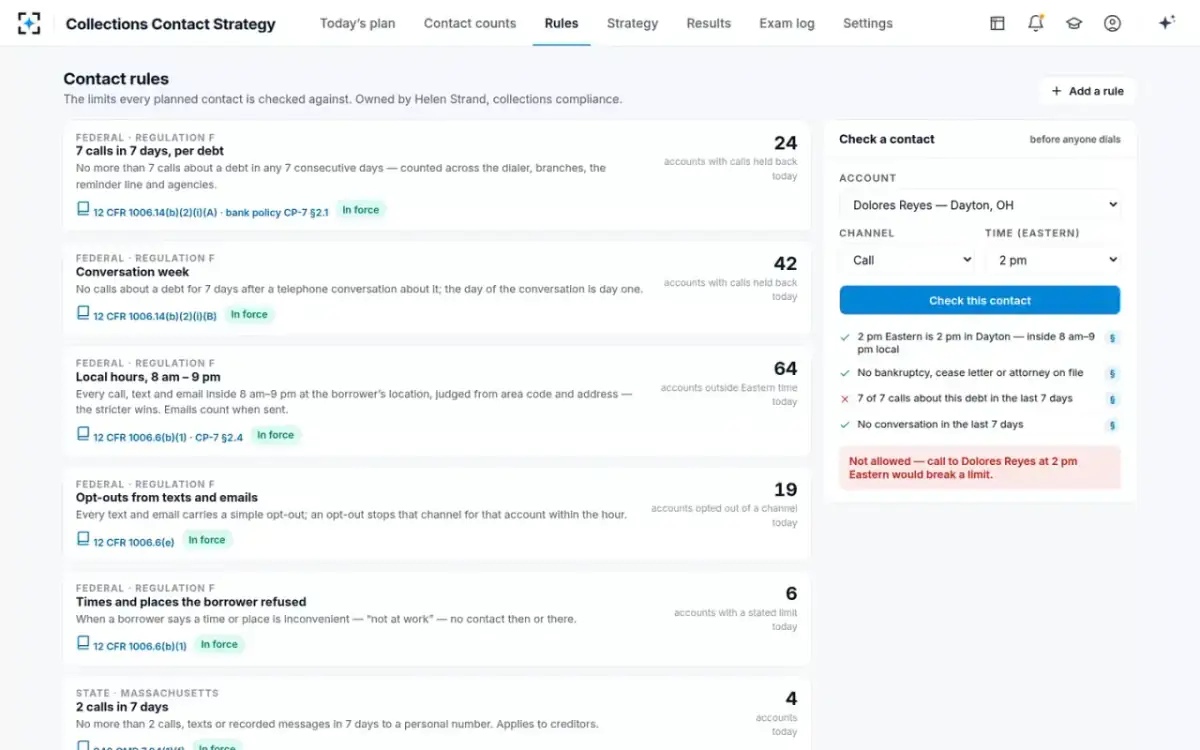
Behind the grid sits a rule set the compliance team owns: federal, state, city and the lender's own stops, each with its citation, each changed only by the people accountable for it. The lender's own stops carry most of the real variation. A lender may run a shorter day than the law allows, 9 a.m. to 8 p.m. for instance, if it judges the extra hour at each end produces complaints faster than payments; that is a policy choice the plan should hold as explicitly as a statute.
Federal, state, city and lender rules as one set the compliance team owns
What evidence do examiners expect for call times?
A test the firm ran itself, on its own attempts, against the window that applied to each account at the moment of each attempt. Examiners sample call and message logs and compare timestamps with the borrower's location; a firm that can produce, for any attempt, the account's candidate locations, the window computed from them, the rule set in force and the time the attempt left has answered the question before it is asked. One that can produce only dialer timestamps in the floor's own zone has handed the examiner the work, and the conclusion.
Six controls a call-time programme should be able to show
- Every location signal kept with its source
Address of record, mailing address, each number's area code, and anything the borrower said. The interpretation asks what the information indicates; one stored zone cannot answer.
- A window computed per account, per day
From that day's offsets, so daylight saving and Arizona never need a manual fix, and from the latest opening and earliest closing among every rule that reaches the account.
- Every channel through the same window
Calls, texts, emails and voicemail drops, from the dialer, the email platform and the agencies alike, timed at the moment of sending.
- Refused times captured as blocks, not notes
Bound to the account and the channels covered, tied to the call they came from, released only when the borrower says so.
- Overrides that cannot reopen a rule
A team lead can move a contact inside the window; nobody can move one outside it without a compliance decision that is itself kept.
- A monthly test with a named reviewer
Every attempt in the month checked against its window, a sample of accounts read in full, and a signature from the compliance analyst who owns the result.
Call times are only one test in the communications module. The examination itself, the request list and the frequency test are set out in CFPB debt collection examination procedures, and the weekly ceiling the same window has to respect is in the 7-in-7 rule.
Where Collections Contact Strategy fits, and where it does not
The solution's agents gather each account's location signals and contact history from the systems a lender already runs, compute the day's window per account under the rule set the compliance team maintains, propose a contact plan inside it, and keep every block with the rule that caused it. Collectors still decide what to say, team leads still move work between people, and the compliance analyst still signs the month's testing; the agents count, check and propose, and do not dial.
It does not replace legal judgement on which rules reach the firm. Whether a state statute binds an in-house floor, whether a borrower's "call me after six" is consent to a later call, how to treat a number that locates nobody: those are decisions a compliance officer makes and the rule set then applies. What the solution removes is the distance between that decision and every attempt on every account the next morning. To see the windows, the blocks and their citations on your own book, start from Collections Contact Strategy.
Questions people ask
Can a collector call before 8 a.m. if the borrower agreed?
Yes. The 8-to-9 window applies only "in the absence of knowledge of circumstances to the contrary", so a borrower who says an earlier call is convenient supplies that knowledge. The agreement should be kept against the account with the call it came from, and it covers only the borrower who gave it.
Do call time restrictions apply to text messages and emails?
Yes. Regulation F applies the time rule to communications through any medium, and the official interpretation times an email or text at the moment it is sent, not when it is read. A message released at 6 a.m. Eastern to a Pacific borrower was sent at 3 a.m. local time.
Do state calling hours replace the federal ones?
No, they stack. Each is a floor, so the usable hours are the latest opening and the earliest closing among every rule that reaches the account. Washington's 7:30 a.m. start helps only a licensee bound by Washington law, and only when no other rule closes that half hour.
Can collectors call on weekends or holidays?
Federal law sets no weekend or holiday rule: Saturday and Sunday carry the same 8-to-9 presumption as a weekday. A borrower who says weekends are inconvenient closes them, as in the CFPB's own example, and a lender's policy may close them anyway.
What if the file locates the borrower nowhere?
A number that maps to no zone, such as a toll-free number, is one less signal, not a licence. Washington presumes the last known residence for such numbers; elsewhere a defensible practice is to use the address of record and narrow the window if anything else in the file points somewhere different.
How long must call-time evidence be kept?
Regulation F requires a debt collector to keep evidence of compliance from the start of collection activity on a debt until three years after its last collection activity on it, and call recordings for three years after each call (12 CFR § 1006.100). Call and message logs with their timestamps are the core of that evidence for this rule; keeping the computed window and the rule set in force beside them matters because a timestamp alone does not show which window applied.