The 7-in-7 rule in collections is the floor most teams write on the wall, and it is a paraphrase of one sentence of Regulation F: a debt collector that places no more than seven calls about one debt in seven consecutive days, and no call in the seven days after a telephone conversation about that debt, is presumed to comply with the Fair Debt Collection Practices Act's ban on repeated or continuous telephone calls. The paraphrase hides the three things that decide whether your floor obeys it — the rule is a presumption and not a cap, it counts per debt and not per person or per number, and its two prongs run on separate clocks. Botminds' Collections Contact Strategy keeps the count that answers all three: every call about each debt, from every team and every agency, in order, with the date the next call is allowed.
The examples on this page come from a fictional sample bank as it runs through the solution: one early-stage collections team working 486 past-due auto, card and personal-loan accounts. The people, the branches and the accounts are invented. The regulation, the final rule's own worked examples and the examination manual are linked where they appear.
The four numbers inside the 7-in-7 rule
7calls
placed about one debt inside the window, before the presumption of compliance is lost
7days
consecutive, counted from the first call — and again from the date of any telephone conversation
1debt
is the unit of count: "each of a consumer’s debts in collection"
0
phone numbers in the arithmetic — a second number for the same debt buys no extra calls
What is the 7-in-7 rule in collections?
It is the short name for the rebuttable presumption in § 1006.14(b)(2)(i). The regulation's own words are worth reading once, because almost every argument about the rule is an argument about one of its clauses:
"Subject to the exclusions in paragraph (b)(3) of this section, a debt collector is presumed to comply with paragraph (b)(1) of this section and FDCPA section 806(5) … if the debt collector places a telephone call to a particular person in connection with the collection of a particular debt neither: (A) More than seven times within seven consecutive days; nor (B) Within a period of seven consecutive days after having had a telephone conversation with the person in connection with the collection of such debt. The date of the telephone conversation is the first day of the seven-consecutive-day period" (12 CFR § 1006.14(b)(2)(i)).
Three readings follow immediately. The subject is a telephone call placed, so inbound calls are outside the arithmetic. The object is a particular debt, so the count attaches to the debt and not to the borrower. And the verb is presumed, so the number is evidence rather than a boundary. The examination manual puts the same rule as a question an examiner asks: whether the collector causes a telephone to ring "repeatedly or continuously with intent to annoy, abuse, or harass", for which "compliance with this provision is presumed, unless either of the following occurs" — more than seven calls in a seven-day period, or a call within seven days of a telephone conversation (CFPB, Debt Collection Examination Procedures, March 2022).
A presumption, not a cap: what the rule actually promises
Two presumptions sit side by side. Stay inside both prongs and you are presumed to comply; exceed either and you are presumed to violate. Both can be rebutted, and the final rule lists the factors for each, so the honest summary is that seven calls is the line at which the burden of proof changes hands.
The two presumptions, and what moves each one
Presumption of compliance (inside the frequencies): You are presumed not to have called repeatedly or continuously with intent to annoy, abuse or harass.
Presumption of a violation (outside either prong): You are presumed to have done exactly that, and the facts have to say otherwise.
Presumption of compliance (inside the frequencies): The other side must prove intent despite your staying inside the numbers.
Presumption of a violation (outside either prong): You must prove you "did not place a telephone call … repeatedly or continuously with intent to annoy, abuse, or harass".
Presumption of compliance (inside the frequencies): Pattern and interval — "seven telephone calls to the same telephone number within one day" is the rule’s own example — voicemail pattern, what the borrower said in earlier calls, and your conduct on them.
Presumption of a violation (outside either prong): A call made to comply with applicable law, a call tied to active litigation, a call answering the borrower’s own request, or a call made after a dropped conversation.
Presumption of compliance (inside the frequencies): Reads the frequency, then reads the file for the pattern behind it.
Presumption of a violation (outside either prong): Looks for the reason, in writing, call by call.
Presumption of compliance (inside the frequencies): Spread the allowance. Seven calls in a day is inside the number and outside the spirit.
Presumption of a violation (outside either prong): If the eighth call has to happen, the reason has to be written down before it is placed.
Supervision has used that door. Examiners found collectors who placed "over 100 telephone calls" to borrowers who had asked them to stop; the frequency was inside § 1006.14(b)(2)(i), "and so the collectors were entitled to a presumption that their conduct was not harassing", but the examiners held that the volume after a stop request "overcame that presumption and had the effect of harassing the consumer" (CFPB Supervisory Highlights, Issue 34, July 2024). A floor that treats seven as an entitlement is reading only half the sentence.
Does the 7-in-7 rule count calls per debt or per person?
Per debt. The regulation defines the unit: "particular debt means each of a consumer's debts in collection. However, in the case of student loan debts, the term particular debt means all student loan debts that a consumer owes or allegedly owes that were serviced under a single account number at the time the debts were obtained by a debt collector" (§ 1006.14(b)(4)). A borrower with a past-due card and a past-due auto loan carries two counts; a borrower with four student loans serviced under one account number carries one.
Phone numbers do not enter the arithmetic at all. Calling a mobile, a landline and a work number about the same debt spends three of the seven. The single exception runs the other way: if a collector has been calling a number and then learns it is not that person's, the regulation treats those calls as never having been placed to that person — "for purposes of § 1006.14(b)(2)(i), the debt collector has not yet placed any telephone calls to that consumer during that seven-consecutive-day period" (comment 14(b)(2)(i)-3). Learning that a number is wrong gives the allowance back; believing it is right does not.
Other rulebooks pick a different unit, which is why a national book cannot be run on one number. New York City's amended rule, effective 1 September 2026, counts communications of every kind rather than calls, and states that where a collector is pursuing several debts, "excessive frequency shall be calculated separately for each distinct account belonging to the consumer" (6 RCNY § 5-77(b)(1)(iv)(B)). Same instinct, different arithmetic — and the stricter of the two is the one that has to hold.
Does an unanswered call count toward the 7-in-7 rule?
Yes, if it connected. The final rule's worked example is built from unanswered calls, which is the clearest answer anyone has published: "On Wednesday, April 1, a debt collector first attempts to communicate with a consumer in connection with the collection of a credit card debt by placing a telephone call and leaving a limited-content message. Between Thursday, April 2, and Tuesday, April 7, the debt collector places six more telephone calls to the consumer about the debt, all of which go unanswered. As of Tuesday, April 7, the debt collector has placed seven telephone calls to the consumer in connection with the collection of the credit card debt within the period of seven consecutive days that started on Wednesday, April 1" (85 FR 76734). Seven calls, one conversation short of a single word exchanged, and still a presumption of compliance — until the eighth.
What fails to count is a call that never reached the network's far end. A call "does not connect to the dialed number if, for example, the debt collector receives a busy signal or an indication that the dialed number is not in service", while "a telephone call that is answered, even if it subsequently drops, has connected to the dialed number" (same rule, comment 14(b)(3)(ii)-1). That single distinction is why a count taken from a dialer's disposition column is usually wrong: "no answer" counts, "busy" does not, and a dropped call counts even though nobody spoke.
The final rule's own seven-day window, drawn to scale
- Call 1 · limited-content messageWed 1
- Calls 2–7 · unansweredThu 2 – Tue 7
- Counted5 calls
- Busy signalnot counted
- Out of servicenot counted
- Calls placedWed 1 – Thu 2
- Conversation Fri 3 — day one of a fresh sevenFri 3 – Thu 9: no calls
The second prong: seven days after a telephone conversation
The prong teams forget is the one that costs the most. A telephone conversation about a debt starts a fresh seven consecutive days in which no call about that debt may be placed at all, and "the date of the telephone conversation is the first day" of that period. The rule's own illustration: a conversation on Friday 14 August means a call placed before Friday 21 August is presumed to violate. One good conversation therefore closes the phone for a week — and it closes it whoever had the conversation, because the prong is about the debt.
This is where a plan built by hand goes wrong in the most expensive direction. A collector who finally reaches a borrower on Tuesday has done the week's best work, and the natural next move — call back Thursday to confirm the promise — is the move the rule presumes against. There are doors: a call "in response to a consumer's request for additional information", or a call placed with consent the borrower gave the collector directly, which buys seven days of exclusion from the day the consent is received. The rule's example is exact. A borrower who says "call back on Monday" has given prior consent, and the Monday call does not spend the allowance; a call on the Wednesday after that, without fresh consent, does.
When does the seven-day window open and close, day by day?
It is a rolling window, not a calendar week, and the two prongs open it on different days. The first prong's window opens on the day of the first call that counts and closes at the end of the seventh consecutive day; a call on day eight is counted against a window that now starts on the day of your second call. The second prong's window opens on the date of a telephone conversation, whatever the call count was before it.
That is why the only workable floor rule is a date rather than a number. In the sample bank, one borrower's seventh call about an auto loan landed on a Tuesday morning; the earliest the eighth could be placed was the next day, Wednesday the 14th, when the oldest call in the window — the one placed on the 7th — dropped out of it. Nobody computes that from a wall chart at nine in the morning. A plan that holds the count holds the date, and the date is what a collector needs: not "you are at seven" but "calls resume Wednesday the 14th".
The calls that never count: consent, no connection, third parties
Three exclusions sit in § 1006.14(b)(3), and all three are narrower than they sound. Calls do not count if they are "placed with such person's prior consent given directly to the debt collector and within a period no longer than seven consecutive days after receiving the prior consent", if they are "not connected to the dialed number", or if they are "placed to the persons described in § 1006.6(d)(1)(ii) through (vi)" — the borrower's attorney, a consumer reporting agency, the creditor and its attorney, and the collector's own attorney.
Note what each one requires. Consent must be given to you, directly, and it expires after seven days. No connection means the network refused the call, not that nobody picked up. And the third-party list is a list of professionals, not of family members. The table below is the version a floor can use.
Counting one debt's week in Collections Contact Strategy: what goes in the number and what does not
A dialled call that rang unanswered
In the seven?Counts
WhyIt connected to the number. The worked example in the final rule counts six unanswered calls toward the seven.
WhereComment 14(b)(2)(i)-1.i
A call answered, then dropped
In the seven?Counts
Why"A telephone call that is answered, even if it subsequently drops, has connected to the dialed number."
WhereComment 14(b)(3)(ii)-1
A busy signal
In the seven?Does not count
WhyThe call "does not connect to the dialed number if, for example, the debt collector receives a busy signal".
Where§ 1006.14(b)(3)(ii)
A number that is out of service
In the seven?Does not count
WhySame exclusion: an indication that the dialled number is not in service.
Where§ 1006.14(b)(3)(ii)
A call that left a limited-content message
In the seven?Counts
WhyThe example’s first of seven calls is a call that leaves one. The message is not the point; the call is.
WhereComment 14(b)(2)(i)-1.i
A call to a number that turns out to be someone else’s
In the seven?Stops counting
WhyOnce the collector learns the number is not that person’s, those calls "are not considered to have been telephone calls placed to that person".
WhereComment 14(b)(2)(i)-3
A call the borrower places to you
In the seven?Does not count
WhyThe frequencies count calls the collector places. An inbound call is not one.
Where§ 1006.14(b)(2)(i)
A call inside seven days of consent given to you directly
In the seven?Does not count
WhyExcluded for seven consecutive days from the day the consent is received.
Where§ 1006.14(b)(3)(i)
A branch officer’s call about the same debt
In the seven?Counts, for a collector in scope
WhyThe rule counts calls about a particular debt, not calls from a particular desk.
Where§ 1006.14(b)(2)(i)
An outside agency’s call about the same debt
In the seven?Counts for that agency
WhyEach collector carries its own count. Whether yours and theirs add up is a question about who placed the call.
Where§ 1006.14(b)(2)(i)
A text message, an email or a letter
In the seven?Does not count
WhyThese are telephone-call frequencies. Other rules reach other channels.
Where§ 1006.14(b)(2)(i)
A voicemail left at the same number seven times in a day
In the seven?Counts, and argues against you
WhyVoicemail pattern is a named factor that can rebut the presumption of compliance.
WhereComment 14(b)(2)(i)-2.ii
What stays open at seven calls — text, email and letters
The frequencies are telephone-call frequencies. At seven calls about a debt, a text message, an email and a letter are all still available, and that is the practical value of knowing exactly where the count stands: the account does not go quiet, it changes channel. In the sample bank a borrower at seven calls moved to a six o'clock email carrying the past-due amount, a link to pay or set a date, the phone line and its hours, and a one-click opt-out.
Two conditions attach. The first is consent and preference: a borrower who has asked you not to use a medium has closed it. Examiners have already found collectors who "communicated or attempted to communicate with consumers through a medium of communication, such as a text message, and/or through a specific telephone number that the consumers had requested the debt collectors not use" (Supervisory Highlights, Issue 34). The second is the hour: an electronic message is judged by the moment you send it, which is why the calling window, by clock and by state governs the email as much as the call. Where a city rule counts communications rather than calls, as New York City's does, the channel switch spends that budget too.
Do calls from a branch or an outside agency count too?
They count against the debt, and that is the sentence that breaks most spreadsheets. The regulation counts calls placed about a particular debt; it does not care which desk placed them. A branch loan officer who rings a past-due borrower about the same auto loan has spent one of the seven as surely as the dialer has. So has the payment-reminder line. A placement agency carries its own count as its own collector, and the cautious course is to hold both views at once: their own number, and the number a regulator would reach by adding everyone who called about that debt.
Where one account's week went, by the desk that dialled — the picture Collections Contact Strategy assembles
Seven calls about one auto loan, 7–13 October
- Collections dialer · 6 · 85.7%
- Branch 14 · 1 · 14.3%
What the count spreadsheet could see
- Dialer only · 6 of 7 · 85.7%
- Invisible · 1 · 14.3%
A whole team’s contacts in the last seven days, by source
- Dialer · 61%
- Texts and email · 18%
- Branches · 9%
- Reminder line · 7%
- Letters and agency · 5%
The arithmetic of invisibility is simple and unforgiving. A look-back over three months at the sample bank found 41 calls over a limit, every one of them placed after a branch or agency call the spreadsheet never saw. None of those 41 came from a collector ignoring a rule. They came from a count that was right at eight in the morning and wrong by ten.
Seven calls reached: what a collector sees instead of a dial tone
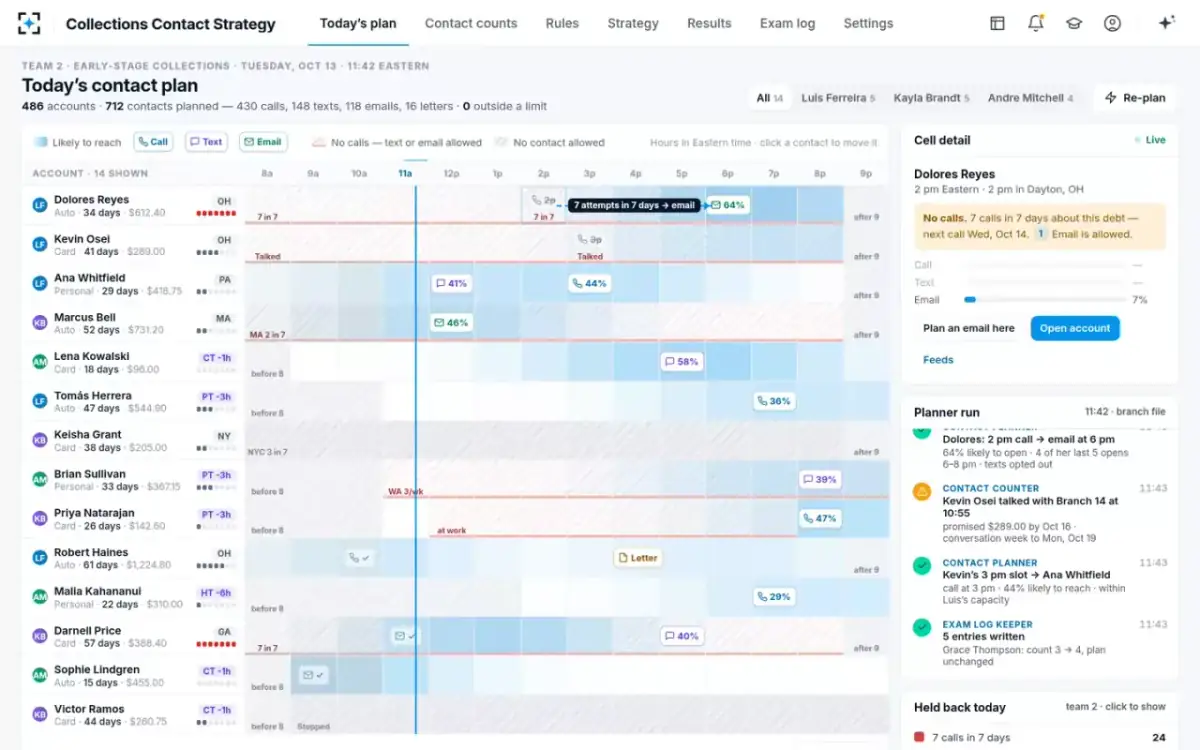
What counts as a telephone conversation under Regulation F?
The regulation does not define the phrase, which makes it the most consequential undefined term on the floor: it is the switch that turns a seven-call allowance into a seven-day silence. What the rule does supply is a boundary on either side. A call that is answered and then drops has connected, and where a conversation about the debt was under way when it dropped, the final rule's own example treats the immediate call-back as a call inside the second prong's week — presumed a violation, with the circumstances able to rebut it — so the conversation had already started the clock. A limited-content message is plainly not a conversation; the April example leaves one and still counts six more calls.
In practice teams draw the line at a live exchange with the right party about the debt. The safe habit is to record which it was at the moment it happens, by the person who was on the call, because the two readings produce different dates and only one of them can be defended later. A conversation logged as an attempt understates the silence you owe; an attempt logged as a conversation costs a week of contact you were entitled to.
How a contact counter proves the number to a compliance analyst
Counting is only half the job. The other half is showing the count's working to someone who has to answer for it — and the examination manual's instruction is to look for evidence, in the entity's own records, of the frequency and what sat behind it. What a compliance analyst needs is a per-debt figure she can take apart: each call with its date, its source system and whether it connected; the date of the last telephone conversation; the limit in force, federal, state, city or the bank's own; and the date the next call is allowed, with the call that frees it named.
One debt's count, with the limit in force and the date the next call is allowed
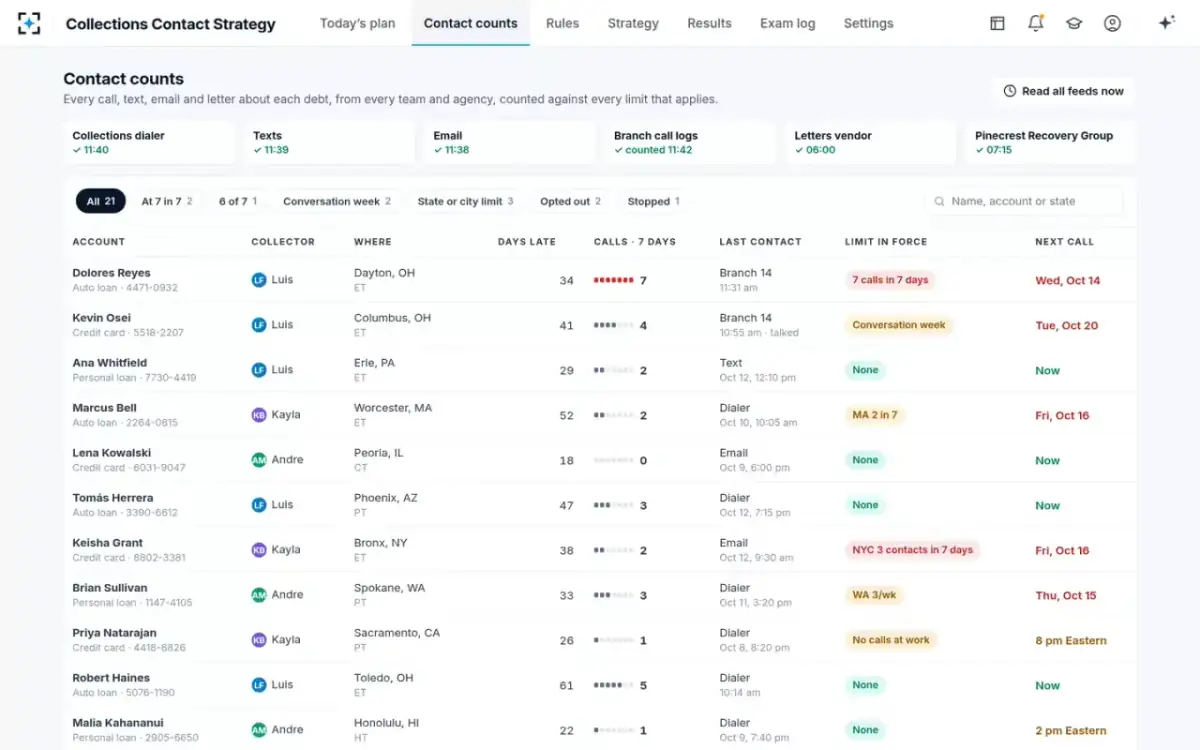
Two properties make that figure usable. It must be sourced: every call traceable to the system that logged it, so an unmatched branch row goes to a person rather than into a guess. And it must be written down as it happens, because a count reconstructed after a complaint is a reconstruction. The monthly discipline that grows out of it — totals, exceptions, opt-out timing, a sample of accounts with their full history — is the subject of what the CFPB's debt collection examination procedures ask you to prove.
One more property matters to the business rather than the exam. Once the seven calls are a known budget, the question stops being whether you may call and becomes which call is worth making — the subject of right party contact rate and what it hides. And if you are a lender collecting your own loans, the prior question is whether any of this binds you at all: which call limits reach a creditor's own team is a shorter list than most compliance officers expect, and a longer one than the FDCPA alone suggests. To see the count, the blocks and the dates on your own accounts, start from Collections Contact Strategy.
Questions people ask
Does the 7-in-7 rule apply to text messages and emails?
No. Section 1006.14(b)(2)(i) sets telephone-call frequencies, so texts, emails and letters do not count toward the seven and are not blocked by it. They are governed by other rules instead: the borrower's consent and medium requests under § 1006.14(h), the inconvenient-time rule, and city rules such as New York City's, which counts communications of every kind rather than calls.
Does a voicemail count as a call under the 7-in-7 rule?
The call that left it counts, if it connected. The voicemail itself is also evidence: the final rule names "the frequency and pattern of any voicemails that the debt collector leaves for a person" as a factor that may rebut the presumption of compliance, giving seven voicemails at one number in a single day as its example. Staying under seven while filling a borrower's inbox is not the protection it looks like.
What happens if a borrower calls us?
An inbound call is not a call the collector places, so it does not count toward the seven. If it becomes a telephone conversation about the debt, though, the second prong applies with its own date, and the seven days of silence start from that day — a borrower-initiated conversation closes the phone exactly as a collector-initiated one does.
What if we called a wrong number seven times?
Once you learn the number is not that person's, comment 14(b)(2)(i)-3 treats those calls as not having been placed to that person for the purposes of the frequency, so the window is clear again. The relief depends on learning it; a number you merely doubt still spends the allowance, and the calls themselves may raise other questions about who you reached.
Do the seven days reset at the start of a week?
No. The window is seven consecutive days measured from a call, or from the date of a telephone conversation, so it moves every day. Monday is not a reset. This is why a floor instruction phrased as a number ("you are at six") is less useful than one phrased as a date ("the next call is allowed on Wednesday the 14th").
Does the 7-in-7 rule apply to a bank collecting its own loans?
Regulation F reaches FDCPA debt collectors, and a creditor collecting its own debts in its own name is generally outside that definition — but about half the states reach original creditors, Massachusetts caps a creditor at two calls in seven days, and New York City's rule covers them from 1 September 2026. Many lenders adopt the federal presumption as policy anyway. The detail is in first party collections laws.