Champion challenger testing is the practice of keeping the strategy you run today as the champion, holding a randomly chosen part of the population on it, running a candidate strategy — the challenger — on the rest, and deciding between them on numbers measured over the same period. In a collections contact strategy that means two halves of a past-due segment worked side by side for a full cycle: one called in today's order, one on the new order of channels and hours. Botminds' Collections Contact Strategy designs each test with a random control group, measures promises to pay per 100 contacts, contacts per promise, complaints and opt-outs, and puts the result in front of a named strategy manager who approves it, declines it or extends the run. The test exists because a contact plan is a rationing decision, and a rationing decision can always be made to look good on one number by spending something that is not on the report.
Every account, person, bank and test number on this page is fictional sample data from the solution as it runs; the research figures are the regulators' and are linked where they appear.
What champion challenger testing means in collections
The champion is not an idea, it is the plan currently in force: the segment order, the channel sequence, the hour at which each account is first attempted, the threshold above which an account is left alone. The challenger changes one thing in that plan and nothing else. A test that changes the channel order and the capacity per collector at the same time cannot tell you which change paid, and a floor that has learned nothing cannot make a second change with any confidence.
What makes the collections version different from testing in marketing is the cap. Under Regulation F a debt collector is presumed to comply with the prohibition on harassing telephone conduct only if it places no more than seven calls about a particular debt in seven consecutive days and none in the seven days after a telephone conversation about it (12 CFR 1006.14(b)(2), worked through in what the seven calls count). The contact allowance is therefore fixed before the test starts. A challenger cannot win by doing more; it can only win by spending the same allowance in a better order. That single constraint is why collections tests are interesting and why they are easy to fake.
One test, two halves of the same segment: what each half was actually doing
Champion · 620 accounts: A call in the hour the account is most likely to be answered, placed by the account’s collector.
Challenger · 620 accounts: An email at 6 pm carrying the past-due amount, a pay-or-set-a-date link and a one-click opt-out.
Champion · 620 accounts: A second call the same week, then a text where consent allows.
Challenger · 620 accounts: The first call the next day, in the same best hour the champion would have used.
Champion · 620 accounts: Unchanged: seven in seven per debt, less any branch, reminder-line or agency call already counted.
Challenger · 620 accounts: Unchanged. The email is not a call and does not consume the allowance.
Champion · 620 accounts: Collectors call; emails wait for the account’s collector to approve them.
Challenger · 620 accounts: Identical. The test changed the order, not who acts.
Champion · 620 accounts: Accounts scored likely to pay without contact get one reminder and no call.
Challenger · 620 accounts: Identical, at the same threshold.
Champion · 620 accounts: Nothing. Collectors saw a normal day’s plan.
Challenger · 620 accounts: Nothing. A floor that knows which half it is working is not a control group.
How is champion challenger testing different from A/B testing?
Mechanically they are the same experiment: random assignment, parallel exposure, one comparison. The difference is in the asymmetry and in what happens afterwards. An A/B test treats both arms as candidates and expects one to be chosen. A champion challenger test treats the incumbent as the thing to be defended: the challenger carries the burden of proof, and a tie means the champion stays. On a collections floor that asymmetry is not politeness, it is risk management. The champion is a plan whose conduct record is already in the exam log; a challenger is a plan nobody has ever had to explain to an examiner.
The second difference is that champion challenger testing is a standing arrangement rather than an event. The held-back half does not disappear when a challenger wins. It becomes the control for the next challenger, which is how a floor keeps a baseline it can trust after six changes rather than comparing each change with a memory of the quarter before. The third difference is granularity: an A/B test usually randomises people, while a collections test randomises accounts, and one borrower can hold more than one past-due account. If the same person lands in both halves, the two arms are contaminating each other, so the split must be by borrower and the accounts follow.
Designing the split: random, held back, and large enough to settle it
Three properties make a split worth reading. It must be random, which means assigned by the system before anyone looks at the accounts, not carved out by state, by collector or by balance band. It must be held back, which means the champion half keeps running the old plan untouched for the whole period even when the challenger starts to look good in week two. And it must be big enough that the difference you care about is larger than the week-to-week noise of the same segment.
The size question has no universal answer, but it has a usable discipline: decide before the run what difference would change the decision, then check that the segment generates enough contacts in a cycle for that difference to be visible above its own variance. A segment that produces 200 contacts a week and a champion rate of 13 promises per 100 contacts will swing by two or three promises per 100 on nothing at all; a one-point improvement in that segment is unreadable however long you run. The honest response is to pick a bigger segment, a longer run or a bigger change — not a smaller threshold for declaring victory.
Three traps are worth naming because each produces a clean-looking result that is wrong. Splitting by collector tests the collectors, not the plan. Splitting by state mixes in the state call limits — Massachusetts allows two calls in seven days, so a Massachusetts-heavy half has a different allowance before the test begins. And re-randomising mid-run, usually to balance the halves after a bad week, destroys the only property that made the comparison meaningful.
How long should a collections challenger run? Four weeks, not one
A collections challenger should run for a full billing and pay cycle, which in practice means four weeks, because a shorter run reads the calendar rather than the change. Past-due behaviour is strongly periodic: borrowers paid on the first and the fifteenth promise differently in the week they are paid, some benefit payments arrive on fixed dates each month, and a week containing a holiday has fewer answered calls at every hour. A one-week challenger that starts on the second of the month and a one-week challenger that starts on the twentieth are measuring two different populations of willingness to pay.
Four weeks of a challenger, and what a one-week run actually reads
- Week 1 · split checkedread only
- Week 2 · first promise readread only
- Week 3 · guardrail trendstopping checks
- Week 4 · result assembleddecide
- One pay-cycle weekconfounded
Four weeks is also the point at which a promise can be partly judged. A promise to pay made in week four has not yet come due when the test closes, which is why a test result is a statement about promises obtained and not about cash collected. Saying so out loud is part of the discipline: the strategy manager approving the change should know that the number in front of her is an intermediate measure, and that the kept-promise rate for the same cohort will arrive a month later and may not agree.
The four numbers: promises, contacts per promise, complaints, opt-outs
A contact strategy test measured on one number can always be won. Measure promises alone and the challenger that calls harder wins. Measure cost per promise alone and the challenger that abandons the hard accounts wins. The four numbers below are chosen so that the easy ways to win show up as a loss somewhere else: two of them say whether the strategy worked, and two say what it cost the people on the other end of the phone.
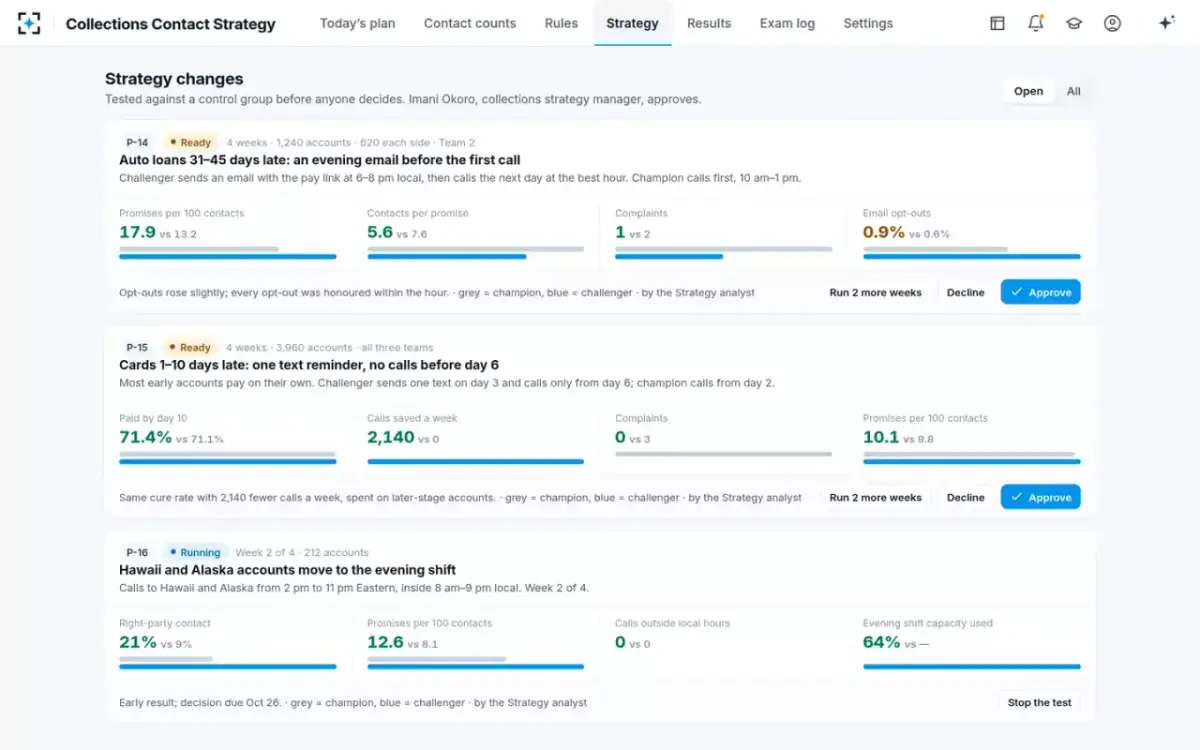
Test P-14 read on four numbers, including the one that got worse
17.9per 100
promises to pay per 100 contacts on the challenger, against 13.2 on the held-back half
demo · sample data
1vs 2
complaints on the challenger half against the champion half, over the four weeks
demo · sample data
0.9%
email opt-out rate on the challenger, up from 0.6% — the number that got worse
demo · sample data
0calls
over any limit on either half: the allowance did not move to make the test work
target
Promises to pay per 100 contacts is the effect the strategy is trying to produce, expressed per contact rather than per dial so that a challenger cannot win by using more of the allowance. Contacts per promise is the same quantity inverted, and it is the number a team lead feels: at 13.2 promises per 100 contacts a promise costs about 7.6 contacts, and at 17.9 it costs about 5.6. Complaints and opt-outs are the guardrails. They are not softer measures — they are the two places where the cost of a harder strategy lands, and they move slowly enough that a floor can run for months without noticing the channel it is burning.
One more number belongs on the sheet even though it is not a test result: calls over any limit, which must be zero on both halves. A challenger that improves promises while quietly spending an eighth call has not beaten the champion; it has changed the rules of the comparison. Keeping that line at zero on both halves is what lets the rest of the numbers be read as a strategy difference at all.
Reporting the bad number: an opt-out rate that rose from 0.6% to 0.9%
In test P-14 the challenger won on promises and lost on opt-outs. Email opt-outs rose from 0.6% of emails sent to 0.9% — three-tenths of a percentage point in absolute terms, half as many borrowers again in relative terms, on the only channel that costs almost nothing and is open when calls are blocked. The strategy analyst reported it next to the win rather than underneath it, which is the behaviour the governance rule exists to produce: the analyst proposes, reports the bad numbers as well as the good, and the strategy manager decides.
The reason an opt-out matters more than its size suggests is that it is permanent and account-specific. Once a borrower has asked you not to use a medium, a debt collector must not use it again: the rule is flat, and the only compliant answer is a narrower set of channels for that account from then on. So a 0.3-point rise is not a 0.3-point cost this month; it is a permanent reduction in the channels available on those accounts for the rest of their life, including the weeks when the call allowance is exhausted and email is the only thing left. A strategy that buys promises today with the cheapest future channel is borrowing, and the report should say so.
The research says the same thing about calls. In the Bureau's consumer survey, 42% of consumers who had been contacted about a debt in collection said they had asked a creditor or collector at least once to stop contacting them, and only a quarter said the contact actually stopped.
Forty-two percent of consumers who reported having been contacted about a debt in collection said they had done so at least once. … Twenty-five percent of consumers said that the creditor or debt collector stopped attempting to contact them after being asked to.
CFPB, Consumer Experiences with Debt Collection, January 2017
Read those two sentences together and the opt-out rate stops being a courtesy metric. Asking to stop is a common act, and being ignored is the common outcome; a floor whose opt-out rate is rising is adding to a population that has already learned the request does not work. The Bureau's examiners have treated repeated contact after such a request as harassing conduct even where the call count stayed inside the presumption — the presumption of compliance is rebuttable, and a request to stop is one of the things that rebuts it (Supervisory Highlights, issue 34, summer 2024). A challenger that raises opt-outs is therefore raising exam exposure as well as cost.
Does model risk guidance apply to a contact strategy score?
Usually the limits are not a model and the score is. The supervisory definition of a model turns on whether statistical, economic or financial theory is used to turn inputs into a quantitative estimate, and it excludes simple arithmetic and deterministic rule-based processes and software with no such theory behind them (SR 26-2, discussed at length in what the agents may and may not do). Counting seven calls in seven days is arithmetic. Judging whether a cell is forbidden is a rule. Estimating the probability that a named borrower answers at 6 pm, or pays without being called, is an estimate produced by a method — and whatever a bank's policy concludes about its risk tier, that is the part a model-risk reviewer will ask about.
Two expectations in that guidance bear directly on champion challenger testing. The first is that performance is assessed by comparing outputs with what actually happened, and that when performance "deviates meaningfully from expectations", banks "generally consider whether model adjustments, recalibration, or redevelopment are warranted". A challenger test is one such comparison, done prospectively, on a held-back control — which is why the test design and its decision belong in the same file as the score's documentation. The second is that monitoring does not stop when the test ends.
Validation can reveal performance deterioration over time and inform judgments about acceptable performance ranges.
Board of Governors of the Federal Reserve System, SR 26-2, 17 April 2026
For a reach score, deterioration has ordinary causes, and the guidance lists the kinds of change monitoring should watch: products, exposures, activities, clients, data relevance and market conditions. A new state limit changes which hours are reachable; a dialer migration changes what an attempt record looks like; an outside agency joining the plan changes the contact history the score is fitted on. Each is a change in data relevance or activity, and each is a reason to ask whether the hours the score prefers are still the hours borrowers answer.
Ongoing monitoring after the challenger wins
A common failure in collections testing is not a bad test. It is a good test whose result is rolled out to the whole book and never read again. The winning challenger was measured on 620 accounts in one segment over four weeks; the book it is now running has other segments, other states, other balance bands and a different mix of consent. The effect it produced on auto accounts 31–45 days past due is a reasonable prior for card accounts 46–60 days past due, and nothing more.
What keeps it honest is a standing baseline and a short list of numbers read on a fixed rhythm. Keep a small randomly held-back slice of the segment on the old plan after roll-out, so the comparison survives; read the four numbers monthly on the whole book, broken out by segment; and set, in advance, the level at which each guardrail triggers a review. On the sample book the next challenger was already drafted on that basis: test P-17, 1,880 card accounts 46–60 days past due, split in half for four weeks, a text at the hour each borrower last answered followed by a call the next day, with texts going only where there is consent and no opt-out, and a start date that waits on the strategy manager's approval.
The result as the strategy manager sees it, before she decides
Who decides, and what the decision has to say
A tested result is not a decision. On this floor the rule is that strategy changes need the collections strategy manager, and only after a tested result with a control group; rule changes — what counts as a contact, which limits apply, the allowed hours — need the compliance analyst instead, and no test can authorise them. Separating the two matters because a challenger that improves promises by touching a limit is a rule change wearing a strategy change's clothes.
What the decision has to say is more interesting than who signs it. A decision that records only "approved" leaves the next reviewer, internal audit or an examiner with no way to tell a measured change from a hunch. The record below is the shape that answers the questions people actually ask a year later, when the analyst who ran the test has moved on and the opt-out rate on that segment is still elevated.
The decision record for one approved challenger
What was tested
An evening email carrying the past-due amount and a pay link, sent before the first call of the cycle, against the current call-first plan.
On whom
1,240 auto accounts 31–45 days past due, split at random into two halves. Neither half was chosen by a collector or a team lead.
For how long
Four weeks, 31 August to 27 September. No change to either half mid-run.
What moved
17.9 promises to pay per 100 contacts against 13.2 on the held-back half. One complaint against two.
What got worse
Email opt-outs rose from 0.6% to 0.9% of emails sent — half as many again closing the cheapest channel the floor has.
What was not measured
Whether the promises were kept. Cash collected lags a promise by up to 30 days, so the kept rate is read at the next review, not here.
Who decided
The collections strategy manager. The analyst that designed and read the test proposes; it cannot approve its own result.
When it is read again
Six weeks after the change goes to the whole book, on the same four numbers, with the opt-out rate as the first line.
Two sentences in that record do most of the work. "What got worse" prevents the quiet rewriting of a mixed result into a clean one. "What was not measured" prevents the test being cited, later and by someone else, as evidence of something it never looked at — cash collected, roll rates, kept promises. Both are also what a reviewer looks for when asking how a change to collection practice was approved, which is why the test and its decision sit in the same append-only log as the contacts themselves and arrive in the monthly pack described in what an examiner asks for.
Stopping rules: the harm that ends a test early
A challenger must be stoppable, and the conditions have to be written before it starts, because in week three everyone involved has an interest in the answer. Three kinds of trigger belong on the list: a conduct trigger, a consent trigger and a data trigger. A conduct trigger is a complaint pattern on the challenger half that the champion half does not show, or any call placed over a limit. A consent trigger is an opt-out rate above a stated multiple of the champion's. A data trigger is the discovery that the split is broken — the same borrower in both halves, or a feed arriving late so one half's counts were wrong for a day.
Stopping is not failure, and it is cheaper than the alternative. A test stopped in week two on a complaint pattern has cost four weeks of analyst time; the same pattern left to run to the end of a quarter and then rolled out to the book is the start of an examination finding. The one rule with no exception is that the stop must be available to the compliance analyst, not only to the strategy owner whose change is being tested.
Eight tests a collections challenger has to pass before it becomes the champion
- The split was random, and by borrower
Assigned before anyone saw the accounts, with every account of one borrower in the same half.
- The champion half was untouched for the whole run
No collector moved an account between halves, and no half was re-randomised to even out a bad week.
- It ran a full cycle
Four weeks, so the pay dates, the benefit dates and at least one quiet week fall in both halves.
- The allowance did not move
Calls over any limit are zero on both halves. A challenger that borrows from the cap is not comparable.
- All four numbers were read, not one
Promises per 100 contacts, contacts per promise, complaints and opt-outs, on both halves, for the same period.
- The guardrails did not get worse without being named
A rise in opt-outs or complaints is reported at the same size as the win, with a view on whether it is acceptable.
- The limits of the result are written down
Which segment, which days past due, which states, and what the test did not measure — cash collected and kept promises above all.
- The decision has an owner and a review date
The strategy manager approves; the result is read again on the whole book six weeks later on the same four numbers.
Where a run of tested changes shows up, months later
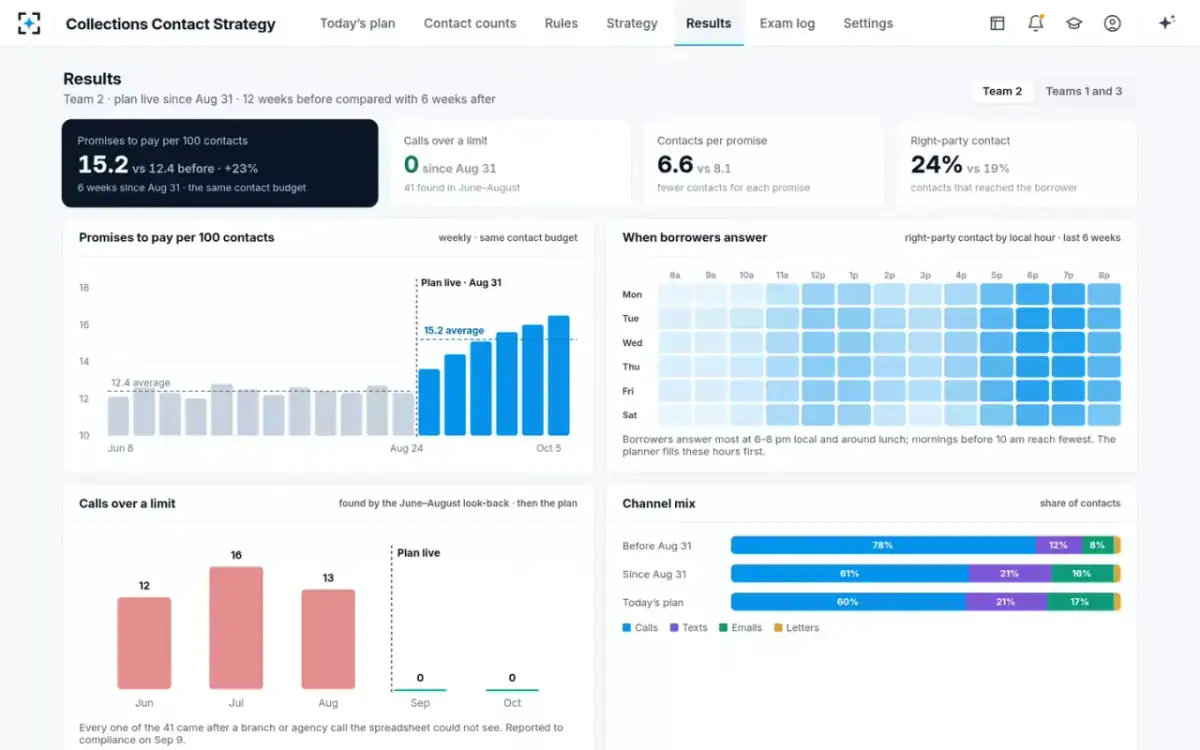
Running a floor this way has an effect that is easy to miss: the arguments change. Without a control group, a channel-order debate is a contest between two people's intuitions about borrowers, and the more senior intuition wins. With one, it is a question with a date on it. The honest case for champion challenger testing in collections is not that it finds big wins — the wins are a point or two of promises per 100 contacts — but that it makes small changes safe to make, repeatedly, on a book where the cost of being wrong is measured in other people's goodwill. To see the tests, the four numbers and the decision record together, start from Collections Contact Strategy, or read how the effect is measured in right party contact rate, and what it hides.
Questions people ask
What is champion challenger testing?
It is a test that keeps the strategy in force as the champion, holds a randomly chosen part of the population on it, and runs a candidate strategy — the challenger — on the rest for the same period. Both halves are read on the same measures, and the champion stays unless the challenger beats it. In collections the halves are accounts in one past-due segment, split by borrower so that no person appears in both.
What should a collections test measure besides payments?
Four things at a minimum: promises to pay per 100 contacts, contacts per promise, complaints and opt-outs. The last two are the guardrails, because nearly every easy way to win on promises — calling harder, calling earlier, using a channel a borrower tolerates rather than wants — shows up first as a complaint or an opt-out. Calls over a limit should also be on the sheet, and should be zero on both halves.
Do opt-outs and complaints count as test results?
Yes, and they decide tests. An opt-out is permanent and account-specific: once a borrower has asked you not to use a medium, that medium is closed for that account, including in the weeks when the call allowance is exhausted. A challenger that lifts promises while raising the opt-out rate is buying this month's result with next quarter's cheapest channel, and the decision record should say so in those terms.
How big does a collections test group need to be?
Big enough that the difference you would act on is larger than the segment's own week-to-week movement. The practical route is to fix the difference that would change your decision first, then check how many contacts the segment generates in a cycle. A segment producing a couple of hundred contacts a week cannot settle a one-point difference in promises per 100 contacts however long it runs; pick a larger segment, a longer run or a bigger change instead.
How do you stop a challenger that is doing harm?
By writing the stopping conditions before the test starts and giving the compliance analyst the power to use them. Three triggers cover most harm: a complaint pattern on the challenger half that the champion half does not show or any call over a limit; an opt-out rate above a stated multiple of the champion's; and evidence that the split itself is broken, such as one borrower appearing in both halves. A stopped test costs four weeks of analyst time, which is the cheapest outcome on the list.
Who approves a collections strategy change?
A named strategy owner, after a tested result — on this floor, the collections strategy manager, who can approve, decline or extend the run by two weeks. Changes to the rules themselves, such as which limits apply or what counts as a contact, are a different decision and belong to the compliance analyst; no test result can authorise one. Keeping the two apart stops a strategy change that quietly loosens a limit from being approved as a strategy change.